Crataegus monogyna is the thorn that drew much of the rural landscape of Europe. It is a dense shrub, or a small tree of modest stature, armed with rigid spines and smothered in white blossom as spring turns, and it belongs to the Rosaceae, the same family as the apple, the pear and the rose. Within that family it sits in the tribe Maleae, the group whose fruit is a pome, and its native range runs from Europe to the Caucasus and from the Maghreb to northern Iraq.
What makes the species remarkable is neither its size nor its rarity, but its sheer ubiquity. It is the dominant woody plant of British hedgerows, an aggressive coloniser of abandoned pasture across half a continent and one of the most heavily symbolic plants in European folklore, while behaving at the same time as a declared invader in Australia, in New Zealand and along the Pacific coast of North America. Few trees hold at once the standing of landscape heritage protected by law on one continent and that of environmental weed on another.
This page gathers the botanical profile of the species: formal classification confirmed against the nomenclatural databases, characters for identification in the field, cultivation requirements, reproductive ecology, a descriptive account of its chemistry, the historical record and its conservation status.
Taxonomy
The accepted name is Crataegus monogyna Jacq., published by Nikolaus Joseph von Jacquin in the third volume of Flora Austriaca, of 1775, on page 50. The record appears in the Index Kewensis under IPNI identifier 723820-1, and the original publication is a new name rather than a recombination. Jacquin separated the species from the broad concept of Crataegus oxyacantha inherited from Linnaeus, a binomial eventually rejected as ambiguous precisely because it had been applied indiscriminately to this plant and to its multi-styled relative.
- Kingdom: Plantae
- Division: Magnoliophyta
- Class: Magnoliopsida
- Order: Rosales
- Family: Rosaceae Juss., 1789
- Subfamily: Amygdaloideae
- Tribe: Maleae
- Genus: Crataegus L., 1753
- Species: Crataegus monogyna Jacq., 1775
The synonymy is among the most extensive in the genus, with hundreds of names on record in the taxonomic databases, the result of two centuries of regional descriptions applied to morphologically variable populations. Among the synonyms most often cited in the literature are Crataegus apiifolia Medik., Crataegus elegans Poir., Crataegus oxyacantha var. monogyna (Jacq.) Wahlenb., Mespilus monogyna (Jacq.) All. and Oxyacantha monogyna (Jacq.) M.Roem. Beyond these, IPNI records more than thirty infraspecific taxa described under the binomial, between subspecies, varieties and forms, a good share of them now considered to hold no independent taxonomic value.
That instability has a known biological cause. The genus Crataegus works as an agamic complex: its polyploid populations reproduce by gametophytic apomixis and fix minimal morphological variants as clonal lineages, which led generations of botanists to christen as species what were no more than microvariants. C. monogyna partly escapes that picture, being diploid with 2n equal to 34, sexual and self-incompatible, and for that reason it keeps continuous variability instead of fixed lineages. Even so, its readiness to hybridise with neighbouring species has led part of the literature to treat it as a compilospecies, a term that describes taxa which absorb genes from their relatives through repeated introgression.
The etymology of the binomial combines two Greek roots. Crataegus derives from krátaigos, a name already used by Theophrastus and connected to krataiós, meaning strong or sturdy, in reference to the exceptional hardness of the wood. The epithet monogyna joins mónos, single, to gyné, woman, in the botanical sense of gynoecium, and points to the character that sets the species apart from its closest European congeners: one style per flower and one stone per fruit.
Morphological Description
A small deciduous tree or a densely branched shrub, usually between five and ten metres tall, with exceptional records approaching fourteen metres where shelter and deep soil allow it. The crown is rounded to irregular and very dense, and the trunk tends to be short and contorted, rarely exceeding half a metre in diameter. Height growth is slow, on the order of fifteen to thirty centimetres a year, offset by a remarkable longevity: specimens several centuries old are documented throughout western Europe, and some British individuals are estimated to be more than seven hundred years of age.
The thorns are the character that gives the plant its name in almost every European language. They measure one to two and a half centimetres, are reddish when young and darken to a brownish grey with age, and correspond anatomically to modified branches rather than transformed leaves, which explains their woody rigidity and their axillary position at the nodes.
Leaves
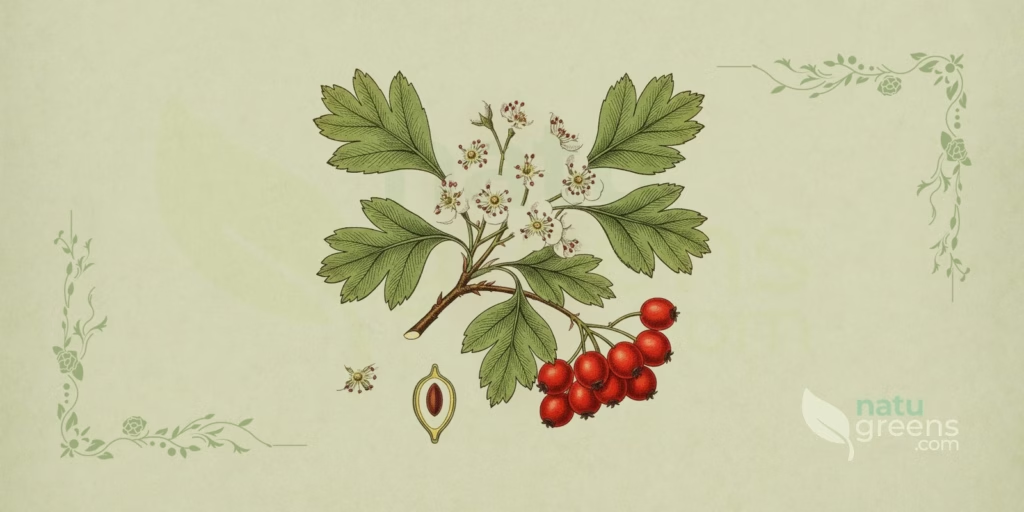
The leaves are alternate, simple and deeply cut, clustered on short shoots along the branches. The blade measures two to five centimetres long by two to four wide, with an obovate to rhombic outline, and bears three to seven lobes whose sinuses run past halfway to the midrib. That depth of lobing is the most useful leaf character in the field. The upper surface is dark green and glossy, the lower paler and glabrous or slightly hairy in the vein axils, and the texture is subcoriaceous. The petiole is one to two centimetres long and carries leafy, toothed stipules at its base.
Flowers
The flowers are hermaphrodite and gather into flat terminal corymbs holding anything between five and twenty-five units per inflorescence. Each flower measures eight to fifteen millimetres across and carries five rounded white petals, occasionally tinged with pink, on a bell-shaped hypanthium. The stamens number fifteen to twenty and display anthers of a reddish pink that contrasts with the white of the petals. The gynoecium has a single style, and it is that detail which settles the identification. The scent is strong and sweet, with an undertone many observers describe as unpleasant, attributed to the trimethylamine present in the floral odour.
Fruits and Seeds
The fruit is an ovoid to globose pome, called a haw in English and a pilrito in Portuguese, eight to twelve millimetres across and glossy dark red at maturity. The flesh is mealy, yellowish and bland to faintly sweet, and inside there is as a rule a single stony pyrene of five to seven millimetres, rarely two. The pyrenes of Crataegus, like those of other Rosaceae, contain cyanogenic glycosides, so the seed is not an edible part, even though the flesh is harmless. The fruits stay on the branches into late winter, which gives them a central place in the diet of birds through the cold season.
Root and Stem
The bark is greyish brown and smooth on young specimens, becoming deeply fissured and scaly with age, in elongated plates. The wood is hard, heavy and fine grained, historically prized for small pieces that had to withstand punishment. The root system is vigorous and deep, with a taproot able to reach three to five metres in permeable substrates, complemented by an extensive lateral network. That architecture explains both the drought tolerance of established plants and the performance of the species in stabilising slopes. The roots throw up suckers readily, and the vegetative regrowth arising from them contributes to the formation of closed thickets.
Distribution and Habitat
The native range covers practically the whole of Europe, from the British Isles and southern Scandinavia to European Russia, reaching the Volga in the east, and runs down through the Caucasus and Transcaucasia to northern Iran. In the south it occurs throughout the Mediterranean basin and crosses into the Maghreb, where it is confined to the mountain ranges of Algeria, Morocco and Tunisia. The easternmost populations, in Syria and northern Iraq, are sparse and restricted to high elevations.
Beyond that range, the species was carried abroad as a hedging and ornamental plant and has naturalised on a continental scale. It is established in the north-eastern United States and south-eastern Canada, along the North American Pacific coast from British Columbia to California, in southern South America, in southern and south-eastern Australia and on both main islands of New Zealand. Several of those territories have given it formal standing as an environmental weed, notably Victoria, Tasmania and the state of Washington, where its invasion of pasture and forest edges is treated as a management problem.
Its edaphic tolerance is extreme and helps to explain that geographical breadth. The plant grows on heavy clays, shallow limestone soils, poor sands or deep fertile ground, across a pH band running from moderately acid to frankly alkaline, with a clear preference for well-drained calcareous clays. It occupies ground from sea level up to around two thousand metres in the mountains of southern Europe, withstands winters with minima near twenty-five degrees below zero and stands up well to strong wind, salt-laden coastal wind included. Its typical settings are wood margins, clearings, secondary scrub, pasture falling out of use and, above all, the hedges that divide agricultural plots.
Cultivation
Propagation from seed is the natural method and also the most laborious, because the pyrenes show double dormancy. A warm phase is needed, in the range of fifteen to twenty degrees for three to four months, followed by a cold phase of two to five degrees for a similar span, and even then emergence usually comes only in the second year after sowing. In the wild, passage through the digestive tract of birds performs the scarification that the nurseryman has to reproduce mechanically. Hardwood cuttings are possible, with modest rooting rates, and ornamental cultivars are multiplied by grafting onto rootstocks of the species itself or of C. laevigata.
Planting requirements are hardly demanding. The plant accepts full sun to partial shade, though it flowers and fruits far better in full sun, and thrives under rainfall regimes running from four hundred to twelve hundred millimetres a year. Irrigation is needed only in the first cycle, and fertilising is rarely justified outside ornamental settings. In hedging, spacing usually falls between thirty and fifty centimetres, in a single row or a staggered double row, and it is the annual or twice-yearly cut that produces the tight, impenetrable branching which makes the hedge work as a barrier. As a free-standing tree, spacing rises to four to six metres, with formative pruning in the early years.
The health picture is dominated by one pathogen. Fireblight, caused by Erwinia amylovora, brings on necrosis of flowers, branches and trunk, can kill mature specimens in a single season and holds quarantine status in several countries, which restricts the movement of nursery stock. Among the fungi there are the rust Gymnosporangium clavariiforme, heteroecious and dependent on Juniperus as its alternate host, the powdery mildew Podosphaera clandestina on young leaves and species of Monilinia in fruit rot. Among the insects, the commonest are the winter moth Operophtera brumata, the leaf miner Lyonetia clerkella, the psyllid Cacopsylla crataegi and the woolly aphid Eriosoma lanigerum.
Fruiting begins between the fifth and the eighth year on seed-raised plants, and around the second or third year on grafted ones. The haws are gathered as they ripen in autumn, and yields hold up over decades, with centuries-old specimens still fruiting normally.
Phenology
Leafing out happens early, generally between March and April in the northern hemisphere, and clearly precedes the opening of the flowers. Flowering concentrates in May and June, shifting by a few weeks according to latitude and altitude, and is so regularly tied to the month of May that the English common name of the tree derives from it. Each corymb stays receptive for only a few days, and the full flowering of an individual rarely runs beyond a fortnight.
Pollination is entomophilous and generalist. The heavy scent and the abundant supply of pollen draw bees, flies of several families, small beetles and hoverflies, and the self-incompatibility of the species makes cross visitation indispensable for fruit to set. The haws ripen from September to November, and their persistence on the branches through the winter stretches the supply of food to the end of the cold season.
Dispersal is endozoochorous and depends almost entirely on frugivorous birds, which swallow the flesh and void the pyrenes intact after digestive scarification, with a real gain in germination. Thrushes, blackbirds and starlings are among the main dispersers in Europe, and in the areas of introduction the role has been taken over by local species, among them the American robin in North America and the pied currawong in Australia, the latter able to carry seed more than a kilometre. Mammals such as the fox act as secondary dispersers. Some granivorous birds eat the flesh without dispersing the seed and behave as fruit predators.
Related Crataegus Species and Confusions
The commonest and most consequential confusion is with Crataegus laevigata, the midland hawthorn, with which the species shares much of its European range. The separation rests on three characters taken together. The leaves of C. monogyna have lobes cut past halfway to the midrib, while those of C. laevigata stop short of a third; the flower has one style in the first and two or three in the second; and the fruit encloses a single pyrene against two or three. The two hybridise frequently and produce Crataegus × media, intermediate in morphology, which makes it prudent always to check more than one character before settling an identification.
Among the thorny shrubs that share the hedgerows of Europe, the blackthorn, Prunus spinosa, is the most frequent look-alike at a distance. The distinction is immediate in the right season: blackthorn flowers before it puts out leaves, its white blossom appearing on still-bare branches, and it bears dark blue drupes with a waxy bloom, whereas hawthorn flowers with its foliage already formed and gives red pomes. The confusion matters because blackthorn fruit has a different chemical profile and the two should not be taken for one another.
The dog rose, Rosa canina, is told apart by its pinnately compound leaves and by its curved prickles set in the bark, superficial structures that flick off with a fingernail, unlike the woody thorns of the hawthorn. The rowan, Sorbus aucuparia, also has pinnately compound leaves, along with fruit borne in erect orange corymbs. Within the genus itself, worth mentioning are C. azarolus, of the Mediterranean, grown for its large fruit, C. crus-galli, North American, with very long thorns and entire leaves, C. mexicana, with yellow fruit, C. pentagyna, of the Caucasus, with black fruit, and C. pinnatifida, of eastern Asia, with markedly pinnatifid leaves.
Phytochemistry
The chemical profile of the species is dominated by phenolic compounds, spread unevenly between the organs. The leaves and flowers concentrate the flavonoid fraction, and in them hyperoside predominates, that is quercetin-3-O-galactoside, alongside rutin, free quercetin itself and its glycosylated forms. Beside the flavonols come the C-glycosylated flavones characteristic of the genus, chief among them vitexin, isovitexin and vitexin-2”-O-rhamnoside, the last used as an analytical marker in the characterisation of plant material from the genus. Comparative analyses point to higher levels in the leaves of the upper branches and in the flower buds.
The oligomeric proanthocyanidins form the second large group, built on epicatechin units and represented above all by dimers and trimers of the procyanidin B2 and C1 type. Their concentration is highest in still-green fruit and falls as ripening proceeds. Ripe fruits accumulate the anthocyanins responsible for the red colour, along with carotenoids, tocopherols in their four forms and ascorbic acid at levels that vary with the population.
Among the phenolic acids, chlorogenic acid is the major one in every organ, accompanied by caffeic acid. The triterpene fraction brings together oleanolic, ursolic and crataegolic acids, distributed mainly in the bark and the leaf cuticle. The flowers also contain biogenic amines, and it is to trimethylamine that the peculiar olfactory note of the flowering is attributed. The pyrenes, as happens in other Rosaceae, store cyanogenic glycosides.
History and Ethnobotany
The hawthorn carries one of the densest symbolic loads in the European flora. In Celtic tradition it was held to be a tree standing on the boundary between worlds, and cutting a lone specimen in a field was considered a dangerous act, a belief that survived in rural Ireland into the twentieth century and that still today has road schemes bending around certain solitary trees. In ancient Greece, branches of the plant figured in the ceremonies associated with Hymen, the divinity of marriage, according to the record of the classical authors.
The association with the month of May runs across the continent. In medieval England, flowering branches were carried in procession at the May Day festivals, and the popular proverb advising against changing one’s clothes until “May be out” refers to the flowering of the tree, not to the end of the month. A double-flowered cultivar, known as the Glastonbury Thorn, fed from the Middle Ages onward the legend of having sprouted from the staff of Joseph of Arimathea driven into English soil, and the specimen that stood for it became an object of pilgrimage.
The most enduring use was agrarian. Peoples of north-western Europe used the species as a live fence from at least the early Middle Ages, and the practice took on industrial scale during the British Enclosure Acts of the eighteenth and nineteenth centuries, when hundreds of thousands of kilometres of hedge were planted to mark out newly privatised holdings. The English word hedge and the common name hawthorn share a Germanic root tied precisely to the idea of an enclosure. The wood, hard and slow burning, was historically worked by rural craftsmen into tool handles, mill gear teeth and turned pieces, and served as firewood of high calorific value.
Haws entered the peasant diet of several European regions as a late-season resource, put up as preserves and jellies in lean years, and the young leaves earned in parts of England the nickname bread and cheese for being eaten straight from the branch on spring walks. Ethnographic records of the nineteenth century further document the use of the hawthorn as a boundary marker and reference point in land agreements, a function that explains the presence of isolated, very old specimens in the middle of open fields.
Conservation
The species is assessed as Least Concern on the IUCN Red List. The classification reflects a vast native distribution, abundant populations and no detectable decline, and it appears in no CITES appendix. There is therefore no restriction on trade or collection at international level.
Such pressures as exist are local and indirect in nature. The agricultural intensification of the post-war decades removed a great length of hedgerow in western Europe, which reduced habitat without threatening the species itself, and the regulatory response reversed the trend in some countries, notably through the legal protection given to historic hedgerows in the United Kingdom from the 1990s onward. Fireblight represents the most serious biotic threat at stand level.
The picture inverts outside the native range. In Australia, in New Zealand and in western North America the species appears on official lists of invasive plants, and management involves mechanical control and restrictions on planting. From an ecological standpoint in Europe, though, its role is a structuring one: hawthorn hedges support hundreds of invertebrate species, offer nesting sites to farmland birds and work as corridors of connectivity between woodland fragments. The plant also acts as a pioneer in the succession of abandoned pasture, creating the shaded conditions under which canopy trees establish themselves.
Interesting Facts
- The scent of the flowers contains trimethylamine, the same compound formed in the decomposition of animal tissue, and English folklore literature records the belief that bringing flowering branches indoors drew death to the house, an association probably born of that olfactory note.
- The species is diploid and sexual in a genus where a good part of the lineages are polyploid and apomictic, which makes it atypical among its relatives and explains why it keeps continuous variation instead of clonal microspecies.
- Some isolated specimens in Ireland and Britain have had road alignments and infrastructure works altered to avoid felling them, on the strength of the popular belief about solitary trees.
- The United Kingdom is estimated to retain hundreds of thousands of kilometres of live hedge, and the hawthorn is the dominant species in most of them, which probably makes it the most planted woody plant in the history of the country.
- The wood is among the hardest in the temperate European flora and was once preferred to metal for the gear teeth of watermills, an application in which resistance to wear mattered more than ease of working.
Notice: this content is for informational purposes and does not replace professional medical advice. Consult a physician or herbal practitioner before using medicinal plants, especially during pregnancy, breastfeeding, or alongside medication.
References and Scientific Studies
View All 11 Cited References
Peer-Reviewed Scientific Studies (2)
- DOI2021 Fichtner, A., Wesche, K. Biological Flora of the British Isles: Crataegus monogyna. Journal of Ecology, 109(1), 541-571. 2021. ↗
- DOI2012 Edwards, J. E., Brown, P. N., Talent, N., Dickinson, T. A., Shipley, P. R. A review of the chemistry of the genus Crataegus. Phytochemistry, 79, 5-26. 2012. ↗
Supplementary Readings (9)
- POWO. Plants of the World Online. Crataegus monogyna Jacq. Royal Botanic Gardens, Kew. ↗
- IPNI. International Plant Names Index. Crataegus monogyna Jacq., Fl. Austriac. 3: 50 (1775). Royal Botanic Gardens Kew, Harvard University Herbaria and Australian National Herbarium. ↗
- Jacquin, N. J. Florae Austriacae, sive Plantarum Selectarum in Austriae Archiducatu. Vindobonae, vol. 3. 1775.
- 1992 Christensen, K. I. Revision of Crataegus sect. Crataegus and nothosect. Crataeguineae (Rosaceae-Maloideae) in the Old World. Systematic Botany Monographs, 35, 1-199. 1992.
- 2003 Phipps, J. B., O’Kennon, R. J., Lance, R. W. Hawthorns and Medlars. Royal Horticultural Society and Timber Press, Portland. 2003.
- 2019 Stace, C. A. New Flora of the British Isles. Cambridge University Press, Cambridge. 4th ed. 2019.
- 1986 Rackham, O. The History of the Countryside. J. M. Dent and Sons, London. 1986.
- 2005 Talent, N., Dickinson, T. A. Polyploidy in Crataegus and Mespilus (Rosaceae, Maloideae): evolutionary inferences from flow cytometry of nuclear DNA amounts. Canadian Journal of Botany, 83(10), 1268-1304. 2005.
- IUCN. The IUCN Red List of Threatened Species. Crataegus monogyna. ↗