Camellia sinensis is the broad-leaved evergreen shrub whose leaves yield every true tea in the world. Green, white, yellow, oolong, black and puerh are not different plants: they are products of a single species, separated by the stage at which the leaf is picked and by how far it is allowed to oxidise afterwards. The species belongs to Theaceae, a woody family in the order Ericales that gathers some nine genera across the tropical and subtropical regions of Asia and the Americas.
Its native range covers the eastern Himalaya, southern China and northern Indochina, a belt of humid subtropical forest where it grows as an understorey tree. Centuries of cultivation turned that forest shrub into the most widely planted perennial crop on the planet after the food grasses, with commercial plantings in more than sixty countries and an internal morphological range wide enough that modern taxonomy recognises five botanical varieties under the same name.
What follows deals with the plant rather than the drink. It brings together formal classification and synonymy verified against IPNI and Plants of the World Online, field identification characters, ecology and native distribution, agronomic practice, the phenological calendar, the garden species most often mistaken for it, the chemistry described in the literature, botanical history and conservation status.
For the traditional uses, properties and preparation methods of this plant, see the article Green Tea (Camellia sinensis): Properties and Benefits.
In everyday English the tea plant is simply Camellia sinensis, and every true tea is made from its leaves.
Taxonomy
The accepted name is Camellia sinensis (L.) Kuntze, confirmed in the International Plant Names Index under record 828548-1 and treated as accepted by Plants of the World Online. Otto Kuntze published the present combination in Revisio Generum Plantarum in 1887, moving into Camellia the basionym Linnaeus had described in 1753 as Thea sinensis. The classification below follows the circumscription adopted at Kew:
- Kingdom: Plantae
- Division: Streptophyta (angiosperms; Magnoliophyta in traditional nomenclature)
- Class: Equisetopsida (Magnoliopsida in older classifications)
- Subclass: Magnoliidae
- Order: Ericales
- Family: Theaceae Mirb.
- Genus: Camellia L.
- Species: Camellia sinensis (L.) Kuntze (1887)
Synonyms
Contrary to what the older literature suggests, the accepted synonymy is short. Plants of the World Online recognises only two names:
- Camellia thea Link (1822), an illegitimate and superfluous name
- Thea sinensis L. (1753), the basionym
One correction is worth recording, since it circulates badly in secondary sources. Names such as Thea bohea L. and Thea viridis L., widely cited in nineteenth-century texts as though they designated the black tea plant and the green tea plant respectively, do not support that split. The difference between the two products was never botanical but a matter of post-harvest processing, and taxonomy eventually settled the point by gathering everything under a single specific name.
Accepted Varieties
Plants of the World Online recognises five infraspecific varieties, two of which account for virtually all world production:
- Camellia sinensis var. assamica (Royle ex Hook.) Steenis: tree habit, large membranous leaves, suited to humid tropical climates. It dominates Assam, Sri Lanka, Kenya and Southeast Asia.
- Camellia sinensis var. dehungensis (Hung T.Chang, H.S.Wang & B.H.Chen) T.L.Ming: a Yunnan variety of restricted distribution.
- Camellia sinensis var. madoensis T.V.Nguyen, V.D.Luong & N.Trieu Le: described from Vietnam and known from few populations.
- Camellia sinensis var. pubilimba Hung T.Chang: recognisable by dense pubescence on the underside of the leaf, especially along the midrib. It occurs in southern China.
- Camellia sinensis var. sinensis: the typical variety, shrubby, with small leathery leaves and good cold tolerance. It dominates plantings in eastern China, Japan, Korea and Taiwan.
The old var. cambodiensis, common in agronomic writing, does not appear among accepted taxa and corresponds to material now placed within the circumscription of var. assamica.
Etymology
Linnaeus coined the generic name in honour of Georg Joseph Kamel, a Moravian Jesuit who lived from 1661 to 1706 and devoted himself to the flora of the Philippines, his surname latinised as Camellus. The epithet sinensis is late Latin for “from China”, a reference to the territory from which the first specimens known to Western science reached Europe, even though the native range extends well beyond Chinese borders. The common name of the drink travelled by a different route: languages that received the product overland took variants of “cha”, after the Cantonese and Mandarin reading of the character 茶, while those supplied by sea through the port of Amoy in southern Fujian took variants of “te”.
Morphological Description
Habit varies sharply with variety and management. Left unpruned, var. assamica forms a single-trunked tree reaching fifteen metres in forest, while var. sinensis stays a shrub branching from the base, between one and a half and five metres tall. In commercial fields both extremes disappear: repeated pruning holds the plant between one and one and a half metres and induces a dense horizontal surface of shoots, the plucking table, which is the structure actually harvested. The bark is smooth and greyish brown, and the crown tends towards a rounded, compact outline.
Leaves
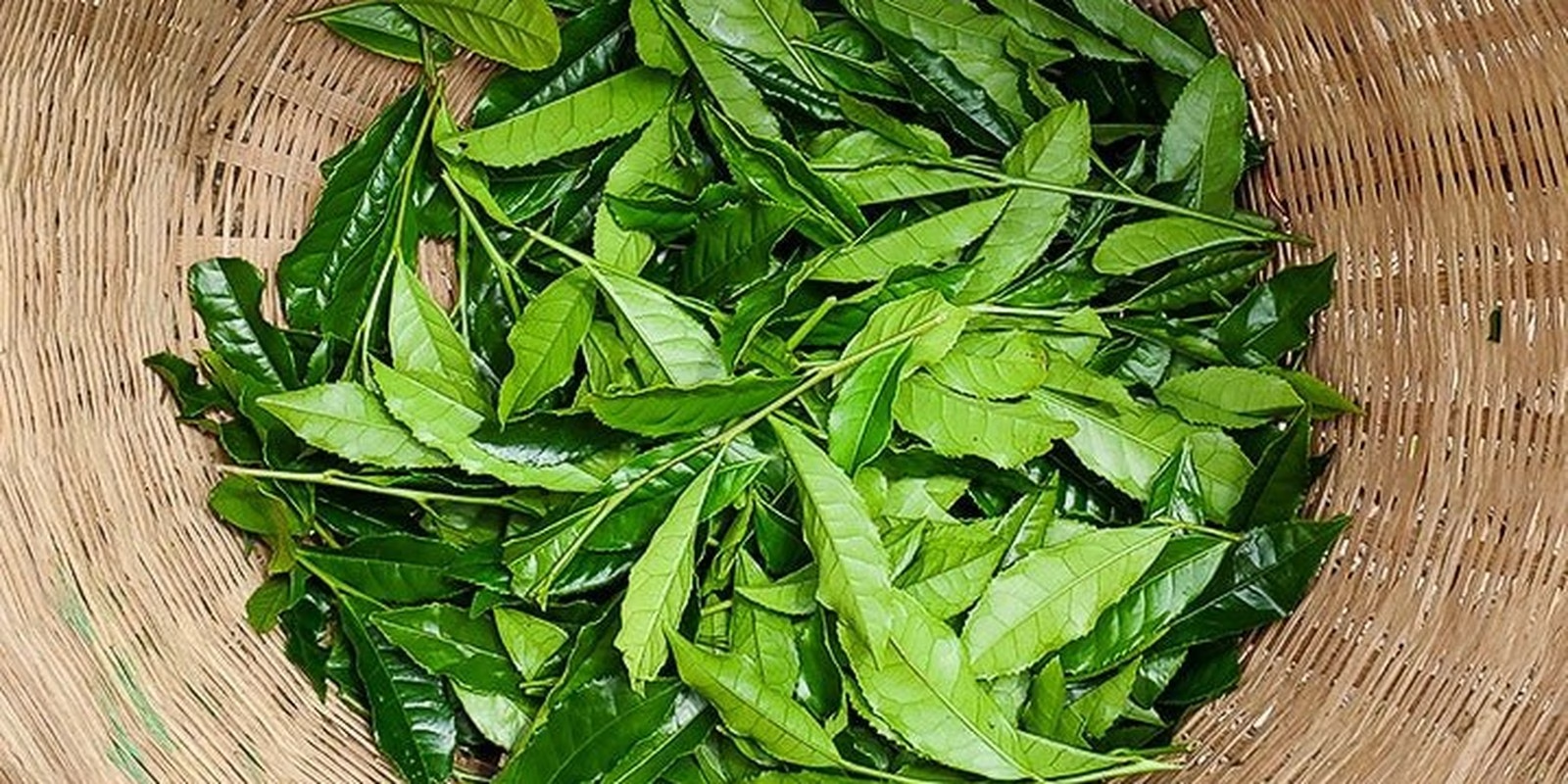
Freshly plucked Camellia sinensis leaves in a bamboo basket. The elliptic-lanceolate blade, the finely serrate margin and the secondary veins that curve away before reaching the edge make up the set of characters used to recognise the species in the field.
The leaves are alternate, simple, evergreen and leathery, with an oblong-lanceolate to elliptic blade. Length is the character that most clearly separates the two main varieties, running from four to eight centimetres in var. sinensis and from ten to twenty-five centimetres in var. assamica, with widths between two and eight centimetres. The upper surface is dark green and glossy, the lower paler and matt. The margin is finely and regularly serrate, and venation is pinnate, with seven to nine pairs of secondary veins standing out in relief beneath and curving before they reach the margin. The petiole is short, five to ten millimetres. Unopened apical buds are covered in silvery white trichomes, the character behind trade designations such as Silver Tip.
Flowers
The flowers are hermaphrodite and borne singly or in groups of two to four in the leaf axils, on short recurved pedicels. They measure two to four centimetres across and carry five to eight petals, usually seven, white to cream, faintly scented and delicate in texture. The calyx has five or six persistent greenish sepals. The androecium is numerous, with two hundred to three hundred stamens whose yellow filaments are fused at the base and whose anthers are orange, forming the showy boss typical of the genus. The style ends in a three-branched stigma. Pollination is entomophilous and depends mainly on bees and small beetles. The species is largely self-incompatible, which explains the high variability of seed-grown plants and the preference of modern growers for vegetative propagation.
Fruits and Seeds
The fruit is a smooth woody capsule, brownish at maturity, two to three centimetres across and three or four lobed depending on how many locules set. Dehiscence is loculicidal. Each capsule holds one to four globose seeds a centimetre to a centimetre and a half across, with a brown testa and an endosperm rich in lipids, which make up fifteen to twenty-two per cent of dry weight. Ripening is slow and takes nine to twelve months from anthesis, so flowers and fruit from the previous cycle share the same branch for much of the year.
Root and Stem
Seedlings develop a well-defined taproot, which in mature plants gives way to a mixed system with abundant laterals and an effective depth of one to three metres depending on soil. That depth is the main determinant of tolerance to short dry spells. The root system is sensitive to prolonged waterlogging and responds poorly to compacted soils or a high water table, which is why growers favour well-drained slopes. The stem is woody with abundant sympodial branching and closely spaced nodes that carry the density of shoots harvested in the field.
Distribution and Habitat
According to Plants of the World Online, the native range runs from the eastern Himalaya to southern China and northern Indochina, including Hainan. The recognised recording units are, in alphabetical order: Assam, China South-Central, China Southeast, East Himalaya, Hainan, Laos, Myanmar, Thailand and Vietnam.
The species occupies the humid subtropical biome. In the wild it grows in the understorey of evergreen hillside forest on acid, deep, organically rich soils, at altitudes from a few hundred metres to over two thousand. The requirement for acidity is strict, and the pH range between four and a half and six defines much of the world’s productive geography. The plant tolerates partial shade, a condition that mirrors its forest origin and that Japanese agronomy turned into a deliberate technique.
Beyond the native range, cultivation has spread across the tropical and subtropical belt. The largest producing centres are in China, India, Kenya, Sri Lanka, Turkey, Vietnam and Indonesia, with smaller plantings in Japan, Taiwan, Georgia, Iran, Rwanda, Malawi, Argentina and Brazil. Brazilian cultivation is concentrated in the Ribeira Valley in São Paulo state, begun in the 1930s by Japanese immigrants around Iguape, Pariquera-Açu and Registro, with smaller nuclei in northern Paraná.
Cultivation of the Tea Plant
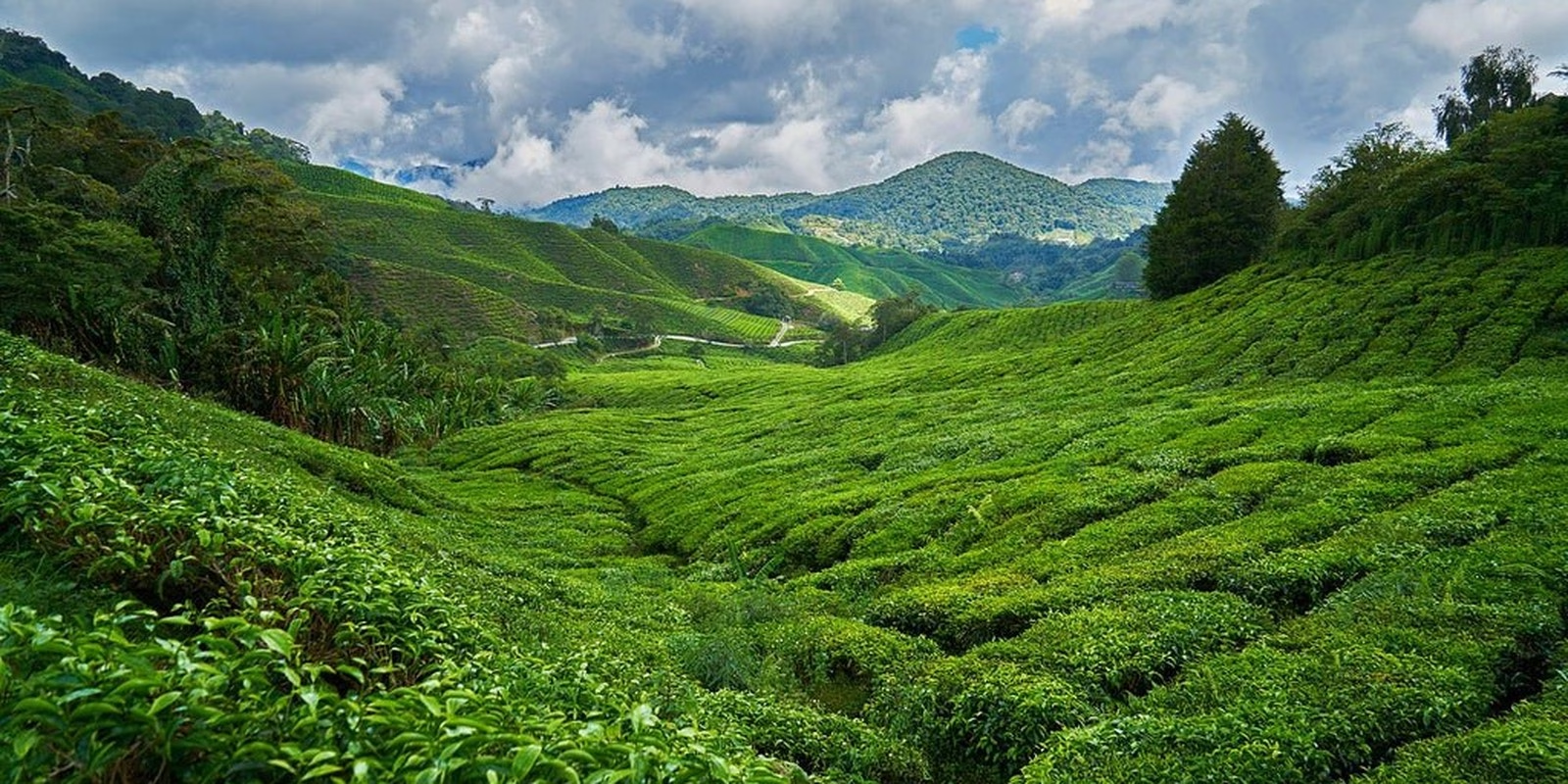
Commercial Camellia sinensis planting on a tropical highland slope. Maintenance pruning holds the bushes at plucking height and forces the dense, continuous canopy of shoots known as the plucking table, over acidic and well-drained soils.
Commercial propagation is almost entirely by semi-hardwood cuttings, five to eight centimetres long and bearing one or two leaves, treated with auxin and rooted in moist substrate over sixty to ninety days. The choice follows from the plant’s self-incompatibility, which makes seed-grown progeny too heterogeneous for a uniform field. Sowing survives in breeding programmes and on smallholdings, with slow germination taking sixty to a hundred and twenty days, and tissue culture is being developed for rapid multiplication of selected cultivars.
Site requirements are narrow. The suitable thermal range lies between fifteen and twenty-eight degrees Celsius through the year, with var. sinensis withstanding minima near zero and var. assamica needing at least twelve degrees. Severe frost is lethal. Annual rainfall must run from fifteen hundred to three thousand millimetres and be well distributed, relative humidity between seventy and ninety per cent, and steady strong wind causes enough leaf abrasion to justify windbreaks in commercial fields.
Standard spacing combines one and a fifth to one and a half metres between rows with sixty to eighty centimetres between plants, giving densities of ten thousand to fourteen thousand plants per hectare. Nitrogen is the most demanded nutrient under intensive management, followed by potassium, phosphorus and zinc. Training rests on three prunings with distinct functions: formation pruning, in the first three years, forces lateral growth and builds the plucking table; maintenance pruning, annual or biennial, holds picking height and stimulates budding; and rejuvenation pruning, applied every eight to twelve years, cuts the plant back to thirty or fifty centimetres to rebuild the canopy.
Harvesting takes only the growing tip of each shoot and follows established standards ranging from the bud alone to a bud with two leaves. High-value fields are picked by hand; mechanisation serves large-scale production. Plants come into commercial bearing around the third year, peak between ten and thirty years, and stay productive for five to ten decades under good management.
Phenology
The annual cycle combines a long period of vegetative growth with flowering concentrated at the end of the season. Budding comes in successive waves, known in the agronomic literature as flushes, separated by intervals of seven to fourteen days through the growing season. In tropical climates the process is practically continuous year round; in temperate or subtropical climates it concentrates into four to six waves between spring and autumn, with marked winter dormancy.
Flowering falls in autumn and early winter, which means September to January in the northern hemisphere and March to July in the southern. Each flower stays receptive for only a few days. Fruiting is slow and the capsule ripens nine to twelve months later, so mature fruit drops at roughly the time of the following bloom. In fields under frequent pruning, flowering is heavily reduced, because continual removal of the tips diverts growth into vegetative shoots and limits the formation of flower buds.
Related Species and Look-alikes
The genus Camellia holds some two hundred and fifty accepted species, concentrated in eastern and southeastern Asia. Confusion is common in gardens and nurseries, particularly outside the flowering season:
- Camellia japonica L.: the classic ornamental camellia, with tens of thousands of registered cultivars. It is told apart by broad, thick, intensely glossy leaves and by large flowers, five to thirteen centimetres across, in red, pink or white, opening in late winter and spring. No use in tea production.
- Camellia nitidissima Chi: a Chinese species notable for golden yellow flowers, exceedingly rare in the genus. Restricted habitat and heavy collecting pressure have placed it under legal protection in China.
- Camellia oleifera Abel: the oil camellia, grown at scale in southern China for its seeds, which yield an edible and cosmetic oil. It resembles C. sinensis in habit and leaf but has larger flowers and considerably bulkier capsules.
- Camellia reticulata Lindl.: a Yunnan species with the largest flowers in the genus, up to fifteen centimetres across, and leaves with conspicuously reticulate venation. Purely ornamental.
- Camellia sasanqua Thunb.: a Japanese ornamental flowering in autumn, with smaller, thinner leaves and medium flowers, five to seven centimetres, white to pink. Its seeds also yield oil.
- Camellia taliensis (W.W.Sm.) Melch.: the closest wild relative, native to Yunnan and northern Myanmar. It separates on fine floral characters, and its genetic proximity makes it central to research on the origin of cultivated tea.
The practical criteria against the two commonest ornamentals hold up well. The flower of C. sinensis is small, white and prominently yellow-stamened, against the large and often double flower of C. japonica. Its leaf is narrower and its serration finer than in either. The calendar helps too: C. sasanqua flowers in autumn, C. sinensis from autumn into early winter, and C. japonica from late winter into spring.
Phytochemistry
The leaf of Camellia sinensis is among the most thoroughly characterised plant materials in existence, and the account that follows is strictly compositional. The groups documented in the literature are, in alphabetical order:
- Carotenoids and volatile derivatives: lutein, beta-carotene and neoxanthin, whose oxidative breakdown yields volatile compounds of the ionone and terpenoid classes that make up the aromatic profile of processed leaf.
- Flavan-3-ol polyphenols: the most abundant group, accounting for somewhere between twenty and thirty per cent of the dry weight of young leaf. It comprises epigallocatechin gallate, epigallocatechin, epicatechin gallate and epicatechin, together with the corresponding non-epimeric catechins.
- Flavonols and phenolic acids: glycosides of kaempferol, myricetin and quercetin, along with gallic, chlorogenic and coumaroylquinic acids.
- Free amino acids: L-theanine, or gamma-glutamylethylamide, is the dominant non-protein amino acid and accounts for much of the soluble nitrogen in young leaf. Its concentration falls under strong light and rises under shade, a relationship Japanese agronomy exploits in covered plantings.
- Methylxanthines: caffeine is the principal one, at two to four per cent of the dry weight of young leaf, accompanied by much smaller amounts of theobromine and theophylline. These purine alkaloids are associated in the ecological literature with defence against herbivory.
- Triterpene saponins: the theasaponins, concentrated mainly in the seeds and root bark.
In sensory terms this composition explains how the material behaves. The flavan-3-ols account for astringency and bitterness, theanine for the sensation described as umami, and the methylxanthines contribute a background bitterness. Post-harvest processing changes the picture profoundly. When the leaf is macerated and exposed to air, the polyphenol oxidase released by cell rupture converts flavan-3-ols into theaflavins and thearubigins, pigments ranging from orange to red. It is the extent of that conversion that separates the types of tea, not any difference between plants.
The oil pressed from the seeds is mostly oleic acid, with smaller fractions of linoleic, palmitic and stearic acids, a profile close to that of olive oil.
One point about toxicity applies in the present tense and is independent of any use. Leaves and leaf waste contain caffeine and theobromine at concentrations that pose a real risk of poisoning to dogs, cats, horses and domestic birds, species that metabolise methylxanthines slowly. Dry or wet plant material discarded into compost accessible to pets deserves care. The theasaponins of the seed are likewise described as irritant and ichthyotoxic.
History and Ethnobotany
Chinese tradition credited the discovery of the infusion to the mythical emperor Shen Nung, placed around 2737 before the common era, a narrative belonging to founding legend rather than to the historical record. Verifiable documentation begins much later. The Cha Jing, the treatise Lu Yu composed between 760 and 780 of the common era under the Tang dynasty, is the oldest text devoted entirely to the plant and its processing, and it already contains accounts of cultivation, picking and leaf grading. The plant also figured in the Chinese materia medica compendia of the period, and the spread of the drink through East Asia followed the diffusion of Buddhism, with monks carrying seed to Japan in the early ninth century.
European contact was late and indirect. Portuguese and Dutch merchants brought the product to Europe in the seventeenth century, but the plant itself stayed unknown to Western botany for decades. Engelbert Kaempfer, a German physician in the service of the Dutch East India Company, observed the plantings in Japan between 1690 and 1692 and published the first European description based on direct observation. It was on that material, and on dried specimens sent from China, that Linnaeus established Thea sinensis in Species Plantarum in 1753. The definitive transfer to Camellia, proposed by Otto Kuntze in 1887, closed more than a century of nomenclatural instability.
The episode with the greatest agronomic consequence took place in northeastern India. Wild broad-leaved populations were recorded in Assam by Robert Bruce around 1823, with botanical confirmation following in the next decade, opening the way to commercial establishment of the crop there from 1839 under the British East India Company. Shortly afterwards, between 1848 and 1851, the Scottish botanist Robert Fortune carried thousands of plants and seeds obtained in China into India on the same company’s behalf, along with skilled workers, an operation that broke the Chinese monopoly and redrew the world map of the crop.
In its societies of origin the plant reached far beyond agriculture. The Japanese tea ritual, chanoyu, formalised by Sen no Rikyu in the sixteenth century, and the preparation practices of southern China established forms of sociability that lasted for centuries. Leaves from old Yunnan plants were pressed into blocks that served as trade currency along the routes linking the region to Tibet.
Conservation
The IUCN Red List classifies Camellia sinensis as Data Deficient, category DD. The apparent contradiction between that status and the plant’s agricultural ubiquity has a simple explanation: the assessment bears on wild populations, poorly delimited and hard to separate from old naturalised plantings, and not on the cultivated area, which exceeds five million hectares worldwide. The species is not listed in the CITES appendices.
The real conservation concerns lie elsewhere. Replacing heterogeneous seed-grown plantings with clonal monocultures derived from a handful of cultivars has sharply narrowed the crop’s genetic base, a situation that germplasm banks in China, India and Japan try to offset by conserving old accessions. Yunnan still holds large specimens estimated to be centuries old, treated as biological heritage and partly included in protected areas, yet exposed to collecting pressure because of the commercial value attached to their leaves. Climate change affects producing regions unevenly, shifting the suitable altitudinal band in Darjeeling, disturbing the regularity of the seasons in Sri Lanka and increasing extreme events in East Africa.
The picture is graver in other species of the genus. Several yellow-flowered camellias of southern China and northern Vietnam, C. nitidissima among them, occupy restricted habitats, suffer intense illegal collecting and fall into threatened categories, and some species in the genus are already recorded as extinct in the wild.
Interesting Facts
- Georg Joseph Kamel, the Jesuit honoured in the generic name, died in Manila in 1706 without ever having seen a tea plant. The tribute came from Linnaeus and had nothing to do with the species.
- The world’s split between the “cha” and “tea” forms mirrors the geography of trade. Languages that received the product overland took variants of “cha”, while those supplied by sea through the port of Amoy took variants of “te”.
- Cutting the light reaching the plant in the weeks before harvest raises theanine and lowers catechin content. Covering the fields has sustained the shaded teas of Uji for centuries.
- The leafhopper Empoasca onukii is a pest across most of producing Asia, but in Taiwan its attack is deliberately tolerated. The plant’s response to the bite alters the volatile profile of the leaf and gives rise to the oolong known as Oriental Beauty.
- Flowers and fruit from different cycles share a branch for months, because the capsule takes almost a year to ripen and reaches maturity when the plant is already flowering again.
- The Japanese cultivar Yabukita, selected by Hikosaburo Sugiyama in 1908, occupies more than seventy per cent of Japan’s planted area on its own, an extreme case of the genetic narrowing that worries germplasm banks.
Notice: this content is for informational purposes and does not replace professional medical advice. Consult a physician or herbal practitioner before using medicinal plants, especially during pregnancy, breastfeeding, or alongside medication.
References and Scientific Studies
View All 10 Cited References
Peer-Reviewed Scientific Studies (4)
- DOI2012 Chen, L.; Apostolides, Z.; Chen, Z. M. (eds.). Global Tea Breeding: Achievements, Challenges and Perspectives. Springer, Berlin. 2012. ↗
- DOI2020 Hazra, A.; Saha, P.; Das, A. Genetic Diversity and Breeding of Tea (Camellia sinensis L.). In: Cash Crops. Springer, Cham. 2020. ↗
- DOI2014 Mondal, T. K. Breeding and Biotechnology of Tea and its Wild Species. Springer India, New Delhi. 2014. ↗
- DOI2014 Owuor, P. O.; Kamau, D. M. The Conservation of Tea Genetic Resources. Plant Genetic Resources, 12(S1), S100-S104. 2014. ↗
Institutional Sources (1)
- GOV2007 Ming, T. L.; Bartholomew, B. Theaceae. In: Flora of China, vol. 12. Science Press and Missouri Botanical Garden Press, Beijing and Saint Louis. 2007. ↗
Supplementary Readings (5)
- IPNI. International Plant Names Index: Camellia sinensis (L.) Kuntze, record 828548-1. Royal Botanic Gardens Kew, Harvard University Herbaria and Australian National Botanic Gardens. ↗
- Kuntze, O. Revisio Generum Plantarum, vol. 1. Arthur Felix, Leipzig. 1891. ↗
- Linnaeus, C. Species Plantarum, vol. 1, p. 515. Laurentius Salvius, Stockholm. 1753. ↗
- POWO. Plants of the World Online: Camellia sinensis (L.) Kuntze. Royal Botanic Gardens, Kew. ↗
- Royal Botanic Gardens, Kew. Tea Plant: Camellia sinensis. Kew Science, Plant Profiles. ↗