Sweet woodruff (Galium odoratum) is a low perennial herb that carpets the floor of Old World temperate woodlands with unbroken sheets of dark green foliage. It belongs to the Rubiaceae, the family of coffee, gardenia and cinchona, and within it to the tribe Rubieae, a group of square-stemmed herbs with whorled leaves that bears little outward resemblance to the tropical shrubs and trees usually associated with the family.
The trait that made the species famous is olfactory, and it keeps a schedule of its own. The living plant is almost odorless, but it only has to wilt or dry for the sweet coumarin note to appear and then linger in the material for months. That behavior explains the German name Waldmeister, master of the wood, and the long presence of sweet woodruff in the material culture of central Europe, from medieval linen chests to the culinary imagery of the month of May.
This profile gathers what the botanical literature records about the species: its formal classification and accepted synonymy, the characters that identify it in the field, its phenological rhythm, the requirements of growing it in shade, a descriptive phytochemical picture, its cultural history and its conservation status.
Taxonomy
The placement of the species has been settled for more than two centuries and is not a matter of current debate. The International Plant Names Index and Plants of the World Online both list Galium odoratum (L.) Scop. as the accepted name, published in the second edition of Flora Carniolica, volume 1, page 105, in 1771.
- Kingdom: Plantae
- Division: Magnoliophyta (angiosperms)
- Class: Magnoliopsida (dicotyledons)
- Order: Gentianales
- Family: Rubiaceae Juss.
- Subfamily: Rubioideae
- Tribe: Rubieae
- Genus: Galium L., 1753
- Species: Galium odoratum (L.) Scop., 1771
The basionym is Asperula odorata L., published by Linnaeus in the first volume of Species Plantarum, page 103, in 1753. Giovanni Antonio Scopoli transferred the species to Galium in 1771, and his combination prevailed because the structure of the corolla and of the fruit follows the pattern of the receiving genus. The older name Asperula odorata is still abundant in literature written before the twentieth century and in the nursery trade, which calls for attention whenever sources from different periods are compared.
Accepted Synonyms
- Asperula eugeniae K.Richt.
- Asperula matrisylva Gilib.
- Asperula odorata L. (basionym)
- Asterophyllum asperula K.F.Schimp. & Spenn.
- Asterophyllum sylvaticum K.F.Schimp. & Spenn.
- Chlorostemma odoratum (L.) Fourr.
- Galium matrisylva F.H.Wigg.
- Galium odoratum var. eugeniae (K.Richt.) Ehrend.
Etymology of the Binomial
The generic name Galium comes from the Greek gala, milk, a reference to the historical role of species in the genus in curdling milk during cheesemaking, a practice documented above all for Galium verum. The epithet odoratum derives from the Latin odoratus, perfumed, and points to the scent the plant develops as it dries. The synonyms built on matrisylva, mother of the forest, and sylvaticum, of the woods, carry the same ecological reading that the German name Waldmeister condensed into a single word.
Morphological Description
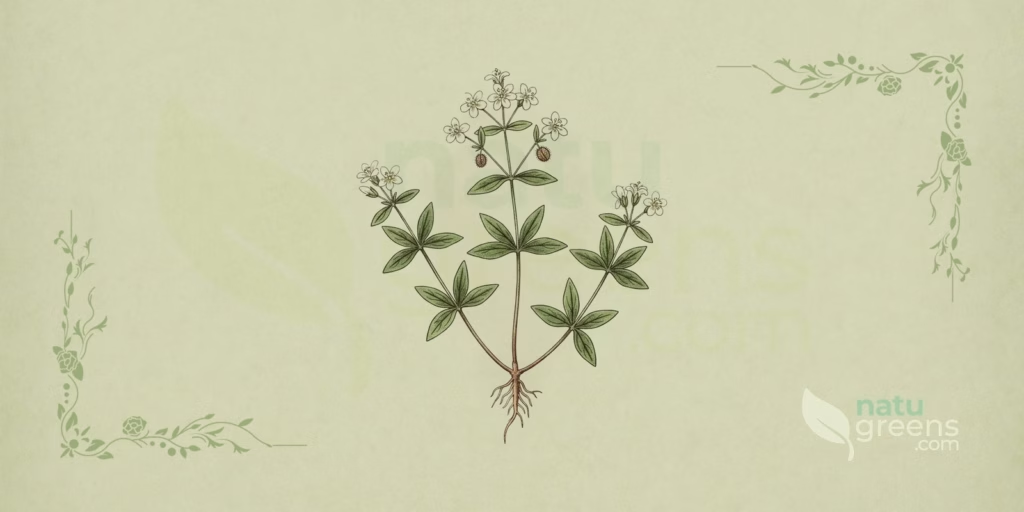
A rhizomatous perennial herb, glabrous over most of its body, averaging 10 to 30 centimeters in height across populations, with individuals reaching 45 centimeters on deep, moist soils. The aerial stems rise erect and solitary from a creeping rhizome, branch only rarely and keep the square cross section typical of the tribe. Together they build clonal patches that can cover dozens of square meters of woodland floor, looking like an even carpet broken only by the trunks of the trees.
Leaves
The leaves are arranged in whorls, that is, in rings around the stem, and this is the most immediate diagnostic character of the species. Each whorl holds six to nine parts, eight being the most frequent number, and there is a morphological detail that casual observation never reveals: only two of those parts are true leaves, while the rest are expanded stipules that have taken on leaf shape and leaf function, an arrangement common in the Rubiaceae.
- Color: dark green, slightly glossy on the upper surface
- Insertion: sessile, without a petiole
- Length: 2 to 5 centimeters
- Margin: entire, edged with minute cilia pointing toward the tip, felt as roughness when a finger is run the other way
- Shape: lanceolate to oblanceolate, ending in a short, stiff mucro
- Texture: membranous
- Width: 5 to 15 millimeters
Flowers
Flowering is inconspicuous up close and striking as a whole, because the white inflorescences rise above the dark foliage in near unison within each clonal patch. The flowers are grouped in stalked cymes, terminal and axillary, each carrying five to fifteen units.
- Calyx: reduced to a vestige, practically imperceptible
- Corolla: white, funnel-shaped to rotate, with four lobes fused at the base
- Diameter: 4 to 7 millimeters
- Ovary: inferior, bicarpellate, with two short styles
- Stamens: four, exserted, alternating with the lobes
Fruits and Seeds
The fruit is a globose schizocarp that splits into two one-seeded mericarps, each 2 to 4 millimeters across. The surface is densely covered in uncinate trichomes, stiff hairs ending in a hook, which fasten the fruit to mammal fur and to the clothes of anyone crossing the patch. The seed fills almost the whole volume of the mericarp and carries no appendages or structures for flight, which confirms how completely dispersal depends on contact.
Root and Stem
The underground system is a slender, white, much branched rhizome, 1 to 2 millimeters thick, running horizontally between 2 and 10 centimeters below the surface, inside the litter and humus layer. Fine adventitious roots and new aerial stems arise from its nodes, and that mechanism accounts for both the clonal spread and the density of the colonies. The aerial stem is square, glabrous and unbranched, and it dies at the end of the growing season, while the rhizome stays alive and dormant through the winter.
Distribution and Habitat
The native range covers temperate Eurasia and northwestern Africa. In Europe the species occurs from Ireland and the Iberian Peninsula to European Russia, and from southern Scandinavia to the mountains of the Mediterranean, reaching its greatest abundance in the beech forests of central Europe. The Asian distribution takes in Anatolia, the Caucasus, Iran, western Siberia, China and Japan, and in North Africa there are records from Algeria, Morocco and Tunisia.
The typical habitat is the understory of closed deciduous forest, above all beech and oak woodland, along with shaded ravines and the banks of woodland streams. The species favors cool, deep soils that are rich in humus and neutral to slightly alkaline in reaction, a condition often met over limestone, although it tolerates moderately acidic ground as well. Its altitudinal range runs from sea level to about 1,800 meters in the massifs of central and southern Europe.
European phytosociology treats sweet woodruff as an indicator of mature beech forest on fertile soil, to the point that the reference plant association of that forest type was named Galio odorati-Fagetum after it. Outside its native range the species has escaped from ornamental cultivation and become naturalized in the northeastern United States, southeastern Canada and woodland areas of New Zealand. Its behavior in those places is one of slow, localized expansion confined to shaded groves near gardens, and it does not appear among the high impact invaders on regional lists, even though North American extension agencies recommend containment in plantings close to native remnants.
Cultivation
Sweet woodruff is one of the few ground covers that thrive in deep shade, which explains its constant presence in gardens under dense canopies where grasses and conventional ground layers fail. In return it demands steady moisture and will not tolerate prolonged direct sun, which scorches the leaf margins and brings on early senescence.
Propagation
- Rhizome division: the main and most reliable method, carried out in early spring or in autumn by separating portions of the clump with roots and several stems, replanted at once into moist, shaded soil
- Seed: fresh fruits sown in autumn onto a humus-rich medium kept moist, given natural cold stratification over winter, with slow and uneven germination the following spring
Requirements
- Cold hardiness: high, the dormant rhizome surviving temperatures well below freezing
- Light: partial to deep shade, performing well under 70 to 90 percent shading
- Moisture: constant, without waterlogging and without letting the medium dry out completely
- Soil: cool, well drained, rich in organic matter, pH between 5.5 and 7.5
- Temperature: optimum growth between 10 and 22 degrees Celsius
Common Pests and Diseases
The species is remarkably little troubled when grown in suitable conditions. The problems recorded most often are snails and slugs, which graze the tender foliage during very wet spells, and the occasional aphid colony on young shoots. Among the diseases there are powdery mildew caused by Erysiphe galii in warm, poorly ventilated settings, rust caused by Puccinia punctata, which raises orange pustules on the underside of the leaves, and root rot on compacted or waterlogged ground.
Management and Harvest
The rhizome advances vigorously and can take over a small bed in two or three seasons, a situation dealt with by buried barriers 15 to 20 centimeters deep or by confinement to a defined area. Feeding amounts to a surface layer of leaf mold in autumn, which reproduces the natural fall of litter. When the aerial parts are harvested, it happens during flowering, and the material is dried in the shade in thin layers, the condition under which the aroma develops and keeps.
Phenology
The annual cycle of sweet woodruff is tuned to the window of light that opens on the floor of deciduous forest before the canopy closes. Shoots emerge early in spring, pushing up from the rhizome while the beeches and oaks are still bare, and vegetative growth concentrates in that period of high relative brightness.
- Dispersal: epizoochorous, through the hooks of the mericarps caught in mammal fur, complemented by clonal spread of the rhizome, which accounts for most of the ground each colony gains
- Flowering: April to June in the northern hemisphere, peaking in May
- Fruiting: June to August, with staggered ripening within a single cyme
- Pollination: generalist entomophily, visited by flies and small hymenopterans, alongside significant rates of self-pollination
- Senescence: yellowing and death of the aerial parts in late summer, the rhizome remaining dormant until the following spring
Related Galium Species and Confusions
The genus Galium holds hundreds of species spread over every continent except Antarctica, and several of them share habitat with sweet woodruff in Europe. The combination of erect, non-clinging stems, whorls of six to nine parts, white flowers and an understory setting separates Galium odoratum from its commoner relatives.
- Cruciata laevipes: a close genus within the same tribe, recognized by whorls of only four parts, by conspicuous hairiness throughout the plant and by yellow flowers gathered in axillary clusters
- Galium aparine: an annual with decumbent or scrambling stems covered in backward pointing trichomes that cling to clothes and fur, with narrower leaves and larger fruits; it develops no coumarin scent on drying
- Galium mollugo: a perennial of meadows and open margins, far taller, with branched stems passing one meter and broad, diffuse inflorescences
- Galium rotundifolium: also a low understory plant, told apart by whorls of four rounded leaves and by inflorescences of few flowers
- Galium verum: a perennial of dry grassland and sunny banks, with yellow flowers in dense clusters and linear leaves in numerous whorls
One further confusion carries practical consequences in European woodland. Paris quadrifolia, a plant of the same herb layer, also shows leaves in a ring around an erect stem, but it bears four broad, wide leaves, a single greenish flower and one black terminal berry. The species is toxic in all its parts and the berry concentrates the risk, so any material collected in the understory calls for a check of the number, shape and size of the leaves before it is handled.
Phytochemistry
The chemical profile of sweet woodruff is dominated by coumarins, and the most interesting point biochemically is that the characteristic compound does not preexist in free form in the living plant. Intact tissue stores glycosylated precursors derived from o-coumaric acid, kept apart from the enzymes that hydrolyze them. Cell rupture caused by wilting, cutting or drying brings enzyme and substrate together, hydrolysis releases the aglycone, and lactonization yields the volatile coumarin responsible for the perceived aroma. That is why the fresh plant is practically odorless while hay made from the species is intensely fragrant.
- Anthraquinones: present in small amounts in the roots and rhizome, pigments characteristic of the Rubiaceae
- Coumarin: 1,2-benzopyrone, the major component of the volatile fraction of dried material, with levels reported around 1 percent of dry mass depending on provenance and harvest stage
- Flavonoids: quercetin and its glycosides, rutin among them
- Herniarin: 7-methoxycoumarin, a methylated coumarin present at lower concentration
- Iridoids: asperuloside, a glycosylated iridoid abundant in the genus, accompanied by monotropein in the aerial parts
- Phenolic acids: caffeic acid and chlorogenic acid, distributed through the aerial parts
- Tannins: condensed tannins at low concentration
Coumarin is hepatotoxic to mammals at high exposure and shows anticoagulant activity once microbial fermentation of plant material converts it into dihydroxylated derivatives, a phenomenon well documented in hay from other species rich in the compound. For that reason food safety authorities in several countries set maximum coumarin limits in foods and beverages, and plant material of this species is not suitable for consumption by dogs and cats.
History and Ethnobotany
The bond between sweet woodruff and the culture of central Europe is old and well documented. German scholarship traces the earliest written mention to the Benedictine monk Wandalbert of Prum in the ninth century, and from the late Middle Ages onward the plant turns up regularly in the herbals and household inventories of the region. The vernacular name Waldmeister, master of the wood, took hold in that period and reflects the popular sense that the species ruled the floor of the woods where it grew.
Medieval and early modern records describe the dried plant as an aromatic material of domestic use. European households stuffed cushions and pillows with the dried herb, kept bunches of it among clothes stored in chests to ward off moths, and scattered the material over the floors of houses and churches, a practice known as strewing that perfumed rooms floored in beaten earth or stone. In several regions the plant went into the garlands and boughs of the spring festivals.
The best known culinary use is Maibowle, also called Waldmeisterbowle, a white wine punch flavored with the herb that marks the arrival of May in Germany, Austria and Switzerland. The same aromatic profile carried over in the twentieth century into the German drinks and confectionery industry, where Waldmeister became a recognizable flavor of syrups, soft drinks and jellies, today obtained largely from synthetic flavorings because of the regulatory limits placed on coumarin in food products.
On the natural history side, the species has accompanied modern botany from the very beginning. Linnaeus described it as Asperula odorata in 1753, in the same volume that founded the binomial nomenclature still in use, and Scopoli carried out the transfer to Galium in 1771. The survival of the older name in German language literature and in the herb trade ran across two centuries and still produces duplicate records in databases that do not reconcile synonyms.
Conservation
The species has no published global assessment on the IUCN Red List, a situation classed as not evaluated. That absence is no sign of fragility: Galium odoratum is common and widely distributed throughout its native range, appears with high frequency in European floristic surveys and is listed as least concern on the national red lists that include it. Nor does it figure in the CITES appendices or face international trade restrictions.
The documented pressures are ecological in nature and act on the habitat rather than on the plant itself. Converting mature deciduous forest into conifer plantations alters litter and soil chemistry in ways unfavorable to the species, and forest fragmentation reduces connectivity between clonal patches whose seed dispersal is limited. Prolonged drought affects populations at the southern edges of the range, where the species already depends on the humid microclimates of ravines. As an indicator of mature forest on fertile soil, the presence of dense colonies works as a positive signal when the conservation status of European beech and oak woodland is assessed.
Interesting Facts
- The ring of leaves that gives the plant its character is largely an anatomical illusion, since only two of the six to nine parts in each whorl are true leaves and the rest are stipules that evolved until they looked like foliage.
- The reference plant association of European beech forest on fertile soil is called Galio odorati-Fagetum, which is to say the species lends its name to one of the most studied forest types on the continent.
- The microscopic hooks of the fruits work by the same mechanical principle of adhesion that inspired the invention of hook and loop fastening from another European plant, and they explain why the mericarps travel stuck to the clothes of anyone crossing a patch in July.
- Waldmeister is a solid cultural reference in Germany, tied to the color green in sweets and drinks, even though most industrial products today contain no material from the plant.
- The scent of sweet woodruff is a product of cell damage rather than of ongoing metabolism, which makes the species a textbook example of chemical defense triggered by tissue rupture.
Notice: this content is for informational purposes and does not replace professional medical advice. Consult a physician or herbal practitioner before using medicinal plants, especially during pregnancy, breastfeeding, or alongside medication.
References and Scientific Studies
View All 9 Cited References
- 2018 Ehrendorfer, F.; Barfuss, M. H. J.; Manen, J.-F.; Schneeweiss, G. M. Phylogeny, character evolution and spatiotemporal diversification of the species-rich and world-wide distributed tribe Rubieae (Rubiaceae). Molecular Phylogenetics and Evolution, 116, 1-16. 2018.
- 2026 European Environment Agency. EUNIS Biodiversity Database: Galium odoratum (L.) Scop. Copenhagen, accessed 2026.
- 2008 European Food Safety Authority. Scientific opinion on coumarin in flavourings and other food ingredients with flavouring properties. EFSA Journal, 793, 1-15. 2008.
- 2026 International Plant Names Index (IPNI). Galium odoratum (L.) Scop. The Royal Botanic Gardens Kew, Harvard University Herbaria and Australian National Herbarium, accessed 2026.
- 2026 IUCN. The IUCN Red List of Threatened Species, version 2026-1. Search of the genus Galium.
- 2026 Missouri Botanical Garden. Plant Finder: Galium odoratum. Saint Louis, accessed 2026.
- 2026 Plants of the World Online (POWO). Galium odoratum (L.) Scop. Facilitated by the Royal Botanic Gardens Kew, accessed 2026.
- 2019 Stace, C. A. New Flora of the British Isles. 4th ed. Middlewood Green: C&M Floristics. 2019.
- 1976 Tutin, T. G.; Heywood, V. H.; Burges, N. A. et al. Flora Europaea, volume 4. Cambridge: Cambridge University Press. 1976.