Quick summary
Grindelia robusta Nutt. / Gumweed is a perennial herbaceous plant, sometimes growing as a small shrub, known for the traditional medicinal uses of its resinous flowering tops. Native to western North America and Mexico, the species adapts to very different settings, from dry slopes and open grasslands to streambanks…
Main caution: Gumweed is contraindicated in kidney disease, because the resin is excreted through the kidneys, and it should not be used for prolonged periods. At high doses there is a traditional record of gastric and kidney…
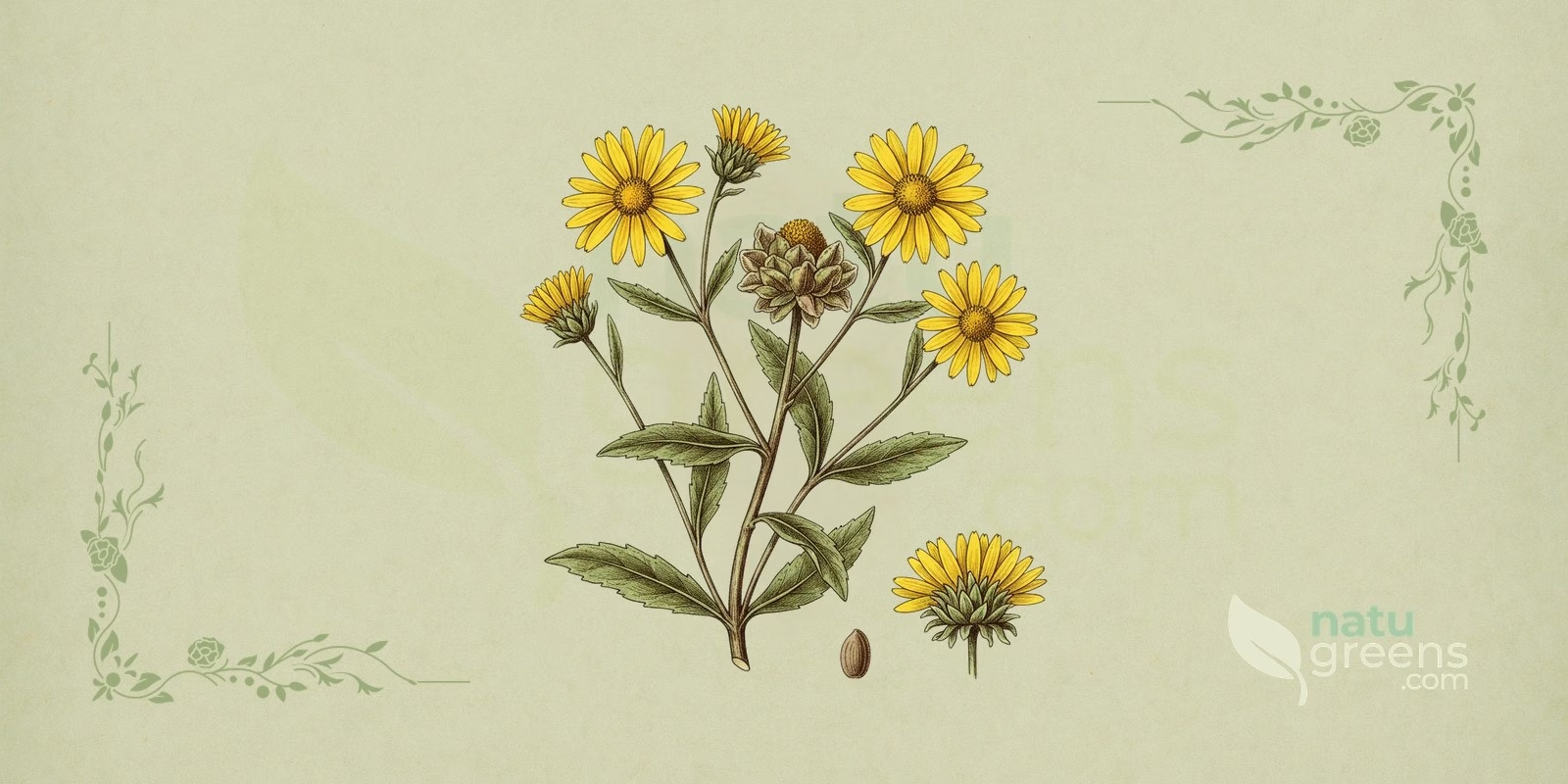
Grindelia robusta Nutt. / Gumweed is a perennial herbaceous plant, sometimes growing as a small shrub, known for the traditional medicinal uses of its resinous flowering tops. Native to western North America and Mexico, the species adapts to very different settings, from dry slopes and open grasslands to streambanks and seasonal riverbeds. Gumweed stands out for its bright yellow flowers, which offer abundant nectar and pollen to bees, and for its aerial parts, harvested during flowering for medicinal use.
Native North American peoples used gumweed for respiratory complaints and skin conditions long before the plant made its way into medical manuals. That happened in the United States from the mid-19th century onward, when it was listed in the United States Pharmacopeia and later in the National Formulary. Today, laboratory studies are investigating the anti-inflammatory and antioxidant activity of its extracts, but its reputation as an expectorant for cough and bronchitis remains a traditional use, under study, with no clinical trials that would allow it to be regarded as a proven effect.
Popular and International Names of Gumweed
- English: August Flower, California Gum Plant, Great Valley Gumplant, Gumweed, Rosin-weed, Scaly Grindelia, Tar Weed, Wild Sunflower.
- French: Grindélia.
- German: Grindeliakraut, Grindelie, Großes Gummikraut, Gummipflanze.
- Italian: Grindelia.
- Lakota: pte ichi yuha.
- Omaha-Ponca: pezhe wasek.
- Portuguese: Grindélia, the name used in Brazilian compounding pharmacies; Erva-gomosa and Planta-da-goma appear in some sources, but there is no established Brazilian common name.
- Spanish: Grindelia, Manzanilla (in some regional contexts, a name that should not be confused with chamomile).
Botanical Synonyms of Grindelia robusta
According to World Flora Online, Grindelia robusta Nutt. is now regarded as a synonym of the accepted name Grindelia hirsutula Hook. & Arn. Even so, Nuttall’s name remains the most widely used in pharmacopoeias, in the scientific literature and in the medicinal plant trade, which is why this article keeps it as the main binomial. In a pharmaceutical context, the herbal drug known as Grindeliae herba also includes closely related species that are often cited alongside gumweed, such as Grindelia camporum Greene, Grindelia humilis Hook. & Arn. and Grindelia squarrosa (Pursh) Dunal. This grouping reflects both the taxonomic complexity of the genus and the botanical closeness of these plants.
Botanical Family: Asteraceae
The Asteraceae family, formerly called Compositae, is one of the largest and most diverse families of flowering plants, with about 1,900 genera and more than 32,000 species distributed worldwide. Its defining feature is the flower head, or capitulum, in which many small flowers are packed so tightly that the whole cluster looks like a single bloom. Its members include plants of great economic, nutritional and medicinal importance, such as lettuce, sunflower and calendula.
Gumweed shows the morphological features typical of the family, with tubular disc florets in the center and ray florets around the edge of the flower head. Asteraceae are known for producing bioactive compounds such as sesquiterpene lactones, flavonoids and essential oils, and this chemical diversity has been the subject of intensive pharmacological research, with implications for the development of herbal medicines and supplements. The kinship also has a practical consequence for safety, since people allergic to other plants in the family may react to gumweed through cross-allergy.
Parts of Gumweed Used
- Dried aerial parts
- Leaves
- Resinous flowering tops (flower heads)
The part of greatest interest is the flowering top, harvested during flowering, when the flower heads and buds are coated with the sticky resin that concentrates the grindelane-type diterpenes. Saponins and flavonoids are also present in the harvested material.
Ethnobotanical and Traditional Uses
- Antispasmodic for the airways (traditional record)
- Asthma (traditional record, not a substitute for medical treatment)
- Bronchitis and bronchial complaints (traditional use, under study)
- Cardiac depressant (old traditional record linked to high doses; see Contraindications)
- Catarrh of the upper respiratory tract
- Common cold
- Cystitis (traditional record)
- Expectorant for cough (traditional use, under study)
- Poison ivy or poison oak dermatitis, in a North American traditional record of topical use
- Skin conditions, applied topically
- Whooping cough (historical record)
These records come mainly from Indigenous medicine and from North American medical practice of the 19th and 20th centuries. None of them replaces medical evaluation, especially in cases of asthma, whooping cough and urinary infections, which require professional diagnosis and follow-up.
Therapeutic Properties of Gumweed
- Antibacterial (activity described in laboratory studies, without clinical confirmation)
- Antifungal (activity observed in the laboratory with extracts of species in the genus)
- Anti-inflammatory (effect observed in cell models, under study)
- Antioxidant (activity measured in laboratory assays with essential oil and extracts)
- Antispasmodic (traditional record of easing coughing spasms)
- Expectorant (traditional use, under study, to help clear mucus)
The available research on gumweed consists mostly of in vitro studies with immune cells and chemical assays of antioxidant activity, which help explain the plant’s traditional reputation but do not establish dose, efficacy or safety in people.
Detailed Phytochemical Profile of Gumweed
- Acetylenic compounds (matricarianol, matricarianol acetate)
- Essential oil (0.2%)
- Flavonoids (kaempferol-3,7-dimethyl ether, kaempferol-3-methyl ether, quercetin methyl ethers)
- Grindelane-type diterpene acids (17-acetoxygrindelic acid, 7,8-epoxygrindelic acid, grindelic acid)
- Monoterpenes and sesquiterpenes (alpha-pinene, borneol, bornyl acetate, limonene, trans-pinocarveol)
- Mucilage
- Phenolic acids (chlorogenic, p-coumaric and p-hydroxybenzoic acids)
- Tannins (5%)
- Triterpenoid saponins (bayogenin, grindeliasapogenin D, oleanolic acid)
Grindelane-type diterpene acids, especially grindelic acid, are the most characteristic constituents of the resin and serve as chemical markers for the genus. The methylated flavonoids on the plant’s surface and the phenolic acids, for their part, are being studied as possible contributors to the anti-inflammatory and antioxidant activity observed in the laboratory.
Preparation and Administration Forms of Gumweed
- Fluid extract
- Herbal tea, infused from the cut dried herb
- Lotion (external use)
- Poultice (external use)
- Tincture
Because gumweed accumulates selenium when it grows in the seleniferous soils of the American West, any preparation should start from quality-controlled material from a supplier that discloses the origin and analysis of the herbal drug. Internal-use forms, for their part, call for professional guidance and only short-term use.
Synergy with Other Medicinal Plants
Respiratory Tract
In the herbalist tradition, gumweed is often combined with other plants for respiratory complaints, and pairings with lobelia (Lobelia inflata) and licorice (Glycyrrhiza glabra) are traditionally recorded for asthma and bronchitis. In this record, lobelia would act as a bronchial relaxant and licorice as an expectorant and anti-inflammatory, forming with gumweed a formula aimed at cough and congestion. Lobelia, however, has known toxicity, and licorice can raise blood pressure with prolonged use, so these blends only make sense under professional guidance. In commercial preparations on the French market, gumweed also appears alongside Gelsemium and Erysimum for symptoms of flu-like conditions and cough. This combination should not be reproduced at home, because gelsemium is a highly toxic plant.
Irritated Skin and Dermatitis
For poison ivy and poison oak dermatitis, a North American traditional record that should not be extrapolated to other skin diseases, gumweed may be combined with calendula (Calendula officinalis). A case report published in 2005 described rapid relief of itching and oozing after applying Grindelia tincture in a calendula cream base, an isolated observation that is not equivalent to a controlled study. Tradition attributes a soothing and wound-healing action to calendula, which would add to gumweed’s effect on irritation. Since both plants belong to the Asteraceae, anyone allergic to the family should avoid this combination.
Recipes and Usage Protocols of Gumweed
Traditional Infusion for Cough and Catarrh
The infusion is the oldest way of preparing gumweed and is traditionally used to ease the cough of flu-like conditions and catarrh of the upper airways, a traditional use, under study, that should be limited to a few days.
- Ingredients: Dried, cut flowering tops of Grindelia robusta, in an amount recommended by a healthcare professional, and about 150 ml of boiling water.
- Preparation: Place the herb in a container, pour the boiling water over it, cover and let it steep for 5 to 10 minutes. Strain and drink warm.
- Dosage: Frequency and duration should be determined individually, without prolonged use; consult a healthcare professional.
Tincture for Internal Use
The tincture gathers gumweed’s constituents in a hydroalcoholic solution and, in the traditional record, is used for the same respiratory complaints as the infusion by those who want a more standardized measure. Being more concentrated and containing alcohol, however, it requires professional guidance and should not be used for prolonged periods.
- Ingredients: Quality-controlled Grindelia robusta herbal drug and extraction solvent (60% V/V ethanol).
- Preparation: The tincture is prepared at a 1:10 ratio, meaning one part gumweed to ten parts solvent, by macerating the plant in the alcohol for a period, followed by filtration.
- Dosage: The dose should be set taking into account kidney function, blood pressure and current medications; consult a healthcare professional.
Fluid Extract
The fluid extract is another concentrated form, traditionally used for the same respiratory indications as the infusion by those who prefer a liquid preparation that is simpler to measure. It also calls for the same precautions as the tincture regarding concentration, alcohol content and duration of use.
- Ingredients: Grindelia robusta herbal drug and extraction solvent (22.5% V/V ethanol).
- Preparation: The fluid extract is prepared at a 1:1 ratio, that is, one part gumweed to one part solvent.
- Dosage: Only at the recommended dose, for a short period; consult a healthcare professional.
The preparations above follow traditional records and do not replace professional guidance. Before any internal use, check the contraindications and interactions described in this article.
Associated Therapies
Western Herbal Medicine
In Western herbal medicine, gumweed is remembered for its expectorant, antispasmodic and anti-inflammatory actions, described mainly by tradition, and it appears in formulas for bronchitis, asthma and cough and in external preparations for skin irritation. The effects under investigation are attributed to the plant’s chemical makeup, which combines resins, flavonoids and saponins. Evidence in humans, however, remains limited and does not justify using gumweed in place of medical care, especially for asthma.
Homeopathy
In the homeopathic materia medica, Grindelia robusta is described for respiratory complaints, particularly asthma with difficult expectoration, and for heart conditions associated with lung problems, as well as spleen pain and a feeling of lethargy. This is an indication specific to homeopathy, without clinical proof, in which the choice of potency and dosage is up to a qualified homeopath based on each patient’s symptoms. This use does not replace medical follow-up for heart or lung disease.
Contraindications and Side Effects of Gumweed
Kidney Disease and Prolonged Use
Gumweed is contraindicated in kidney disease, because the resin is excreted through the kidneys, and it should not be used for prolonged periods. At high doses there is a traditional record of gastric and kidney irritation, which is why any internal use should be short, at a dose guided by a healthcare professional, and stopped in the event of lower back pain, changes in urine or digestive discomfort.
Blood Pressure and Heart Rate
There is a traditional record of a hypotensive effect and of reduced heart rate at high doses, which calls for caution and professional guidance for people taking antihypertensives and antiarrhythmics. The combined effects can lower blood pressure or heart rhythm too much. People with low blood pressure, bradycardia or other heart conditions should also talk to their doctor before using the plant.
Allergic Reactions
There is a risk of cross-allergy to Asteraceae, so people sensitive to plants in this family, such as calendula, chamomile, chrysanthemum and ragweed, may also react to gumweed with contact dermatitis, hives and, in rare cases, more serious reactions. Before topical use on larger areas, it is advisable to test the product on a small patch of skin and observe the reaction before continuing.
Gastrointestinal Irritation
In sensitive people, gumweed may irritate the stomach lining, and high doses can cause diarrhea and kidney or gastric irritation. There are no recent reports of serious adverse events with traditional use at usual doses, but caution is advised, especially for those with gastritis, ulcers or other gastrointestinal problems.
Raw Material Quality and Selenium
The plant accumulates selenium in the seleniferous soils of the American West, so only quality-controlled material, with an identified origin and a supplier’s certificate of analysis, should be used. The botanical identity of the product must also be checked, since the herbal drug Grindeliae herba may include other species of the genus, such as Grindelia squarrosa.
Pregnancy and Breastfeeding
During pregnancy and breastfeeding, the advice is to avoid gumweed due to a lack of safety data, and pregnant or breastfeeding women should consult a healthcare professional before using any product that contains the plant.
Children and Adolescents
Gumweed is intended only for adults and older adults, because there are no data on safety and efficacy in children and adolescents under 18. Tinctures and fluid extracts also contain alcohol, which adds weight to the recommendation not to use it in these age groups.
Limits of Traditional Use
Traditional topical use for poison ivy dermatitis is a North American record and should not be extrapolated to eczema, open wounds or other skin diseases. Likewise, its use as an expectorant for cough and bronchitis is a traditional use, under study, that does not replace medical evaluation of persistent cough, shortness of breath or wheezing.
Historical Notes and Interesting Facts
Origin of the Name
The genus name Grindelia honors David Hieronymus Grindel (1776-1836), a Baltic German pharmacist and botanist, and follows the common taxonomic practice of naming plants after scientists whose work left a mark on the botany of their time.
Names Linked to the Resin
Many of the plant’s English names, such as gumweed, rosin-weed and tar weed, refer to the sticky resin that coats the flower heads and buds. It is the same secretion that concentrates the diterpenes characteristic of the genus and explains the tacky feel when handling the fresh plant.
Native North American Peoples
Gumweed has a long history of use among Native North American peoples, who employed it for various medicinal purposes and valued it especially for bronchial problems and skin conditions, including reactions caused by poison ivy. This traditional knowledge was decisive for the plant’s later adoption by Western medicine. The names recorded in languages such as Lakota and Omaha-Ponca still recall this origin.
Official Recognition
The plant gained official recognition in Western medicine from the mid-19th century onward and was listed in the United States Pharmacopeia from 1882 to 1926 and in the National Formulary of the United States until 1960. This presence shows gumweed’s standing in the medical practice of the time, even though the inclusion criteria of that period were very different from today’s standards of scientific proof.
Frequently Asked Questions about Gumweed
What Is the Traditional Use of Gumweed?
Gumweed is traditionally used to ease the cough of flu-like conditions, catarrh of the upper airways, asthma and bronchitis, a traditional use, under study, that does not replace medical treatment. It is also applied to the skin for irritation and dermatitis, most notably in the North American record for poison ivy reactions.
Which Benefits of Gumweed Have Been Studied?
Laboratory studies have observed anti-inflammatory activity in immune cells and antioxidant activity in the plant’s essential oil and extracts. The expectorant and antispasmodic action that would explain the relief of cough comes from tradition and has not yet been confirmed by robust clinical trials.
How Do You Make Gumweed Tea?
The traditional tea is an infusion of the dried flowering tops in about 150 ml of boiling water, kept covered for 5 to 10 minutes, then strained and drunk warm. The amount of herb, the frequency and the duration of use should be set by a healthcare professional, always for just a few days and with quality-controlled material.
Does Gumweed Have Contraindications?
Yes, gumweed is contraindicated in kidney disease, because the resin is excreted through the kidneys, and it should not be used for prolonged periods, since high doses have a traditional record of gastric and kidney irritation. It should also be avoided by people allergic to Asteraceae and during pregnancy and breastfeeding, due to a lack of safety data.
Does Gumweed Interact with Heart Medications?
There is a traditional record of a hypotensive effect and of reduced heart rate at high doses, so people taking antihypertensives or antiarrhythmics need caution and professional guidance before taking the plant. The combination may add up the effects and lower blood pressure or heart rhythm too much.
Can Children Use Gumweed?
No, use is not recommended in children and adolescents under 18, because safety and efficacy data are lacking for this age group and the concentrated liquid forms contain alcohol. The plant is intended only for adults and older adults, always with professional guidance.
Notice: this content is for informational purposes and does not replace professional medical advice. Consult a physician or herbal practitioner before using medicinal plants, especially during pregnancy, breastfeeding, or alongside medication.
How to cite this article
NATUGREENS. Gumweed (Grindelia robusta): Properties and Benefits. Natugreens, 3 Nov. 2026. Disponível em: https://natugreens.com/gumweed-grindelia-robusta/. Accessed: Nov. 4, 2026.
Natugreens. (2026). Gumweed (Grindelia robusta): Properties and Benefits. Natugreens. https://natugreens.com/gumweed-grindelia-robusta/
References and Scientific Studies
- PMC2007 Fraternale D, et al. Essential oil composition and antioxidant activity of aerial parts of Grindelia robusta from Central Italy. Fitoterapia. 2007.
- PMC2009 Krenn L, et al. Contribution of methylated exudate flavonoids to the anti-inflammatory activity of Grindelia robusta. Fitoterapia. 2009.
- PMC2010 La VD, et al. Active principles of Grindelia robusta exert antiinflammatory properties in a macrophage model. Phytother Res. 2010.
- PMC2014 Ferreres F, et al. HPLC-DAD-ESI/MS(n) analysis of phenolic compounds for quality control of Grindelia robusta Nutt. and bioactivities. J Pharm Biomed Anal. 2014.