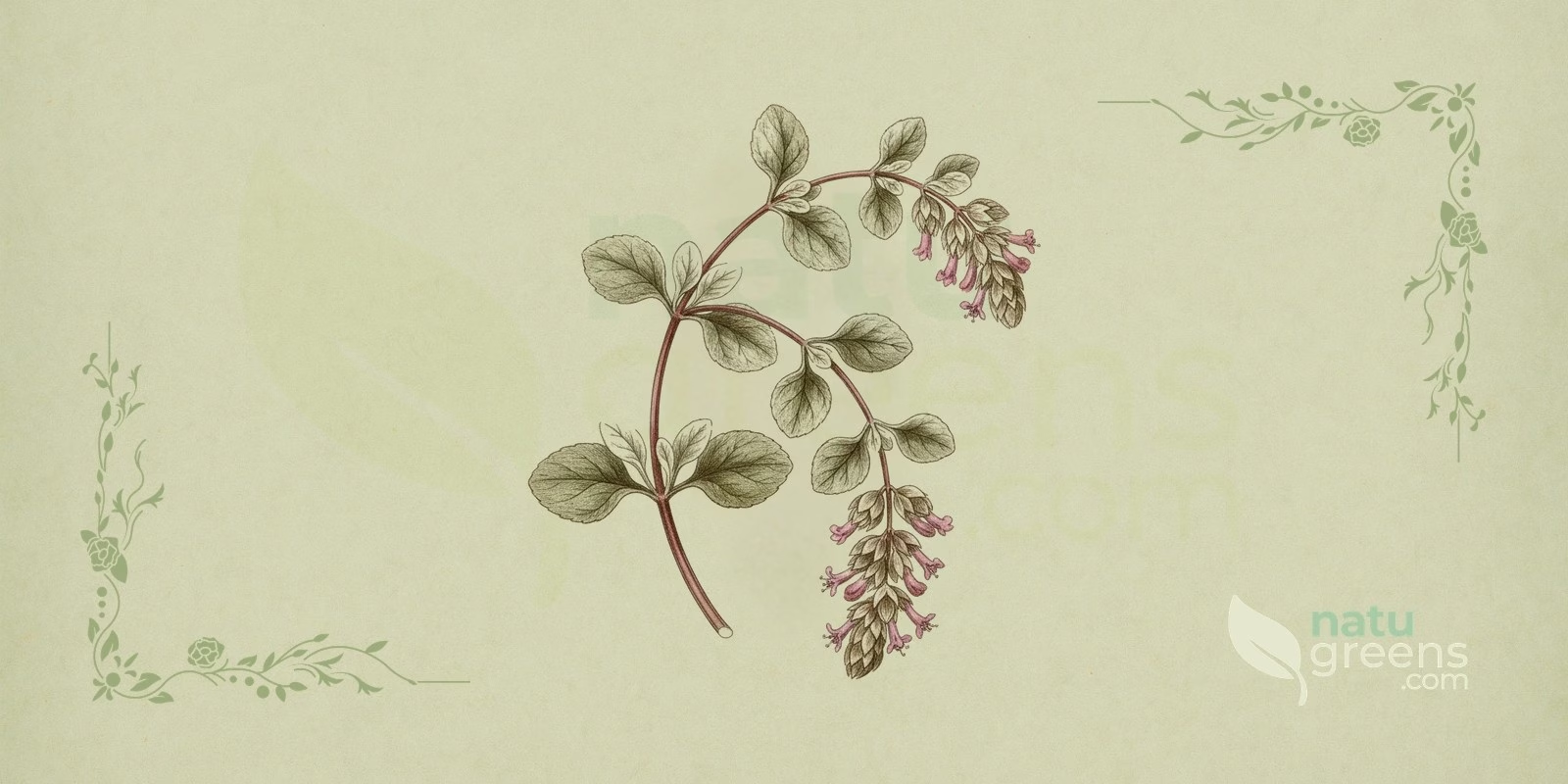
Origanum dictamnus L. / Dittany of Crete, also known as Cretan oregano, is a small, aromatic, frost-sensitive perennial of the Lamiaceae family, endemic to the Greek island of Crete, where it grows wild on rocky slopes and in hard-to-reach gorges. Prized since antiquity as a seasoning and as an herb used in a range of folk medicine preparations, dittany stands out for its velvety foliage, covered in a grayish down, and for the delicate flowers that appear in summer and autumn.
In traditional medicine, the plant is used for a variety of complaints, from digestive discomfort to minor wounds, and its phytochemical composition, in which carvacrol stands out, is linked to the antimicrobial and antioxidant activities observed in laboratory studies. For centuries, harvesting it in the mountains of Crete was a dangerous task left to gatherers who climbed sheer cliffs, but today the species is protected and the material available should come from cultivation, which supplies its medicinal, culinary and ornamental uses and keeps dittany present in contemporary herbal medicine.
Popular and International Names of Dittany of Crete
- English: Cretan dittany, Dittany of Crete, Hop marjoram.
- French: Dictame de Crète, Origan de Crète.
- German: Diptam-Dost, Kretischer Diptam.
- Italian: Dittamo di Creta, Origano di Creta.
- Portuguese: Díctamo-de-Creta, Orégano-de-Creta.
- Spanish: Díctamo de Creta, Orégano de Creta.
Botanical Synonyms of Origanum dictamnus
- Amaracus dictamnus (L.) Benth.
- Amaracus tomentosus Moench
- Dictamnus creticus Garsault, nom. inval.
- Majorana dictamnus (L.) Kostel.
- Origanum dictamnifolium St.-Lag.
- Origanum saxatile Salisb., nom. illeg.
These names appear in older botanical literature and in herbarium collections, but the accepted name today is Origanum dictamnus L., and the synonym Dictamnus creticus should not be confused with the genus Dictamnus, which belongs to the Rutaceae family and includes plants not closely related to dittany.
Botanical Family: Lamiaceae
The Lamiaceae family, formerly called Labiatae, is a vast and diverse group of flowering plants comprising about 236 genera and more than 7,000 species, recognizable by their square stems, opposite leaves and two-lipped flowers, which are often aromatic. Their wealth of essential oils explains why so many species in the group serve cooking, perfumery and folk medicine, such as lavender, mint, rosemary, sage and thyme, all known for the intense aroma of their leaves.
Origanum dictamnus shares the family’s distinctive features, above all the presence of volatile compounds responsible for its striking aroma and for much of the scientific interest it attracts. The Lamiaceae are distributed across temperate and tropical regions, and many of their members have adapted to dry, stony environments, such as the cliffs where dittany of Crete lives. Phytochemical research shows that species in the family are important sources of phenolic acids, flavonoids and terpenoids, substances with relevant biological activities in experimental studies.
Parts of Dittany of Crete Used
- Flowers
- Leaves
- Stems
In practice, flowers, leaves and thin stems are harvested together as aerial parts, the material that the traditional use monograph of the European Medicines Agency (EMA) designates as Origani dictamni herba; for home use, it is best to buy only cultivated material, since the species is protected and its wild populations are threatened.
Ethnobotanical and Traditional Uses
- Colds and mouth infections (traditional use)
- Cough associated with colds (traditional use)
- Digestive discomfort (traditional use)
- Flavoring for foods and beverages
- Minor skin inflammation (traditional use)
- Minor wound healing, as a poultice (traditional use)
- Stomach aches (traditional use)
These uses belong to the traditional record and partly coincide with the indications described in the EMA traditional use monograph, which cites cough associated with colds, digestive discomfort and minor skin inflammation, although this recognition is not equivalent to clinical proof of efficacy.
Therapeutic Properties of Dittany of Crete
- Anti-aging for the skin (antioxidant effect observed in skin cell cultures, with no studies in people)
- Anti-inflammatory (effect investigated in preliminary laboratory studies)
- Antimicrobial (activity of the essential oil against bacteria and fungi observed in the laboratory)
- Antioxidant (ability to neutralize free radicals observed in extracts, in in vitro studies)
- Antispasmodic (traditional use for digestive discomfort)
- Carminative (traditional use for relieving gas)
These activities have been described mainly in laboratory tests with the essential oil or with extracts of the plant, and so far there are no clinical studies confirming an equivalent effect from the home use of dittany in infusions or compresses.
Detailed Phytochemical Profile of Dittany of Crete
- Carvacrol
- Cymene (p-cymene)
- Flavonoids
- Gamma-terpinene
- Thymol
- Triterpenic acids (oleanolic and ursolic)
Carvacrol is the most prominent compound in the essential oil, accompanied by smaller amounts of thymol, gamma-terpinene and cymene, while water-based extracts gather flavonoids and other soluble phenolic compounds, associated with the herb’s antioxidant capacity. Oleanolic and ursolic acids complete the profile, and the proportion among all these components varies with the growing site, the harvest season and the part of the plant analyzed.
Preparation and Administration Forms of Dittany of Crete
- Compress, for external use
- Essential oil, only diluted and for external use
- Light infusion (tea)
- Poultice, for external use
The infusion should always be light, prepared with a small amount of dried leaves and flowers, because excess carvacrol irritates the mucous membranes of the mouth and stomach. The essential oil must not be taken by mouth under any circumstances and, for external use, it must be diluted in a vegetable oil, while poultices and compresses are intended only for intact skin or for small superficial lesions. To determine the amount, frequency and duration of use, consult a health professional.
Synergy with Other Medicinal Plants
With Peppermint and Fennel
In herbal tradition, dittany of Crete is combined with other digestive herbs, such as peppermint (Mentha × piperita) and fennel (Foeniculum vulgare), in infusions traditionally used to relieve cramps, flatulence and indigestion. The proposed explanation is that the carvacrol in dittany, the menthol in peppermint and the anethole in fennel would add up to relaxing effects on the smooth muscle of the gastrointestinal tract and help expel gas, a hypothesis that has not yet been tested with the blend of the three plants.
With Common Oregano and Thyme
Combining dittany with common oregano (Origanum vulgare) or with thyme (Thymus vulgaris) brings together plants rich in phenols such as carvacrol and thymol, whose activity against bacteria and fungi has been observed in laboratory tests. In the traditional record, this blend appears in compresses for minor skin lesions and in light infusions during colds, a use that does not replace medical care for respiratory, digestive or skin infections.
Recipes and Usage Protocols of Dittany of Crete
Light Infusion of Leaves and Flowers
Ingredients: 1 level teaspoon of dried dittany of Crete leaves and flowers, from cultivated sources, and 200 ml of boiling water.
Preparation: Place the leaves and flowers in a cup, add the boiling water, cover and let steep for 5 to 7 minutes before straining. This preparation is traditionally used to relieve stomach aches and indigestion and, in folk tradition, also as a relaxing drink, taken after meals or before bed. Keep use to a few days and, for continued use or in case of a diagnosed illness, consult a health professional.
Compress for Minor Wounds and Skin Irritations
Ingredients: 2 tablespoons of dried dittany of Crete leaves and flowers, from cultivated sources, and 250 ml of water.
Preparation: Boil the leaves and flowers in the water for 10 minutes to make a decoction, strain and let it cool until lukewarm. Soak a clean cloth or a piece of gauze in the liquid and apply it to the area for 15 to 20 minutes, two to three times a day. The compress is traditionally used on minor wounds, scratches and mild skin irritations, a use associated with the antimicrobial and anti-inflammatory activity observed in the laboratory, and it should not be applied to deep or extensive wounds or to wounds showing signs of infection, which require medical evaluation.
The preparations above follow traditional records and do not replace professional guidance. Before any internal use, check the contraindications and interactions described in this article.
Associated Therapies
Aromatherapy
In aromatherapy, dittany of Crete essential oil, rich in carvacrol and thymol, is used for its stimulating notes and for the sense of a purified environment its aroma conveys. Brief inhalation of the steam, with a few drops in hot water or in a diffuser, is traditionally used to give a feeling of clearer airways, but concentrated vapor can irritate the eyes and mucous membranes and should be avoided near babies and young children. In massage, always diluted in a vegetable oil, the oil appears in blends traditionally used for muscle aches and tension, and a sensitivity test on a small area of skin should precede any application.
Clinical Herbal Medicine
In herbal medicine, dittany of Crete appears in formulations aimed at digestive discomfort and cough associated with colds, an approach that partly coincides with the EMA traditional use monograph, and some practitioners include it in immune support formulas, a use without clinical proof. The extracts are valued for their content of phenolic compounds, responsible for much of the biological activity studied, and the dose and form of administration should be defined by health professionals, who assess each person’s condition and possible interactions with medications. The plant is still being studied, but the available data come mainly from laboratory tests and do not yet support clinical indications.
Contraindications and Side Effects of Dittany of Crete
General Contraindications
Dittany of Crete is contraindicated during pregnancy and breastfeeding, even though ancient texts record the use of the plant to stimulate menstruation and ease childbirth: this historical record is not a recommendation, and it is precisely the potential emmenagogue effect, capable of stimulating uterine contractions, that makes its use inadvisable for pregnant and breastfeeding women. People with a known allergy to plants of the Lamiaceae family, such as basil, oregano and thyme, should avoid the plant, since contact sensitization to a preparation containing dittany has been reported. In children, it should only be used under the guidance of a health professional, and the plant should be avoided in babies and young children; at any age, anyone with a chronic illness or who takes medications should seek professional advice before starting.
Common Side Effects
Carvacrol, the predominant phenol in the essential oil, irritates the mucous membranes when consumed in excess, which is why the plant should be used only as a light infusion, with no essential oil taken by mouth. In high doses, dittany may cause gastrointestinal irritation, nausea or vomiting, and applying the undiluted essential oil may cause irritation or an allergic skin reaction in sensitive people, which makes it mandatory to dilute it and do a sensitivity test on a small area before topical use. With light infusions and short-term use, adverse effects are rarely reported, which does not remove the need to watch for any sign of intolerance.
Drug Interactions
Because it contains carvacrol and thymol, dittany of Crete may, in theory, interact with anticoagulant medications, increasing the risk of bleeding, and may also enhance the effect of sedatives and anxiolytics, with a risk of excessive drowsiness. There is also a suggestion of a mild blood sugar lowering effect, which has been little studied, so people with diabetes who take glucose-lowering drugs should monitor their blood glucose more closely, and anyone on continuous drug therapy should use the plant only under medical supervision.
Cultivated Origin and Protection of the Species
Endemic to Crete, dittany of Crete is a protected species in the European Union, with threatened wild populations, which is why only cultivated material should be used, never plants gathered in the wild or products bought from wild sources. When buying dried leaves or essential oil, look for an indication of cultivation on the label or ask the supplier, and refuse any product that does not state its origin.
Not to Be Confused with White Dittany
Dittany of Crete should not be confused with Dictamnus albus, the white dittany or gas plant, a member of the Rutaceae family that shares part of its common name but belongs to another genus, has a different chemical composition and a safety profile of its own, so the information on use and risk for one species does not apply to the other.
Historical Notes and Interesting Facts
Dittany of Crete has a long written history and appears in texts by Aristotle, Hippocrates and Theophrastus, while in Greek mythology it was associated with the goddess Aphrodite and regarded as a plant with magical powers. The best-known legend is found in Virgil’s Aeneid, which tells how Venus used dittany to heal the wounds of Aeneas, drawing out of the hero’s body the arrow that had struck him, an episode that shows how old the plant’s fame as a healing herb was.
The plant was so highly valued that harvesting it became a risky activity, carried out by men known as erondades (love seekers), who risked their lives in the mountains of Crete to reach the tufts clinging to the rocks. Besides its medicinal use, dittany was used to flavor wines and drinks such as absinthe and vermouth, and today, protected by European legislation because of its rarity and its risk of extinction in the wild, its cultivation is concentrated in villages such as Embaros, in Crete.
Frequently Asked Questions about Dittany of Crete
Can Dittany of Crete Be Consumed Daily?
The traditional record describes the consumption of dittany of Crete as a light infusion, for short periods, and there are no studies supporting prolonged daily use. For continued use, observe how your body responds and consult a health professional, especially if you have a pre-existing illness or take other medications.
Does Dittany of Crete Help with Digestion?
Tradition uses dittany of Crete for digestive discomfort, a use that the EMA traditional use monograph describes as a traditional record, without clinical proof. The carminative and antispasmodic properties attributed to the plant would explain the relief of bloating, gas and cramps reported by tradition, usually with a light infusion taken after meals.
Can Children Consume Dittany of Crete?
Use in children should only take place under the guidance of a health professional, because the potency of dittany and the lack of specific pediatric studies call for caution, even though other herbs of the Lamiaceae family are used in childhood. In babies and young children, the safest course is to avoid the plant and also the inhalation of its essential oil.
Does Dittany of Crete Have Antimicrobial Action?
Laboratory studies with the essential oil and extracts of dittany of Crete have observed activity against various bacteria and fungi, attributed mainly to carvacrol and thymol. These results have not yet been confirmed in people and help explain the traditional use on minor wounds, but they do not justify using the plant to treat infections, which require medical evaluation.
What Are the Main Contraindications of Dittany of Crete?
The plant is contraindicated during pregnancy and breastfeeding, because of the risk of stimulating uterine contractions, and should be avoided by anyone allergic to plants of the Lamiaceae family. It also calls for caution in people who take anticoagulants, sedatives or diabetes medications, and the essential oil should never be swallowed, so any use should be preceded by a conversation with a health professional.
Can I Gather Dittany of Crete in the Wild?
No, because dittany of Crete is endemic to Crete, protected in the European Union and has threatened wild populations. Use only cultivated material, never plants gathered in the wild or products of wild origin, and check the origin stated by the supplier before buying.
Notice: this content is for informational purposes and does not replace professional medical advice. Consult a physician or herbal practitioner before using medicinal plants, especially during pregnancy, breastfeeding, or alongside medication.
References and Scientific Studies
- PMC2015 Mitropoulou G, et al. Composition, antimicrobial, antioxidant, and antiproliferative activity of Origanum dictamnus (dittany) essential oil. Microb Ecol Health Dis. 2015.
- PMC2023 Paloukopoulou C, et al. Extensive analysis of the cultivated medicinal herbal drug Origanum dictamnus L. and antimicrobial activity of its constituents. Phytochemistry. 2023.
- PMC2012 Paulsen E, et al. Contact sensitization to dittany of Crete (Origanum dictamnus) in a herbal remedy. Contact Dermatitis. 2012.
- PMC2023 Sarropoulou V, et al. Cretan Dittany (Origanum dictamnus L.), a Valuable Local Endemic Plant: In Vitro Regeneration Potential of Different Type of Explants for Conservation and Sustainable Exploitation. Plants (Basel). 2023.