



Quick summary
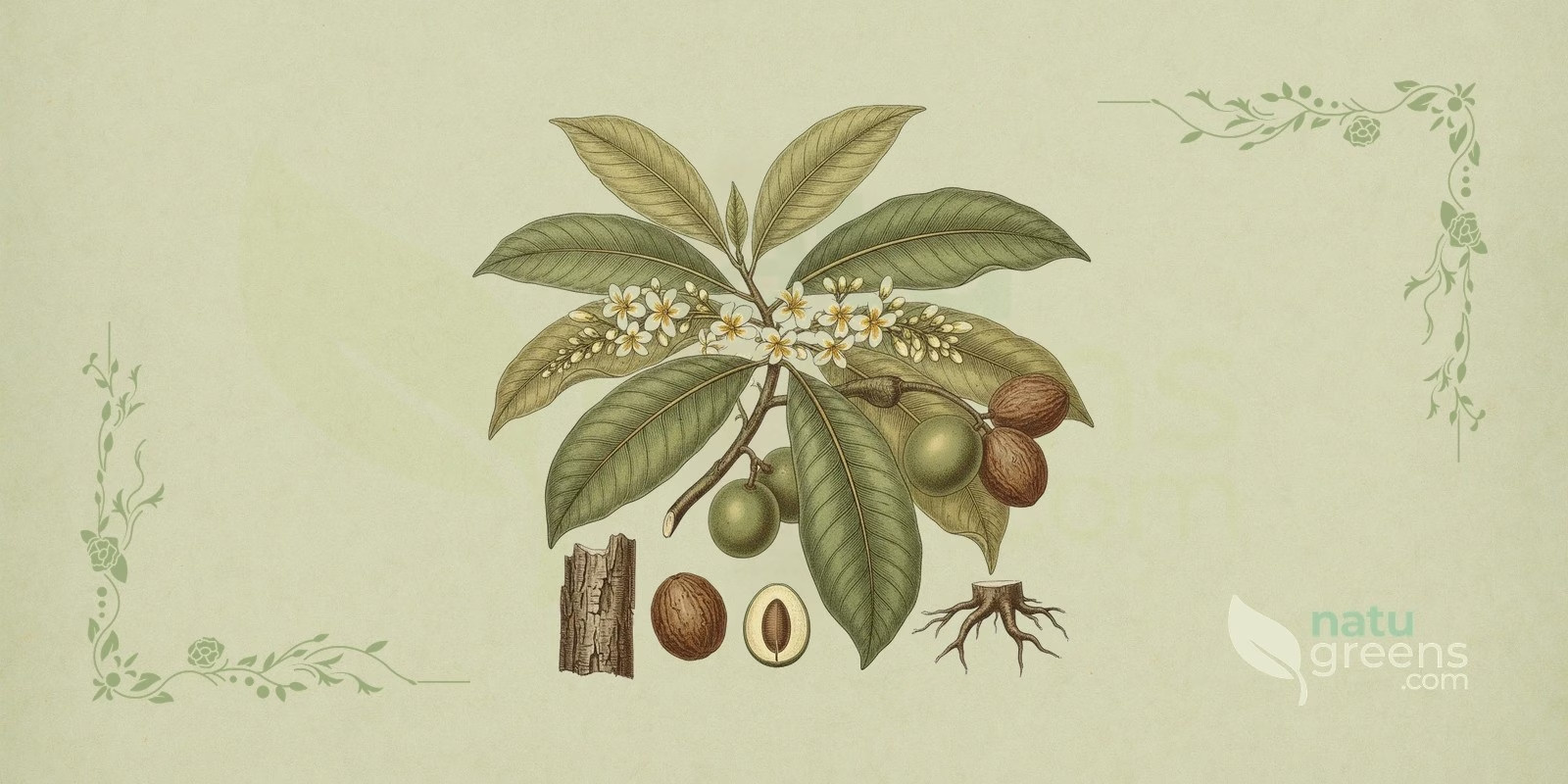
Calophyllum inophyllum L., known as tamanu, is a broad-crowned evergreen tree with thick, glossy leaves that grows on the beaches and coastal sands of the Old World tropics, from the east coast of Africa to Asia, Australia and the Pacific islands. For centuries it was prized for its timber, used to build canoes, and…
Main caution: In Polynesia, tamanu was planted near the marae, the sacred places of worship, and its durable wood was carved into canoes and utensils. The trees thrive in sandy, salty soil, which is why they are common along the…
Calophyllum inophyllum L., known as tamanu, is a broad-crowned evergreen tree with thick, glossy leaves that grows on the beaches and coastal sands of the Old World tropics, from the east coast of Africa to Asia, Australia and the Pacific islands. For centuries it was prized for its timber, used to build canoes, and for the shade it casts along the shore. Today it is best known for the oil pressed from its kernels, a thick, dark green oil with a strong smell that is used in cosmetics. The oil is for external use only, and the effects on the skin attributed to it are still being studied.
Popular and International Names of Tamanu
- English: Alexandrian laurel, beauty leaf, tamanu.
- French: calophylle inophylle, tamanu.
- German: Tamanubaum.
- Hawaiian: kamani.
- Malagasy: foraha.
- Portuguese: tamanu.
- Spanish: tamanu.
In the trade, the oil is also sold as foraha oil, kamani oil, dilo oil or calophyllum oil.
It Is Not Guanandi
Tamanu is not the Brazilian guanandi (Calophyllum brasiliense), a native tree of the same genus also called jacareúba. The name guanandi belongs only to the Brazilian species and should not be applied to tamanu, just as studies on one species do not hold for the other.
Botanical Synonyms of Tamanu
The accepted name is Calophyllum inophyllum L. Recorded synonyms include:
- Balsamaria inophyllum Lour.
- Calophyllum bingator Roxb.
- Calophyllum blumei Wight
Botanical Family: Calophyllaceae
In current classification, tamanu belongs to the Calophyllaceae family. Older sources place it in Clusiaceae or Guttiferae, but phylogenetic studies led to Calophyllaceae being recognized as a family in its own right. The group brings together tropical trees and shrubs rich in resins, xanthones and coumarins, with opposite leaves and dense, parallel venation that is very easy to see on tamanu leaves. The genus name comes from Greek and means beautiful leaf.
Parts of Tamanu Used
The part of greatest interest is the kernel of the fruit, from which the oil is pressed after weeks of drying in the sun, as the kernel turns from pale to brown and oily. Traditionally, the leaves, bark and resin were also used in external preparations. The kernel and the oil are not edible and are toxic if swallowed.
Ethnobotanical and Traditional Uses of Tamanu
On Pacific islands such as Tahiti and Samoa, and in Madagascar, the oil was traditionally applied to the skin for minor cuts, irritation and chafing, and used in massage for body aches. In India and Southeast Asia, the leaves and oil went into external preparations for skin problems. The oil was also burned as lamp fuel.
These are records of traditional use. Deep wounds, severe burns and skin infections need medical care.
Therapeutic Properties of Tamanu
The activities below have been observed in the laboratory, in animals or in small studies. None of them has been proven in robust clinical trials:
- Acne-prone skin, scars and stretch marks (traditional cosmetic use and small studies, under study)
- Antibacterial (oil tested against skin bacteria in the laboratory, under study)
- Anti-inflammatory (extracts in experimental models, under study)
- Antioxidant (free radical scavenging activity in laboratory assays)
- Wound healing (stimulation of skin cells in vitro, under study)
The oil has also shown ultraviolet absorption in the laboratory, which does not make it a sunscreen. For sun protection, use products with a tested protection factor.
The calanolides studied against HIV come mainly from a different species, Calophyllum lanigerum. There is no basis whatsoever for attributing antiviral action to tamanu oil.
Detailed Phytochemical Profile of Tamanu
The oil combines fatty acids common to vegetable oils with a resinous fraction rich in compounds typical of the genus:
- Coumarins (such as calophyllolide and inophyllolide, characteristic of the genus)
- Fatty acids (mainly oleic, linoleic, palmitic and stearic)
- Flavonoids (phenolic compounds with antioxidant activity)
- Triterpenes (such as friedelin, found in the bark and leaves)
- Xanthones (phenolic compounds studied for anti-inflammatory activity)
The resinous fraction gives the oil its dark green color and pronounced smell, and it also concentrates the compounds associated with contact allergy.
Preparation and Administration Forms of Tamanu
Tamanu oil is used on the skin, either neat on small areas or blended into creams, lotions and other vegetable oils. Before using it for the first time, do a patch test:
- Apply a small amount to the inside of your forearm.
- Wait 48 hours without washing the area with harsh soaps.
- If redness, itching or blisters appear, do not use the oil.
Do not apply it to deep wounds, severe burns or infected skin without professional advice. Keep the oil out of the reach of children.
Synergy with Other Medicinal Plants
Skin Blends
In cosmetics, tamanu oil is combined with calendula (Calendula officinalis) infused oil and with small amounts of the essential oils of lavender (Lavandula angustifolia) and tea tree (Melaleuca alternifolia). Essential oils raise the risk of allergy, and the blend should be patch tested on the skin before use.
Massage Blends
In massage oils, it appears alongside arnica (Arnica montana) infused oil, ginger (Zingiber officinale) and chili pepper extract (Capsicum spp.). Arnica should not be used on broken skin, and chili pepper can cause intense burning, especially near the eyes and mucous membranes.
Recipes and Usage Protocols of Tamanu
Diluted Facial Oil
A common way to use it is to blend a small proportion of tamanu oil into a lighter vegetable oil, such as jojoba or grapeseed, and apply a few drops to clean skin. Do the patch test first and stop if irritation develops.
Moisturizer for Rough Areas
A few drops mixed into a neutral moisturizing cream can be applied to dry elbows, knees and feet. Do not apply it to the nipples while breastfeeding or to a baby's skin.
The preparations above follow traditional records and do not replace professional guidance. Before using them, check the contraindications and interactions described in this article.
Associated Therapies of Tamanu
Natural Cosmetics
Tamanu oil is an ingredient in creams, balms and facial oils, with a reputation for improving the look of scars and marks. The studies on these uses are small and early, and the results vary. Inflammatory acne, bothersome scars and extensive stretch marks deserve a dermatologist's assessment.
Traditional Pacific Medicine
In Polynesia, the oil is part of traditional skin care and massage. These practices belong to the local culture and are not equivalent to proven treatments.
Contraindications and Side Effects of Tamanu
- Ingestion: the kernel and the oil are not edible and are toxic if swallowed. If swallowed by accident, seek medical care or contact a poison control center immediately.
- Contact allergy: allergic contact dermatitis from tamanu oil has been documented. Always do a patch test before use.
- Wounds and burns: do not apply to deep wounds, severe burns or infected skin without professional advice.
- Tree nut allergy: the oil comes from the seed of a tree, and people with a tree nut allergy should be cautious.
- Pregnancy, breastfeeding and babies: there are no safety data. Avoid applying it to the nipples and to infants' skin.
Historical Notes and Interesting Facts about Tamanu
In Polynesia, tamanu was planted near the marae, the sacred places of worship, and its durable wood was carved into canoes and utensils. The trees thrive in sandy, salty soil, which is why they are common along the shore, where their roots help hold the sand in place.
The round fruits float and can be carried by ocean currents, which helps explain how widely the species has spread across the islands of the Indian and Pacific Oceans. The seed oil has also been studied as a raw material for biodiesel.
Frequently Asked Questions about Tamanu
What Is Tamanu Oil and What Is It Used For?
It is an oil pressed from the dried kernels of Calophyllum inophyllum and used in skin cosmetics. Its effects on wound healing, acne and scars are under study, and the evidence is still limited.
Can Tamanu Oil Be Taken by Mouth?
No. The oil and the kernel are toxic if swallowed and are meant for external use only. If swallowed by accident, seek medical care immediately.
Does Tamanu Oil Get Rid of Scars?
There is no evidence that it gets rid of scars. Small studies suggest a possible improvement in their appearance, but the results are preliminary. For scars that bother you, see a dermatologist.
Can Tamanu Oil Cause an Allergy?
Yes, it can. Cases of allergic contact dermatitis have been documented. Always test it on a small patch of skin before use.
Are Tamanu and Guanandi the Same Tree?
No. Tamanu is Calophyllum inophyllum, from Asia and the Pacific. Guanandi is Calophyllum brasiliense, a tree native to Brazil.
Does Tamanu Oil Work as a Sunscreen?
No. The ultraviolet absorption seen in the laboratory is no substitute for a sunscreen with a tested protection factor.
How Should Tamanu Oil Be Stored?
In a tightly closed dark glass bottle, in a cool place away from light and out of the reach of children. Throw the oil away if it starts to smell rancid.
Notice: this content is for informational purposes and does not replace professional medical advice. Consult a physician or herbal practitioner before using medicinal plants, especially during pregnancy, breastfeeding, or alongside medication.
How to cite this article
NATUGREENS. Tamanu (Calophyllum inophyllum): Oil, Uses and Precautions. Natugreens, 20 Nov. 2026. Disponível em: https://natugreens.com/calophyllum-inophyllum-tamanu-oil/. Accessed: Nov. 20, 2026.
Natugreens. (2026). Tamanu (Calophyllum inophyllum): Oil, Uses and Precautions. Natugreens. https://natugreens.com/calophyllum-inophyllum-tamanu-oil/
References and Scientific Studies
- DOI2002 Dweck, A. C. and Meadows, T. (2002). Tamanu (Calophyllum inophyllum): the African, Asian, Polynesian and Pacific panacea. International Journal of Cosmetic Science, 24(6), 341-348. A review of the traditional and cosmetic uses of the oil. ↗
- DOI2015 Léguillier, T. et al. (2015). The wound healing and antibacterial activity of five ethnomedical Calophyllum inophyllum oils: an alternative therapeutic strategy to treat infected wounds. PLoS One, 10(9), e0138602. Oils of different origins stimulated skin cells and showed antibacterial activity in vitro. ↗
- DOI2004 Le Coz, C. J. (2004). Allergic contact dermatitis from tamanu oil (Calophyllum inophyllum, Calophyllum tacamahaca). Contact Dermatitis, 51(4), 216-217. A case report of allergic contact dermatitis caused by the oil. ↗
You May Also Like



Take your time and tell us everything you think, details included. Every response is read by someone on our editorial team and goes into the article's revision. An honest critique helps us more than a polite compliment.
Take your time and tell us everything you think, details included. Every response is read by someone on our editorial team and goes into the article's revision. An honest critique helps us more than a polite compliment.