Moringa (Moringa oleifera Lam.) is a small to medium deciduous tree and by far the most widely cultivated member of a small and rather peculiar botanical family, the Moringaceae, whose thirteen accepted species are scattered across the Indian subcontinent, the Arabian Peninsula, the Horn of Africa, Madagascar and southwestern Africa. According to Plants of the World Online, maintained by the Royal Botanic Gardens, Kew, the native range of the species is surprisingly narrow for a tree that has become so ubiquitous: northeastern Pakistan and northwestern India, along the sub-Himalayan belt where the seasonally dry tropical biome prevails. Everything else, from the Caribbean to Polynesia, is introduced territory. Moringa did not spread on its own; it was carried.
What makes the species remarkable from a botanical standpoint is not only that expansion. Moringa combines a set of characters rarely found together among cultivated tropical trees: leaves divided two or three times pinnately, almost fern-like in appearance, zygomorphic white flowers borne in pendulous panicles, and an elongated, deeply ribbed capsular fruit that can exceed half a metre in length. The seeds, globose and fitted with three papery wings, form one of the most reliable diagnostic signatures in the genus. The tree grows with unusual speed, reaching several metres in its first year, and withstands long droughts thanks to a deep taproot.
There is also a kinship that tends to surprise anyone seeing the tree for the first time. The Moringaceae sit within the order Brassicales, the same order as mustard, cabbage and nasturtium, and moringa inherited from that lineage the glucosinolate pathway responsible for the pungent smell released when the root or bark is cut. That pungency is the source of one of the tree’s English names, horseradish tree, in reference to the European horseradish (Armoracia rusticana). The comparison is more precise than it first appears: horseradish belongs to the Brassicaceae, a neighbouring family within the same order, and the two plants defend themselves with the same class of compounds, even though one is a temperate herb and the other a tree of hot, dry country.
Taxonomy
The accepted name is Moringa oleifera Lam., published by Jean-Baptiste de Lamarck in the Encyclopédie Méthodique, Botanique, volume 1, page 398, in 1785. Plants of the World Online records the binomial as accepted and recognises eighteen synonyms for the species, the legacy of a long nomenclatural history that began before the genus itself was created.
The full classification, following the taxonomic backbone adopted by Kew, runs as follows:
- Kingdom: Plantae
- Phylum: Streptophyta
- Class: Equisetopsida
- Subclass: Magnoliidae
- Order: Brassicales
- Family: Moringaceae
- Genus: Moringa Adans., 1763
- Species: Moringa oleifera Lam., 1785
The Moringaceae are a monogeneric family, which is to say that everything the family contains fits within the genus Moringa Adans., established by Michel Adanson in 1763 in Familles des Plantes. The genus holds thirteen accepted species and four generic synonyms: Alandina Neck., Anoma Lour., Donaldsonia Baker f. and Hyperanthera Forssk. These names circulated widely in the nineteenth century, and both Anoma and Hyperanthera once housed moringa itself before the nomenclature settled.
Homotypic Synonyms
Founded on the same nomenclatural type, that of the Linnaean name Guilandina moringa L., which Lamarck would later replace:
- Anoma moringa (L.) Lour., Fl. Cochinch.: 279 (1790)
- Guilandina moringa L., Sp. Pl.: 381 (1753)
- Hyperanthera moringa (L.) Vahl, Symb. Bot. 1: 30 (1790)
- Hyperanthera pterygosperma Oken, Allg. Naturgesch. 3(3): 1727 (1841), nom. illeg. superfl.
- Moringa moringa (L.) Millsp., Publ. Field Columb. Mus., Bot. Ser. 1: 490 (1902), not validly published
- Moringa pterygosperma Gaertn., Fruct. Sem. Pl. 2: 314 (1791), nom. illeg. superfl.
Heterotypic Synonyms
Names proposed from other types and later brought under Moringa oleifera:
- Hyperanthera decandra Willd., Sp. Pl., ed. 4, 2: 535 (1799)
- Moringa amara Durin, Rev. Gén. Bot. 25: 469 (1913)
- Moringa domestica Buch.-Ham., Mem. Wern. Nat. Hist. Soc. 5: 371 (1826)
- Moringa edulis Medik., Theodora: 48 (1786)
- Moringa erecta Salisb., Prodr. Stirp. Chap. Allerton: 326 (1796)
- Moringa nux-eben Desf., Tabl. École Bot., ed. 3: 303 (1829)
- Moringa octogona Stokes, Bot. Mat. Med. 2: 466 (1812)
- Moringa parvifolia Noronha, Verh. Batav. Genootsch. Kunsten 5(4): 20 (1790), nom. nud.
- Moringa polygona DC., Prodr. 2: 478 (1825)
- Moringa robusta Bojer, Hortus Maurit.: 117 (1837)
- Moringa sylvestris Buch.-Ham., Mem. Wern. Nat. Hist. Soc. 5: 373 (1826)
- Moringa zeylanica Pers., Syn. Pl. 1: 461 (1805)
Two of these names deserve the attention of anyone consulting older literature. Moringa pterygosperma Gaertn. circulated for decades in agronomic manuals and still turns up in technical texts from the twentieth century, although it has been a superfluous illegitimate name since publication. Moringa zeylanica Pers. populated works on the flora of Ceylon and today stands as a plain heterotypic synonym.
Etymology
The generic name Moringa is a latinisation of the Dravidian vernacular for the tree, recorded as murungai in Tamil and muringa in Malayalam, languages of southern India where the plant was grown long before any European description. The epithet oleifera comes from the Latin oleum, oil, joined to the verb ferre, to bear or to yield, and alludes to the high fixed-oil content of the seeds, known in the old trade as ben oil or behen oil. The basionym Guilandina moringa, coined by Linnaeus in 1753, honoured the Prussian botanist Melchior Wieland, latinised as Guilandinus, who directed the botanical garden of Padua in the sixteenth century.
Morphological Description
A small to medium deciduous tree, generally between 10 and 12 metres tall and exceptionally reaching 15 metres on deep soils and free of competition. The habit is slender, with a single erect bole, high branching and an open, irregular, rather thin crown that casts only a light, filtered shade. Early growth is remarkably fast: seed-raised specimens commonly pass 3 to 4 metres in their first year. Useful longevity falls between 20 and 30 years, though isolated individuals may live considerably longer.
Leaves
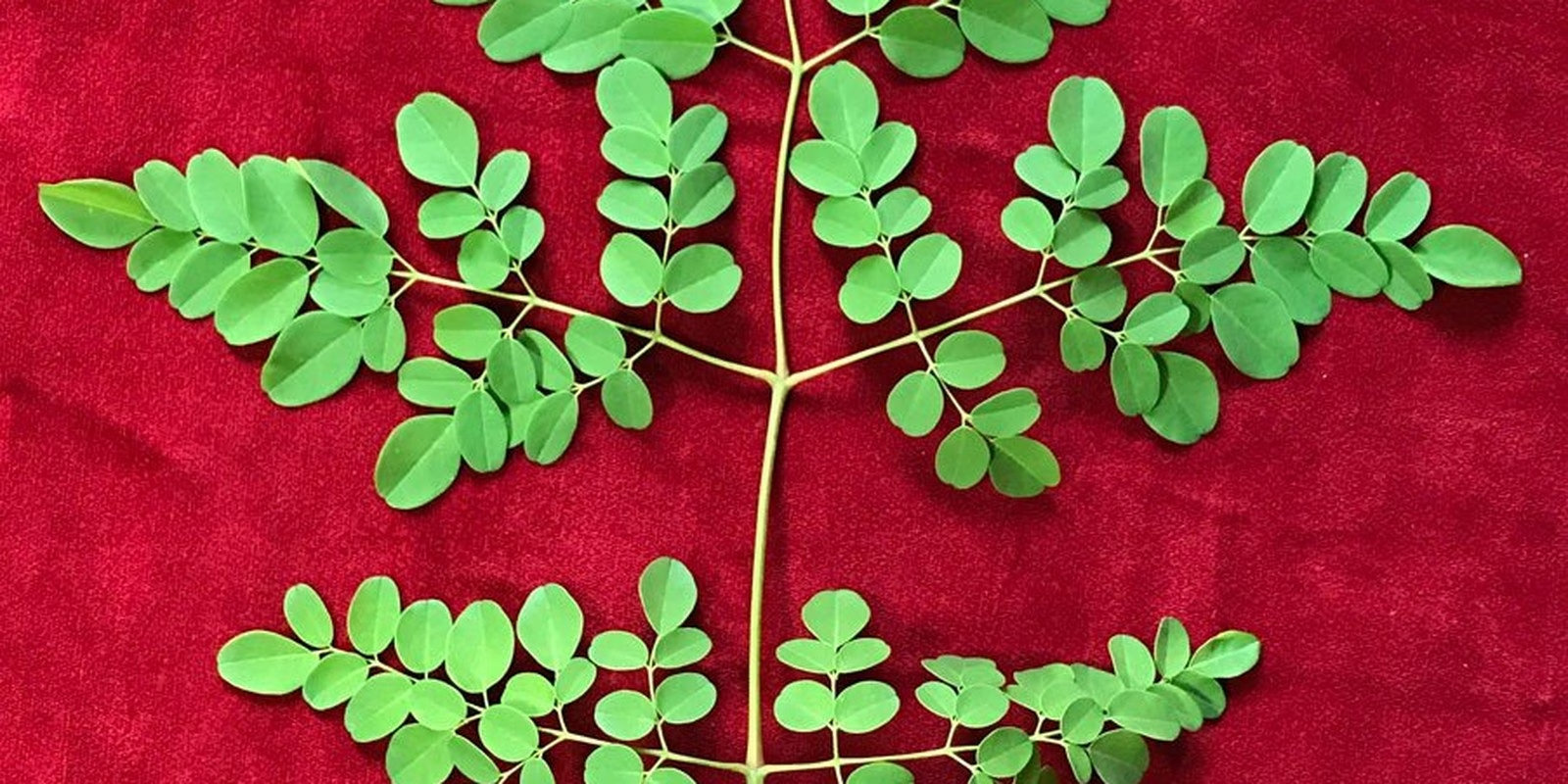
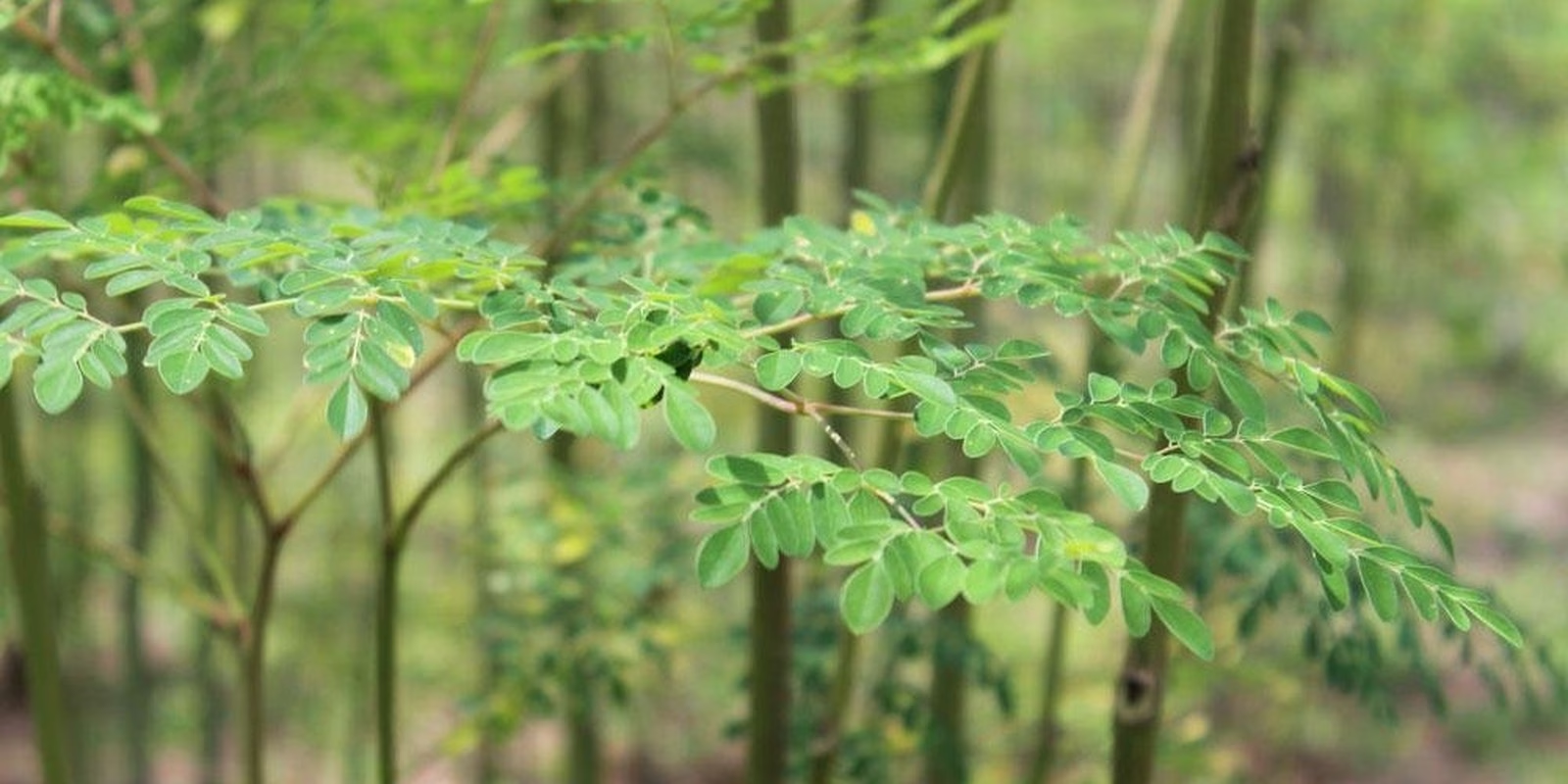
A thrice-pinnate compound leaf of Moringa oleifera, its obovate leaflets set in pairs along the pinnae.
The leaves are the most immediately recognisable character of the species. Alternate and spirally arranged along the branches, they measure 30 to 70 centimetres in total length and are bipinnate to tripinnate, in most individuals divided three times in succession, an arrangement that gives the whole a fern-frond lightness rare among cultivated woody plants. The rachis is faintly winged. The terminal leaflets, ovate to obovate or oblong, are small, 1 to 2 centimetres long, set in opposite pairs, bright light green on the upper surface and paler beneath. In response to prolonged drought the tree sheds its foliage entirely and flushes again with the first rains.
Flowers
The flowers are gathered into pendulous axillary panicles 10 to 30 centimetres long, loose and decidedly showy when flowering is heavy. Each flower measures 2 to 3 centimetres across, is fragrant and zygomorphic, with five free and unequal petals in white to cream, often tinged yellow towards the base. The androecium bears five fertile stamens alternating with five sterile staminodes, an arrangement characteristic of the family. The ovary is superior, pubescent and carried on a short gynophore. The scent is sweet and understated, and nectar production is generous, which makes the species a melliferous plant of interest to beekeepers wherever it is grown on any scale.
Fruits and Seeds
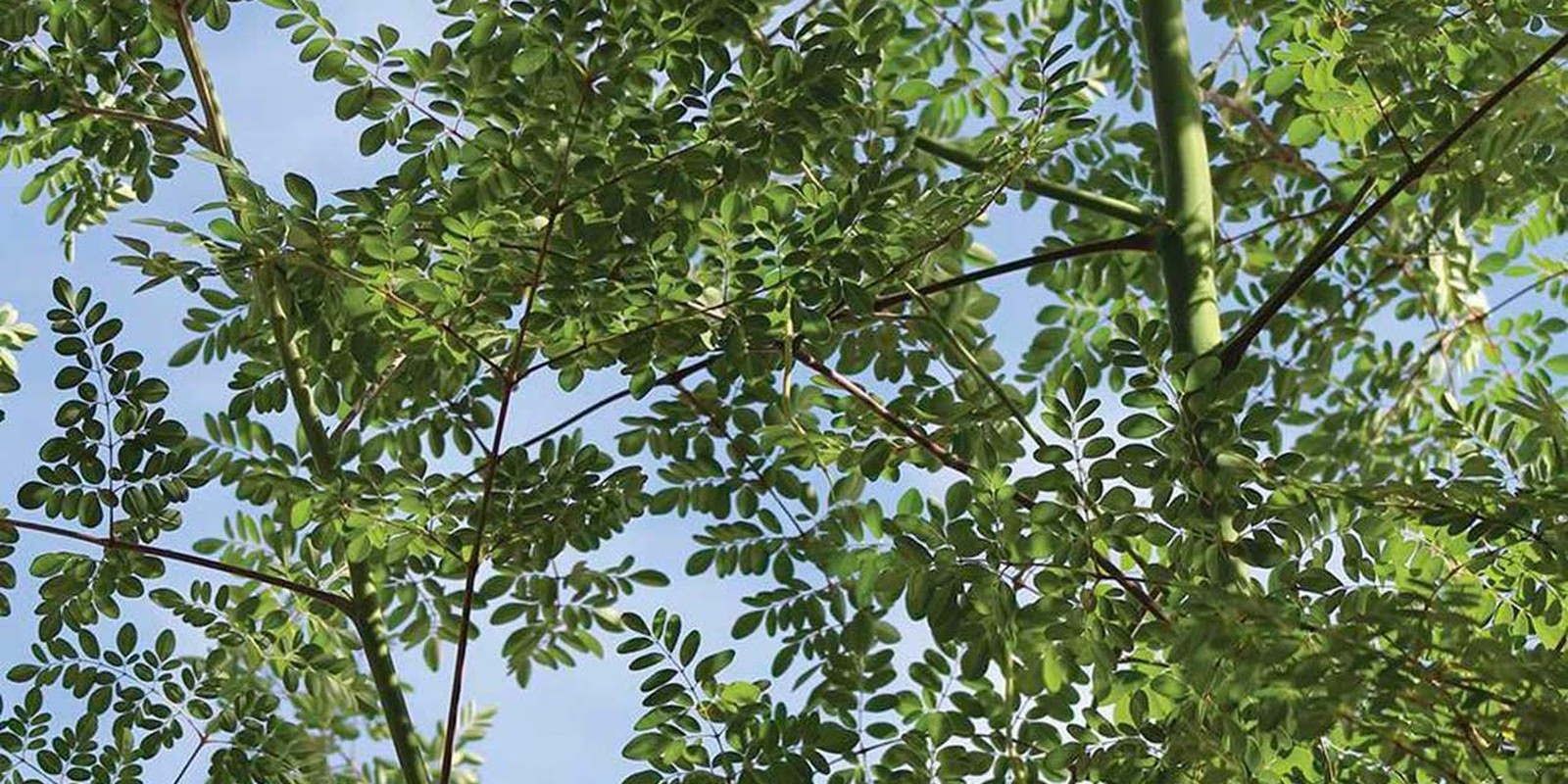
Still-green capsules hanging among the foliage of the crown, months before they darken and split open.
The fruit is an elongated, pendulous, three-valved capsule that opens by longitudinal dehiscence when ripe. It typically measures 20 to 60 centimetres long, with selected cultivars reaching 90 centimetres, and 1 to 1.8 centimetres in diameter. Nine well-marked longitudinal ribs run its length, giving the fruit the silhouette of a drumstick, the image behind the English name drumstick tree. The colour shifts from bright green in the immature stage to dark brown at maturity, reached 3 to 6 months after pollination.
Each capsule holds 12 to 35 globose to ellipsoid seeds, 1 to 1.5 centimetres in diameter and weighing a few tenths of a gram apiece. The seed coat is dark brown and carries three papery membranous wings, whitish to translucent, arranged longitudinally. Those wings are an all but unmistakable diagnostic character: none of the pinnate-leaved trees moringa is usually confused with produces anything resembling a three-winged seed. Fixed-oil content runs between 35 and 40 per cent of dry mass.
Root and Stem
The root system is a deep taproot reaching as far as 3 metres in permissive soil profiles, and it accounts for the species’ notable tolerance of long dry spells. In young plants the main root is thick and tuberous, with a sharply pungent smell and taste owing to the glucosinolates, and it is precisely that pungency that gave rise to the historical comparison with horseradish. The trunk usually measures 30 to 60 centimetres in diameter in mature trees and carries a spongy, corky bark, whitish to pale grey, with faint longitudinal fissures, which exudes a clear gum when wounded that darkens on exposure to air. The wood is white, light, fibrous and of low natural durability, with no meaningful timber value.
Moringa Distribution and Habitat
Plants of the World Online confines the native distribution of Moringa oleifera to northeastern Pakistan and northwestern India, a region of foothills and adjoining plains along the western Himalayan system. It is worth noting that much of the agronomic literature describes the natural range more broadly, taking in Nepal and Bangladesh, but Kew treats those territories as introduced range rather than original spontaneous occurrence.
The introduced range, by contrast, is vast and covers virtually the whole tropical and subtropical belt of the planet. Kew records the species as introduced in some eighty territories, among them Angola, Bangladesh, Cameroon, Cuba, Ethiopia, Florida, Jamaica, Kenya, Madagascar, Mali, Mexico (northwest), Myanmar, Nepal, Nigeria, Puerto Rico, Queensland, Senegal, Seychelles, Sri Lanka, Sudan, Tanzania, Thailand, Venezuela and Vietnam. In Brazil moringa is a cultivated exotic, most likely introduced during the colonial period and now found above all in the semi-arid Northeast and in warm-climate areas of the North and Central-West.
Its preferred habitat is the seasonally dry tropical biome, with a defined rainy season and a pronounced dry period. The species thrives between 25 and 35 degrees Celsius, briefly tolerates minima close to zero and succumbs to hard frost, which can kill the entire aerial part. It adapts to a wide range of rainfall regimes, from roughly 250 to 1,500 millimetres a year, and occurs from sea level to about 1,500 metres of altitude, with records reaching 2,000 metres. It prefers sandy to sandy-loam soils, well drained and slightly acid to neutral in pH, tolerates poor ground and shows moderate salinity tolerance. What it does not forgive is waterlogging, which favours root rot.
In several parts of its introduced range the species has escaped cultivation and formed spontaneous populations, chiefly in disturbed ground, roadsides and abandoned plots in dry climates. Regional compendia record naturalised behaviour in parts of the Caribbean, West Africa and islands of the Pacific and Indian Oceans, although moringa does not appear among the high-impact invaders on the main global lists, most likely through a combination of limited dispersal and poor competitiveness in closed vegetation.
Cultivation
A close-spaced planting managed for leaf harvest, with slender stems and regrowth driven by repeated cutting.
Propagation is by seed or by cutting, and the choice between the two has structural consequences for the resulting plant. Seeds germinate in 7 to 14 days in moist substrate at 25 to 30 degrees Celsius, require no dormancy breaking and hold their viability for something between 6 and 12 months in ordinary storage, losing germinative power quickly thereafter. Seed-raised plants develop the characteristic taproot and prove longer-lived and more drought-hardy. Cutting propagation uses woody branches 1 to 1.5 metres long and 4 to 5 centimetres thick, planted straight into the field and rooting in 30 to 45 days; it brings fruiting forward, but yields a shallow root system and individuals that are shorter-lived and more prone to windthrow.
The light requirement is absolute: full sun, with no middle ground, since shading sharply reduces both leaf production and fruiting. Spacing varies with the purpose of the planting. Close-spaced systems aimed at foliage work with 0.5 to 1 metre between plants and 1 to 1.5 metres between rows, reaching densities of several thousand plants per hectare, while plantings intended for fruit adopt 3 to 5 metres in both directions. Irrigation is needed through the first year of establishment and becomes supplementary thereafter in most suitable climates. Organic matter incorporated at planting pays off, and annual pruning at the end of the dry season keeps height in check and encourages lateral shoots.
Pests recorded in commercial plantings include leafhoppers and aphids on new shoots, scale insects on branches and fruit, defoliating caterpillars of the genera Noorda and Eupterote, and flies of the genus Gitona, which attack developing capsules. On the pathological side, the problems most often cited are anthracnose caused by Colletotrichum gloeosporioides, Cercospora leaf spot, root rot in poorly drained soils and vascular wilt caused by Fusarium, the last of these capable of killing the entire plant.
Leaf harvest can begin 60 to 90 days after planting in close-spaced systems, with successive cuts at intervals of 35 to 45 days through the growing season. Green fruit becomes available from 8 to 12 months in seed-raised plants and earlier in plants from cuttings, while full production of mature seed settles in around the second or third year. Peak yield falls between the third and eighth year of life.
Phenology
The phenological behaviour of moringa depends heavily on the local climate. In humid tropical climates without a pronounced dry season the tree may flower and fruit almost continuously through the year, with flowers and fruit at several stages overlapping on the same individual. In regions with a defined dry season the pattern is clearly seasonal instead: leaf fall accompanies the height of the drought, flowering concentrates at the end of that period or shortly after the first rains, and fruiting follows some months later. Young plants often flower in their first year, a precocity uncommon among trees.
Pollination is predominantly entomophilous. Bees of various genera, including Apis, are the most frequent and effective visitors, drawn by the abundant nectar and the sweet fragrance of the flowers; in parts of the range, visits by nectar-feeding birds and by flies are also recorded. The zygomorphic flower, with the larger upper petal serving as a standard and the lower ones as a landing platform, is consistent with that picture of animal pollination. The species shows some degree of self-compatibility, but cross-pollination results in better fruit set.
Seed dispersal is primarily anemochorous. The three membranous wings act as a lifting surface and let the seed glide some distance when the capsule splits, usually in the depths of the dry season, with the tree bare and the winds at their strongest. Water acts as a secondary vector in seasonal drainages. Deliberate human transport, however, explains by far the greater part of the species’ present distribution across the world.
Related Species and Confusions
The genus Moringa comprises thirteen accepted species: M. arborea Verdc., M. borziana Mattei, M. concanensis Nimmo ex Dalzell & A.Gibson, M. drouhardii Jum., M. hildebrandtii Engl., M. longituba Engl., M. oleifera Lam., M. ovalifolia Dinter & A.Berger, M. peregrina (Forssk.) Fiori, M. pygmaea Verdc., M. rivae Chiov., M. ruspoliana Engl. and M. stenopetala (Baker f.) Cufod. The range of forms within that small assemblage is striking, running from slender trees with finely divided foliage to caudiciform plants with swollen barrel-like trunks.
Within the genus, the most useful points of distinction are these:
- Moringa concanensis, of western India, is the closest look-alike to common moringa and occurs in overlapping territory; it is separated by larger and stiffer leaflets, flowers with narrower petals and fruit that is generally shorter and thicker.
- Moringa drouhardii, from Madagascar, and Moringa ovalifolia, from Namibia, are unmistakable for their caudiciform stems, thickened into a bottle or barrel shape, a habit absent in M. oleifera.
- Moringa peregrina, of the Arabian Peninsula and northeastern Africa, has far less divided leaves whose leaflets drop early, smaller flowers and a frequently shrubby habit in rocky settings.
- Moringa stenopetala, from southern Ethiopia and northern Kenya, is told apart by its less divided leaves with much larger leaflets, by the narrow petals that give the species its name and by a frequently multi-stemmed trunk.
Outside the genus, the commonest confusions arise in the field with finely pinnate-leaved trees in the Fabaceae, above all at the juvenile stage and without reproductive material. Legumes such as Leucaena leucocephala, species of Senna and Cassia, and the flamboyant tree (Delonix regia) have bipinnate leaves that evoke moringa foliage from a distance. With the plant in hand, telling them apart is straightforward. All those legumes produce a pod, a two-valved fruit with flattened, wingless seeds, very different from the nine-ribbed capsule and three-winged seeds of moringa; the moringa leaf, moreover, is usually divided one order further than theirs. The spongy whitish bark that exudes a clear gum when cut, and the pungent smell of a freshly wounded root, complete the identification with a comfortable margin of certainty.
Phytochemistry
The chemistry of moringa organises itself around two axes: the glucosinolates, inherited from the order Brassicales, and the fixed oil of the seeds. The dominant compound of the first group is glucomoringin, chemically a 4-(alpha-L-rhamnopyranosyloxy)benzyl glucosinolate, present in leaves, seeds, bark and root. When tissue is ruptured, the enzyme myrosinase, held in a separate compartment in the intact cell, hydrolyses the glucosinolate and releases the corresponding isothiocyanate, 4-(alpha-L-rhamnopyranosyloxy)benzyl isothiocyanate. That two-step reaction is the same one behind the pungency of mustard and radish, and it explains the acrid odour given off by a cut root.
The distribution of the remaining groups through the plant is as follows:
- Bark and gum: exudate polysaccharides, tannins and smaller amounts of glucosinolates.
- Flowers: glycosylated flavonols and soluble nectar sugars.
- Immature fruit: dietary fibre in the region of 4 to 6 per cent, ascorbic acid at a concentration high for a green fruit and a modest protein content.
- Leaves: flavonols, chiefly quercetin and kaempferol glycosides; phenolic acids of the chlorogenic and caffeoylquinic group; carotenoids, predominantly beta-carotene, lutein and zeaxanthin; high protein levels on a dry-weight basis, in the reported range of 25 to 30 per cent; minerals including calcium, iron, magnesium, potassium and zinc.
- Root and root bark: alkaloids, among them moringinine and spirochin, together with the highest density of glucosinolates in the plant.
- Seeds: fixed oil accounting for 35 to 40 per cent of dry mass, with oleic acid as the overwhelmingly dominant component at around 70 per cent of the fatty acids; glucomoringin and derivatives; low-molecular-weight cationic proteins; the carbamate niazimicin.
The root and root bark concentrate the alkaloids of the species, spirochin among them, whose toxicity is documented in the toxicological literature. These tissues are not safe food material, contrary to what the resemblance in flavour to horseradish might suggest. In moringa, which part of the plant is involved changes everything, and that is a botanical fact of the first order.
History and Ethnobotany
The record of human involvement with moringa and its congeners is a very old one. In pharaonic Egypt the oil pressed from Moringa seeds, known as ben oil, appears in funerary and cosmetic contexts, and residue analysis on Old Kingdom vessels has identified its presence; the species exploited in the Nile valley was predominantly M. peregrina, native to the region, although M. oleifera did circulate along later trade routes. Greek and Roman authors mentioned the same oil as an odourless base for perfumes, taking advantage of its remarkable resistance to going rancid.
On the Indian subcontinent the tree appears in Sanskrit literature under names such as shobhanjana and shigru, and it stood among the plants grown in household gardens for millennia. Communities of southern India and Sri Lanka took the immature fruit and the leaves into everyday cooking, a practice that spread to Southeast Asia and the Philippines through networks of trade and migration. Populations of the Sahel and Sudan used crushed seed to clarify turbid water, a procedure described by nineteenth-century travellers and ethnographers and systematically documented in the twentieth.
Global dispersal took hold during the colonial period. Portuguese, Spanish, English and French navigators and settlers carried the species from southern Asia to tropical colonies in the Americas, in Africa and on the islands of the Indian and Pacific Oceans, where the tree met conditions close to those of its native range and established itself with ease. Formal botanical description came with Lamarck in 1785, more than thirty years after Linnaeus had named the plant Guilandina moringa, and the nomenclature would remain unstable for over a century, which explains the long list of synonyms that accumulated.
Conservation
The IUCN Red List assessment, carried out in August 2019 and published in 2020, classifies Moringa oleifera as Least Concern (LC, criteria version 3.1). The picture is a comfortable one and follows from two factors working together: the species occurs in at least one protected area within its native distribution and is cultivated at scale in dozens of countries, which makes its persistence all but independent of wild populations. The assessment further records active ex situ conservation and identifies no relevant ongoing threat. The species is not listed in any CITES appendix.
Two reservations nonetheless deserve mention. The first is genetic erosion: commercial expansion rests on a handful of selected cultivars, and the number of accessions held in germplasm banks is modest against the area now planted, leaving the diversity of the original populations of northwestern India and northeastern Pakistan under-represented. The second is the contrast with the congeners, which are far more fragile. Several species in the genus have naturally restricted distributions and face real pressure, among them M. arborea, endemic to a tiny area in northern Kenya, and the caudiciform species of Madagascar and Namibia, targeted by illegal collection for the ornamental succulent trade. The robustness of M. oleifera, then, does not extend to the family it represents.
Interesting Facts
- The family Moringaceae is monogeneric and holds only thirteen accepted species, one of the leanest groups among angiosperm families with global economic relevance.
- Moringa is a relative of mustard and cabbage, all within the order Brassicales, a kinship that its tree form disguises completely but that glucosinolate chemistry gives away at once.
- Ben oil, pressed from the seeds, is exceptionally resistant to oxidation and for that reason served for centuries as a neutral carrier in perfumery and, later, as a lubricant for precision clockwork.
- The three-winged seeds glide on the wind like small paper helicopters, a dispersal adaptation uncommon among trees of the dry regions of southern Asia.
- The genus Moringa was created in 1763 by the French naturalist Michel Adanson, the same man Linnaeus honoured in the name of the baobabs, Adansonia. The coincidence has a certain charm: three species of Moringa develop caudiciform trunks swollen into a bottle shape and so repeat, from the other side of evolutionary history, the silhouette of the baobabs, without being closely related to them.
Notice: this content is for informational purposes and does not replace professional medical advice. Consult a physician or herbal practitioner before using medicinal plants, especially during pregnancy, breastfeeding, or alongside medication.
References and Scientific Studies
View All 10 Cited References
- Adanson, M. Familles des Plantes, vol. 2: 318. Paris, 1763.
- Lamarck, J. B. Encyclopédie Méthodique, Botanique, vol. 1: 398. Panckoucke, Paris, 1785.
- 1996 Miller, A. G. & Cope, T. A. Flora of the Arabian Peninsula and Socotra, vol. 1: 1-586. Edinburgh University Press, 1996.
- 2002 Olson, M. E. Combining data from DNA sequences and morphology for a phylogeny of Moringaceae. Systematic Botany, 27(1): 55-73, 2002.
- POWO. Moringa Adans. Plants of the World Online, Royal Botanic Gardens, Kew. Available at ↗
- POWO. Moringa oleifera Lam. Plants of the World Online, Royal Botanic Gardens, Kew. Available at ↗
- 2020 Roland, C. Moringa oleifera. The IUCN Red List of Threatened Species 2020: e.T61890232A61890241. Assessed 28 August 2019, category Least Concern (LC). Available at ↗
- The International Plant Names Index. Moringa oleifera Lam., record 584736-1. Available at ↗
- 1986 Verdcourt, B. Moringaceae. Flora of Tropical East Africa: 1-11. Royal Botanic Gardens, Kew, 1986.
- 2001 Wu, Z. & Raven, P. H. (eds.). Flora of China, vol. 8: 1-506. Science Press, Beijing, and Missouri Botanical Garden Press, St. Louis, 2001.