Curcuma longa L. / Turmeric, known as turmeric, is an herbaceous plant of the Zingiberaceae family, native to Southeast Asia and used for over 4,000 years in Ayurvedic and Chinese medicine. What sets the species apart is its orange rhizome, rich in curcumin, a polyphenol with potent anti-inflammatory and antioxidant properties.
Traditional practice employed the rhizome against digestive disorders, inflammation, and liver conditions, and modern science has since validated many of those same uses. That convergence consolidated turmeric as one of the most researched and most valued medicinal plants in the world, present today in herbal teas, culinary dishes, and pharmaceuticals.
For taxonomy, morphology and cultivation of this plant, see the Botanical Profile of Curcuma longa.
Popular and International Names of Curcuma longa
- English: turmeric, Indian saffron, yellow ginger, curcuma.
- French: curcuma, safran des Indes, turmeric.
- German: Kurkuma, Gelbwurz, Indischer Safran, Gelber Ingwer.
- Italian: curcuma, zafferano delle Indie, turmerico.
- Portuguese: cúrcuma, açafrão-da-terra, açafrão-da-índia (PT); açafrão-da-terra, cúrcuma, gengibre-amarelo (BR).
- Spanish: cúrcuma, azafrán de la India, turmérico, jengibre amarillo.
Botanical Synonyms of Curcuma longa
The nomenclature of Curcuma longa carries several historical synonyms, starting with Curcuma domestica Valeton, a name that appears throughout the older literature, and continuing with Amomum curcuma Jacq., which circulated in the period before the genus was reclassified. The record also includes Curcuma brog Valeton and Stissera curcuma Raeusch. among the names once applied to the species.
The name currently accepted and validated by the international scientific community is Curcuma longa L., as recorded in reference databases such as Plants of the World Online and World Flora Online.
Botanical Family: Zingiberaceae
The Zingiberaceae family, also called the ginger family, brings together about 50 genera and over 1,600 species of tropical plants characterized by aromatic rhizomes, large leaves, and showy flowers. Alongside turmeric, the family counts relatives as familiar as ginger (Zingiber officinale) and cardamom (Elettaria cardamomum).
Species in this group are valued both for their culinary properties and for their bioactive compounds with therapeutic applications, which is why they stand out so consistently in traditional Asian medicine.

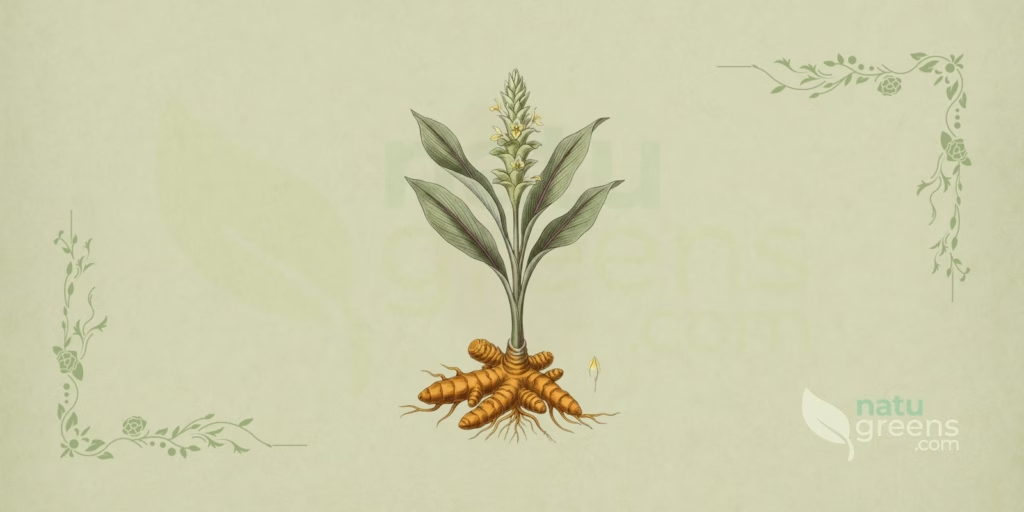
Botanical illustration of Curcuma longa L. (turmeric, açafrão-da-terra, cúrcuma), perennial herbaceous plant of the Zingiberaceae family described by Carl Linnaeus in 1753, native to South Asia, showing complete plant with large oblong-lanceolate green leaves, thick rhizomatous root system with characteristic bright orange-yellow interior in cross-section, and spike of pale yellow tubular flowers, in 19th-century botanical encyclopedia style on aged herbarium paper background.
Parts of Curcuma longa Used
- Fresh rhizome
- Dried and powdered rhizome
Ethnobotanical and Traditional Uses of Curcuma longa
- Cardiovascular prevention
- Digestive disorders
- Joint anti-inflammatory
- Liver and biliary conditions
- Neuroprotection and memory
- Respiratory infections
- Skin diseases (eczema, psoriasis)
- Wound healing
Therapeutic Properties of Curcuma longa
- Analgesic (relieves pain)
- Anti-inflammatory (reduces inflammation)
- Antimicrobial (fights microorganisms); traditional use, without established clinical efficacy
- Antioxidant (fights free radicals)
- Antitumor (potential to inhibit tumor growth)
- Carminative (reduces intestinal gas)
- Cholagogue (stimulates bile release)
- Hepatoprotective (protects the liver); traditional use, without established clinical efficacy
- Hypocholesterolemic (helps lower cholesterol); traditional use, without established clinical efficacy
- Immunomodulatory (regulates the immune system); traditional use, without established clinical efficacy
- Neuroprotective (protects the nervous system); traditional use, without established clinical efficacy
- Vasodilator (improves blood circulation)
Detailed Phytochemical Profile of Curcuma longa
- Ar-turmerone
- Beta-caryophyllene
- Bisdemethoxycurcumin
- Curcumin (main curcuminoid, 2-8% of dried rhizome)
- Demethoxycurcumin
- Essential oil (3-7%: zingiberene, alpha-turmerone, beta-turmerone)
- Polysaccharides (ukonan A, B, C, D)
- Proteins
- Resins
- Sesquiterpenes
- Vitamins (C, E, K)
- Zingiber
Preparation and Administration Forms of Curcuma longa
- Capsule (standardized extract)
- Decoction
- Golden milk
- Infusion
- Paste (culinary and therapeutic use)
- Poultice (topical use)
- Powder (spice and supplement)
- Tincture
Synergy with Other Medicinal Plants
Curcuma longa + Piper nigrum (Black Pepper)
The piperine in black pepper increases curcumin bioavailability by up to 2,000%, and this synergy enhances the anti-inflammatory and antioxidant effects, which makes the pairing fundamental for anyone hoping to maximize curcuminoid absorption.
Curcuma longa + Zingiber officinale (Ginger)
This combination enhances anti-inflammatory and digestive properties at the same time, and it proves particularly effective in cases of arthritis, nausea, and gastrointestinal disorders, thanks to the synergistic action of gingerols and curcuminoids.
Curcuma longa + Boswellia serrata (Indian Frankincense)
This is a powerful combination for chronic inflammatory conditions such as rheumatoid arthritis, because boswellic acids and curcumin act through complementary pathways. Preliminary studies are looking at curcumin combined with boswellic acids in inflammatory joint conditions, and the results so far are not enough to establish efficacy. In rheumatoid arthritis, these preparations never replace disease-modifying antirheumatic drugs (DMARDs).
Recipes and Usage Protocols of Curcuma longa

Botanical illustration in 19th-century encyclopedia style showing Curcuma longa (turmeric) preparation scene for golden milk with ceramic cup, fresh turmeric rhizomes with orange interior, golden powder, wooden spoon, glass jar, black peppercorns and cinnamon stick on aged herbarium paper with sage-green tone.
Anti-inflammatory Decoction
Ingredients: 1 teaspoon (3g) of grated fresh rhizome, 250ml of water, 1 pinch of black pepper.
Preparation method: Boil the water, add the turmeric and the pepper, keep everything on low heat for 10 minutes, then strain and consume warm.
Dosage: Drink 1 to 2 cups per day, always after meals.
Indications: Joint inflammation, muscle pain.
Digestive Infusion
Ingredients: 1 teaspoon of turmeric powder, 1 slice of ginger, 250ml of boiling water, honey to taste.
Preparation method: Pour the boiling water over the turmeric and the ginger, cover for 8-10 minutes, then strain and sweeten.
Dosage: Drink 1 cup 30 minutes before meals.
Indications: Dyspepsia, flatulence, poor digestion.
Golden Milk
Ingredients: 1 teaspoon of turmeric powder, 250ml of milk, 1 pinch of black pepper and cinnamon, honey to taste.
Preparation method: Heat the milk, add the powders, and stir well for 2-3 minutes before sweetening to taste.
Dosage: Drink 1 cup at bedtime.
Indications: Anti-inflammatory action, immune support, sleep improvement.
Turmeric Paste (Topical Use)
Ingredients: 2 tablespoons of turmeric powder, water or coconut oil as needed.
Preparation method: Mix the powder with the chosen liquid until you obtain a homogeneous paste.
Dosage: Apply to the affected area, leave it in place for 15-20 minutes, then wash it off and repeat 1-2 times daily.
Indications: Wounds, eczema, psoriasis, acne.
Hydroalcoholic Tincture
Ingredients: 200g of chopped fresh rhizome, 1 liter of 70% grain alcohol.
Preparation method: Macerate the rhizome in the alcohol for 21 days in a dark bottle, shaking it daily, then filter and store.
Dosage: Take 20-30 drops diluted in water, 2 to 3 times daily.
Indications: Liver support, systemic anti-inflammatory action.
Hepatoprotective Syrup
Ingredients: 50g of grated fresh rhizome, 500ml of water, 300g of pure honey.
Preparation method: Boil the turmeric in the water for 20 minutes, strain the liquid, add the honey, and stir until it dissolves before storing.
Dosage: Take 1 tablespoon 2 to 3 times daily.
Indications: Liver protection, biliary stimulation. Concentrated curcumin supplements, especially high bioavailability formulas, have been linked to cases of acute liver injury: anyone with liver disease, on continuous medication or planning to supplement for long periods should do so only under medical supervision and with laboratory monitoring.
Associated Therapies
Ayurveda
In Ayurvedic medicine, turmeric (haridra) is considered tridoshic because it balances Vata, Pitta, and Kapha. It appears in formulations such as Haridra Khanda for blood purification and in the detoxification practices known as shodhana.
Chinese Herbal Medicine
In traditional Chinese medicine, turmeric (jiang huang) moves Qi and Blood in order to relieve pain, and because it belongs to the Liver and Spleen meridian it is indicated for abdominal pain, amenorrhea, and trauma.
Western Herbal Medicine
Western herbal medicine recognizes turmeric as a potent anti-inflammatory and prescribes it in standardized extracts for arthritis, ulcerative colitis, and the prevention of neurodegenerative diseases, usually in formulas that also carry black pepper.
Homeopathy
In homeopathic tradition, Curcuma longa is associated with digestive and liver complaints, always in low dilutions. Jaundice, intense abdominal pain, and suspected gallstones require immediate medical evaluation, and turmeric is contraindicated when there is bile duct obstruction.
Contraindications and Side Effects of Curcuma longa
General Contraindications
Medicinal use of turmeric should be avoided by anyone with bile duct obstruction, gallstones, or severe liver diseases, since the plant stimulates bile secretion. People with active gastric ulcers should also exercise caution, since high doses can bring on dyspeptic discomfort and the antiplatelet action of curcumin works against anyone who already has damaged mucosa.
Special Precautions
Pregnant women should avoid medicinal doses, as the plant may stimulate uterine contractions, and during breastfeeding culinary use is safe while supplements should be avoided. It is recommended to suspend use two weeks before surgery, given the bleeding risk that the plant carries.
Drug Interactions
Because of its anticoagulant properties, using turmeric alongside medications such as warfarin or aspirin requires strict medical monitoring. Diabetic patients should monitor their blood glucose closely, as turmeric may potentiate the effect of hypoglycemic agents.
Side Effects
Gastrointestinal effects such as nausea, diarrhea, and abdominal discomfort can appear at ordinary supplementation doses, and they become more frequent as the dose goes up. Topical use may cause temporary yellow stains on the skin. Allergic reactions are rare but remain possible in sensitive individuals.
Frequently Asked Questions about Curcuma longa
Can Turmeric Replace Anti-Inflammatory Medications?
Turmeric has proven anti-inflammatory action, but it should not replace prescribed medications without medical guidance. It can be used as a complementary therapy in mild chronic inflammation, always under professional supervision.
What Is the Difference Between Saffron and Turmeric?
They are distinct plants, and the difference shows up in both the part that is harvested and the price it commands. Turmeric (Curcuma longa) is an orange rhizome and stays affordable, whereas true saffron (Crocus sativus) consists of red flower stigmas and ranks among the most expensive spices in the world.
How to Increase Curcumin Absorption?
Curcumin has low bioavailability on its own, so the way to optimize absorption is to consume it together with black pepper (piperine) and healthy fats such as olive oil or coconut oil. Mild heating also improves its solubility and can be combined with both of those measures.
Does Turmeric Stain Teeth?
Regular consumption may cause temporary yellow stains, but there are simple ways to keep them from setting in. Drink through a straw, rinse your mouth with water after use, and brush your teeth 30 minutes later, because the stains are superficial and removable.
Can I Consume Turmeric Daily?
Yes, daily use in culinary doses of 1-3g of powder is safe and beneficial for most people. Therapeutic doses of 500-2,000mg of curcumin should be supervised by a professional and should respect the contraindications described above.
Does Turmeric Help Prevent Alzheimer’s?
Epidemiological studies suggest a correlation, and curcumin does cross the blood-brain barrier while demonstrating potential to reduce beta-amyloid plaques. Animal research is promising, but human studies are still limited in number.
What Is the Best Way to Store Turmeric?
Fresh rhizome should be stored in the refrigerator, wrapped in paper towel inside a perforated plastic bag, where it keeps for 2-3 weeks. Powder should be stored in an airtight container, protected from light, heat, and humidity, which maintains its potency for up to 2 years.
Does Turmeric Interfere with Medications?
Yes, turmeric can interact with various medications, and the most relevant interactions occur with anticoagulants, antiplatelets, antidiabetics, and antihypertensives. Anyone taking regular medication should consult a doctor before starting supplementation.
Notice: this content is for informational purposes and does not replace professional medical advice. Consult a physician or herbal practitioner before using medicinal plants, especially during pregnancy, breastfeeding, or alongside medication.
References and Scientific Studies
View All 10 Cited References
Peer-Reviewed Scientific Studies (8)
- PMC2009 Aggarwal BB, Harikumar KB. Potential therapeutic effects of curcumin, the anti-inflammatory agent, against neurodegenerative, cardiovascular, pulmonary, metabolic, autoimmune and neoplastic diseases. International Journal of Biochemistry & Cell Biology. 2009.
- PMC2012 Chandran B, Goel A. A randomized, pilot study to assess the efficacy and safety of curcumin in patients with active rheumatoid arthritis. Phytotherapy Research. 2012.
- PMC2017 Hewlings SJ, Kalman DS. Curcumin: A Review of Its Effects on Human Health. Foods. 2017.
- PMC2009 Jurenka JS. Anti-inflammatory properties of curcumin, a major constituent of Curcuma longa: a review of preclinical and clinical research. Alternative Medicine Review. 2009.
- PMC2011 Prasad S, Aggarwal BB. Turmeric, the Golden Spice: From Traditional Medicine to Modern Medicine. Herbal Medicine: Biomolecular and Clinical Aspects. 2011.
- PMC1998 Shoba G, et al. Influence of piperine on the pharmacokinetics of curcumin in animals and human volunteers. Planta Medica. 1998.
- PMC2018 Small GW, et al. Memory and Brain Amyloid and Tau Effects of a Bioavailable Form of Curcumin in Non-Demented Adults: A Double-Blind, Placebo-Controlled 18-Month Trial. American Journal of Geriatric Psychiatry. 2018.
- PMC2021 Zoi V, et al. The Role of Curcumin in Cancer Treatment. Biomedicines. 2021.
Institutional Sources (1)
- GOV1999 World Health Organization. WHO monographs on selected medicinal plants — Volume 1. 1999.
Supplementary Readings (1)
- 2018 European Medicines Agency. European Union herbal monograph on Curcuma longa L., rhizoma. EMA/HMPC. 2018.