Curcuma longa L. is a rhizomatous perennial herb in the Zingiberaceae, the same family as ginger and cardamom, and it holds an unusual position among cultivated plants: no wild population of it is known anywhere. The evidence points to a cultigen that arose in south-western India, most likely through hybridisation followed by millennia of continuous human selection, and the outcome is a sterile triploid that reproduces only vegetatively. English usage knows it mainly as turmeric, though Indian saffron, yellow ginger and curcuma all circulate in older trade literature.
What makes the plant recognisable at a glance is not the shoot, which resembles that of many other gingers, but the rhizome. Cut across, it reveals a saturated orange that has almost no parallel among cultivated underground stems, a consequence of curcuminoids concentrated in the parenchyma. That colour underpinned centuries of use as a textile and food dye, long before any laboratory took an interest in the chemistry of the rhizome.
This profile deals with the plant strictly as an organism: nomenclature, morphology, agronomic requirements, annual cycle, relationships within the genus, and a descriptive account of rhizome composition. The genus Curcuma L. holds roughly 130 accepted species centred on India, mainland South East Asia and northern Australia, and most field identification problems resolve themselves once the sectioned rhizome and the bract pattern are examined carefully.
For the traditional uses, properties and preparation methods of this plant, see the article Turmeric (Curcuma longa): Complete Guide.
English usage knows this plant mainly as turmeric, while Indian saffron, yellow ginger and curcuma still circulate in older trade literature.
No wild population of turmeric is known anywhere, and the sterile triploid reproduces only vegetatively.
Taxonomy
The accepted name is Curcuma longa L., published by Carl Linnaeus in Species Plantarum, volume 1, page 2, in 1753. The record corresponds to identifier 796451-1 in the International Plant Names Index, and both IPNI and Plants of the World Online retain the binomial as the current name of the species.
Full Classification
- Kingdom: Plantae
- Clade: Angiosperms
- Clade: Monocots
- Order: Zingiberales
- Family: Zingiberaceae Martinov
- Subfamily: Zingiberoideae
- Tribe: Zingibereae
- Genus: Curcuma L., 1753
- Species: Curcuma longa L., 1753
Accepted Synonyms
A long cultivation history produced parallel names across regional botanical traditions, all now treated as synonyms:
- Curcuma domestica Valeton, 1918 (the dominant name in Indonesian and South East Asian literature)
- Curcuma ochrorhiza Valeton
- Curcuma soloensis Valeton
- Curcuma tinctoria Guibourt
- Kua domestica Medik.
- Stissera curcuma Giseke, 1792
The abundance of synonyms has a straightforward explanation. Because the species is sterile and moves only as planting material, it travelled from region to region as rhizome fragments, and each centre of cultivation ended up described independently by botanists who had no way of comparing source populations.
Etymology of the Binomial
The generic name derives from Arabic kurkum, a term applied to yellow colouring substances and to true saffron, which entered European languages through medieval Latin. The specific epithet longa, from Latin, contrasts the elongated secondary rhizomes of this species with the rounder shape Linnaeus had observed in other Curcuma known to him.
Morphological Description
A medium-sized perennial herb reaching 0.9 to 1.2 metres in full vegetative growth. The aerial structure is not a true stem but a pseudostem formed by tightly overlapping leaf sheaths, an arrangement typical of the family. All above-ground growth dies back at the close of the rainy season, and the plant passes the dry period reduced to its rhizome, from which it resprouts in the following cycle. No woody tissue occurs anywhere in the organism.
Leaves
- Arrangement: alternate and distichous, in two opposite ranks along the pseudostem
- Colour: uniform glossy green on both surfaces
- Length: 30 to 60 centimetres
- Petiole: long, continuing into the sheath that builds the pseudostem
- Shape: oblong-lanceolate, with an acute apex and an attenuate base
- Venation: parallel, with a prominent midrib and fine, densely spaced lateral veins
- Width: 8 to 15 centimetres
The leaves give off a faint scent when crushed, far weaker than that of the rhizome, which helps separate the species from strongly aromatic-leaved relatives in the family.
Flowers
The inflorescence is a dense cylindrical spike emerging from the centre of the leaf rosette on a short scape. Bracts dominate its appearance: the lower fertile ones are pale green and shelter the flowers in small clusters, while the upper ones form a sterile coma in white to pink tones, showier and often mistaken for petals by first-time observers.
- Flower colour: pale yellow, with a darker blotch on the labellum
- Flower size: small, largely concealed by the bracts
- Inflorescence length: 12 to 20 centimetres
- Ovary: inferior, tricarpellate
- Pollination: entomophilous, with recorded visits by bees and flies
- Stamens: a single fertile stamen accompanied by petaloid staminodes forming the labellum
It is worth noting that many commercial stands never flower at all, either because harvest precedes anthesis or because local conditions fail to trigger spike emergence.
Fruits and Seeds
This is the shortest section of the profile, for a structural reason. Curcuma longa is a triploid with 2n = 63 chromosomes, a condition that prevents regular meiosis and blocks the formation of functional gametes. The species produces neither mature fruit nor viable seed under normal cultivation, and the rare capsules occasionally reported yield no offspring. All variation among cultivars is therefore somatic in origin, accumulated through mutation and selection over centuries of vegetative propagation.
Root and Stem (Rhizome)
The rhizome is the plant’s underground stem axis and holds its reserves. It organises into two clearly distinct morphological categories: a globose to ovoid central rhizome, called the mother rhizome or bulb, 3 to 5 centimetres across and weighing between 50 and 150 grams; and cylindrical branching secondary rhizomes, the fingers, which arise laterally from it and weigh 10 to 30 grams each.
- Interior: deep orange, ranging from mustard yellow to an almost reddish orange depending on cultivar
- Odour: pronounced, earthy and faintly woody
- Skin: thin, yellowish brown to orange, marked by rings of sheath scars and dormant buds
- Texture: firm and slightly fibrous when fresh, brittle once dried
The roots proper are fine, fibrous and adventitious, arising from the base of the rhizomes. The system is shallow, rarely going beyond 30 centimetres, which explains how sensitive the crop is to waterlogging.
Distribution and Habitat
Being a cultigen, the species has no natural range in the strict sense. The most widely accepted hypothesis places its origin in south-western India, and Plants of the World Online records exactly that provenance. From there, distribution was entirely mediated by human movement of rhizomes.
The greatest concentration of cultivation and of cultivar diversity lies in South and South East Asia, above all in India and Thailand, followed by Bangladesh, Indonesia, Myanmar and Vietnam. Later dispersal reached the whole tropical belt, including eastern and western Africa, the Caribbean, Central America, northern South America and the Pacific islands.
The ecological niche corresponds to the seasonally dry tropical biome. The plant behaves as a rhizomatous geophyte, using the rainy season to build foliage and store reserves and surviving drought in underground dormancy. It favours mid-slope positions or level ground with free drainage, and does not tolerate soils subject to standing water.
In Brazil, where Portuguese navigators introduced it during the colonial period, cultivation settled mainly in northern Goiás, with Mara Rosa as the best-known hub, extending more thinly across Minas Gerais, Mato Grosso, Mato Grosso do Sul and inland São Paulo.
Cultivation
The crop demands heat, water and organic matter, and repays that in a short cycle. The conditions favouring rhizome development are reasonably well defined:
- Altitude: sea level to around 1,500 metres, performing best between 200 and 800 metres
- Light: full sun, tolerating partial shade with reduced yield
- Rainfall: 1,500 to 2,500 millimetres a year, spread over a rainy season of 5 to 7 months
- Relative humidity: 70 to 85 per cent through the vegetative phase
- Soil: deep, fertile, sandy loam with free drainage and pH between 5.0 and 6.5
- Temperature: optimum range of 20 to 30 degrees Celsius; growth halts below 10 degrees and frost is lethal
Propagation
With the sexual route closed, multiplication depends entirely on rhizome fragments. The standard material is the fingers, cut into pieces of 25 to 40 grams carrying one or two visible buds, laid horizontally at 5 to 8 centimetres depth. The mother rhizome sprouts well too, but is usually sold instead because it fetches a higher price. Sprouting occurs 15 to 30 days after planting, and treating the planting material with fungicide beforehand is routine practice to limit early rotting losses.
Management
Typical spacing runs from 0.4 to 0.6 metre between rows by 0.2 to 0.3 metre between plants, giving densities of 50,000 to 100,000 plants per hectare. Planting fertilisation usually incorporates 20 to 40 tonnes of organic matter per hectare, supplemented by balanced mineral fertilisation through the cycle with particular attention to potassium. Straw mulch is close to universal in this crop, since it conserves moisture, moderates soil temperature and suppresses weed competition during the early weeks, before the canopy closes the inter-rows. Earthing up around the base of the clumps, done around the second or third month, encourages rhizome expansion.
Pests and Diseases
- Aspidiella hartii: a scale insect that infests stored rhizomes
- Colletotrichum capsici: agent of greyish brown leaf spotting
- Conogethes punctiferalis: a borer whose larvae tunnel into developing rhizomes, the leading pest in Asian plantings
- Pratylenchus coffeae: the lesion nematode, associated with yield decline in infested soils
- Pythium aphanidermatum: cause of rhizome rot, most severe in poorly drained soils
- Ralstonia solanacearum: bacterium responsible for rapid wilt and rot
Harvest and Post-Harvest
Harvest readiness is signalled by yellowing and drying of leaves and pseudostems, between 9 and 10 months after planting. Yields run to roughly 20 to 30 tonnes of fresh rhizome per hectare under intensive cultivation and 15 to 18 tonnes in extensive organic systems. Once lifted, rhizomes are separated into mothers and fingers, washed and graded. Industrial processing involves gelatinising the starch in water or steam, sun drying for 10 to 15 days to below 10 per cent moisture, and mechanical polishing of the dark outer layers. The final ratio comes to about five tonnes of fresh rhizome for every tonne of dried powder.
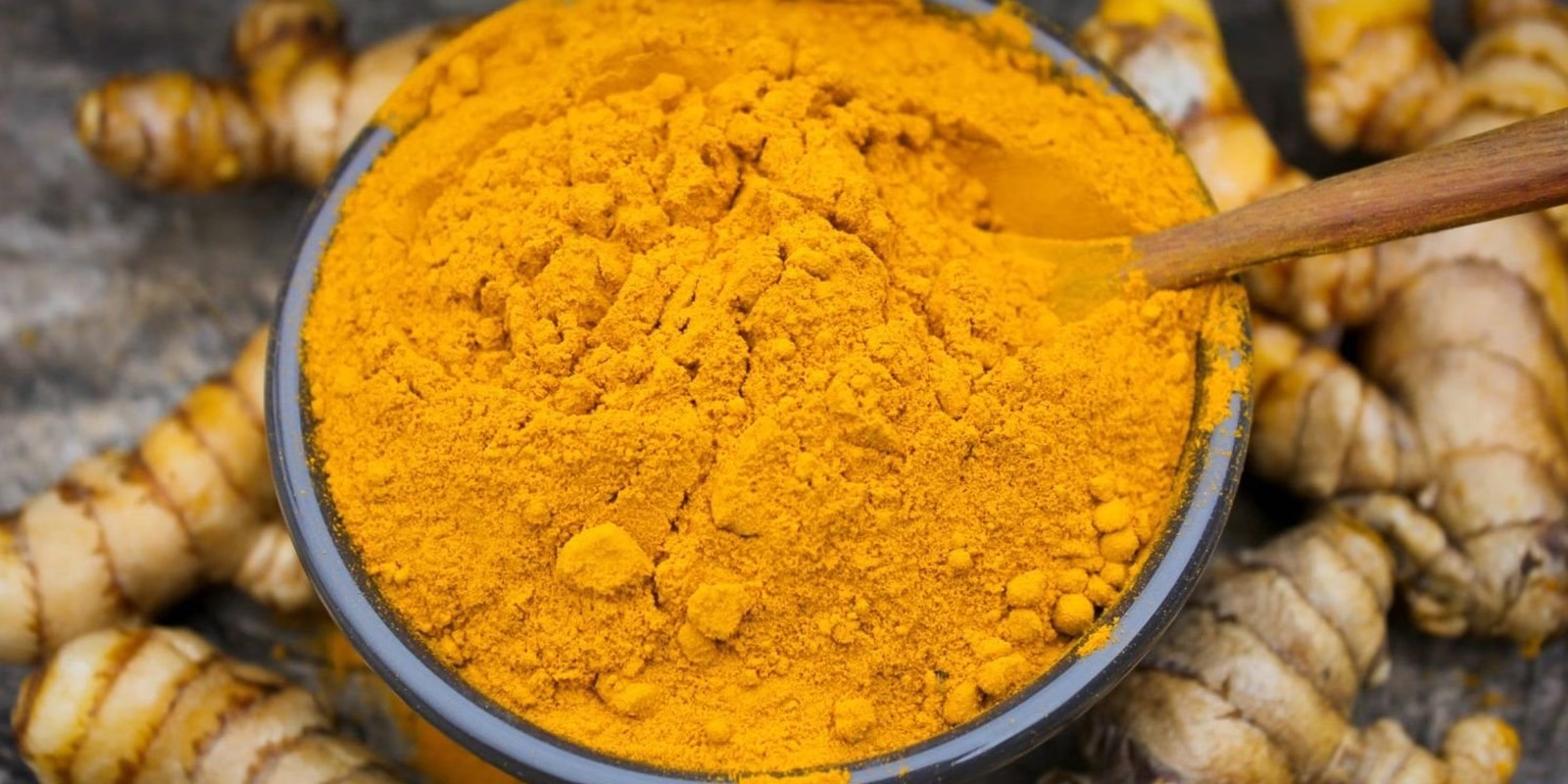
Once boiled and sun-dried, the rhizomes of Curcuma longa are ground into the deep orange powder sold as turmeric.
Phenology
The cycle is annual and tightly coupled to the rainfall regime, which makes the phenology of the species quite predictable within any given growing region.
- Flowering: June to September in the northern hemisphere and December to March in the southern, always at the height of the rains
- Rhizome bulking: 3 to 4 months of thickening, overlapping the end of the vegetative phase
- Senescence and dormancy: progressive yellowing of the foliage as the dry season sets in, followed by rhizome rest
- Sprouting: 15 to 30 days after planting, with the first pseudostems emerging
- Vegetative growth: 4 to 6 months of leaf expansion and clump formation
On the farming calendar, planting follows the onset of the rains: April and May in India, September to November in central Brazil.
Related Species and Confusions
Identifying Curcuma in the vegetative state is notoriously difficult, since many species in the genus share stature, leaf shape and rhizomatous habit. The decisive characters lie in the sectioned rhizome and in the inflorescence.
- Curcuma amada Roxb.: rhizome white to cream inside, with an unmistakable green mango scent
- Curcuma angustifolia Roxb.: narrower leaves and a starch-rich rhizome of pale colour
- Curcuma aromatica Salisb.: a floral scent profile and a rhizome interior far less saturated with orange
- Curcuma caesia Roxb.: rhizome bluish to nearly black inside, unmistakable when cut
- Curcuma zedoaria (Christm.) Roscoe: larger rhizome, pale yellow to whitish inside, with a pronounced camphoraceous odour
Two confusions outside the genus deserve a note. Ginger, Zingiber officinale Roscoe, belongs to the same family and has narrower, longer leaves along with a pale yellow rhizome interior and a citrus-pungent aroma. True saffron, Crocus sativus L., is not closely related at all: it sits in the Iridaceae, and the traded product is the flower stigmas rather than any underground organ. The overlap in common names across several European languages comes only from the similar colour both impart to food.
Phytochemistry
This section describes rhizome composition as reported in the analytical literature, without any inference about effects in people. More than 230 compounds have been identified in the dried material, falling into the following groups:
- Curcuminoids: 2 to 9 per cent, made up of curcumin (60 to 75 per cent of the fraction), demethoxycurcumin (15 to 25 per cent) and bisdemethoxycurcumin (5 to 15 per cent)
- Dietary fibre: 2 to 7 per cent
- Essential oil: 3 to 7 per cent, containing ar-turmerone, alpha-turmerone, beta-turmerone, curlone and further sesquiterpenes
- Minerals: copper, iron, magnesium, manganese and potassium at measurable levels
- Polysaccharides: fractions designated ukonan A, B, C and D
- Proteins: 6 to 8 per cent
- Starch: 60 to 70 per cent of dry mass, the majority component
- Vitamins: niacin, riboflavin and ascorbic acid in modest amounts
Curcuminoids are fat-soluble diarylheptanoids and account entirely for the colour of the rhizome. Their concentration varies considerably between cultivars, and that variation underpins all modern agronomic selection in the species. Indian cultivars such as Lakadong, from Meghalaya, rank among the highest recorded, while traditional southern Indian material tends to sit in lower bands. Content also responds to environment and management, potassium supply, light exposure and cycle length to harvest among them.
History and Ethnobotany of Turmeric
The oldest material record comes from the Indus Valley. Excavations at Harappa and Mohenjo-daro recovered residues consistent with curcumin on cooking implements, pushing the association between this plant and human societies back some five thousand years. Vedic texts around 1500 BCE already mentioned the plant in ritual and domestic contexts, and later compilations of the Indian medical tradition, among them the Caraka Samhita and the Sushruta Samhita, listed it among the species in common use at the time.
In East Asia, Marco Polo noted cultivation in southern China in the thirteenth century, and his description compared the product to true saffron, a comparison repeated for centuries and eventually fixed in several European common names. Between the fifteenth and eighteenth centuries the rhizomes moved along Portuguese and Dutch trade routes as both spice and dyestuff, and that traffic is how the plant reached Brazil, where it established in household cultivation from the seventeenth century onward.
Outside food, the most consistent historical application was as a dye. The pigment coloured textiles, foodstuffs and ritual objects across South and South East Asian cultures, and wedding ceremonies in several regions of India incorporated a paste of the rhizome into preparation rites for the couple, a practice documented by ethnographers through the nineteenth and twentieth centuries.
One legal episode from the late twentieth century deserves recording. In 1995 a United States patent was granted to researchers associated with the University of Mississippi covering applications of turmeric, and the Indian Council of Scientific and Industrial Research challenged the grant by producing documentation of prior traditional knowledge. The patent was revoked in 1997, and the case has since been cited as a precedent in international debate over the appropriation of traditional knowledge.
Conservation
The species does not appear on the IUCN Red List, which is what one would expect of a cultigen with no wild populations available for assessment under the usual criteria. There is no extinction risk in the conventional sense: commercial cultivation spans dozens of countries and the planted area is large.
The genuine concern lies elsewhere, in genetic diversity. Because propagation is exclusively clonal and the market rewards a handful of high-curcuminoid cultivars, the genetic base actually under cultivation has been narrowing. Germplasm banks in India, notably the National Bureau of Plant Genetic Resources, maintain over a thousand accessions precisely to conserve the somatic variation accumulated in local material now falling out of use.
It is worth separating the situation of Curcuma longa from that of its wild relatives. Several species in the genus, among them Curcuma aromatica, Curcuma caesia and natural populations of Curcuma zedoaria, face real pressure from habitat loss and extractive collection, and some appear on regional threatened species lists in the Indian subcontinent.
Interesting Facts
- Curcumin shifts colour with the pH of the medium, from yellow under acid conditions to reddish brown in alkaline ones, a property that made paper impregnated with the pigment a classic laboratory reagent for detecting borates.
- Mara Rosa, in northern Goiás, has concentrated Brazilian production since the 1970s and is pursuing geographical indication status.
- Sangli, in the Indian state of Maharashtra, operates as the largest wholesale trading hub for the product in the world.
- The city of Erode, in Tamil Nadu, became known as the Yellow City through the historical scale of cultivation in the region, and secured a protected geographical indication in India in 2008.
- Triploid sterility means that virtually all turmeric grown worldwide descends from a small number of original clonal lineages.
Notice: this content is for informational purposes and does not replace professional medical advice. Consult a physician or herbal practitioner before using medicinal plants, especially during pregnancy, breastfeeding, or alongside medication.
References and Scientific Studies
Peer-Reviewed Scientific Studies (3)
- DOI2007 Leong-Skornickova, J. et al. Chromosome numbers and genome size variation in Indian species of Curcuma (Zingiberaceae). Annals of Botany, 100(3), 505-526. 2007. ↗
- DOI2007 Ravindran, P. N., Babu, K. N., Sivaraman, K. (Eds.). Turmeric: The Genus Curcuma. CRC Press. 2007. ↗
- DOI2005 Sasikumar, B. Genetic resources of Curcuma: diversity, characterization and utilization. Plant Genetic Resources, 3(2), 230-251. 2005. ↗
Supplementary Readings (4)
- Govaerts, R. et al. World Checklist of Zingiberaceae. Royal Botanic Gardens, Kew. ↗
- International Plant Names Index. Curcuma longa L. Royal Botanic Gardens Kew, Harvard University Herbaria and Australian National Botanic Gardens. ↗
- 2003 Leong-Skornickova, J., Sabu, M., Prasanthkumar, M. G. Curcuma mutabilis (Zingiberaceae): a new species from south India. Gardens’ Bulletin Singapore, 55, 219-228. 2003.
- Linnaeus, C. Species Plantarum, vol. 1, p. 2. Stockholm. 1753. ↗