Arctium lappa / Burdock
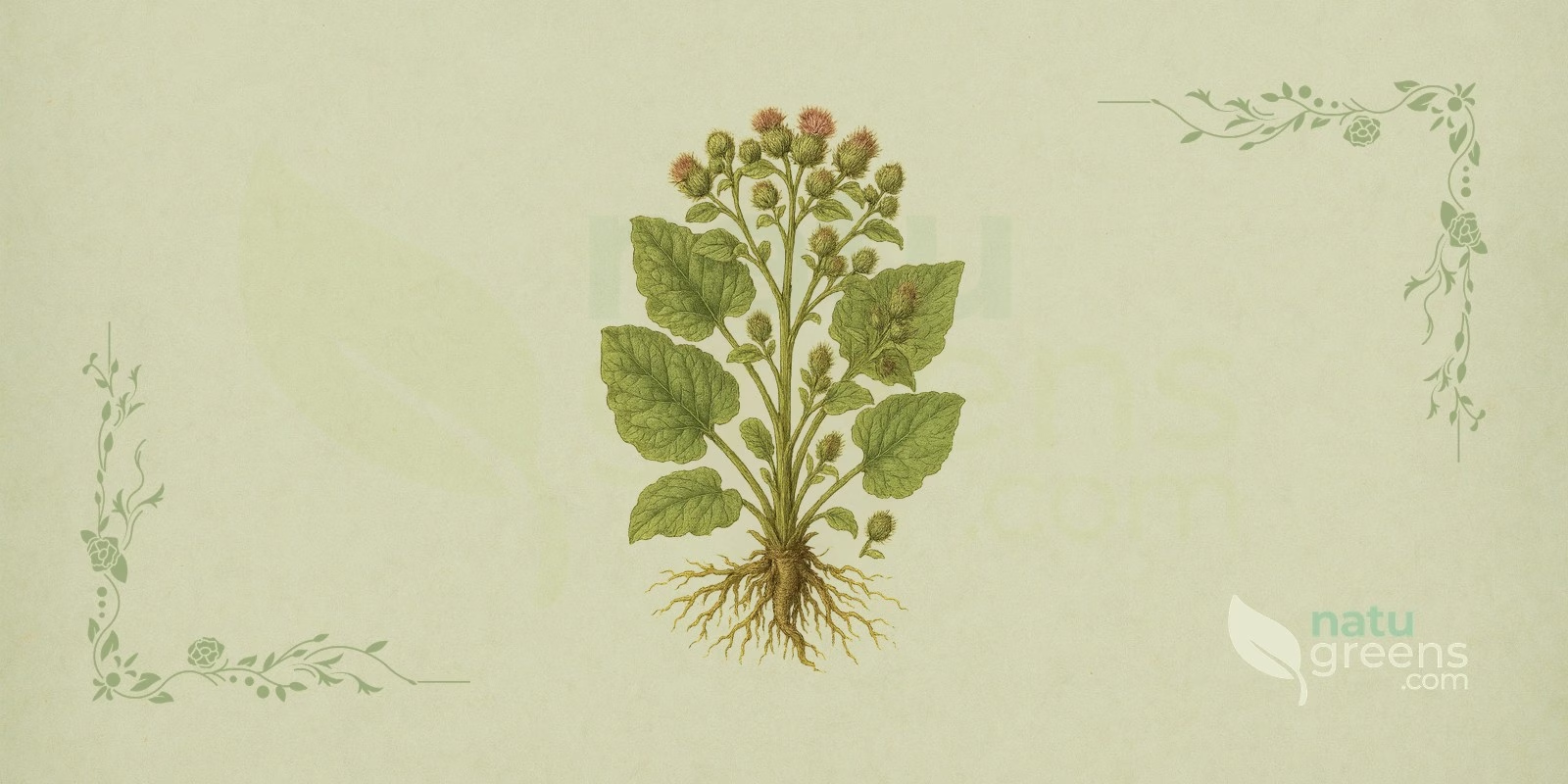
Burdock, scientifically known as Arctium lappa, is a medicinal plant with a rich history of use across many cultures around the world. Native to Eurasia, this hardy plant of the Asteraceae family is prized for its roots, leaves, and seeds, which are used in both cooking and traditional medicine. Burdock is recognized for its notable therapeutic properties, including anti-inflammatory, antioxidant, and detoxifying actions. Its applications range from treating skin problems to supporting digestive and immune health. Modern scientific research has validated many of the traditional uses of burdock, cementing its place as one of the most studied and widely used medicinal plants in the world.
Popular and International Names of Burdock
- English: greater burdock, gobo, edible burdock, lappa, beggar’s buttons, thorny burr, happy major.
- Spanish: bardana, lampazo, agarrocha, agarrucha, aguipegotes, amor de hortelano.
- Portuguese: bardana, bardana-maior, carrapicho-grande, orelha-de-gigante, pega-moço, pega-pega.
- French: bardane, grande bardane, bouton de gueux.
- Italian: bardana maggiore, lappa.
- German: Klette, Grosse Klette, Filz-Klette.
Botanical Synonyms of Arctium lappa
The botanical synonym most frequently found in contemporary scientific literature for Arctium lappa is Lappa major Gaertn. Other synonyms include Arctium majus (Gaertn.) Bernh. and Arctium minus (Hill) Bernh., although Arctium lappa L. is the accepted name widely used in pharmacological and phytotherapeutic publications.
Botanical Family: Asteraceae
Arctium lappa belongs to the botanical family Asteraceae, also known as Compositae. This is one of the largest families of flowering plants, comprising roughly 1,900 genera and more than 32,000 species distributed across the globe. The Asteraceae family includes plants of great economic, culinary, and medicinal importance, such as chamomile, artichoke, and sunflower.
Parts of Burdock Used
- Leaves
- Roots
- Seeds
Ethnobotanical and Traditional Uses
- Anti-inflammatory action
- Antimicrobial action
- Antiseptic action
- Blood sugar regulation
- Calming, soothing effect
- Choleretic action (stimulates bile production)
- Constipation relief
- Depurative action (purifies the body of toxins)
- Detoxifying action
- Digestive support (indigestion and flatulence)
- Diuretic action
- Healing of wounds and gastric ulcers
- Immune support
- Improvement of poor appetite
- Relief of renal colic
- Relief of symptoms associated with seborrheic dermatitis
- Remedy for rheumatism, scurvy, and venereal diseases
- Treatment for hair loss
- Treatment of gout and fevers
- Treatment of skin problems such as acne, eczema, and psoriasis
- Wound healing
Therapeutic Properties of Burdock
- Antibacterial (activity studied against bacteria)
- Anti-inflammatory (effect studied in reducing inflammation)
- Antimicrobial (inhibitory effect studied on microorganism growth)
- Antioxidant (activity studied against free radicals that helps protect cells)
- Antiseptic (studied for infection prevention)
- Antiviral (activity studied against viruses)
- Choleretic (effect studied on bile production by the liver)
- Depurative (purifies the blood and eliminates toxins)
- Diuretic (effect studied on urine production that helps eliminate excess fluid)
- Gastroprotective (protective effect studied on the gastric mucosa)
- Hepatoprotective (protective effect studied on the liver)
- Hypoglycemic (effect studied in reducing blood sugar levels)
- Immunostimulant (effect studied on the immune system)
- Neuroprotective (protective effect studied on the nervous system)
- Orexigenic (effect studied on appetite)
- Wound-healing (effect studied on the healing of wounds)
Detailed Phytochemical Profile of Burdock
Burdock (Arctium lappa) is a rich source of bioactive compounds that give the plant its many medicinal properties. Among its main phytochemical constituents are:
- Lignans: Arctigenin and arctiin are the most prominent lignans, found mainly in the fruits and seeds. Arctigenin, a dibenzylbutyrolactone phenylpropanoid lignan, is one of the most studied active ingredients.
- Monosaccharides and Polysaccharides: Burdock root is rich in carbohydrates, including mannose, glucose, fructose, and galactose. Polysaccharides such as inulin and fructooligosaccharides (FOS) are abundant, contributing to its prebiotic and hypoglycemic properties.
- Caffeoylquinic Acids: Several caffeoylquinic acids have been isolated from different parts of burdock, such as 4,5-O-dicaffeoyl-1-O-[4-malic acid methyl ester]-quinic acid (DCMQA) and chlorogenic acid (3-O-caffeoylquinic acid). These compounds show important pharmacological effects, including studied neuroprotective activity.
- Flavonoids: Rutin, myricetin, quercetin, apigenin, and kaempferol are among the flavonoids present, contributing to the plant’s antioxidant properties.
- Pectin: A polysaccharide that contributes to the regulation of intestinal transit.
Preparation and Administration Forms of Burdock
- Compresses
- Cream
- Dry Extract
- Essential Oil
- Fluid Extract
- Poultice
- Tea (Infusion or Decoction)
- Tincture
Synergy with Other Medicinal Plants
Suggested Combinations with Other Plants
Burdock can be combined with other medicinal plants to enhance its therapeutic effects. For skin problems, for example, synergy with dandelion (Taraxacum officinale) or stinging nettle (Urtica dioica) can strengthen its depurative and anti-inflammatory action. For digestive support, combining it with ginger (Zingiber officinale) or peppermint (Mentha piperita) may improve digestion and relieve flatulence. For immune support, Echinacea purpurea can be an excellent complement.
Recipes and Usage Protocols of Burdock
Burdock Tea for Detoxification and Digestion
Ingredients: 1 dessert spoon (2 to 6 g) of dried burdock root, 250 ml of water.
Preparation: Place the water and burdock root in a pot and boil for 5 minutes. Let it cool slightly, strain, and drink. Up to 3 cups a day are recommended to support digestion and fluid elimination.
Topical Compress for Skin Problems
Ingredients: Burdock tea (prepared as above), gauze or cotton.
Preparation: Soak a piece of gauze or cotton in the warm burdock tea and apply it to the affected area of skin (boils, acne, dermatitis) three times a day. This topical application helps reduce inflammation and supports healing.
Burdock Tincture for Depurative Use
Ingredients: 200 g of dried burdock root, 1 liter of 70% alcohol.
Preparation: Place the roots in a glass jar and cover them with the alcohol, sealing tightly and letting the mixture macerate for 14 days in a dark place, shaking daily to aid extraction of the active compounds. After straining the liquid and storing it in a dark glass bottle, the resulting tincture can be diluted in water as directed by a healthcare professional, used to support the depurative and anti-inflammatory action traditionally attributed to burdock.
The preparations above follow traditional records and do not replace professional guidance. Before any internal use, review the contraindications and interactions described in this article.
The preparations above follow traditional records and do not replace professional guidance. Before any internal use, check the contraindications and interactions described in this article.
Associated Therapies
Herbal Medicine
Burdock is widely used in herbal medicine for its depurative, diuretic, and anti-inflammatory properties. It is employed in treating dermatological conditions, digestive disorders, and as support for detoxification of the body.
Homeopathy
In homeopathy, Arctium lappa is used to treat various skin conditions, such as acne, eczema, and boils, as well as glandular and rheumatic problems. The mother tincture or dilutions are prepared from the fresh root of the plant.
Traditional Chinese Medicine (TCM)
In TCM, burdock (Niubang) is used to disperse wind-heat, detoxify and purify the blood, and treat common colds, coughs, sore throat, measles, and skin eruptions. It is valued for its cleansing and detoxifying properties.
Contraindications and Side Effects of Burdock
Contraindications
- Pregnancy and Breastfeeding: Contraindicated for pregnant women due to its potential to trigger uterine contractions. There is insufficient evidence regarding its safety for breastfeeding women.
- Children: Should not be used by individuals under 18 years of age due to the lack of studies confirming its efficacy and safety.
- Allergies: People with allergies to plants in the Asteraceae family (such as daisies and chrysanthemums) may be sensitive to burdock.
- Diabetes: Due to its hypoglycemic effect, people with diabetes should use it with caution and under medical supervision, as it may enhance the effect of diabetes medications.
- Surgery: It is recommended to stop using burdock at least two weeks before any surgery, due to its potential to affect blood sugar levels and blood clotting.
Side Effects
- Allergic Reactions: Allergic reactions may occur in sensitive individuals, manifesting as skin rashes, itching, or swelling.
- Dehydration and Electrolyte Imbalance: Due to its diuretic properties, excessive use can lead to dehydration and electrolyte imbalance.
- Drug Interactions: May interact with diabetes medications (enhancing hypoglycemia) and anticoagulants (increasing the risk of bleeding).
- Gastrointestinal Disturbances: In some cases, it may cause mild gastric discomfort.
Historical Notes and Interesting Facts
Origin and Spread
Burdock is native to Europe and Asia but was introduced to other parts of the world, such as North America, where it has become naturalized. In Brazil, its introduction is attributed to Japanese immigrants, who cultivated it for both its medicinal and culinary value.
Culinary Use
In Japan, burdock root is a popular vegetable known as gobo, used in a variety of dishes such as soups, stir-fries, and salads. It is prized for its earthy flavor and crunchy texture, as well as its high fiber and nutrient content.
Inspiration for Velcro
An interesting piece of trivia is that the hooks on burdock burrs inspired the invention of Velcro. In 1941, Swiss engineer George de Mestral observed how burdock burrs stuck easily to his dog’s fur and to his clothes, which led him to develop the hook-and-loop fastening system.
Historical Use in Medicine
Although there is no precise official record of when its medicinal use began, burdock has been used for centuries. There are accounts of its use in treating a skin ailment of King Henry III of France, which demonstrates its historical significance in folk medicine.
Frequently Asked Questions about Burdock
Can Burdock Tea Help with Weight Loss?
Burdock tea has diuretic properties that can help eliminate excess fluid from the body, which may result in a slight reduction in weight. However, it is not a substitute for a balanced diet and physical exercise for sustainable weight loss.
What Is the Best Way to Take Burdock?
The ideal form of use depends on the goal. For detoxification and digestive support, tea is popular. For skin problems, topical compresses or tinctures may be more effective. The root can also be eaten as food. Always consult a healthcare professional for guidance.
Does Burdock Interact with Any Medications?
Yes, burdock can interact with diabetes medications, enhancing their hypoglycemic effect, and with anticoagulants, increasing the risk of bleeding. It is essential to inform your doctor about burdock use if you are taking other medications.
Is It Safe to Use Burdock During Pregnancy?
No, burdock is contraindicated during pregnancy due to its potential to induce uterine contractions. Pregnant or breastfeeding women should avoid its use.
How Long Does It Take for Burdock to Work?
The time it takes to see the effects of burdock can vary depending on the condition being treated, the form of use, and individual factors. In general, continuous, regular use for a few weeks may be necessary to notice significant benefits.
Notice: this content is for informational purposes and does not replace professional medical advice. Consult a physician or herbal practitioner before using medicinal plants, especially during pregnancy, breastfeeding, or alongside medication.
References and Scientific Studies
- PEER Arctium lappa (Burdock): Insights from ethnopharmacology potential, chemical constituents, clinical studies, pharmacological utility and nanomedicine – ScienceDirect
- DOI2021 Moro, T. M. A., & Clerici, M. T. P. S. (2021). Burdock (Arctium lappa L.) roots as a source of inulin-type fructans and other bioactive compounds: Current knowledge and future perspectives for food and non-food applications. Food Research International, 141, 109889. ↗
- DOI2023 Yosri, N., Alsharif, S. M., Xiao, J., Musharraf, S. G., Zhao, C., Saeed, A., … & El-Seedi, H. R. (2023). Arctium lappa (Burdock): Insights from ethnopharmacology potential, chemical constituents, clinical studies, pharmacological utility and nanomedicine. Biomedicine & Pharmacotherapy, 158, 114104. ↗
- DOI2021 Yang, Y., Gao, H., Liu, W., Liu, X., Jiang, X., Li, X., … & Zhao, Q. (2021). Arctium lappa L. roots ameliorates cerebral ischemia through inhibiting neuronal apoptosis and suppressing AMPK/mTOR-mediated autophagy. Phytomedicine, 85, 153526. ↗
- DOI2020 Alsamarrai, A. Z., Al-Samarrai, R. R., & Alsamarrai, A. (2020). Isolation and identification of flavonoids from Arctium lappa stem and study the hepato protective effect on acetaminophen induced liver damage. International Journal of Psychosocial Rehabilitation, 24(5), 5191-5198. ↗