Mucuna pruriens (L.) DC. / Velvet Bean, popularly known as velvet bean, cowage, or mucuna, is a tropical legume widely distributed in Africa and Asia and cultivated in many regions of the world. This annual climbing plant, which can exceed 15 meters in length, is recognized both for its medicinal properties and for its agricultural use. The velvet bean has been employed for millennia in traditional medicine systems, such as Ayurveda, thanks to its remarkable therapeutic benefits.
The plant is particularly notorious for the stinging hairs on its pods and young leaves, which cause intense itching on contact. Its seeds, however, are the most valued part, being a natural source of levodopa (L-DOPA), an essential precursor of the neurotransmitter dopamine. This characteristic gives the velvet bean a significant role in supporting neurological and reproductive health and emotional well-being, consolidating its importance in modern and traditional herbal medicine.
Popular and International Names of the Velvet Bean
- English: velvet bean, Bengal velvet bean, cowage, cowitch, Florida velvet bean, lacuna bean, Lyon bean, Mauritius velvet bean, monkey tamarind.
- Spanish: frijol terciopelo, grano de terciopelo, ojo de buey, ojo de venado, pica-pica.
- Portuguese: feijão-da-flórida, feijão-veludo, fava-coceira, mucunã, pó-de-mico.
- French: haricot velu, pois mascate, poil à gratter.
- Italian: fagiolo di velluto, fagiolo vellutato, mucuna.
- German: Juckbohne, Samtbohne.
- Sanskrit (Ayurveda): kapikacchu, atmagupta.
Botanical Synonyms of the Velvet Bean
The scientific name Mucuna pruriens (L.) DC. is the most accepted and most widely used in the botanical literature. The plant, however, has a rich taxonomic history, resulting in several synonyms that can still be found in older publications or specific regional contexts. The variety Mucuna deeringiana is frequently treated as a synonym or subspecies of Mucuna pruriens, reflecting the complexity of classifying species with wide geographic distribution and morphological diversity.
Among the most common synonyms are:
- Carpopogon pruriens (L.) Roxb.
- Dolichos pruriens L.
- Mucuna aterrima (Piper & Tracy) Holland
- Mucuna deeringiana (Bort) Merr.
- Mucuna prurita Hook.
- Stizolobium aterrimum Piper & Tracy
- Stizolobium deeringianum Bort
- Stizolobium pruriens (L.) Medik.
Botanical Family: Fabaceae

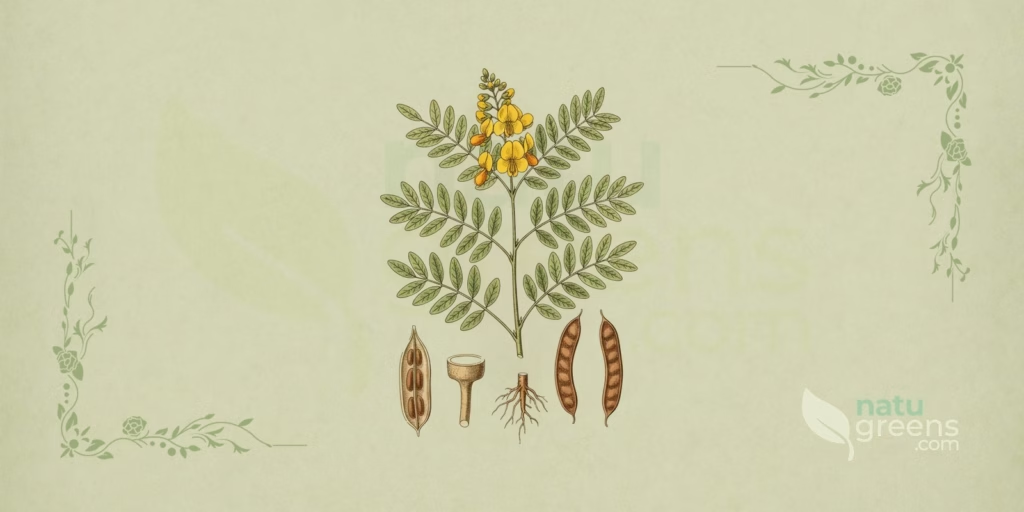
Botanical illustration of Mucuna pruriens (L.) DC. (velvet bean, cowage, mucuna), an annual climbing plant of the Fabaceae family described by Carl Linnaeus, native to Africa and Asia, showing the complete plant with velvety pods, trifoliate leaves, and purple flowers, in 19th-century botanical encyclopedia style on an aged herbarium paper background.
Mucuna pruriens belongs to the vast, diverse Fabaceae family, also known as Leguminosae. This family is the third largest of the flowering plants, encompassing about 765 genera and more than 19,500 species. The Fabaceae are characterized by the formation of pods (legumes) and by the ability of many of their species to fix atmospheric nitrogen in the soil through a symbiosis with rhizobia bacteria in their roots, a trait of great ecological and agricultural importance.
Within the Fabaceae, the velvet bean is classified in the subfamily Faboideae. The plants of this family are economically important, including food crops such as beans, lentils, soybeans, and peanuts, as well as ornamental and medicinal species. The presence of bioactive compounds, such as alkaloids, flavonoids, and saponins, is common among Fabaceae members, contributing to their many therapeutic and nutritional applications.
Parts Used of the Velvet Bean
- Leaves
- Roots
- Seeds
- Trichomes (pod hairs)
Ethnobotanical and Traditional Uses of the Velvet Bean
- Aphrodisiac
- Bone fractures
- Coughs
- Dog bites (ethnobotanical record; an animal bite requires rabies and tetanus prophylaxis assessment at a health facility)
- Male infertility
- Nervous disorders
- Pleurisy
- Ringworm
- Scorpion stings (ethnobotanical record; scorpion stings are a medical emergency that may require specific antivenom, with no substitute in any plant)
- Snakebite relief (ethnobotanical record; snakebite is a medical emergency requiring antivenom at a health facility, with no substitute in any plant)
- Wounds and ulcers
Therapeutic Properties of the Velvet Bean
- Adaptogenic (helps the body cope with stress)
- Antibacterial (fights bacteria); traditional use, without established clinical efficacy
- Antidiabetic (helps balance blood sugar levels); traditional use, without established clinical efficacy
- Anti-inflammatory (reduces inflammation)
- Antimicrobial (activity against microorganisms); traditional use, without established clinical efficacy
- Antioxidant (fights free radicals)
- Antivenom (traditionally used against snake venom)
- Aphrodisiac (increases libido and sexual energy); traditional record, without established clinical efficacy
- Cardioprotective (protects heart health); traditional use, without established clinical efficacy
- Digestive (promotes digestive function and elimination)
- Hypocholesterolemic (lowers cholesterol); traditional use, without established clinical efficacy
- Immunomodulatory (modulates the immune system); traditional use, without established clinical efficacy
- Neuroprotective (protects the nervous system and brain); traditional use, without established clinical efficacy
Detailed Phytochemical Profile of the Velvet Bean
- Alkaloids (mucunadine, mucunine, prurienine, prurieninine)
- Amino acids (including L-DOPA)
- Flavonoids (quercetin, luteolin)
- Glycosides
- L-DOPA (levodopa)
- Mucunain
- Saponins
- Serotonin
- Steroids
- Tannins
- Terpenoids
Preparation and Administration Forms of the Velvet Bean
- Capsules and tablets (standardized extracts)
- Decoctions (seeds and green pods)
- Fermentation (seeds for foods such as benguk tempe)
- Seed powder (taken with water, milk, ghee, or honey)
Synergy with Other Medicinal Plants
Enhancement of Neuroprotective Effects
The velvet bean, rich in L-DOPA, can be combined with plants that also act on the nervous system, such as ashwagandha (Withania somnifera) or brahmi (Bacopa monnieri). This synergy aims to enhance the neuroprotective and adaptogenic effects, supporting stress management and improved cognitive function. The combination can benefit individuals seeking brain health support and reduced mental fatigue, acting in a complementary way to optimize the body’s response to daily challenges.
Reproductive Health Support
To optimize reproductive health, the velvet bean can be paired with herbs such as Tribulus terrestris or shatavari (Asparagus racemosus). This combination is frequently used in Ayurvedic medicine to improve fertility, libido, and sexual vitality. The aphrodisiac properties of the velvet bean, together with the tonic effects of the other plants, can create a more balanced hormonal environment and promote the overall health of the reproductive system, in both men and women.
Recipes and Usage Protocols of the Velvet Bean
The seed powder contains L-DOPA in pharmacological concentration, and a single teaspoon can supply the equivalent of a medication dose. Do not use these preparations on your own, especially if you take antidepressants, MAOIs, antidiabetic drugs, antipsychotics, or medication for Parkinson’s disease, and confirm dose and frequency with a healthcare professional before any regular use.
Energizing Velvet Bean Latte
Ingredients: 1 teaspoon of velvet bean seed powder, 200 ml of plant-based milk (almond, coconut, or oat), 1/2 teaspoon of ground cinnamon, 1/4 teaspoon of ground ginger, honey or maple syrup to taste.
Preparation: Warm the plant-based milk in a pan. Add the velvet bean powder, cinnamon, and ginger, stirring well to dissolve. Remove from the heat before boiling. Sweeten to taste. This latte can be enjoyed in the morning for a boost of energy and focus, or in the afternoon to fight fatigue. Combining mucuna with spices enhances its effects and improves the absorption of the active compounds, providing a nutritious, revitalizing beverage.
Revitalizing Velvet Bean Smoothie
Ingredients: 1 teaspoon of velvet bean seed powder, 1 ripe banana, 1/2 cup of frozen red berries, 150 ml of water or plant-based milk, 1 tablespoon of chia seeds.
Preparation: Combine all the ingredients in a blender and blend until smooth and creamy. For a more liquid consistency, add more water or plant-based milk. This smoothie is ideal for breakfast or as a nutritious snack, providing sustained energy and antioxidant support. The velvet bean, combined with fruit and seeds, offers a concentrated dose of nutrients that contribute to general well-being and daily vitality.
Associated Therapies
Ayurveda
In Ayurvedic medicine, the velvet bean, known as kapikacchu, is highly valued as a rejuvenating tonic (rasayana) and adaptogen. It is widely used to nourish the nervous system (majja dhatu), support healthy sexual energy, and strengthen the reproductive organs (shukra dhatu). The velvet bean is considered effective for balancing the Vata and Pitta doshas, benefiting conditions such as infertility and neurological disorders, and as an aphrodisiac. Its heavy, oily nature contributes to building ojas, the body’s vital essence, promoting immunity and vitality.
Modern Phytotherapy
Modern phytotherapy recognizes the velvet bean mainly for its L-DOPA content, making it an object of study for the treatment of Parkinson’s disease. Standardized extracts are used to deliver controlled doses of L-DOPA, minimizing the side effects associated with synthetic formulations. In addition, the velvet bean is investigated for its antioxidant, anti-inflammatory, and neuroprotective properties, being incorporated into supplements for cognitive support, stress management, and improved sexual health. Research continues to explore its potential in several areas.
Contraindications and Side Effects of the Velvet Bean
General Contraindications
The velvet bean should be avoided by individuals with a known allergy to the plant or to other members of the Fabaceae family. Pregnant and breastfeeding women should use the velvet bean with extreme caution and only under medical guidance, given the lack of conclusive safety studies in these groups. Patients with psychosis, schizophrenia, glaucoma, cardiac arrhythmias, chronic nerve pain, or stomach ulcers should abstain from using the plant, as its components can worsen these conditions or interact negatively with medications.
Drug Interactions
It is crucial that patients being treated with levodopa and other antiparkinsonian drugs, antipsychotics, metoclopramide, antidepressants, monoamine oxidase inhibitors (MAOIs), antidiabetic medications, or anesthetics consult a health professional before using the velvet bean. The L-DOPA in mucuna can interact with these medications, potentiating their effects or causing serious adverse reactions. For example, combination with MAOIs can lead to hypertensive crises, and with antidiabetics, to hypoglycemia. Medical supervision is indispensable to avoid complications.
Side Effects
At high doses or in sensitive individuals, the velvet bean can cause side effects such as nausea, abdominal discomfort, vomiting, and insomnia. In cases of excessive use, headaches, movement disorders, fatigue, tremors, and fainting can occur. The L-DOPA content can induce hypotension in some users. It is essential to respect the recommended doses and watch for any adverse reaction, stopping use and seeking medical guidance if needed. Adequate water intake can help mitigate some of these effects.
Curiosities and Historical Facts of the Velvet Bean
The Plant That Itches Like a Monkey
The Sanskrit name of the velvet bean, kapikacchu, translates as “one who itches like a monkey”, a direct reference to the fine stinging hairs that cover the plant’s pods. These hairs contain serotonin and mucunain, substances that cause intense irritation and itching on contact with the skin. This peculiar characteristic not only gave rise to its popular names, but also made it known as “pó-de-mico” (itching powder) in Brazil, where the plant is often associated with pranks and local legends about its irritating properties.
The Secret Hidden in the Seeds
Another Sanskrit name for the velvet bean is atmagupta, meaning “secret self”. This name alludes to the medicinal value of the seeds, hidden inside the apparently harmless but irritating pods. The seeds are the part richest in L-DOPA, a compound that revolutionized the treatment of Parkinson’s disease. The discovery and traditional use of these seeds as a nervous system tonic demonstrate a deep knowledge of the plant’s properties, passed down through generations in cultures such as Ayurveda.
Cultivation and Varieties
The velvet bean is cultivated in many tropical regions, notably India, where it is planted in sandy or clay soils. The seed harvest usually takes place between November and December. Over time, specific varieties have been developed, such as “Zhandu Kanchha”, which offers a higher L-DOPA yield and significantly fewer irritating hairs on the pods. This evolution in cultivation reflects the ongoing effort to optimize mucuna production for medicinal and agricultural purposes, making it more accessible and safer to handle and consume.
Frequently Asked Questions about the Velvet Bean
Is the Velvet Bean Safe for Long-Term Use?
Studies indicate that the velvet bean is generally considered safe for long-term use in most individuals, especially when used within the recommended dosages. There are no long-term clinical trials with the velvet bean, and the available studies followed participants for only a few months. The safety of prolonged use is therefore not established, and any continued use calls for professional supervision. However, any prolonged use should be monitored by a health professional, who can watch for possible adverse effects and adjust the dosage to individual needs, ensuring the safety and efficacy of the treatment.
What Are the Main Health Benefits of the Velvet Bean?
The velvet bean offers an impressive range of health benefits, mainly thanks to its richness in L-DOPA. It is widely recognized for its neuroprotective properties, used to support nervous system and brain health and as an adjuvant in the treatment of neurological disorders. It also acts as an adaptogen, helping the body manage stress, and has aphrodisiac effects, improving libido and fertility. Its antioxidant, anti-inflammatory, and antidiabetic properties also contribute to general well-being and the prevention of various health conditions.
How Does the Velvet Bean Work in the Body?
The action of the velvet bean in the body is multifaceted, but its main mechanism is linked to L-DOPA, which is converted into dopamine in the brain. Dopamine is a neurotransmitter crucial for mood, cognition, movement, and motivation. By increasing dopamine levels, the velvet bean can improve motor function, reduce stress, and promote a sense of well-being. Beyond L-DOPA, other phytochemicals in the plant, such as flavonoids and alkaloids, contribute antioxidant, anti-inflammatory, and adaptogenic properties, acting in synergy to promote health across several body systems.
Notice: this content is for informational purposes and does not replace professional medical advice. Consult a physician or herbal practitioner before using medicinal plants, especially during pregnancy, breastfeeding, or alongside medication.
References and Scientific Studies
Peer-Reviewed Scientific Studies (3)
- PMC2012 Lampariello, L. R., et al. (2012). The Magic Velvet Bean of Mucuna pruriens. Journal of Traditional and Complementary Medicine, 2(4), 331-339.
- PEER2015 Pulikkalpura, H., et al. (2015). Levodopa in Mucuna pruriens and its degradation. Scientific Reports, 5, 11078.
- PMC2004 Manyam, B. V., Dhanasekaran, M., & Hare, T. A. (2004). Neuroprotective effects of the antiparkinson drug Mucuna pruriens. Phytotherapy Research, 18(9), 706-712.
Supplementary Readings (2)
- 2008 Singh, A., & Singh, S. K. (2008). Mucuna pruriens – A comprehensive review. International Journal of Pharmaceutical Sciences and Research.
- 2007 Sathiyanarayanan, L., & Arulmozhi, S. (2007). Mucuna pruriens (L.) DC. – A comprehensive review. Pharmacognosy Reviews.