The eggplant (Solanum melongena L.) is one of the most economically important cultivated members of the nightshade family and, at the same time, one of the oldest crops domesticated on the Asian continent. It belongs to the Solanaceae, the same botanical grouping as the pepper, the potato and the tomato, and sits within the subgenus Leptostemonum, the lineage known as the spiny solanums. What sets it apart within that group is the combination of bulky, fleshy fruits, a rarity among wild relatives that bear tiny berries, and a marked reduction in prickles achieved over millennia of human selection.
The species originated in southern and southeastern Asia, the region where its wild progenitor Solanum insanum L. still occurs, and from there it travelled along trade routes that carried it first into the Persian and Arab world, then to the Mediterranean and, centuries later, to the Americas. The Indian subcontinent remains the crop’s principal reservoir of genetic diversity, with hundreds of landraces differing in shape, colour, size and degree of spininess.
From a botanical standpoint, the eggplant is remarkable for three reasons. The first is the extraordinary plasticity of the fruit, which spans the whole range between three-centimetre spheres and forty-centimetre serpentine cylinders within a single binomial. The second is the persistence of a weak reproductive barrier with related wild species, which produces recurrent gene flow and complicates the taxonomic delimitation of the complex. The third is its role as an experimental model in domestication studies, since the crop’s history is reasonably well documented in Sanskrit, Chinese and Arabic texts.
Taxonomy
The accepted name of the species is Solanum melongena L., published by Carl Linnaeus in Species Plantarum, volume 1, page 186, in 1753. The record appears in the International Plant Names Index under identifier 820053-1. It is worth noting that a later illegitimate homonym exists, Solanum melongena Wall. (1831), which carries no nomenclatural validity for this species.
Complete Classification
- Kingdom: Plantae
- Division: Magnoliophyta (angiosperms)
- Class: Magnoliopsida (eudicots)
- Order: Solanales
- Family: Solanaceae Juss.
- Subfamily: Solanoideae
- Genus: Solanum L., 1753
- Subgenus: Leptostemonum Bitter
- Species: Solanum melongena L., 1753
Accepted Synonyms
The long history of cultivation produced independent descriptions of local forms, which modern taxonomy has gathered under a single name. The synonyms recognised in the standard taxonomic databases include:
- Melongena esculenta (Dunal) Grecescu
- Melongena incurva Mill.
- Melongena ovata Mill.
- Melongena teres Mill.
- Solanum edule Schumach. & Thonn.
- Solanum esculentum Dunal
- Solanum indicum Roxb.
- Solanum longum Roxb.
- Solanum oviferum Salisb.
- Solanum ovigerum Dunal
- Solanum pseudoundatum Blume
- Solanum sativum Dunal
One point deserves attention: the treatment of Solanum insanum L. The monographic revision of the spiny solanums of tropical Asia keeps that taxon as an accepted and distinct species, corresponding to the wild population from which the eggplant descends. Other authors prefer to reduce it to Solanum melongena subsp. insanum (L.) Banfi, Galasso & Bartolucci, published in 2017. Both readings coexist in the current literature, and the choice depends on how much weight is given to the continuous gene flow between cultivated and feral forms.
Etymology of the Binomial
The origin of the generic name Solanum is uncertain. The hypothesis most often repeated in the classical literature links the word to the Latin solamen, in the sense of solace or soothing, although no derivation has solid documentary support. The epithet melongena comes from Medieval Latin, a Latinised form of the Italian melanzana, which in turn goes back to the Arabic badinjan, borrowed from the Persian badingan and, further back still, from the Sanskrit vatingana. The English word aubergine travelled the same road by way of Catalan and French, which makes the common name a linguistic record of the plant’s own route of dispersal.
Morphological Description
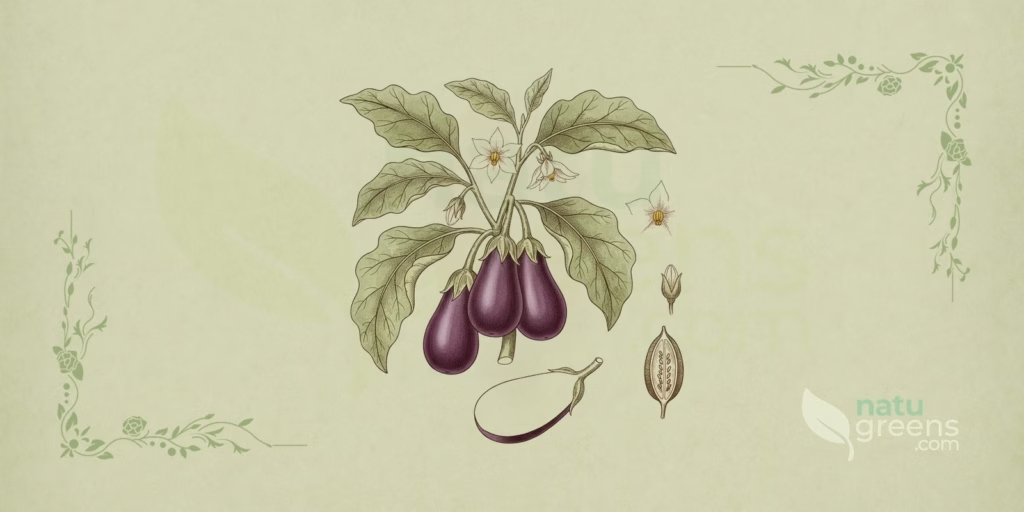
The eggplant is a robust herb to short-lived subshrub, perennial in warm climates and grown as an annual in commercial horticulture. Height ranges from 40 to 150 centimetres, with records of up to two metres under protected cultivation and an extended cycle. The habit is erect, with sympodial branching from a well-marked first fork, and the whole aerial part bears an indumentum of stellate trichomes, a constant feature of the subgenus Leptostemonum and a useful character for field identification.
Leaves
- Arrangement: alternate, simple, without stipules
- Colour: dark green on the adaxial surface, paler and greyish on the abaxial surface because of the density of the indumentum
- Indumentum: stellate trichomes with 4 to 8 rays, giving a velvety texture
- Length: 10 to 25 centimetres
- Petiole: stout, 3 to 8 centimetres, occasionally prickly
- Shape: ovate to oblong-ovate, with an irregularly lobed or sinuate margin and an asymmetrical base
- Width: 5 to 15 centimetres
Primitive varieties and feral forms carry prickles on the midrib and on the secondary veins. In modern cultivars these prickles have been reduced or eliminated by selection, and where they persist they rarely exceed half a millimetre in width at the base.
Flowers
- Anthers: five, yellow, connivent in a cone around the style, dehiscing through an apical pore
- Calyx: five lobes, persistent and accrescent, forming the crown seen at the base of the harvested fruit
- Colour: pale to deep violet, with a yellow centre formed by the cone of anthers
- Diameter: 3 to 5 centimetres
- Inflorescence: a reduced cyme, with one larger long-styled flower and a few smaller short-styled flowers that function as males
- Sexuality: hermaphrodite flowers, with functional heterostyly within the same inflorescence
- Shape: rotate corolla, five-lobed, the lobes partly joined by interlobal tissue
Fruits and Seeds
The fruit is a fleshy berry, never a capsule, and its morphological variation is the widest recorded among fruit vegetables.
- Colour: dark purple in most cultivars, but also white, green, yellow, orange or striped in two colours
- Diameter: 3 to 15 centimetres
- Flesh: whitish and spongy, with wide intercellular spaces that darken through enzymatic oxidation once exposed to the air
- Length: 3 to 40 centimetres
- Shape: globose, ovoid, pyriform, cylindrical or serpentine
- Weight: 30 grams in miniature types to more than 1,000 grams in globose types
The seeds are numerous, discoid to reniform and flattened, 2 to 4 millimetres across, with a yellowish to light brown seed coat. They lie embedded in the placental flesh and become harder and darker as the fruit moves from the horticultural harvest stage to physiological maturity, when the skin loses its gloss and takes on yellowish or brownish tones.
Root and Stem
The root system is a taproot, the main axis reaching 60 to 90 centimetres in deep, loose soils, with a dense lateral network concentrated in the top 30 centimetres. That distribution explains why the crop is sensitive both to surface waterlogging and to root-knot nematodes. The stem is woody at the base in long-cycle plants, cylindrical, covered by the same stellate indumentum as the leaves, and may carry scattered prickles in the less domesticated forms.
Distribution and Habitat
The native range recorded in the standard taxonomic databases covers the western Indian Ocean and tropical and subtropical Asia, including Assam, Bangladesh, Borneo, the eastern and western Himalaya, Hainan, India, Java, Laos, Madagascar, Malaysia, Mauritius, Myanmar, Pakistan, the Philippines, Réunion, south-central and southeastern China, Sri Lanka, Sulawesi, the Lesser Sunda Islands, Thailand and Vietnam. Beyond that belt, the presence of the species results from human introduction for cultivation.
The eggplant is now grown across practically every tropical, subtropical and warm-temperate region, as well as under glass at high latitudes. World production exceeds 55 million tonnes a year, with China accounting for the greater part of the volume and India in second place. In Brazil, cultivation is concentrated in the market-garden belt around the large cities of the Southeast, led by São Paulo, Minas Gerais and Rio de Janeiro, under a peri-urban horticultural system. Flora e Funga do Brasil records the species as cultivated on Brazilian territory, without established naturalisation.
Environmental requirements are narrow in temperature and broad in soil. The optimum thermal range lies between 22 and 30 degrees Celsius by day and between 18 and 22 degrees at night; below 10 degrees the plant suffers foliar damage and growth stalls, and frost is lethal. It prefers deep, fertile, well-drained soils rich in organic matter, with a pH between 5.5 and 7.0, tolerating textures from sandy to clayey provided drainage is adequate. Cultivation runs from sea level to around 1,200 metres of altitude, with protection needed above that. Feral and semi-wild populations occur in disturbed areas of southern and southeastern Asia, but the species is not among the invasive plants of global concern.
Cultivation
Commercial propagation is by seed, sown in trays and transplanted once the seedlings reach four to six true leaves, which usually happens between 30 and 45 days after sowing. Germination takes 7 to 14 days at temperatures between 25 and 30 degrees Celsius, below which the process becomes slow and uneven. One technique that has gained ground in recent decades is grafting onto resistant rootstocks, Solanum torvum Sw. being the most widely used for combining tolerance to nematodes and to bacterial wilt with good vigour.
Full sun is indispensable, with at least eight hours of direct light a day. Water demand over a four to six month cycle falls between 500 and 1,200 millimetres, and supplementary irrigation is the rule in most producing regions, since water deficit during fruiting causes flower abortion and misshapen fruits. Usual spacing ranges from 1.0 to 1.2 metres between rows and 0.5 to 0.7 metres between plants. Plants are trained to two to four main stems, with side shoots removed below the first fork and support provided by stakes or twine, given the weight the fruits reach.
Among the most significant pests are the broad mite (Polyphagotarsonemus latus), which causes crinkling and silvering of young leaves; the small fruit borer (Neoleucinodes elegantalis), a key pest in Brazilian fields; the whitefly (Bemisia tabaci), a vector of geminiviruses; root-knot nematodes (Meloidogyne spp.); and aphids (Aphis gossypii and Myzus persicae). On the disease side, bacterial wilt caused by Ralstonia solanacearum is the most destructive in tropical soils and has no effective chemical control, which makes resistant rootstocks and crop rotation the central strategies. Anthracnose (Colletotrichum spp.), verticillium wilt (Verticillium dahliae) and rots caused by Phytophthora capsici complete the phytosanitary picture.
Harvest takes place when the fruit reaches about two thirds of the cultivar’s final size, while the skin is still firm, smooth and glossy. Loss of gloss and yellowing indicate that physiological maturity has advanced and that the seeds have already hardened. Because the peduncle is woody and the calyx is often prickly, harvesting is done with shears rather than by hand twisting.
Phenology
Under tropical conditions flowering is continuous as long as the temperature stays within the favourable range, and the plant carries flowers and fruits at different stages at the same time. The first bud normally appears between 50 and 70 days after sowing, and the interval between anthesis and harvest stage varies from 20 to 30 days, shortening in the heat. In regions with a defined cold season the cycle behaves as an annual, with flowering concentrated in the warm months.
The poricidal anthers impose a regime of buzz pollination: pollen is released only when the flower is subjected to vibration at the right frequency, a behaviour performed by bees of particular groups. Bumblebees of the genus Bombus and carpenter bees of the genus Xylocopa are the most frequently cited visitors, and under protected cultivation the introduction of managed colonies raises fruit set. The species is predominantly autogamous, with natural outcrossing rates that the literature places between low values and around 30 per cent, depending on pollinator density and cultivar.
Natural dispersal depends on animals that eat the ripe fruit and pass the seeds intact, a mechanism still observable in feral Asian populations. Under cultivation, however, dispersal is entirely human, and the horticultural harvest stage itself, which precedes seed maturity, cuts the reproductive cycle short before it can complete.
Related Species and Confusions
The genus Solanum brings together more than 1,200 accepted species and is the largest among the angiosperms, which is why confusion is so frequent in gardens, backyards and field margins. The most useful distinctions are the following:
- Solanum aethiopicum L.: the African eggplant, with small fruits that ripen red or orange and a less accrescent calyx. It includes the forms sold in Brazil as jiló.
- Solanum incanum L.: a wild species of North Africa and the Middle East, with yellow fruits a few centimetres across and abundant prickles. A close relative, used in breeding.
- Solanum insanum L.: the wild progenitor, told apart by its numerous prickles, broad at the base and spread over stems, petioles and calyces, and by its small, bitter fruits.
- Solanum linnaeanum Hepper & P.-M.L.Jaeger: a Mediterranean shrub with globose yellow fruits, common in disturbed coastal areas.
- Solanum macrocarpon L.: the gboma, cultivated in tropical Africa, with larger and thicker leaves and a strongly accrescent calyx that wraps much of the fruit.
- Solanum mammosum L.: a Neotropical species with orange fruits bearing unmistakable nipple-like protuberances. The fruits are toxic and must not be eaten under any circumstances, which makes this the most dangerous confusion on the list.
- Solanum paniculatum L.: the jurubeba, a shrub native to Brazil with spherical yellowish-green fruits 1 to 2 centimetres across, holding far more seeds than those of the eggplant.
- Solanum torvum Sw.: a shrub exceeding three metres, with small fruits gathered in clusters and more deeply cut leaves. Widely used as a rootstock.
The most reliable diagnostic criterion for separating the cultivated eggplant from its wild relatives is the combination of a large fleshy fruit with the absence or strong reduction of prickles. Seedlings, however, are practically indistinguishable to the naked eye, and secure identification at the juvenile stage means waiting for the plant to fruit.
Eggplant Phytochemistry
The chemical profile of the eggplant follows the pattern of the Solanaceae of subgenus Leptostemonum, with strong compartmentalisation between organs. The main groups of compounds and their distribution in the plant are as follows.
Hydroxycinnamic acids dominate the phenolic fraction of the fruit, and chlorogenic acid accounts for most of that pool, concentrating in the flesh. It is this compound that takes part in the browning reactions seen when the flesh is cut and exposed to the air, in the presence of polyphenol oxidases.
Anthocyanins are confined to the fruit epidermis and determine its colour. In purple cultivars the predominant pigment is nasunin, an acylated delphinidin derivative, absent from white and green cultivars, whose colouring comes from residual chlorophylls or from a lack of pigmentation.
Steroidal glycoalkaloids, chiefly solamargine and solasonine, concentrate in the leaves, stems, shoots and immature fruits, and fall to low levels in the flesh of fruits picked at the horticultural stage. Here a safety note applies that is not historical but current: the vegetative parts of the eggplant contain these glycoalkaloids in toxic amounts, and eating leaves, stems or shoots causes poisoning in people and in domestic animals. The ASPCA classifies Solanum species, the eggplant among them, as toxic to dogs, cats and horses, and the risk falls precisely on the green portions of the plant.
Rounding out the picture are the steroidal saponins, present at low concentrations in the fruits and more prominent in the roots; the stellate trichomes, whose function is structural rather than chemical; and the mineral fraction of the fruit, in which potassium is the most abundant element.
History and Ethnobotany
The oldest written records of the eggplant appear in Sanskrit texts from the Indian subcontinent, and Chinese agricultural literature mentions it from the first centuries of the Common Era, which places domestication between two and four thousand years ago. One detail that historians of agriculture like to highlight is that the early Chinese cultivars described in those texts were small and whitish, a long way from the large purple fruits associated with the species today.
The plant reached Persia and the Arab world around the eighth century, and cooks of the Abbasid caliphate took it into the court repertoire, with recipe collections of the period recording dozens of preparations based on the roasted or stewed fruit. It was by that route that the eggplant reached the Mediterranean, spreading through Al-Andalus and Sicily between the tenth and twelfth centuries, which explains the Arabic origin of the Iberian vernacular names.
In medieval and Renaissance Europe the reception was hostile. Herbals of the period linked the fruit to fevers, melancholy and mental disturbance, and the Italian form mala insana, that is, mad apple, crystallised that suspicion in the name itself. Sixteenth-century botanists recorded the plant chiefly as a garden curiosity. Culinary acceptance took hold first in Italy and Spain during the seventeenth century, and reached France and northern Europe only in the eighteenth.
In the Americas, introduction came with Iberian colonisation, and enslaved African peoples brought to Brazil and the Caribbean wove the fruit into culinary traditions of their own, a process of appropriation that historical ethnobotany documents in colonial recipe books. In India and southeastern Asia, rural communities maintained for generations local varieties selected for particular traits of shape, colour and flavour, a heritage now recognised as the foundation of the crop’s diversity.
In the history of botany, Linnaeus described the species in 1753 from material grown in European gardens, and the French botanist Michel Félix Dunal published in 1813 the first detailed monograph of the genus Solanum, laying down infrageneric classification foundations that modern taxonomy has revised but not entirely abandoned.
Conservation
Solanum melongena has no published assessment on the IUCN Red List, a situation to be expected for a species whose present existence depends entirely on human cultivation and whose wild populations are assigned to distinct taxa. The recorded status is therefore NE, not evaluated. Nor does the species appear in the CITES appendices, and there is no international restriction on its trade.
The relevant conservation concern does not fall on the species as a whole but on the diversity within it. The rapid replacement of local varieties by uniform commercial hybrids narrows the genetic base available for breeding, a phenomenon clearly documented in the Indian subcontinent and in southeastern Asia, where landrace erosion has advanced over recent decades. Ex situ collections act as a counterweight: the World Vegetable Center in Taiwan holds one of the largest eggplant germplasm collections in the world, and national banks in France, India and Spain conserve complementary accessions.
The wild relatives deserve particular attention. Solanum incanum, Solanum insanum and Solanum linnaeanum constitute genetic reserves for traits of resistance to biotic and abiotic stress, and habitat loss across their natural ranges directly compromises the future breeding potential of the crop.
Interesting Facts
- The English name eggplant does not describe the familiar purple fruit at all, but the white ovoid cultivars that reached England in the eighteenth century, whose fruits looked like hen’s eggs hanging from the plant.
- What is harvested as a vegetable is botanically a berry, the same fruit category as the grape and the tomato, and the seeds the flesh contains are fully viable once the fruit reaches physiological maturity.
- The prickly crown at the base of the fruit is not part of the fruit at all: it is the calyx of the flower, which stays attached and keeps growing after fertilisation, a condition known as an accrescent calyx.
- The eggplant flower releases pollen only under vibration at a specific frequency, a mechanism that rules out the honey bee as an efficient pollinator and explains why commercial glasshouses turn to bumblebee colonies.
- The flesh darkens within minutes of being cut because its cells store phenolic compounds that react with oxygen in the presence of enzymes released by the cut, the same principle that browns apples and potatoes.
Notice: this content is for informational purposes and does not replace professional medical advice. Consult a physician or herbal practitioner before using medicinal plants, especially during pregnancy, breastfeeding, or alongside medication.
References and Scientific Studies
View All 12 Cited References
Peer-Reviewed Scientific Studies (2)
- DOI2019 Page, A., Gibson, J., Meyer, R. S., Chapman, M. A. Eggplant domestication: pervasive gene flow, feralization, and transcriptomic divergence. Molecular Biology and Evolution, 36(7), 1359-1372. 2019. ↗
- DOI2017 Ranil, R. H. G., Prohens, J., Aubriot, X., Niran, H. M. L., Plazas, M., Fonseka, R. M., Vilanova, S., Fonseka, H. H., Gramazio, P., Knapp, S. Solanum insanum L., the neglected wild progenitor of eggplant. Genetic Resources and Crop Evolution, 64, 1707-1722. 2017. ↗
Supplementary Readings (10)
- 2018 Aubriot, X., Knapp, S., Syfert, M. M., Poczai, P., Buerki, S. Shedding new light on the origin and spread of the brinjal eggplant. American Journal of Botany, 105(7), 1175-1187. 2018.
- 2007 Daunay, M.-C., Janick, J. History and iconography of eggplant. Chronica Horticulturae, 47(3), 16-22. 2007.
- Dunal, M.-F. Histoire naturelle, medicale et economique des Solanum. Paris. 1813. ↗
- Flora e Funga do Brasil. Solanum melongena L. Jardim Botanico do Rio de Janeiro. ↗
- Global Biodiversity Information Facility. Solanum melongena L. GBIF Backbone Taxonomy. ↗
- International Plant Names Index. Solanum melongena L., Sp. Pl. 1: 186 (1753), record 820053-1. ↗
- 2013 Knapp, S., Vorontsova, M. S., Prohens, J. Wild relatives of the eggplant: new understanding of species names in a complex group. PLoS ONE, 8(2), e57039. 2013.
- Linnaeus, C. Species Plantarum, vol. 1, p. 186. Stockholm. 1753. ↗
- Plants of the World Online. Solanum melongena L. Royal Botanic Gardens, Kew. ↗
- 2016 Vorontsova, M. S., Knapp, S. A revision of the spiny solanums of Africa and Madagascar. Systematic Botany Monographs, 99, 1-436. 2016.