Solanum mammosum is a robust herbaceous nightshade that bears one of the most instantly recognisable fruits in the plant kingdom: a glossy golden berry, almost waxy to the touch, carrying three to five rounded swellings around its base and a short conical beak at the tip. That improbable silhouette earned the plant a blunt catalogue of common names, among them apple of Sodom, cow’s udder, fox head, nipplefruit and titty fruit. The species belongs to the Solanaceae, the same family as the aubergine, the potato and the tomato, and to Solanum, the largest genus of flowering plants in the Americas.
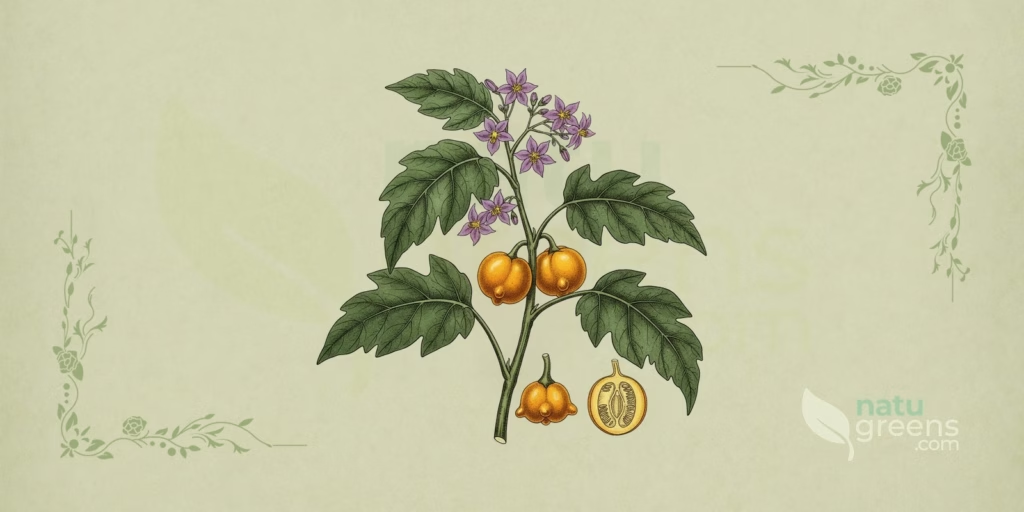
Native to tropical America, the plant sits within the Acanthophora clade, a group of spiny nightshades whose closest relatives include Solanum aculeatissimum, Solanum capsicoides and Solanum viarum. Stems, petioles and leaf veins are armed with straight, sharp prickles, and nearly every surface of the plant is coated in a dense felt of stellate hairs that lends the whole thing a velvety, greyish cast. Steroidal glycoalkaloids accumulate in every organ, and the fruits are not edible.
What makes the species remarkable goes well beyond the shape of its fruit. Described by Linnaeus in 1753 from material collected in Barbados, it circulated early through European botanical gardens as a curiosity and, centuries later, turned into a global ornamental commodity. In East and Southeast Asia the dried fruits acquired the status of a Lunar New Year emblem, a rare instance of an American plant becoming a festive symbol on the far side of the world. This profile treats Solanum mammosum strictly as a botanical subject: nomenclature, morphology, ecology, descriptive chemistry, history and conservation.
Taxonomy
The accepted name is Solanum mammosum L., published by Carl von Linné in Species Plantarum, volume 1, page 187, in 1753. The record appears in the International Plant Names Index under identifier 285235-2 and is recognised as an accepted name by Plants of the World Online and by the GBIF backbone taxonomy. The lectotype, designated by Knapp and Jarvis in 1990, is an illustration published by Leonard Plukenet in 1692, supplemented by herbarium material from the Sloane collection held in London. It is worth recording that a later homonym exists, Solanum mammosum Lour., published by João de Loureiro in the Flora Cochinchinensis in 1790, an illegitimate name that does not apply to this species.
The full classification runs as follows:
- Kingdom: Plantae
- Division: Tracheophyta (vascular plants)
- Class: Magnoliopsida (eudicots)
- Order: Solanales
- Family: Solanaceae
- Genus: Solanum L.
- Subgenus: Leptostemonum (spiny nightshades), Acanthophora clade
- Species: Solanum mammosum L., 1753
Accepted Synonyms
A long history of ornamental cultivation produced an extensive synonymy, with names applied independently in Europe and in the Americas across the eighteenth and nineteenth centuries. The recognised heterotypic synonyms include:
- Solanum corniculatum André
- Solanum corniculatum C.Huber
- Solanum cornigerum André
- Solanum globiferum Dunal
- Solanum mammosum subsp. corniculum Ridl.
- Solanum mamosissimum Ram.Goyena
- Solanum platanifolium Hook.
- Solanum platanifolium Sims
- Solanum villosissimum Zuccagni
Etymology of the Binomial
The generic name Solanum was already in use among classical Latin authors for plants of this affinity, and its origin is usually traced to the verb solari, to soothe or console, although the derivation is disputed and may simply point back to sol. The epithet mammosum comes from the Latin mamma, breast, with the augmentative suffix -osus, and means roughly “well supplied with breasts” or “nippled”, an obvious nod to the basal swellings of the fruit. Linnaeus merely formalised what the pre-Linnaean phrase name for the Barbadian material already said, describing a golden fruit shaped like an inverted pear.
Morphological Description
This is a robust herb to short-lived subshrub, usually annual or biennial in cultivation, reaching 0.5 to 1.5 metres in height and occasionally topping 2 metres on fertile soils in hot climates. The habit is erect, branching just above the base into an open architecture that exposes the fruits and accounts for much of the plant’s ornamental appeal. The whole plant is densely pubescent, with sessile and stalked stellate hairs that give it a plush texture, and armed with straight yellowish prickles scattered irregularly along stems, petioles and leaf veins.
Leaves
The leaves are alternate and simple, broadly ovate to suborbicular in outline, with a cordate base and a blade 10 to 25 centimetres long by 8 to 20 centimetres wide. The margin carries three to five shallow to deep lobes separated by rounded sinuses, which brings the silhouette close to that of a plane tree leaf, a resemblance preserved in the old synonym Solanum platanifolium. Both surfaces are densely clothed in stellate hairs, paler and more felted beneath, and the midrib normally bears straight prickles above and below. The petiole measures 3 to 8 centimetres and is prickly as well.
Flowers
The inflorescences are short extra-axillary cymes bearing few flowers, typically three to eight. The species is andromonoecious, a condition common in the Acanthophora clade: the basal flower of each inflorescence is hermaphrodite and fruit-bearing, while the remainder are functionally male, with a reduced ovary. The corolla is rotate to stellate, 2 to 3.5 centimetres across, with five acute recurved lobes in lilac to violet, more rarely whitish. There are five stamens, their yellow anthers elongate and tapering towards the tip, arranged in a loose cone and opening by apical pores, the arrangement typical of the genus. The style of the fertile flowers is straight and slightly exserted, and the calyx is prickly and persistent.
Fruits and Seeds
The fruit is a berry 4 to 7 centimetres long, ovoid to pear-shaped in outline, deep golden yellow when ripe, with a firm, smooth, shining pericarp. The base carries three to five conical or rounded swellings and the apex is drawn out into a short beak, the combination responsible for the common names. Inside, the pulp is dry to spongy and whitish, enclosing numerous discoid brown seeds around 3 to 4 millimetres across, finely reticulate on the surface and lacking a marginal wing. That absence of a wing is a diagnostic character against Solanum capsicoides, whose seeds are conspicuously winged. The fruits stay firm for weeks after picking and dry down without losing their colour, which is what sustains their use in dried arrangements.
Root and Stem
The root system is taprooted, with a well defined main axis and shallow lateral branching, a pattern consistent with the pioneering behaviour of the species on disturbed ground. The stem is herbaceous to semi-woody at the base, cylindrical, greyish green from the stellate indumentum and armed with straight prickles 0.5 to 2 centimetres long, densest on young internodes. In individuals that survive more than one cycle, the base lignifies and takes on fissured brown bark.
Distribution and Habitat
The species is native to tropical America. Pinning down the precise limits of that native range is a matter of disagreement in the literature, and understandably so: ornamental cultivation began early and ran deep, blurring the boundary between spontaneous and escaped populations. Plants of the World Online places the original core in the Antilles, with native occurrence across most of the West Indian islands, whereas revisions of the genus locate the origin on the South American mainland. Today the plant occurs continuously from southern Mexico to Bolivia and Venezuela, along with the whole of the Caribbean, and in Brazil it turns up mainly as a cultivated and subspontaneous plant.
Outside the Americas the species is established across much of the Old World tropics. There are consolidated records from China, Myanmar, the Philippines, Thailand and Vietnam, where it is treated as naturalised, and scattered occurrences in tropical Africa and Madagascar, reached by the same ornamental route. Its preferred habitat is disturbed ground: forest edges, secondary scrub, degraded pasture, roadsides, waste ground and abandoned cropland. The plant tolerates heat and full sun, needs reasonable moisture through its cycle and will not take frost. The altitudinal range runs from sea level to about 2,000 metres, with Colombian records between 150 and 2,400 metres.
Ruderal behaviour and abundant seed production give the species a strong capacity to colonise, and it appears on regional lists of potentially invasive plants in parts of Southeast Asia and on Pacific islands. Even so, it is not regarded as a high-impact invader: it favours bare soil and retreats once the canopy closes, which limits how far it can spread into mature vegetation.
Cultivation
Propagation is from seed, taken from ripe fruits, washed and dried in the shade. Neither stratification nor scarification is required, and germination generally takes two to three weeks in a moist substrate at around 25 degrees Celsius. Seedlings tolerate pricking out once they reach the second pair of true leaves and establish quickly in the field. Five to seven months usually pass between planting and the first harvest of ripe fruit.
The plant demands full sun and a fertile, deep, well drained soil with a pH between 5.5 and 7.0, and responds well to incorporated organic matter. The ideal thermal range falls between 20 and 30 degrees Celsius, and suitable rainfall sits between 800 and 2,500 millimetres a year, with supplementary irrigation during dry spells. Generous spacing is advisable, both because of the open habit and for ease of handling, since the prickles make any work in tight rows thoroughly unpleasant. Suede gloves and long sleeves are basic kit for anyone managing the crop.
Pests and diseases are those of nightshades in general, and proximity to plantings of aubergine, scarlet eggplant, sweet pepper or tomato encourages inoculum to move between them. Worth watching are the two-spotted spider mite (Tetranychus urticae), which colonises the undersides of leaves in hot dry spells, the whitefly (Bemisia tabaci), a begomovirus vector, bacterial wilt (Ralstonia solanacearum), which causes rapid collapse in wet, poorly drained soils, and the cucurbit beetle (Diabrotica speciosa), a frequent defoliator in Brazil. Fruits are harvested once they reach full golden yellow and the peduncle begins to dry, cut with secateurs rather than twisted off, so as to keep the calyx intact, since it is part of the decorative value.
Phenology
In a humid tropical climate, flowering and fruiting overlap and run almost continuously through the year, so that a single individual will normally show buds, open flowers, green fruits and ripe fruits at the same time. In regions with a marked dry season, or in the subtropics, the cycle concentrates in the warm, wet months and the plant dies with the first frosts.
Poricidal anthers impose buzz pollination, which restricts effective visitors to bees capable of sonication. Bumblebees of the genera Bombus and Xylocopa and larger stingless bees are among the pollinators documented for the group, and andromonoecy means that most flowers in an inflorescence work purely as a pollen source, setting no fruit. Seed dispersal is the least documented aspect of the species’ biology. A large fruit with a firm pericarp and dry pulp does not match the typical bird-dispersal pattern, and mammals are assumed to play a part, along with water transport in floodplain areas and, above all over recent decades, anthropochorous dispersal tied to the ornamental trade in fruits and seeds.
Related Solanum Species and Confusions
Within the Acanthophora clade, Solanum mammosum is set apart from its nearest relatives by the combination of larger, distinctly violet flowers, a dense soft indumentum on leaves and stems, and large fruits with a nippled base. The most frequent points of confusion are these:
- Solanum aculeatissimum Jacq.: white and smaller flowers, globose fruits 2 to 3 centimetres across, green with stripes that yellow as they ripen, and no basal swellings whatsoever.
- Solanum capsicoides All. (cockroach berry): the closest look-alike in fruit size, but the berry is globose and smooth, orange to red, and the seeds are conspicuously winged, a decisive character once the fruit is cut open.
- Solanum melongena L. (aubergine): superficially similar in habit and leaf, but with few or no prickles in the cultivars, solitary flowers or sparse cymes, and large purple or white fruits with no swellings.
- Solanum viarum Dunal (tropical soda apple): white flowers, mottled globose fruits around 3 centimetres across, and even more aggressive prickles, without the velvety indumentum of S. mammosum.
One nomenclatural caution is worth recording for anyone consulting Brazilian sources: the vernacular name juá-bravo is applied to Solanum mammosum and to Solanum viarum in different regions, and jurubeba-do-pará circulates for more than one species of the genus. In any identification that matters, the binomial and the fruit and seed characters count for more than the local name.
Phytochemistry
Solanum mammosum accumulates steroidal glycoalkaloids in every organ, at their highest concentration in green fruits and young leaves. The characteristic compounds are solasonine and solamargine, two triglycosides that share the same aglycone, solasodine, and differ only in the composition of their sugar chain. Solasodine is a spirosolane-type steroidal alkaloid, insoluble in water, and its abundance in this species was the reason the plant was assessed, from the 1970s onwards, as a plant source of raw material for the steroid semi-synthesis industry in the lowland tropics.
Beyond the glycoalkaloids, the chemical profile described for the species includes steroidal saponins, diosgenin, phytosterols and flavonoids, among them kaempferol and quercetin. These compounds are not evenly distributed through the plant: the alkaloids predominate in fruits and leaves, with a partial drop in content as the fruit ripens, while the flavonoids concentrate in the leaves.
The presence of these glycoalkaloids is the central toxicological fact about the species. Fruits, leaves and stems are toxic, and ingestion causes poisoning, with gastrointestinal signs and neurological involvement in more serious cases. The plant is not edible and must not be treated as food at any stage of ripeness. The risk applies equally to dogs, cats and livestock, and the appealing look of the ripe fruit, golden and about the size of a small pear, is precisely what makes the species dangerous in gardens where children play.
History and Ethnobotany
The first consolidated European record of the plant is Leonard Plukenet’s illustration of 1692, drawn from material collected in Barbados, which Linnaeus would adopt as the basis of the name in 1753. By the eighteenth century the species was already circulating through European botanical gardens as a curiosity, and the nineteenth century multiplied the published names precisely because cultivated material varied in size, leaf lobing and number of fruit swellings, leading horticulturists and botanists to describe as new species what was variation within one.
In the Americas, ethnographic records document uses that had nothing to do with food. Twentieth-century surveys recorded that Amazonian peoples, among them the Cofán, used the plant material against cockroaches and other household insects, and Michael Nee’s 1979 revision of section Acanthophora gathers reports of the fruits being used as a fish poison and as an insecticide across parts of Central America and northern South America. The juice of the fruit was also described as a cleaning agent, employed in the manner of a detergent. All these historical uses are consistent with the glycoalkaloid profile of the plant and reinforce, rather than contradict, the reading of it as a toxic species.
The Asian trajectory is the most curious of all. Introduced as an ornamental, the plant acquired names of its own in Chinese, among them the characters read as milk aubergine and five-finger aubergine, and the swellings on the fruit came to be read as fingers. Through a mixture of phonetic and visual association, the fruit became an emblem of the phrase “five generations under one roof”, and fruiting branches began to feature in Lunar New Year arrangements and decorative trees, the golden colour standing for prosperity. It is because of that market that dried fruits of the species cross borders every year.
One divergent record deserves a note, with an explicit caveat attached. A floristic survey of Cambodia and Vietnam published in 2014 recorded local consumption of the cooked fruits, a report that specialists revising the genus themselves classified as surprising given the chemical profile of the species and the fact that the fruits are used as an insecticide elsewhere. The toxicological literature treats the plant as inedible, and that is the reading which prevails.
Conservation
Solanum mammosum has no published assessment on the IUCN Red List and is listed as not evaluated (NE) in the taxonomic databases that record the field. In this case the absence of an assessment signals no worrying gap: the species is widely distributed, ruderal in behaviour, short in cycle, abundant in seed production and firmly established in commercial cultivation across all five tropical continents, a combination that places it outside any foreseeable risk category.
The species appears in no CITES appendix and is not included on the official Brazilian list of threatened flora. The conservation questions attached to it point the other way from the usual: in parts of Southeast Asia and on Pacific islands, monitoring is directed at its potential to establish in degraded areas, and local guidance discourages discarding ornamental fruits in natural settings. For anyone growing it outside its native range, the responsible practice is to remove the fruits before they break down on the ground.
Interesting Facts
- The scientific name was fixed from an engraving rather than a pressed plant: the lectotype designated in 1990 is Plukenet’s illustration of 1692, a case in which the image carries full nomenclatural weight.
- There are two Solanum mammosum in the botanical literature. Linnaeus’s, of 1753, is the valid name; João de Loureiro’s, published in 1790 in the Flora Cochinchinensis, is a later homonym and does not denote this plant.
- The cultural reading of the fruit shifts radically from one language to the next. In Portuguese and Spanish the swellings became breasts and udders; in Chinese they became fingers, and the fruit came to stand for five generations living under one roof.
- The anthers do not split open along slits, as in most flowers, but through minute pores at the tip. Pollen is released only when a bee grips the anther cone and vibrates its thoracic muscles, a mechanism that shuts out the majority of floral visitors.
- The fruits dry without shrivelling or losing their colour, which explains their career in long-lasting floral arrangements and the existence of an international trade in dried fruits of the species.
Notice: this content is for informational purposes and does not replace professional medical advice. Consult a physician or herbal practitioner before using medicinal plants, especially during pregnancy, breastfeeding, or alongside medication.
References and Scientific Studies
View All 10 Cited References
- Flora e Funga do Brasil. Solanum mammosum L. Jardim Botânico do Rio de Janeiro.
- GBIF Secretariat. GBIF Backbone Taxonomy: Solanum mammosum L. Global Biodiversity Information Facility.
- IPNI. International Plant Names Index: Solanum mammosum L., Sp. Pl. 1: 187. 1753. Royal Botanic Gardens Kew, Harvard University Herbaria and Australian National Botanic Gardens.
- 1990 Knapp, S.; Jarvis, C. E. The typification of the names of New World Solanum species described by Linnaeus. Botanical Journal of the Linnean Society, v. 104, p. 325-367. 1990.
- Linnaeus, C. Species Plantarum, v. 1, p. 187. Stockholm. 1753.
- 1979 Nee, M. Patterns in biogeography in Solanum, section Acanthophora. In: Hawkes, J. G.; Lester, R. N.; Skelding, A. D. (Eds.). The Biology and Taxonomy of the Solanaceae. London: Academic Press. 1979.
- POWO. Plants of the World Online: Solanum mammosum L. Royal Botanic Gardens, Kew.
- Solanaceae Source. Solanum mammosum L. Natural History Museum, London.
- 1977 Telek, L.; Delpin, H.; Cabanillas, E. Solanum mammosum as a source of solasodine in the lowland tropics. Economic Botany, v. 31, p. 120-128. 1977.
- 2016 Vorontsova, M. S.; Knapp, S. A revision of the spiny solanums, Solanum subgenus Leptostemonum (Solanaceae), in Africa and Madagascar. Systematic Botany Monographs, v. 99. 2016.