Aralia racemosa is a large perennial herb of the forest floor, thoroughly at home in the deciduous woodlands of eastern North America. It belongs to the Araliaceae, the family that also holds Asian ginseng and ivy, and it stands out among native North American herbs for an unusual combination of characters: compound leaves that run well past half a metre in length, broadly branched panicles of minute flowers, and a thick, aromatic underground crown capable of holding the same patch of forest for decades.
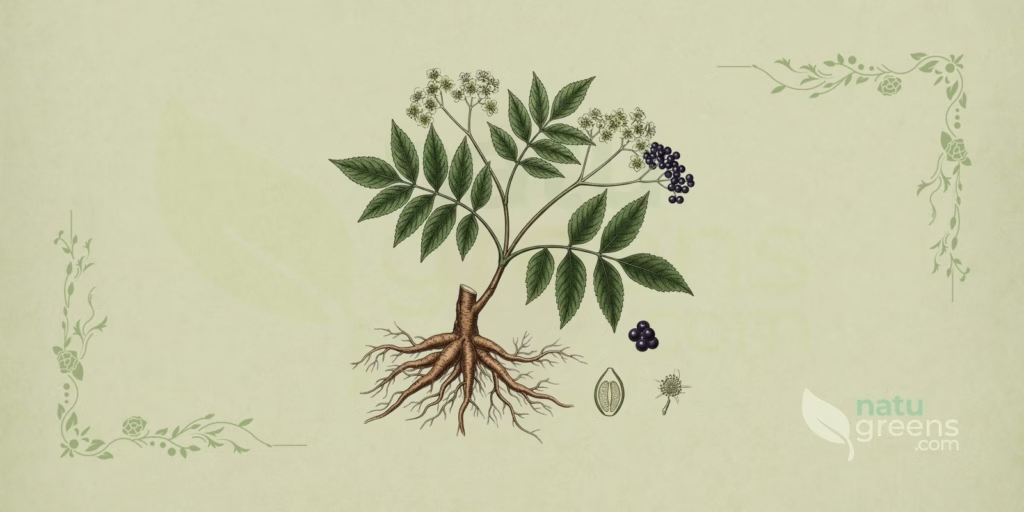
The overall look of the plant belies its herbaceous nature. Every spring, reddish shoots break through the litter and within a few weeks raise a structure of almost shrubby proportions, which the first hard frost then flattens entirely. That yearly cycle of construction and collapse, financed by reserves laid down in the rhizome over the previous summer, goes a long way towards explaining why the species thrives precisely where light is scarce and competition for canopy space is fierce.
This profile gathers what the botanical literature records for the species: its current taxonomic circumscription, the characters that identify it in the field, its geographical range, its cultivation requirements, its phenology, the classes of compounds described for the taxon and for the genus, and the historical record of its place in North American ethnobotany.
Taxonomy
The species was described by Carl Linnaeus in Species Plantarum, volume 1, page 273, published in 1753, and it remains accepted under that original binomial in both the International Plant Names Index and Plants of the World Online, maintained by the Royal Botanic Gardens, Kew. Its placement in the genus has never been seriously challenged, which is remarkable for a taxon named in the earliest years of binomial nomenclature.
- Kingdom: Plantae
- Clade: Angiosperms, eudicots, asterids
- Order: Apiales
- Family: Araliaceae Juss.
- Subfamily: Aralioideae
- Genus: Aralia L.
- Species: Aralia racemosa L., Sp. Pl. 1: 273 (1753)
Synonyms and Infraspecific Taxa
The accepted synonymy is short and comes down to varietal names of regional currency:
- Aralia racemosa f. foliosa (Vict. & J.Rousseau) Scoggan
- Aralia racemosa var. foliosa Vict. & J.Rousseau
Two further infraspecific names call for caution, because they are handled differently depending on the source consulted. Aralia racemosa subsp. bicrenata (Wooton & Standl.) S.L.Welsh & N.D.Atwood, from the mountains of the southwestern United States, is recognised as a subspecies by Plants of the World Online, whereas regional floras prefer to raise it to full species rank as Aralia bicrenata Wooton & Standl. Aralia racemosa var. occidentalis Torr., published in 1874, now appears in most nomenclatural databases as a name of uncertain application. Anyone working with herbarium material from western North America should check which circumscription the source follows before comparing distribution data.
Etymology of the Binomial
The origin of the generic name remains obscure. The hypothesis repeated most often in the literature traces Aralia to the French Canadian vernacular “aralie”, a term said to have reached Joseph Pitton de Tournefort through the physician and naturalist Michel Sarrazin, who was based in New France in the early eighteenth century. No convincing Greek or Latin etymology has been proposed since. The epithet racemosa comes from the Latin racemus, a cluster, and alludes to the long, pendent look of the flower and fruit clusters, even though the inflorescence is strictly a panicle of umbels rather than a true raceme.
Morphological Description
This is a robust perennial herb with no true wood above ground, forming broad, rounded clumps. The stems of the season reach 1 to 2 metres in height and an equivalent spread, which gives the plant a bulk unusual for an understorey herb. The aerial parts are glabrous or nearly so, green to purplish, and die back completely in autumn. The sap is watery and colourless, a useful character for separating the genus from understorey families that bleed latex.
Leaves
The leaves are alternate, very large and two to three times pinnate, which gives the plant a silhouette that many observers describe as tropical. The whole blade can reach 80 centimetres in length, carried on a long petiole that broadens at the base, where it partly clasps the stem. Each primary division bears three to seven ovate to heart-shaped leaflets up to 15 centimetres long, with an acuminate tip and an asymmetrical or slightly cordate base. The margin is doubly serrate, with larger teeth that themselves carry smaller ones, a diagnostic character within the genus. The upper surface is dark green and the lower surface paler, at times sparsely hairy along the veins.
Flowers
The flowers are tiny, white to greenish cream, about 2 millimetres across, and are arranged in globose umbels gathered into terminal and axillary panicles that may exceed 30 centimetres. Each flower is actinomorphic and pentamerous, with five short petals, five stamens alternating with the petals, and an inferior ovary of five carpels topped by free styles. The flowering display is inconspicuous from a distance and surprisingly showy up close, above all because of the number of umbels open at the same time within a single panicle.
Fruits and Seeds
The fruit is a fleshy globose drupe 5 to 7 millimetres across, turning from green to purplish red and finally to a very dark, almost black purple when ripe. The pendent clusters of ripe fruit contrast with the reddish petiole and make for the most ornamental moment of the whole cycle. Each drupe encloses three to five flattened, pale brown pyrenes of 2 to 3 millimetres, whose seeds carry a poorly differentiated embryo at dispersal, a condition that accounts for the prolonged dormancy discussed below.
Root and Stem
The underground system is the most distinctive organ of the species. It consists of a thick, fleshy horizontal rhizome with brown bark and yellowish interior, which thickens year after year and puts out sturdy lateral roots. Fresh tissue gives off a strong, sweetish aroma, compared in the literature to sassafras and liquorice, and produced by volatile oil stored in the parenchyma. It is from this rhizome that the buds responsible for the complete regrowth of the aerial parts emerge in spring.
Distribution and Habitat of Aralia racemosa
The species is native to central and eastern Canada and to the north-central and eastern United States. On Canadian territory it occurs from Manitoba and Ontario through to Quebec, New Brunswick, Nova Scotia and Prince Edward Island. In the United States the range runs from Maine, Minnesota and South Dakota down to Alabama, Georgia and Mississippi, covering virtually the whole eastern deciduous forest province. Outside its native range, Plants of the World Online records an introduced occurrence in Great Britain, where the plant has escaped from ornamental cultivation without behaving as an aggressive invader.
The typical habitat is the interior of mature deciduous and mixed forest, under a canopy of maples, beeches, birches and oaks, along with shaded woodland edges, moist ravines, rocky slopes and mountain stream banks. It favours deep soils rich in organic matter, with abundant leaf litter, good moisture retention and efficient drainage, in a slightly acid to neutral pH range. The altitudinal span runs from low ground near the northern coast up to around 1,500 metres in the Appalachians, and the southwestern subspecies occupies shaded canyons at higher elevations still. Cold tolerance is broad, with dormant rhizomes that come through the severe winters of zones 3 to 9 on the United States Department of Agriculture hardiness scale. No invasive behaviour has been documented anywhere in the introduced range.
Cultivation
Propagation by rhizome division is the quickest and most predictable route. The work is done in late winter or early spring, before the buds break the surface, separating portions that carry at least two viable buds and replanting them straight away in a shallow hole, with the rhizome just below the surface. Plants raised this way regain their original vigour within two or three seasons.
Propagation from seed is slower and calls for an understanding of dormancy in this taxon. The seeds carry an immature embryo at dispersal and require a warm period followed by prolonged cold stratification, in the range of 90 to 120 days at 2 to 4 degrees Celsius, before germination will occur. The pulp of the drupe should be removed before storage, since it inhibits germination. Even when the protocol is followed, emergence tends to be irregular and spread over more than one season, which is why specialist nurseries sow outdoors in autumn and wait for the following spring.
Cultivation requirements mirror the natural habitat. The plant asks for partial to deep shade, tolerating full sun only in cool climates and with constant soil moisture. The ideal substrate is a deep woodland compost, kept moist without waterlogging and covered by a permanent layer of leaves or shredded bark. Spacing should allow for the final bulk of the clump, with at least 1 metre between specimens. Heavy feeding is unnecessary and even counterproductive, since it favours top growth at the expense of the underground system.
Among the phytosanitary problems most often cited are slugs and snails, which attack the tender shoots in spring, the Japanese beetle Popillia japonica in regions where it is invasive, mites in dry air, and the occasional aphid on the inflorescences. On the disease side, fungal leaf spots appear in wet summers, and root rot caused by Phytophthora is the most serious risk on compacted or poorly drained soils. Harvesting of horticultural interest is limited to ripe fruit in late summer, gathered for seed. Lifting rhizomes from wild populations is discouraged for conservation reasons discussed further on.
Phenology
Shoots emerge between April and May in the northern hemisphere, while the canopy has yet to close completely and light still reaches the forest floor. Flowering is concentrated from June to August, peaking in July, and a single individual keeps umbels open for several weeks thanks to the staggered opening within the panicle.
The pollination system is generalist and the nectar sits exposed on the floral disc, within reach of insects with short mouthparts. Recorded visitors include solitary bees, solitary wasps, hoverflies, ants, small beetles and day-flying moths, with no relationship of specialisation documented. That opportunistic strategy is consistent with flowering at the height of summer, when the supply of pollinators in the understorey is high.
Fruiting runs from August to October. Dispersal is predominantly endozoochorous: frugivorous birds, thrushes of the genera Catharus and Turdus among them, eat the drupes and deposit the seeds well away from the parent plant, while small mammals such as chipmunks complete the service on a local scale. After dispersal, morphophysiological dormancy imposes a gap of at least one winter, often two, between fruit fall and seedling emergence. Juvenile growth is slow, and an individual usually takes three to five years to flower for the first time.
Related Species and Confusions
The genus Aralia holds some seventy species spread across Asia and the Americas, several of which grow alongside this one or are cultivated in the same region. The most useful distinctions in the field are the following:
- Aralia californica S.Watson: the western vicariant, of similar size, restricted to riparian forest along the Pacific coast, with no geographical overlap with the eastern species.
- Aralia cordata Thunb.: a large herb from East Asia, grown in Japan as a vegetable, with simply serrate leaflet margins and a more clearly racemose inflorescence.
- Aralia hispida Vent.: a low subshrub of sandy soils and clearings, with the lower stem covered in stiff bristles and a stature that rarely passes 1 metre.
- Aralia nudicaulis L.: develops no leafy aerial stem, since the single leaf and the inflorescence arise separately from the rhizome, and the inflorescence amounts to a few umbels held below the foliage.
- Aralia spinosa L.: a woody shrub or small tree armed with stout prickles on trunk and petioles, a character that settles identification at once.
Three look-alikes outside the genus deserve attention because they mislead beginners:
- Actaea racemosa L.: shares the specific epithet by coincidence and nothing else. It belongs to the Ranunculaceae, has ternate leaves and an erect, white, elongated racemose inflorescence, very different from the globose umbels of the Araliaceae.
- Phytolacca americana L.: resembles the plant at a distance in its robust herbaceous bulk and its clusters of dark fruit, but it has simple rather than compound leaves, a conspicuously reddened stem, and flattened berries in racemes. The distinction matters for safety: the roots, stems and fruit of Phytolacca americana contain saponins and phytolaccatoxin, and eating them causes poisoning.
- Sambucus spp.: the elders repeat the pattern of compound leaves and dark fruit in clusters, but they have persistent woody stems, opposite leaves and a flat-topped corymb, whereas Aralia racemosa has alternate leaves and top growth that is wholly annual.
Phytochemistry
The chemical characterisation of the species is less thorough than that of Asian relatives of commercial interest, and much of what is known comes from phytochemical screening and comparative work at genus level. Analyses of root and stem record the presence of saponins, triterpenes, glycosides, flavonoids, tannins and volatile oil.
Oleanane-type triterpene saponins make up the most characteristic class in Aralia and account, together with the polyacetylenes, for the chemical profile that brings the genus close to Panax. The araliosides, built on an oleanolic aglycone with variable glycosidic chains, are the emblematic group of that lineage. Polyacetylenes of the falcarinol and falcarindiol type, common in Araliaceae and Apiaceae, are likewise described for the genus and concentrate in the underground tissues and in young lateral roots.
The volatile oil of the rhizome accounts for the intense aroma of the fresh plant and brings together monoterpenes and sesquiterpenes in proportions that vary with provenance and harvest date. Phenolic compounds, above all caffeic acid derivatives, occur throughout leaves and roots. The distribution of metabolites across the plant body follows the family pattern: the underground organs concentrate saponins and polyacetylenes, while the leaves accumulate flavonoids and phenolic acids by preference.
History and Ethnobotany
The material on which Linnaeus based his description came from the North American expedition of Peter Kalm, a pupil of Linnaeus himself, carried out between 1748 and 1751. Kalm noted in his journals that settlers and Indigenous peoples knew the aromatic root well long before any European botanist had named the plant.
The ethnobotanical record is among the most extensive for any North American herb. Daniel Moerman’s compilation brings together dozens of uses attributed to peoples across the whole eastern half of the continent, among them the Algonquin, Cherokee, Chippewa, Choctaw, Iroquois, Maliseet, Menominee, Meskwaki, Mi’kmaq, Ojibwe, Penobscot and Potawatomi. The Cherokee prepared infusions of root and fruit; the Iroquois made compound decoctions that combined roots and barks from several plants; groups around the Great Lakes included the rhizome in mixtures directed at respiratory complaints. Several of these peoples also treated the plant as a seasonal food and as an element of ceremonial practice, a dimension that twentieth-century literature frequently overlooked while cataloguing medicinal applications alone.
In the nineteenth century the species entered the repertoire of North American eclectic medicine and appeared in the King’s American Dispensatory, the compendium published in 1898 by John King, Harvey Wickes Felter and John Uri Lloyd. The common name “life-of-man”, used in parts of New England and the Canadian Maritimes, is a relic of that reputation. In the same period the root became an input for the beverage trade: its aroma served as a substitute for or complement to sarsaparilla in root beer formulations, and the domestic use of that flavouring persisted in Appalachia through much of the twentieth century. None of this amounts to a present-day indication; it is a historical record of how different cultures related to the plant.
Conservation
The species has no published assessment on the Red List of the International Union for Conservation of Nature, a situation classed as not evaluated. The available reference is the NatureServe system, which assigns Aralia racemosa a global rank of G5, corresponding to a secure taxon, with N5 in Canada and N4 in the United States. Its wide distribution and its presence in many states support that classification.
The picture changes at the edges of the range, where peripheral populations receive state-level risk ranks and appear on local lists of species of concern. Four kinds of pressure are documented: the collection of rhizomes from wild populations to supply the herb trade; the fragmentation and clearance of mature forest, the only habitat in which the species thrives; heavy browsing by deer in regions where their populations have grown in the absence of predators; and competition from invasive understorey plants, notably Alliaria petiolata and Microstegium vimineum. United Plant Savers keeps the species on its watch list and recommends cultivation as an alternative to wild collection. Aralia racemosa appears in no appendix of the Convention on International Trade in Endangered Species of Wild Fauna and Flora.
On household safety, one factual note is in order: the species appears neither on the list of plants toxic to dogs and cats nor on the list of non-toxic plants published by the ASPCA, which means an absence of assessment rather than proof of harmlessness. The fruits contain saponins, a class of compounds associated with gastrointestinal irritation when eaten in quantity.
Interesting Facts
- The common name has no relationship of kinship with the spikenard of biblical and Mediterranean tradition, which corresponds to Nardostachys jatamansi, a Himalayan plant of the family Caprifoliaceae. The name transferred purely on the strength of a similar root aroma.
- The epithet racemosa describes the plant it names rather badly. The inflorescence is a panicle of umbels, an arrangement quite distinct from a true raceme, and Linnaeus seems to have been guided by the pendent look of the fruit clusters.
- The plant is herbaceous yet behaves as a long-lived perennial. Clumps established in mature forest can hold the same spot for decades, rebuilding more than 1 metre of top growth every year.
- The only documented occurrence outside North America is naturalisation in Great Britain, the result of escapes from ornamental cultivation in shade gardens.
- Two North American understorey plants carry the epithet racemosa and were used in the same region, although they belong to families with no close kinship: Actaea racemosa, of the Ranunculaceae, and the species of this profile, of the Araliaceae.
Notice: this content is for informational purposes and does not replace professional medical advice. Consult a physician or herbal practitioner before using medicinal plants, especially during pregnancy, breastfeeding, or alongside medication.
References and Scientific Studies
View All 11 Cited References
Peer-Reviewed Scientific Studies (3)
- DOI2004 Lowry, P. P., Plunkett, G. M., Wen, J. Generic relationships in Araliaceae: looking into the crystal ball. South African Journal of Botany, 70(3), 382-392. 2004. ↗
- PEER NatureServe. Aralia racemosa, American Spikenard: global rank G5. NatureServe Explorer, Arlington. ↗
- DOI2001 Wen, J. Evolution of the Aralia-Panax complex (Araliaceae) as inferred from nuclear ribosomal ITS sequences. Edinburgh Journal of Botany, 58(2), 243-257. 2001. ↗
Supplementary Readings (8)
- 2016 Flora of North America Editorial Committee. Flora of North America North of Mexico, vol. 13: Araliaceae. Oxford University Press, New York. 2016.
- Global Biodiversity Information Facility. Aralia racemosa L. GBIF Backbone Taxonomy. ↗
- International Plant Names Index. Aralia racemosa L., Species Plantarum 1: 273. Royal Botanic Gardens Kew, Harvard University Herbaria and Australian National Herbarium. ↗
- Linnaeus, C. Species Plantarum, vol. 1. Laurentius Salvius, Stockholm. 1753.
- 1998 Moerman, D. E. Native American Ethnobotany. Timber Press, Portland. 1998.
- Native Plant Trust. Aralia racemosa L., American spikenard. Go Botany. ↗
- Plants of the World Online. Aralia racemosa L. Royal Botanic Gardens, Kew. ↗
- United Plant Savers. Species At-Risk Assessment Tool: Spikenard, Aralia racemosa. unitedplantsavers.org. ↗