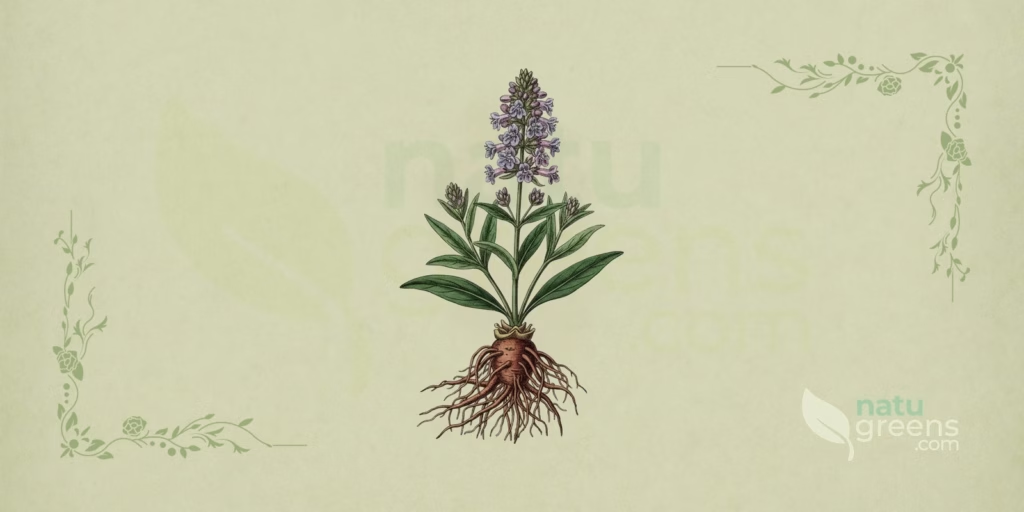
Few herbaceous plants carry a commercial biography as long as that of Nardostachys jatamansi. It is a rhizomatous perennial herb of the family Caprifoliaceae, restricted to the alpine meadows of the Himalaya and the adjoining ranges of south-western China, where it forms low tufts among rocks and grassy slopes above three thousand metres. The organ that made it famous lies buried: a short, roughly cylindrical rhizome wrapped in a tangle of reddish brown fibres, the remains of old leaf bases, which gives off a woody, earthy odour noticeable at some distance whenever the soil is disturbed.
That rhizome is the nard of the ancients, the spikenard of English biblical translation, the raw material of one of the costliest ointments of the Mediterranean world and a commodity that crossed the Indian subcontinent bound for Egypt and Rome long before any European botanist set eyes on the living plant. The distance between the collecting grounds and the consuming markets produced centuries of confusion about the identity of the species, a confusion settled only in the first half of the nineteenth century and whose traces still surface in synonyms and in trade names that circulate to this day.
What follows describes the plant and its history, not its use. The taxonomy follows Plants of the World Online, from the Royal Botanic Gardens, Kew, with the name confirmed in the International Plant Names Index; the morphology draws on the Flora of China treatment and on the Himalayan floristic literature; the ethnographic record appears as history, in the past tense. Conservation is the point on which this profile insists most, because the species is critically endangered and the pressure on it comes precisely from the harvesting of the rhizome.
Nardostachys Taxonomy
The accepted name is Nardostachys jatamansi (D.Don) DC., a combination published by Augustin Pyramus de Candolle in 1830, in volume 4 of the Prodromus Systematis Naturalis Regni Vegetabilis, page 624. The basionym is Patrinia jatamansi D.Don, of 1825. It was in that same passage of the Prodromus that De Candolle separated the genus Nardostachys from the valerian assemblage, recognising that the Himalayan plant sat poorly in any of the genera then available.
- Kingdom: Plantae
- Phylum: Streptophyta
- Class: Equisetopsida
- Subclass: Magnoliidae
- Order: Dipsacales
- Family: Caprifoliaceae
- Subfamily: Valerianoideae
- Genus: Nardostachys DC.
- Species: Nardostachys jatamansi (D.Don) DC., 1830
The family placement deserves a note. For almost two centuries the species was treated in Valerianaceae, and it is under that family that it appears in the IPNI, which records the family of the protologue. The APG IV classification dissolved Valerianaceae within Caprifoliaceae in the broad sense, so that the taxon now sits in Caprifoliaceae, subfamily Valerianoideae. Both readings describe the same organism, and recent literature still alternates between them according to the date and the tradition of the journal.
Synonyms
POWO recognises nine synonyms, a high figure for a species of such restricted range and one explained by the combination of fragmentary material reaching Europe and geographically isolated populations described independently of one another.
- Fedia grandiflora Wall.
- Fedia jatamansi Wall. ex DC.
- Nardostachys chinensis Batalin (1894)
- Nardostachys gracilis Kitam. (1954)
- Nardostachys grandiflora DC. (1830)
- Nardostachys jatamansi C.B.Clarke (1881), illegitimate later homonym
- Patrinia jatamansi D.Don (1825)
- Valeriana jatamansi D.Don (1821), illegitimate name
- Valeriana jatamansi (D.Don) Wall., illegitimate name
Two of these names still circulate as though they were valid species. Nardostachys grandiflora DC. was described by De Candolle on the same page as N. jatamansi and survived in Indian and Nepalese pharmacognostic literature for much of the twentieth century, official trade documents included. Nardostachys chinensis Batalin remains in use in part of the Chinese literature, which treats it as a distinct taxon of more northerly distribution, and some distribution modelling studies still work with two species in the genus. Under the POWO treatment the genus is monospecific, and that is the reading adopted here.
There is also a homonym that is not a synonym and that causes more trouble than all the others put together: Valeriana jatamansi Jones, published in 1790, is a different species, Himalayan as well, also traded, and the origin of the problem is set out further on, in the section on related species.
Etymology
The generic name combines the Greek nardos, an ancient designation for an aromatic oriental plant that reached Greek through Near Eastern languages, with stachys, spike, in reference to the dense, compact inflorescence that crowns the flowering stem. The same image survives in the English spikenard and in the Portuguese espicanardo, both built on the notion of nard in a spike. The epithet jatamansi comes from Sanskrit and describes the rhizome with precision: jata denotes the matted lock of hair, the tangled tress of ascetics who neither cut nor comb their hair, and the word captures the felt of dark fibres that envelops the underground organ.
Morphological Description
Nardostachys jatamansi is a perennial herb of modest stature, with a stout rhizome and an erect or oblique caudex from which arise a rosette of basal leaves and one or a few flowering stems reaching 5 to 50 centimetres in height according to exposure and altitude. The plant is aromatic throughout, though the concentration of the odour in the rhizome is unmistakable, and the vegetative body is glabrous or only sparsely puberulent. The compact habit and the rosette pressed against the ground are typical responses to life on the alpine floor, where the wind is constant and the growing season lasts a few weeks.
Leaves
- Colour: green to dark green, with no marked difference between the two surfaces
- Arrangement: basal leaves in a rosette, cauline leaves opposite in one or two pairs
- Basal leaves: 3 to 25 centimetres long by 0.5 to 2.5 centimetres wide, narrowly spatulate to linear-oblanceolate, with a petiole close in length to the blade
- Cauline leaves: sessile or subsessile, oblong to ovate, distinctly smaller than the basal ones
- Venation: three main veins, visible against the light
- Base, margin and apex: attenuate base, entire margin, obtuse apex
Flowers
- Colour: rose-purple, pink or magenta
- Corolla: campanulate, 4.5 to 9 millimetres, with five broadly ovate to oblong lobes of 2 to 3.8 millimetres, the outer face more or less villous and occasionally glabrous
- Calyx: five semiorbicular to triangular-lanceolate lobes, usually ciliate, which enlarge after anthesis
- Stamens: four, inserted on the corolla tube
- Ovary: inferior, with a single fertile ovule
- Inflorescence: congested cymes gathered into a terminal head 1.5 to 2 centimetres across, with four to six lanceolate involucral bracts and each flower subtended by a bract of its own
Fruits and Seeds
- Type: achene, with a single seed per fruit
- Dimensions: 3 to 4 millimetres long
- Shape: obovoid, crowned by the persistent calyx lobes
- Indumentum: white hispidity, partial or uniform, at times reduced to almost nothing
- Fruiting calyx: deltoid to ovate lobes of 1.5 to 2.5 millimetres, with prominent and conspicuous reticulate venation
A frequent misconception in popular writing is worth correcting here. The accrescent calyx of Nardostachys jatamansi does not form the plumose pappus characteristic of Valeriana and of so many Asteraceae. The lobes stay broad, membranous and reticulate, working more like a small stiff sail than like a parachute of bristles.
Rhizome and Stem
The rhizome is the diagnostic organ of the species and the part that sustained the entire historical trade in nard. It measures 2.5 to 7.5 centimetres long, is elongate and approximately cylindrical, dark grey to almost black on the outside and paler in section, and comes wholly clothed in dense tufts of reddish brown fibres, which are the petioles and leaf sheaths of earlier seasons decayed until only the vascular bundles remain. That fibrous coat is the character that allows authentic material to be told apart from substitutes in the dried root trade. The caudex, from which the flowering stems arise, is short and erect or slightly oblique, and the aerial stem is simple, without branching below the head.
Distribution and Habitat
The native range of the species follows the Himalayan arc and extends eastward into the Chinese interior. POWO records occurrence in the west and east Himalaya, in Nepal, in Bangladesh, in Assam, in Myanmar, in Tibet, in Qinghai and in the north-central and south-central provinces of China. In terms of countries that amounts to Bhutan, China, India, Myanmar and Nepal, with the Indian populations concentrated in Arunachal Pradesh, Himachal Pradesh, Sikkim and Uttarakhand, and the Nepalese ones spread across more than twenty districts, from the far west to Solukhumbu.
The habitat is alpine and subalpine, between roughly 3,000 and 5,000 metres of altitude. The plant occupies open meadows, undisturbed grassy slopes, rocky outcrops and clearings in juniper and rhododendron formations, with a marked preference for steep, moist ground and for coarse sandy loam soils, rich in organic matter and well drained. The climatic regime is that of the summer monsoon superimposed on an alpine winter, with precipitation concentrated into a few months, prolonged snow cover and a wide daily temperature range through the growing season.
There is no record of the species naturalising outside its native range, nor of invasive behaviour anywhere in the world. The combined requirement of altitude, photoperiod and prolonged cold makes it all but incapable of escaping from cultivation, and the agronomic trials conducted below the natural belt confirm that limitation in fairly drastic fashion.
Cultivation
Propagation is by seed or by rhizome division, and neither route is straightforward. The seeds are poorly tolerant in storage: kept at room temperature they lose viability in under a year, and conservation at low temperature more than doubles that span. Under controlled conditions germination responds best to temperatures around 15 degrees Celsius with continuous lighting, and trials have recorded gains from hormonal treatment with gibberellic acid. A sowing depth of about half a centimetre, in a substrate of soil, sand and well rotted organic matter in equal proportions, was the combination that yielded the best nursery results.
The sowing window varies with the altitude of the nursery, which says a great deal about the ecological rigidity of the plant. At intermediate altitudes the months of October and February proved suitable; in the natural habitat, above three thousand metres, May sowing is the one that follows the thaw. Rhizome division, carried out during dormancy, is the more reliable method wherever propagating material is available, provided each division retains viable buds and a root system of its own.
Cultivation trials comparing three altitudinal bands gave an unambiguous result: at 2,200 metres and at 3,600 metres cultivation proved commercially viable in most treatments, whereas at 1,800 metres mortality was total in every one of them. Outside the alpine belt, then, the species simply fails to establish, which explains why supply to the market went on depending on wild collection even after decades of attempts at domestication.
The literature on pests and diseases is sparse, probably because commercial cultivation never reached any scale. The problems reported are the predictable ones for a geophyte of moist soils: rotting of the rhizome under prolonged waterlogging or poor drainage. The most frequently cited biotic pressure in the natural habitat is not an agricultural pest but grazing, since trampling and consumption by herds of yak, sheep and goats in alpine meadows rank among the threats formally recognised for the species. As for harvesting, the critical point is that the product is the rhizome, and extraction means pulling up the whole plant, killing the individual and leaving nothing to resprout.
Phenology
The reproductive cycle is compressed into the short alpine summer. Flowering runs from late June to August, and fruiting extends from August to early September, so that the plant has only a few weeks between the thaw and the return of the frosts in which to complete the whole process. Outside that window the aerial part disappears and the rhizome lies dormant beneath the snow.
Pollination is entomophilous, inferred from floral morphology: a campanulate corolla with a short tube, pink to magenta colouring, four stamens and a reward accessible to short-tongued visitors, a combination consistent with the generalist pattern common in Himalayan alpine meadows. The identity of the effective pollinators, however, is poorly documented, and there exists for this species no floral biology study comparable to those available for European congeners of Valeriana. Assemblages of floral visitors in alpine meadows of that altitudinal band tend to be dominated by small dipterans and hymenopterans, which points to a weakly specialised system, but the direct attribution of pollinators to the species remains an open question.
Dispersal of the achenes is anemochorous over short distances. The accrescent, reticulate calyx lobes increase the surface of the fruit and favour transport by wind, though without the efficiency of a true plumose pappus, and the white hispidity of the fruit wall may contribute to occasional adhesion to the coats of herbivores. The practical outcome is a predominantly local dispersal, with the formation of dense population nuclei, a pattern that helps explain why collecting concentrated on a single slope is capable of wiping out entire subpopulations.
Related Species and Confusions
The case of Nardostachys jatamansi is one of the most instructive in economic botany, because the confusion arose from a documented error and outlived two hundred years of corrections.
In 1790 William Jones published in Asiatick Researches a study devoted to identifying the nard of the ancients with a living Himalayan plant. Jones worked from a description and a drawing sent by third parties, and the material he received from Bhutan under the name jatamansi was not the right species but the plant that would come to be known as Valeriana wallichii. The name Valeriana jatamansi Jones was therefore applied to the wrong taxon. The confusion deepened when Roxburgh published, in 1799, a figure that combined the rhizome of the true nard with the stem and leaves of the other species. Once the problem was detected, Nathaniel Wallich sent authentic material collected in Kumaon and at Gosainthan, and David Don described it correctly, first as Valeriana jatamansi in 1821 and then, in validly published form, as Patrinia jatamansi in 1825. De Candolle transferred that name to the new genus in 1830.
The practical consequences persist in the dried root trade, where three plants circulate under partly overlapping vernacular names:
- Selinum vaginatum (Edgew.) C.B.Clarke: known as bhootkeshi, it belongs to another family, Apiaceae, but produces roots of similar external appearance and odour, and is the most frequent substitute in Indian markets. Reliable separation calls for anatomical examination or a chemical profile, since the macroscopic likeness is considerable.
- Valeriana jatamansi Jones: called tagar or mushkbala, it is Himalayan like Nardostachys and shares several common names with it, jatamansi itself included. The most practical character for separation lies in the rhizome: in Nardostachys it comes wrapped in the felt of twisted fibres from the leaf bases, whereas in Valeriana the petioles lack that hairy covering. The living plant differs as well, with broad cordate leaves and an open panicle rather than a compact head.
- Valeriana officinalis L.: a European species of the same subfamily, far larger in stature, with pinnate leaves and broad corymbiform cymes, offering no possibility whatever of confusion with the whole plant, although dried milled material has found its way into the trade.
Analytical methods were developed precisely to tell the three apart, with quantification of markers by high performance thin layer chromatography, and the profiles obtained show that the chemical differences between them are wide enough for diagnostic use.
Phytochemistry
The rhizome and the root concentrate an essential oil rich in sesquiterpenes, and it is this volatile fraction that accounts for the characteristic odour of the species. The yield varies considerably with geographic provenance, altitude and time of collection, to the point that oil composition has been used to discriminate origins in chemical profiling studies.
Among the sesquiterpenes described in the oil are jatamansone, also referred to as valeranone, nardostachone, calarene, guaia-6,9-diene, alpha-gurjunene, beta-gurjunene, valencene, alpha-maaliene, spirojatamol, seychellene, seychelane, nardostachnol and aristolone. The sesquiterpene alcohols beta-eudesmol, elemol and patchoulol belong to the same fraction. The quantitative profile is variable, and different batches analysed by gas chromatography coupled to mass spectrometry show different major components.
Beyond the volatiles, the species accumulates terpenic coumarins, among them jatamansin and oroselol, along with jatamansinol, the steroid beta-sitosterol and the furanocoumarin angelicin. Analyses of root and rhizome extracts also record tannins, flavonoids, phenolic compounds in general, saponins, and the protein and carbohydrate fractions expected in a storage organ. Valerenic acid, the classic marker of the genus Valeriana, occurs here as well, and comparison of its content between Nardostachys jatamansi, Valeriana jatamansi and Selinum vaginatum was one of the parameters proposed for distinguishing the three materials in trade.
The distribution of the compounds through the body of the plant is strongly asymmetric. Transcriptomic work mapping the expression of genes in the sesquiterpene pathway found activity concentrated in the underground tissues, which is consistent with the practical observation that the aerial part has no commercial value and that only the rhizome was ever the object of extraction throughout history.
History and Ethnobotany
Nard was one of the costliest luxury goods of Mediterranean antiquity, and the written record is abundant. Dioscorides dealt with the plant in book I of De Materia Medica, in the first century, recording the provenance of the material and the manner in which it was gathered in the mountains of the east. Pliny the Elder and other Latin authors listed the substance among the oriental commodities of highest value, and the ointment circulated under the names unguentum nardinum and unguentum nardi spicatae. The scale of prices becomes clear in a passage of Horace, who offered Virgil a whole cadus of wine, something around thirty-six litres, in exchange for a small onyx box filled with nard.
In religious texts the product appears with the same freight of value. Nard is named in the Song of Songs and returns in the Gospels, in the scene where an alabaster jar holding the ointment is broken, an episode in which the price estimate mentioned is equivalent to almost a year of wages. The routes that brought the material from the Himalaya to the Mediterranean ran through the north-west of the Indian subcontinent and through the maritime trade of the Indian Ocean, and the distance between origin and consumption accounts for much of the price.
In South Asia the rhizome is recorded in the classical compilations of Ayurveda under the Sanskrit name jatamansi, and the Tibetan and Persian literatures noted it too. Outside the medical context, with which this profile does not deal, the material was burned as incense in ritual and entered perfumery compositions, applications that persisted for centuries and that account for a substantial share of historical demand. In the producing regions of Nepal and north-western India, high altitude collection was a seasonal activity of mountain communities, who climbed to the alpine meadows in late summer, and that organisation of labour is documented in ethnographic surveys and in trade records from the British colonial period.
Conservation
Nardostachys jatamansi is assessed as Critically Endangered on the IUCN Red List, under criterion A2cd, in an assessment published in 2021. The category rests on the suspicion of a population reduction of at least eighty per cent over the last ten years, attributed to direct exploitation and to degradation of habitat quality. Few herbaceous plants of such extensive range carry so high a risk category, and the reason lies in the nature of the harvest.
Extraction is destructive by definition. Since the product is the rhizome, the whole plant is pulled up, the individual dies and nothing left in the ground resprouts. Add to that slow growth in an alpine environment, short-range dispersal and the brief viability of the seeds, and the result is a very low capacity for recovery after each collecting event. Entire subpopulations have already vanished from historically productive areas, and the species ranks among the most intensively traded plants of the Indian Himalaya. To that picture are added overgrazing, habitat loss and deforestation in the subalpine contact zones.
The species has been listed in Appendix II of CITES since 1997, which subjects international trade to export licensing and to evidence that extraction does not harm the survival of the wild population. Nepal, the leading exporting country, operates with national quotas set through discussion in the Standing Committee of the convention, and supply chain traceability projects have been implemented with support from wildlife trade monitoring organisations. India and Nepal maintain conservation programmes in protected areas and high altitude cultivation trials, whose effectiveness runs up against the agronomic limitations described above.
Interesting Facts
- The English name spikenard is a literal rendering of the Greek binomial: nardos plus stachys, nard in a spike, exactly the construction that produced the Portuguese espicanardo and that describes the compact head at the top of the stem.
- The epithet jatamansi describes neither the flower nor the leaf but the tangle of fibres clothing the rhizome. In Sanskrit, jata denotes the matted tress of ascetics who do not comb their hair, and the image fits with unusual precision for a botanical epithet.
- The confusion over identity lasted more than thirty years and involved four of the great names in the natural history of British India. William Jones described the wrong plant in 1790, Roxburgh published in 1799 a figure that mixed two species, Wallich sent authentic material from the Himalaya and David Don finally got it right in 1825.
- A small onyx box filled with nard ointment was worth, according to Horace, a whole cadus of wine, a quantity close to thirty-six litres. The product came from slopes above three thousand metres, on the far side of the known world.
- The genus Nardostachys is today monospecific according to POWO, yet part of the Chinese literature continues to recognise N. chinensis as a separate taxon, and distribution modelling work published in the last decade still operates with two species. The question is not closed.
For another slow-growing medicinal root facing serious conservation pressure from wild harvesting, see our complete botanical profile of Sanguinaria canadensis (bloodroot).
Notice: this content is for informational purposes and does not replace professional medical advice. Consult a physician or herbal practitioner before using medicinal plants, especially during pregnancy, breastfeeding, or alongside medication.
References and Scientific Studies
View All 10 Cited References
- Candolle, A. P. de. Prodromus Systematis Naturalis Regni Vegetabilis, volume 4, page 624. Paris, 1830.
- 2026 CITES. Appendices I, II and III. Convention on International Trade in Endangered Species of Wild Fauna and Flora. Accessed 2026.
- CITES. National Quota Fixation for Jatamansi (Nardostachys jatamansi) in Nepal. Standing Committee document, SC71 Doc. 12, Annex 5.
- Dioscorides, P. De Materia Medica, book I, chapter 7. First century.
- Don, D. Prodromus Florae Nepalensis. London, 1825.
- 2011 Flora of China, volume 19, treatment of Valerianaceae. Science Press and Missouri Botanical Garden Press, Beijing and Saint Louis, 2011.
- 2026 IPNI. The International Plant Names Index. Royal Botanic Gardens Kew, Harvard University Herbaria and Australian National Herbarium. Available at www.ipni.org. Accessed 2026.
- 2021 IUCN. Nardostachys jatamansi. The IUCN Red List of Threatened Species 2021, e.T50126627A88304158. Available at www.iucnredlist.org. Accessed 2026.
- Jones, W. The Spikenard of the Ancients. Asiatick Researches, volume 2. Calcutta, 1790.
- 2026 POWO. Plants of the World Online, Royal Botanic Gardens, Kew. Entry for Nardostachys jatamansi (D.Don) DC. Available at powo.science.kew.org. Accessed 2026.