Cordia lutea is a densely branched shrub or a small tree of the borage family, recognisable from a distance by the yellow trumpet-shaped flowers that cover its crown for much of the year. The species occupies the dry lowlands of western South America, from Colombia down to Peru, and it reaches the Galápagos archipelago as well, where it ranks among the commonest native plants of the coastal arid zone. In the dry forests of north-western Peru it behaves as a structural element of the landscape, sharing the shrub layer with algarrobo and zapote.
The vernacular name shifts with the region. Muyuyo is the usual form in Ecuador and in Galápagos, while overo and flor de overo circulate in northern Peru. English-speaking horticulture settled on yellow geiger, in deliberate contrast with the orange geiger applied to Cordia sebestena. Nothing older than that trade label ever took hold in English, which leaves the binomial as the safest reference for anyone hunting the species in nurseries or herbarium cabinets.
What makes Cordia lutea remarkable reaches well beyond ornamental appeal. It is one of the few Neotropical Boraginaceae whose heterostylous breeding system has been documented in detail, it sustains a network of day-flying and night-flying pollinators on oceanic islands notably poor in insects, and it produces fruit with pulp so mucilaginous that Andean and coastal communities once put it to work as glue. This profile gathers the formal taxonomy, the diagnostic morphology, the ecology of arid country, the descriptive phytochemistry and the historical record of use, with no guidance of any kind on present-day application.
Taxonomy
Cordia lutea belongs to the Boraginaceae in the broad circumscription adopted by APG IV, within the subfamily Cordioideae. Part of the literature treats Cordiaceae as a family in its own right, an arrangement that leaves the relative position of the species untouched. The genus Cordia brings together several hundred pantropical species, with its greatest diversity in the Neotropics.
- Kingdom: Plantae
- Division: Tracheophyta (angiosperms)
- Class: Magnoliopsida
- Order: Boraginales
- Family: Boraginaceae Juss.
- Subfamily: Cordioideae
- Genus: Cordia L.
- Species: Cordia lutea Lam., 1791
The protologue appeared in the first volume of Jean-Baptiste de Lamarck’s Tableau encyclopédique et méthodique des trois règnes de la nature, Botanique, on page 421, in 1791. The record is held in the International Plant Names Index under identifier 274993-2, and Plants of the World Online keeps the binomial as the accepted name, with no recombination proposal currently in force.
The synonymy runs long, a reflection of the successive generic rearrangements that Boraginales went through across the nineteenth and twentieth centuries. Plants of the World Online recognises roughly a dozen subordinate names, among them:
- Calyptracordia rotundifolia (Ruiz & Pav.) Friesen
- Coilanthera rotundifolia (Ruiz & Pav.) Raf.
- Cordia flava (Andersson) Gürke
- Cordia marchionica Drake
- Cordia rotundifolia Ruiz & Pav.
- Ectemis lutea (Lam.) Raf.
- Firensia lutea (Lam.) Raf.
- Gerascanthus luteus (Lam.) Borhidi
- Gerascanthus rotundifolius (Ruiz & Pav.) Friesen
- Lithocardium flavum (Andersson) Kuntze
- Lithocardium rotundifolium (Ruiz & Pav.) Kuntze
- Varronia flava Andersson
- Varronia rotundifolia (Ruiz & Pav.) A. DC.
One point of nomenclature deserves a warning. Non-specialist sources circulate the combination Varronia lutea attributed to Borhidi, which corresponds to no validly published name for this plant. The Borhidi recombination that does exist is Gerascanthus luteus.
As for etymology, the generic name honours Valerius Cordus (1515-1544), the German botanist and apothecary whose work on materia medica circulated throughout Renaissance Europe. The epithet comes from the Latin luteus, yellow, a direct nod to the colour of the corolla, which is the most conspicuous character of the species in the field.
Morphological Description
The plant is a densely branched shrub or a small tree between 2 and 8 metres tall, with an open crown and a spreading habit. The trunk rarely exceeds 20 centimetres in diameter and tends to be crooked, clothed in grey, finely fissured bark. In the drier seasons it sheds part or all of its foliage, a deciduous behaviour that varies with the rainfall regime of each population.
Leaves
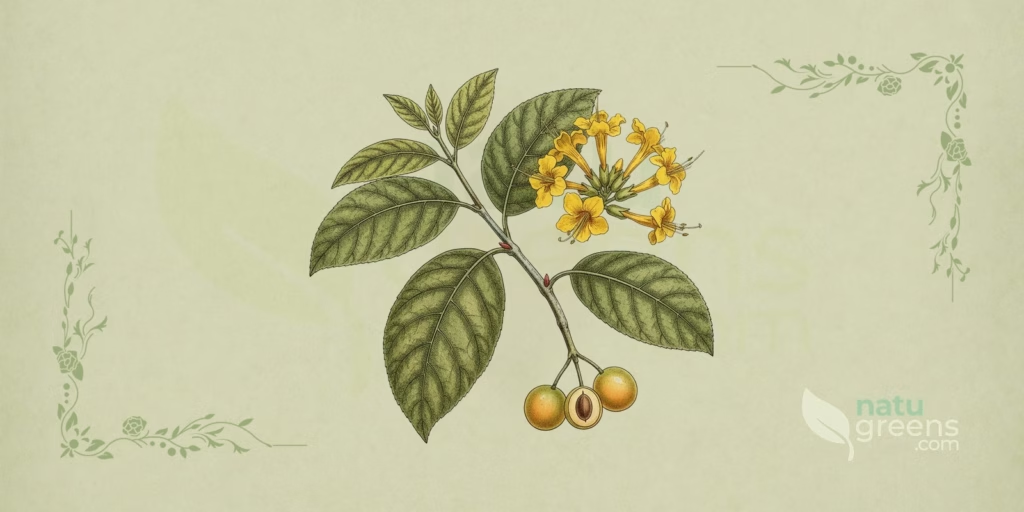
The leaves are alternate, simple and without stipules, measuring 4 to 10 centimetres long. The outline ranges from ovate to suborbicular, with a rounded to obtuse apex and a finely toothed to crenate margin. The upper surface is rough to the touch and all but glabrous, while the lower one carries hairs distributed over the midrib and the blade. The petiole is short, which gives the leafy twig a compact look when seen from above.
Flowers
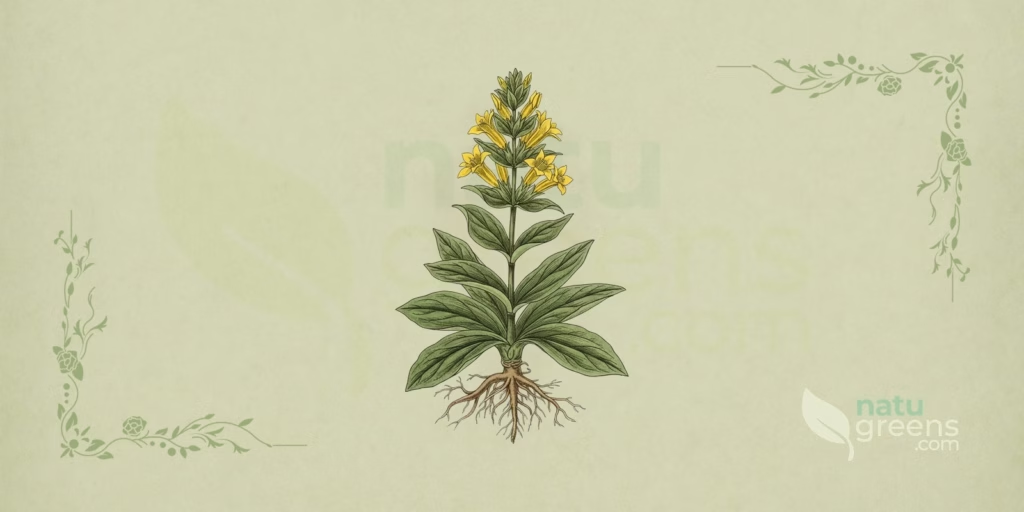
The flowers are borne in terminal cymes and concentrate all the diagnostic value of the species. The calyx is cylindrical, around 10 millimetres long and 5 to 7 millimetres wide, longitudinally ribbed and persistent. The corolla is sympetalous, bright yellow and trumpet-shaped, measuring 2 to 4 centimetres across the throat, with five to eight spreading lobes. The stamens likewise number five to eight and sit inserted in the tube. The scent is sweet and carries over a short distance.
The species is heterostylous, with two floral morphs distributed across different individuals. One presents a long style and low anthers, the other combines a short style with high anthers. The reciprocal architecture favours pollen transfer between complementary morphs, and pollination experiments show markedly higher fruit set from legitimate crosses.
Fruits and Seeds
The fruit is a globose drupe 8 to 12 millimetres across, white and translucent when ripe, seated at the base on the persistent calyx, which stays green and ribbed. The pulp is abundantly mucilaginous and sticks readily to surfaces, a trait with direct ecological consequences. The taste opens agreeably sweet and turns bitter within a few seconds. Each fruit holds one to four seeds protected by a hard endocarp.
Root and Stem
The stems are long, slender and erect, the young branches pubescent until they lose their hairs on lignifying. The grey bark flakes away in thin plates on older specimens. The plant resprouts easily from the base and roots from woody cuttings, an attribute long exploited in raising living fences across the dry country of Ecuador and Peru.
Distribution and Habitat
The native range covers western South America and takes in Colombia, mainland Ecuador, insular Ecuador in the Galápagos archipelago, and Peru. On Peruvian territory the species follows the Pacific coastal strip and the dry inter-Andean valleys, and it forms part of the dry forests of Tumbes, Piura and Lambayeque. In Galápagos it counts as native and occupies the arid lowland zone, with a strong presence close to the shoreline.
Beyond its natural range, Cordia lutea has been introduced to Hawaii and to the Marquesas Islands. On the island of Hawaii it is listed as naturalised, and the invasiveness risk assessment applied across the archipelago gave the species a low score, with no documented evidence of negative impact outside its original distribution so far. That result contrasts with the behaviour of other members of the genus on Pacific islands, which is reason enough to keep monitoring in place.
The characteristic biome is the seasonally dry tropics. Populations range from sea level up to roughly 1,500 metres, with scattered records higher up in the inter-Andean valleys. The plant thrives on low rainfall and endures long spells without rain, behaving as a facultative xerophyte that responds quickly to pulses of precipitation. As for substrate, it grows on sandy soils, on the expansive clays of former wet beds and on ground with high salinity, a tolerance uncommon among ornamental trees with showy flowers.
Cultivation
Propagation goes by seed and by cuttings, and both routes are used in restoration nurseries in Ecuador and Peru. The seeds show dormancy tied to the hard endocarp and to the mucilage that envelops the fruit, so careful cleaning of the pulp is the first step with any batch. Mechanical scarification and treatment with gibberellic acid appear in the literature as ways of evening out germination, and Peruvian trials show that passage through the gut of natural dispersers also alters the germination response of the seed.
Cuttings are the more direct route to production at scale. Trials run in the province of Santa Elena, on the Ecuadorian coast, report satisfactory strike rates even without rooting hormone, with results that support the use of the species in fodder plantings and living fences. Woody material responds well, and the density of regrowth tends to be high.
In the field the plant demands full sun and well-drained soil. It tolerates prolonged drought, salinity and poor soils, yet it will not take frost, which confines cultivation to tropical and subtropical regions free of sub-zero temperatures. Spaced watering is enough once the plant is established, and excess moisture in the substrate is the commonest mistake made in the nursery.
Records of specific pests are scarce. In Hawaii the species was identified as an alternative host of the lobate lac scale, which prompted phytosanitary attention in the ornamental plantings of the archipelago. Scale insects in general turn up on the branches wherever ventilation is poor. Fruit is gathered once the drupe reaches its translucent white colour and the pulp softens, the point at which the seeds are already mature and extraction is simpler.
Phenology
The annual cycle was followed in detail at the Chaparrí Private Ecological Reserve, in Chongoyape, Lambayeque, between July 2004 and June 2005. Vegetative development runs through the whole year and peaks between February and April, with figures close to 60 per cent. Bud emission concentrates between January and June, reaching a maximum of around 20 per cent in January and February. Flowering predominates from December to June, likewise in the region of 20 per cent on average, while fruiting spreads across the entire year and hits a maximum of 14 per cent in August, with green and ripe fruit on the same plant. Temperature correlated with all three phases.
Pollination combines day-flying and night-flying agents. Carpenter bees are the most effective diurnal visitors, and in Galápagos that role falls to Xylocopa darwini, the only bee native to the archipelago and an extreme generalist within the local pollination networks. Moths take over at night, and they proved more efficient at carrying pollen between separate plants. The mating system is mixed, with relatively low fruit production arising from the combination of selfing and outcrossing in an environment where few insects are available.
Dispersal is predominantly zoochorous. Birds and lava lizards eat the fruit in Galápagos, and the sticky pulp adheres to the bodies of large animals, giant tortoises and seabirds included, which opens an additional epizoochorous route of transport. In northern Peru the Sechuran fox, Lycalopex sechurae, swallows the fruit and features among the documented dispersers of the species in dry forest.
Related Cordia Species and Confusions
Within the genus, corolla colour and fruit appearance settle most doubts. Three relatives account for the commonest mix-ups in collections and landscaping:
- Cordia sebestena L.: the corolla is orange-red rather than yellow, and the leaves are larger and more leathery. This is the species behind the horticultural name orange geiger, and it occurs naturally in the Caribbean.
- Cordia sinensis Lam.: small, cream-yellow flowers, with fruit ripening in shades of orange to red, against the translucent white of Cordia lutea. Its distribution is Afro-Asian, with an analogous ecological role in arid zones.
- Cordia subcordata Lam.: an orange corolla, larger cordate leaves and a woody fruit whose buoyant endocarp is adapted to dispersal by sea. It occurs on the islands of the Pacific and the Indian Ocean, where it may live alongside introduced populations of Cordia lutea.
Outside the Boraginaceae, the most frequent confusion involves Tecoma stans (L.) Juss. ex Kunth, of the family Bignoniaceae, which displays yellow tubular flowers of similar appearance at a distance. Separation is immediate from the leaves, imparipinnate and compound in Tecoma stans and simple in Cordia lutea, and from the fruit, an elongate linear capsule that has nothing in common with the white drupe of the Boraginaceae.
One identification warning is worth recording. The Boraginaceae include genera that accumulate hepatotoxic pyrrolizidine alkaloids, among them Echium, Heliotropium and Symphytum. Sterile vegetative material of Boraginaceae is difficult to determine with confidence, and collections lacking flower or fruit do not allow Cordia lutea to be reliably separated from those neighbours.
Phytochemistry
The best characterised chemical profile is that of the flowers. A preliminary phytochemical assessment carried out on material from Otuzco, in Peru, identified phenolic compounds, leucoanthocyanidins and flavonoids as the predominant classes in the methanolic and ethanolic extracts obtained by reflux. Quantification by high-performance liquid chromatography recorded 60.63 milligrams of rutin and 0.558 milligrams of quercetin per gram of dry sample, which places rutin as the major flavonoid by a wide margin.
An earlier survey of chemical composition, cited in that same work, found rutin and quercetin fractions of the same percentage order and recorded fatty acids among the constituents, with linoleic acid, palmitic acid and glyceryl hexadecanoate at levels close to 0.1 per cent. Gas chromatography coupled to mass spectrometry of the floral ethanolic extract further recorded butyl esters of long-chain fatty acids and gibberellic acid.
That same survey detected no pyrrolizidine alkaloids in the flowers analysed. The finding is worth noting because this group of metabolites is frequent in the Boraginaceae, and absence in one sample does not automatically extend to other populations, to other organs of the plant or to other phenological stages.
In the fruit the dominant component is mucilage, a polysaccharide complex responsible for the viscous, adhesive consistency of the pulp. That fraction is what allows the ripe fruit to stick to surfaces and what underpinned the historical use described below. Bark and leaves concentrate phenolic compounds, without any quantitative characterisation for them as detailed as the one available for the flowers.
History and Ethnobotany
Lamarck formally described the species in 1791 from South American material, at a time when the Peruvian collections of Ruiz and Pavón were feeding the European herbaria. It is no accident that Cordia rotundifolia, published by those two Spanish botanists, ended up reduced to synonymy under Lamarck’s binomial.
The most characteristic records of use have nothing medicinal about them. The mucilage of the fruit served as paper glue and as hair fixative among Ecuadorian communities, an application that has returned to study in recent years as a cosmetic raw material at the Universidad Politécnica Salesiana. The wood went into boats, canoes and simple structures in coastal settlements. On the Ecuadorian coast the species was folded into fodder systems, taking advantage of the density of foliage it achieves, and throughout its range farmers planted it as a living fence and cut it for firewood. Ripe fruit was eaten raw as a wild fruit, though the late bitterness curbed anyone’s appetite for it.
Ethnobotanical surveys carried out in Peru between the 1990s and the 2000s, among them the study run in the province of Canta, in Lima, recorded Cordia lutea among the plants present in the domestic repertoire of Andean and coastal communities. Those inventories document the cultural memory attached to the species and constitute no recommendation of any kind. In Galápagos the plant appears in historical listings of useful vegetation from the first settlements of the archipelago, chiefly for its fruit and its timber.
Conservation
Cordia lutea was assessed for the IUCN Red List and classified as Least Concern, in the 2019 assessment conducted under the Global Tree Specialist Group. The rationale rests on the wide distribution, the large population and the absence of relevant threats identified for the species across its range as a whole. It appears in none of the CITES appendices.
A comfortable reading of the individual status should not obscure the fragility of the environment where the plant lives. The dry forests of north-western Peru and the coastal dry scrub of Ecuador are among the most fragmented ecosystems in South America, pressed by agricultural and livestock expansion, by firewood extraction and by goat grazing. The species is used frequently in programmes to recover degraded land in the arid zones of both countries, precisely because it propagates so easily and tolerates difficult soils.
There is also an indirect dimension to its conservation value. At Chaparrí, Cordia lutea belongs to the set of species that supply food to the white-winged guan, Penelope albipennis, a bird endemic to northern Peru and one of the most threatened on the continent. Phenological studies of that diet were designed precisely to understand the seasonal availability of resources for the bird, which gives the plant a functional role that outreaches its own risk category.
Interesting Facts
- The species is distylous: some individuals carry a long style with low anthers and others the reverse arrangement, and fruit set is only robust when pollen travels between the two complementary types.
- Night-flying moths outdo bees at moving pollen between separate plants, a counterintuitive result for a flower that is yellow, showy and fragrant by day.
- The fruit pulp is adhesive enough to have served as paper glue and as hair fixative, and it is still being investigated as a cosmetic raw material.
- In Galápagos the leaves are mined by the moth Bucculatrix cordiaella, whose specific epithet refers directly to the host plant.
- In the English-language ornamental plant trade the species is the yellow geiger, paired with the orange geiger, the name given to Cordia sebestena.
Notice: this content is for informational purposes and does not replace professional medical advice. Consult a physician or herbal practitioner before using medicinal plants, especially during pregnancy, breastfeeding, or alongside medication.
References and Scientific Studies
View All 10 Cited References
- Charles Darwin Foundation. Galapagos Species Checklist: Cordia lutea Lam. Charles Darwin Foundation, Puerto Ayora, Ecuador.
- 2007 De la Cruz, H.; Vilcapoma, G.; Zevallos, P. A. Ethnobotanical study of medicinal plants used by the Andean people of Canta, Lima, Peru. Journal of Ethnopharmacology, 111(2), 2007.
- International Plant Names Index. Cordia lutea Lam., Tabl. Encycl. 1: 421 (1791), ID 274993-2. Royal Botanic Gardens Kew, Harvard University Herbaria and Australian National Botanic Gardens.
- 2019 IUCN. The IUCN Red List of Threatened Species: Cordia lutea. 2019 assessment, Global Tree Specialist Group.
- Lamarck, J.-B. Tableau encyclopédique et méthodique des trois règnes de la nature. Botanique, vol. 1, p. 421. Paris, 1791.
- 2008 Martos, J. R.; Scarpati, M.; Rojas, C.; Delgado, G. E. Fenología de algunas especies que son alimento para la pava aliblanca Penelope albipennis. Revista Peruana de Biología, 15(2), 2008.
- 1999 McMullen, C. K. Flowering Plants of the Galápagos. Cornell University Press, Ithaca, 1999.
- 2011 McMullen, C. K. Pollination of the heterostylous Galápagos native Cordia lutea (Boraginaceae). Plant Systematics and Evolution, 2011.
- Plants of the World Online. Cordia lutea Lam. Royal Botanic Gardens Kew, London.
- 2019 Venegas Casanova, E. A.; Gómez Alva, A. M.; Chávez León, A. N.; Valdiviezo Campos, J. E.; Ormeño Llanos, M.; Vásquez Corales, E. Evaluación fitoquímica preliminar del extracto metanólico y etanólico de las flores de Cordia lutea Lam. (Boraginaceae) y su capacidad antioxidante. Arnaldoa, 26(1): 359-368, 2019.