Euphrasia officinalis is a diminutive annual herb of the family Orobanchaceae, known in English as eyebright. It rarely exceeds 25 centimetres in height and goes almost unnoticed among the vegetation of open meadows, yet at close range it reveals white two-lipped flowers streaked with purple and marked by a yellow blotch on the lower lip that works as a nectar guide for insects.
The species occurs naturally across the temperate regions of Europe and western Asia, from Finland to Western Siberia and Turkey, almost always tied to nutrient-poor grassland under extensive management. The biological trait that defines it is hemiparasitism: although it carries chlorophyll and photosynthesises on its own account, it connects through haustoria to the roots of grasses and other neighbouring plants, from which it draws water and mineral salts. Without a host, seedlings usually waste away within a few weeks of germination.
From the standpoint of systematics, Euphrasia is one of the thorniest genera in the European flora. Recurrent polyploidy, abundant hybridisation and morphologically distinct local populations have produced a swarm of microspecies whose boundaries remain under discussion among specialists. The name E. officinalis came to be applied in a broad sense, covering much of that complex. This profile treats the plant in strictly botanical terms: classification, morphology, ecology, phenology, descriptive chemical composition and conservation.
Taxonomy
The accepted name is Euphrasia officinalis L., published by Linnaeus in Species Plantarum, volume 2, page 604, in 1753. The record appears in IPNI under identifier 802732-1 and is recognised as an accepted name by Plants of the World Online, of the Royal Botanic Gardens, Kew. The species is the type of the genus Euphrasia L.
- Kingdom: Plantae
- Division: Tracheophyta
- Class: Magnoliopsida
- Order: Lamiales
- Family: Orobanchaceae
- Tribe: Rhinantheae
- Genus: Euphrasia L., 1753
- Species: Euphrasia officinalis L., 1753
One common discrepancy between databases is worth noting. Nomenclatural indexes such as IPNI record the genus under Scrophulariaceae, the family in which Linnaeus and the botanists of the nineteenth century placed it. Current phylogenetic classifications, followed by the APG and by Kew itself, transferred every hemiparasitic genus of the tribe Rhinantheae to Orobanchaceae, and that is the position adopted here.
Synonymy and Infraspecific Taxa
For the name in its strict sense, Plants of the World Online lists a single synonym, Euphrasia officinalis subsp. major Ehrh., published in 1780 and treated as not validly published. That scarcity of synonyms is misleading: what exists in abundance are infraspecific taxa and microspecies that different authors handle now as subspecies of E. officinalis, now as species in their own right. Among the currently accepted subspecies are:
- Euphrasia officinalis subsp. anglica (Pugsley) Silverside
- Euphrasia officinalis subsp. campestris (Jord.) Kerguélen & Lambinon
- Euphrasia officinalis subsp. monticola Silverside
- Euphrasia officinalis subsp. officinalis
- Euphrasia officinalis subsp. pratensis (Wimm. & Grab.) Schübl. & G.Martens
Names such as Euphrasia rostkoviana Hayne, Euphrasia nemorosa (Pers.) Wallr. and Euphrasia stricta J.P.Wolff ex J.F.Lehm. circulate both as independent species and as entities subordinate to the complex, depending on which flora is consulted. Anyone working with herbarium material needs to record the taxonomic source being followed, on pain of comparing data that are not comparable.
Etymology
The generic name comes from the Greek euphrosýne, meaning joy or good cheer, and alludes to Euphrosyne, one of the three Graces of Greek mythology. The epithet officinalis derives from the Latin officina, the dispensary of medieval monasteries, and signals that the plant featured in the catalogues of European apothecaries at the time Linnaeus was writing. The English name eyebright and the German Augentrost, literally comfort of the eyes, share the same cultural origin, discussed further below.
Morphological Description
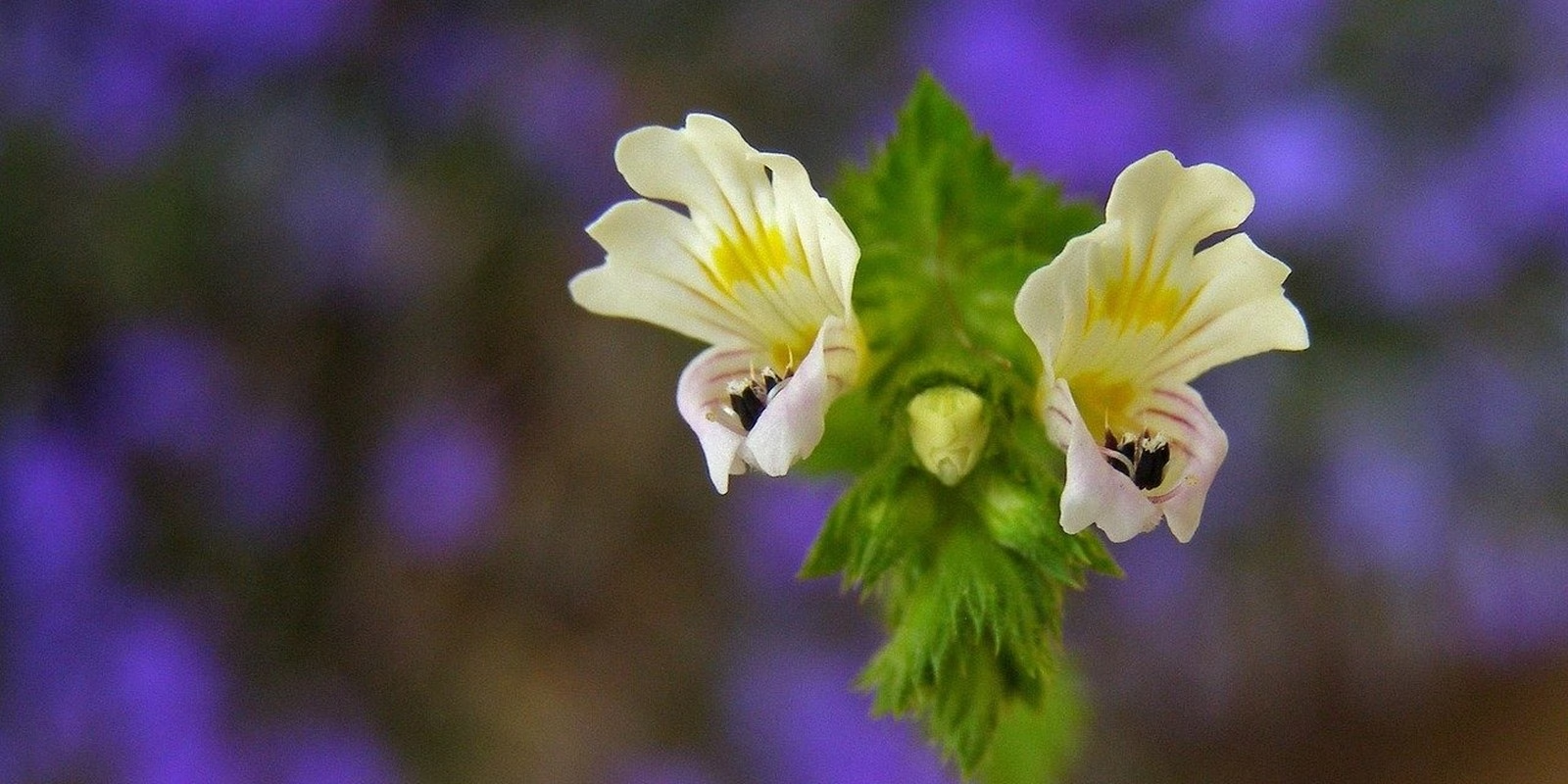
A pair of Euphrasia officinalis flowers at anthesis, the purple streaks converging on the yellow blotch that steers insects towards the mouth of the corolla tube.
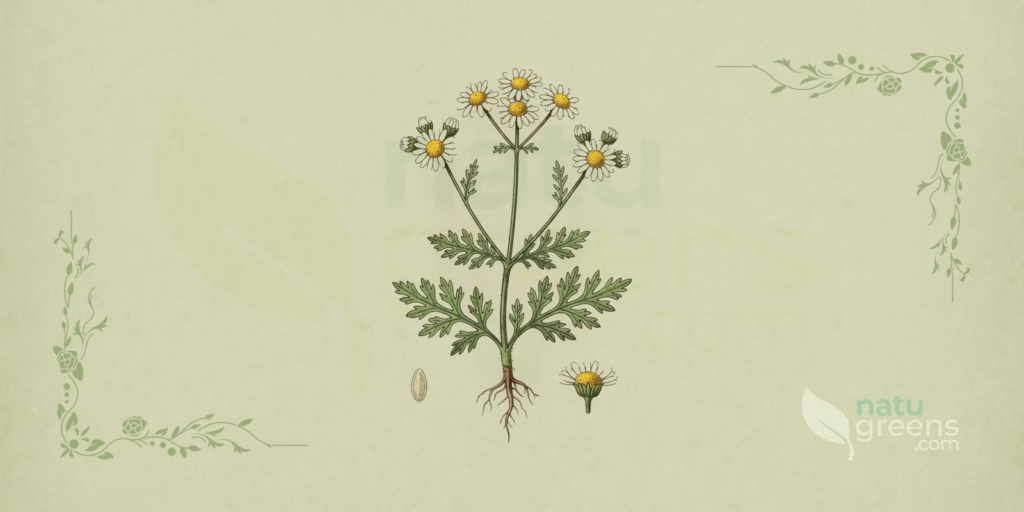
An erect annual herb, 5 to 25 centimetres tall, exceptionally reaching 35 centimetres in vigorous populations. Habit varies a good deal according to host availability and soil fertility: on very poor ground the plant may flower at a few centimetres with a single stem, whereas well-established individuals form small tufts branched from the base. The whole of the aerial portion is covered in short trichomes, glandular or not depending on the subspecies, a character that specialists frequently use in identification.
Leaves
The leaves measure 5 to 15 millimetres long by 4 to 10 millimetres wide, are sessile and ovate to suborbicular in outline. They are arranged in opposite pairs along the lower stem and tend to become alternate in the region of the inflorescence, where they grade into leaf-like bracts. The margin bears three to six pairs of sharp, well-defined teeth, one of the most useful characters for separating the genus from similar-looking neighbours. Colouring is dark green, often flushed with bronze or purple in plants exposed to full sun, and the texture is stiff to the touch.
Flowers
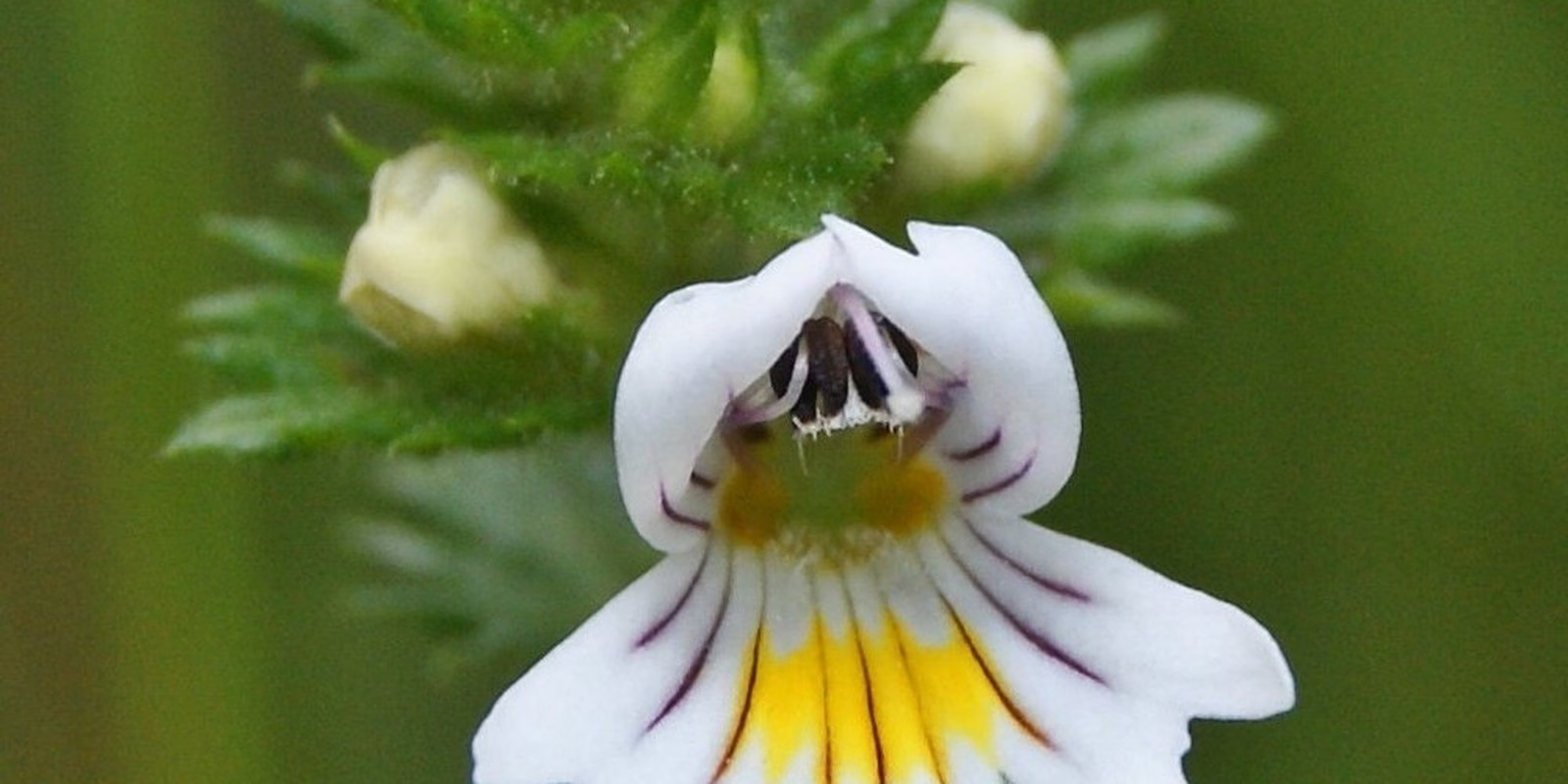
Detail of the two-lipped corolla: the upper lip forms a two-lobed hood sheltering the four didynamous stamens, while the lower one opens into three lobes that serve as a landing platform.
The flowers are zygomorphic and arise singly in the axils of the bracts, forming a leafy terminal spike that lengthens as flowering progresses. The calyx is tubular, hairy and ends in four teeth. The corolla measures 6 to 10 millimetres in most populations, reaching 12 millimetres in the large-flowered plants of the rostkoviana group, and is two-lipped: the upper lip forms a slightly recurved, two-lobed hood, while the lower one opens into three lobes that serve as a landing platform. The ground colour is white or pale lilac, crossed by converging purple streaks and marked by a vivid yellow blotch on the lower median lobe. There are four didynamous stamens, included within the corolla tube, with anthers whose thecae bear pointed appendages.
Fruits and Seeds
The fruit is a laterally compressed loculicidal capsule, 4 to 7 millimetres long, which splits into two valves on ripening and remains enclosed by the persistent calyx. Each capsule holds numerous minute seeds, 0.5 to 1 millimetre, oblong, pale brown and marked by longitudinal ridges that are readily visible under a hand lens. The very low weight of the seeds is decisive for the ecology of the species, because their minimal food reserve leaves the seedling with very little time in which to locate a host.
Root and Stem
The root system is shallow and poorly developed, with a short main root and fine lateral roots spreading through the upper soil layer. From these arise the haustoria, specialised organs that attach to the root of a neighbouring plant, penetrate the cortex and establish vascular continuity with the host xylem. It is through that connection that eyebright obtains water and mineral nutrients. Preferred hosts belong to the Poaceae, but the species also links to Fabaceae, Plantaginaceae and Asteraceae, among other families. The stem is simple or branched, rounded in section, green to reddish, with short internodes.
Distribution and Habitat
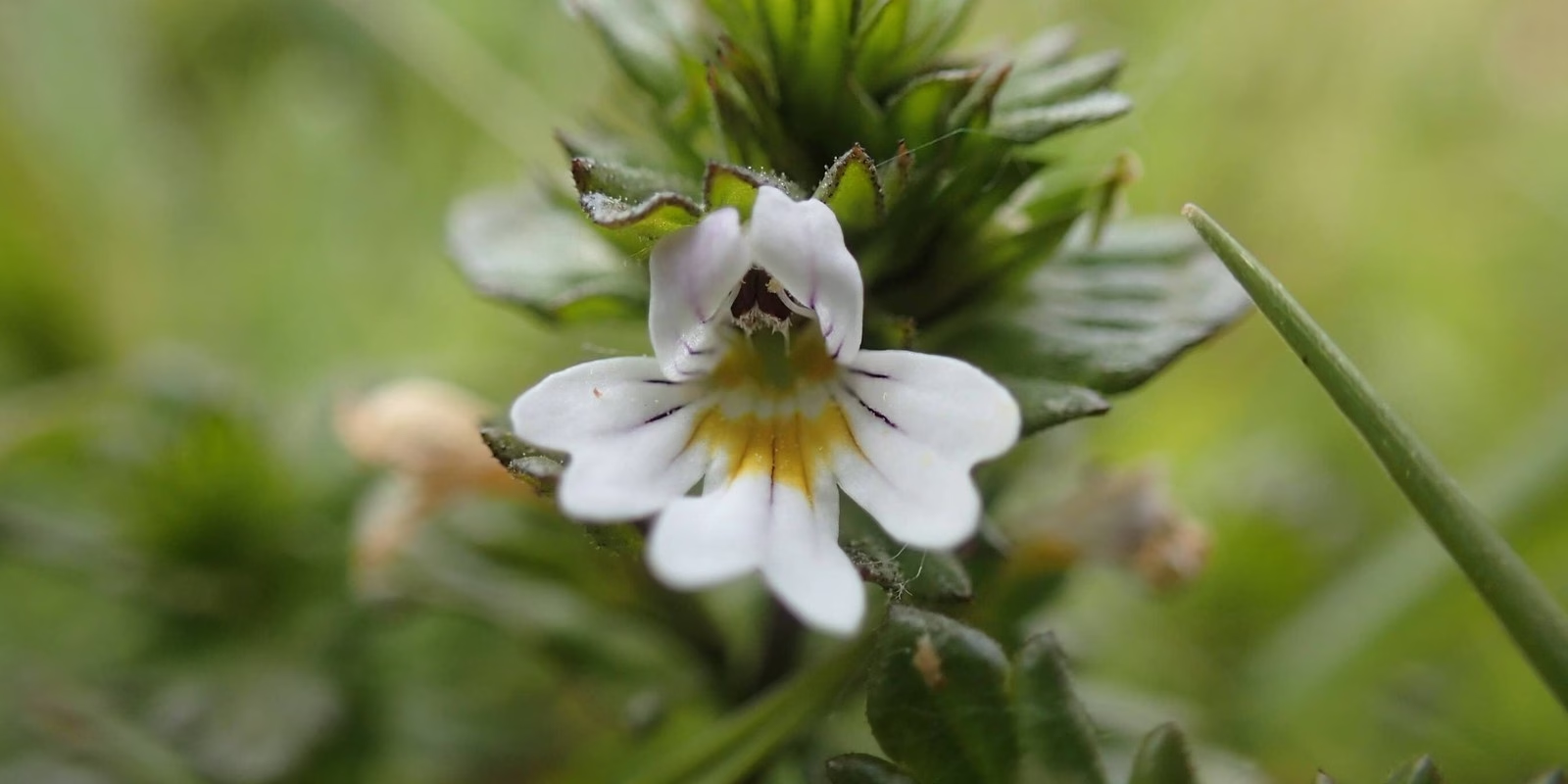
Eyebright flowers close to the ground, threaded among the meadow grasses from which it draws water and mineral salts through haustoria attached to neighbouring roots.
The native range recognised by Plants of the World Online runs from Finland to Western Siberia and Turkey, covering practically the whole of Europe, the Caucasus and Transcaucasia. The species is recorded from the British Isles and Scandinavia through to the Balkan Peninsula and European Russia, with a presence in the Alps, the Carpathians and the Pyrenees. Beyond that belt there are introduced and naturalised populations in the far south of South America, in central and southern Chile, southern Argentina and the Falkland Islands, most likely carried along with European forage seed. Eyebright does not occur in Brazil, neither spontaneously nor in cultivation on any scale.
Typical habitats are oligotrophic meadows, extensively managed pasture, woodland clearings, path margins, drained peatland, coastal grassland and alpine meadows, from sea level up to around 2,500 metres depending on the microspecies. The climate is temperate, with annual rainfall on the order of 500 to 1,500 millimetres and mild summers. The plant tolerates soils ranging from neutral to distinctly calcareous and fares badly on waterlogged acid ground.
One ecological point deserves emphasis: eyebright is an indicator of poor soil. Enrichment through nitrogen fertilisation favours competitive grasses, which grow, shade out and eliminate the hemiparasite within a few seasons. For that reason, vegetation ecologists tend to read the local disappearance of the species as a sign of agricultural intensification. No problematic invasive behaviour has been recorded in the areas where it has been introduced.
Cultivation
Growing eyebright is notoriously difficult, and the reason is hemiparasitism. The seed germinates unaided, but the seedling has to find a compatible root within a matter of weeks or die once its reserves are exhausted. Botanical collections and meadow restoration projects get around the problem by sowing eyebright together with host grasses, generally species of Agrostis, Festuca and Lolium, on a deliberately impoverished substrate.
Sowing is done in autumn, broadcast over closely cut vegetation, so that winter supplies the cold stratification the seeds need in order to break dormancy. Fertilising is counterproductive for the reason already given, and watering is confined to spells of prolonged drought, since excess moisture favours leaf fungi. Standard meadow management consists of a single annual cut, late enough for the capsules to have released that year’s seed.
Recorded plant health problems include the rust Coleosporium euphrasiae, which produces orange pustules on the underside of the leaves, downy mildew caused by Peronospora spp. and powdery mildew caused by Erysiphe spp. in damp spells. Aphids occasionally colonise the inflorescences, and heavy grazing wipes out entire populations before fruiting. Collection of propagating material follows capsule ripening, between late summer and early autumn, and calls for close attention, because dehiscence is rapid and the seed is lost into the soil within a few days.
Phenology
In the northern hemisphere, flowering runs from June to September, peaking in July and August, with a few weeks of variation according to altitude and latitude. Alpine populations flower later and over a shorter period. Fruiting follows closely, from August to October, and the plant completes its entire cycle in a single season, dying once it has dispersed its seed.
Pollination is entomophilous. Short-tongued bees, hoverflies and other flies visit the flowers, drawn by the contrast of the yellow blotch against the pale ground, which steers the insect towards the mouth of the tube. Self-pollination is common and, in several lineages, predominant, with a documented correlation between ploidy level and rate of autogamy: tetraploid populations tend towards smaller flowers and more self-fertilisation than diploid ones. That mixture of breeding systems helps to explain the proliferation of local forms within the genus.
Dispersal is essentially barochorous. Seeds fall a short distance from the mother plant, and long-distance transport depends on external agents, above all livestock, hay-cutting machinery and the movement of forage material between holdings. It was by that route that the species reached the southern cone of the Americas.
Related Species and Confusions
The genus Euphrasia brings together somewhere between 270 and 350 species, depending on the treatment adopted, with a remarkable bipolar distribution: it is present in Europe, Asia, North America, the Andes, Australasia and even on subantarctic islands. In Europe, the most frequent confusions arise not between genera but within Euphrasia itself. Separating E. nemorosa, E. arctica, E. stricta and E. salisburgensis from the forms of E. officinalis requires examination of trichome type, corolla length, the number of internodes below the first flower and the shape of the leaf teeth, preferably with complete, well-pressed material.
Outside the genus, three meadow hemiparasites are regularly mistaken for eyebright by untrained observers. Odontites vernus has flowers that are entirely pink to purple, without the yellow blotch, and narrow, linear leaves. Rhinanthus minor is considerably larger, 20 to 50 centimetres, with yellow flowers and an inflated, flattened calyx that rattles once the seeds dry. Melampyrum pratense has a tubular yellow corolla and a more robust habit, along with linear to lanceolate leaves.
Temperate Europe holds no notoriously toxic plant that closely resembles eyebright in flower, but the general warning still stands: field identification based on a photograph of a small white flower alone is inadequate for any purpose, and determination to species level within Euphrasia usually calls for a specialist.
Phytochemistry
The chemical composition of the aerial parts of Euphrasia officinalis and of closely related microspecies has been characterised by various research groups over recent decades. The most consistent markers are iridoid glycosides, a class abundant in the Lamiales.
- Iridoids: aucubin, catalpol, euphroside, eurostoside, geniposide, ixoroside and mussaenoside, concentrated in the aerial parts.
- Phenylethanoids: verbascoside, also called acteoside, along with leucosceptoside A and decaffeoylacteoside.
- Flavonoids: apigenin and its glycosylated derivatives, luteolin-7-O-glucoside, quercetin and rutin.
- Phenolic acids: caffeic acid, chlorogenic acid and ferulic acid.
- Tannins: condensed and hydrolysable fractions in the aerial parts.
Comparative surveys among alpine populations of Euphrasia rostkoviana revealed an interesting pattern of variation: the iridoids appeared in every population sampled, whereas the presence and levels of rutin and of the phenylethanoids fluctuated considerably from one site to another. Part of that variation was associated with altitude and site conditions. Since the plant draws some of its resources from its host, the chemical profile of a population may also reflect the composition of the surrounding vegetation, and comparisons between studies call for caution regarding the taxonomic identity of the material analysed.
Eyebright in History and Ethnobotany
The association between eyebright and the eyes is an old one and accounts for the epithet, the English name and the German Augentrost. The Doctrine of Signatures, a current of thought widespread in medieval and Renaissance Europe, held that the appearance of a plant indicated its purpose; the converging purple streaks and the yellow blotch of the corolla were read as a resemblance to an eye, and on that basis the plant came to feature in the catalogues of European monastic apothecaries. Herbal and prescription records from the fourteenth to the seventeenth centuries document that reputation, which passed through the European pharmacopoeia and reached the rural folk practice of the nineteenth century.
The plant also left its mark on literature. John Milton, in Paradise Lost, published in 1667, placed eyebright among the plants that the archangel Michael employs to clear Adam’s sight, a passage that fixed the name in English-speaking culture.
Within the history of botany, the genus played a part of its own. Linnaeus described Euphrasia officinalis in 1753. Nineteenth-century naturalists documented the hemiparasitic nature of the genus, and from the 1960s onwards Peter F. Yeo undertook the revision that still organises our understanding of the European species, demonstrating the extent of polyploidy, hybridisation and apomixis within the group. Yeo published his taxonomic revision of Euphrasia in Europe in 1978, and it remains the basis for later regional floras.
Conservation
The IUCN Red List carries no published global assessment for Euphrasia officinalis sensu lato, so the correct status to record is not evaluated. Neither does the species appear in the CITES appendices. In terms of abundance, the complex remains widely distributed across Europe and is not at risk of extinction as a whole.
The picture changes on descending to the level of microspecies and local populations. Agricultural intensification, nitrogen fertilisation, the drainage of wet grassland and the abandonment of extensive grazing have wiped out oligotrophic meadows across much of the continent, and eyebright populations along with them. In the United Kingdom, endemic microspecies such as Euphrasia rivularis and Euphrasia vigursii rank among the most threatened plants in the national flora. The general decline of pollinating insects adds further pressure on lineages that depend on cross-pollination. Conservation programmes for semi-natural grassland, built around late cutting and low-density grazing, are the main management tool available.
Interesting Facts
- The genus Euphrasia has a bipolar distribution, a rare pattern in plants: it occurs in the cool temperate zones of the northern hemisphere and reappears in the southern Andes, in New Zealand and on subantarctic islands, the outcome of long-distance dispersal followed by recent radiations.
- Because it reduces the vigour of dominant grasses, eyebright and other meadow hemiparasites are used in ecological restoration projects as a tool for opening up space for less competitive herbaceous species.
- Ploidy levels within the genus range from diploid to dodecaploid, built on a base chromosome number of eleven, through multiple independent polyploidisation events.
- In the British flora alone, dozens of hybrid combinations have already been described within Euphrasia, which makes the genus one of the champions of hybridisation among the plants of the British Isles.
- The name of the genus honours Euphrosyne, one of the three Graces of Greek mythology, whose name means joy.
Notice: this content is for informational purposes and does not replace professional medical advice. Consult a physician or herbal practitioner before using medicinal plants, especially during pregnancy, breastfeeding, or alongside medication.
References and Scientific Studies
View All 10 Cited References
- International Plant Names Index (IPNI). Euphrasia officinalis L., Sp. Pl. 2: 604 (1753), record 802732-1. Royal Botanic Gardens Kew, Harvard University Herbaria and Australian National Botanic Gardens. Available at ↗
- Plants of the World Online (POWO). Euphrasia officinalis L. Royal Botanic Gardens, Kew. Available at ↗
- 1978 Yeo, P. F. A taxonomic revision of Euphrasia in Europe. Botanical Journal of the Linnean Society, v. 77, p. 223-334, 1978.
- 1972 Tutin, T. G. et al. (eds.). Flora Europaea, vol. 3. Cambridge: Cambridge University Press, 1972.
- 2019 Stace, C. A. New Flora of the British Isles. 4th ed. Middlewood Green: C&M Floristics, 2019.
- 2008 Gussarova, G. et al. Molecular phylogeny and biogeography of the bipolar Euphrasia (Orobanchaceae): recent radiations in an old genus. Molecular Phylogenetics and Evolution, v. 48, n. 2, p. 444-460, 2008.
- 2022 Wang, X. et al. Pervasive phylogenomic incongruence underlies evolutionary relationships in eyebrights (Euphrasia, Orobanchaceae). Frontiers in Plant Science, v. 13, article 869583, 2022.
- 2002 Ersöz, T. et al. Iridoid and phenylethanoid glycosides from Euphrasia pectinata. Turkish Journal of Chemistry, v. 26, n. 2, p. 179-185, 2002.
- 2017 Zidorn, C. et al. Research survey on iridoid and phenylethanoid glycosides among seven populations of Euphrasia rostkoviana Hayne from the Alps. Phytochemistry, v. 136, p. 92-97, 2017.
- 2024 IUCN. The IUCN Red List of Threatened Species. Version 2024. Available at ↗