Aesculus hippocastanum L. / Horse Chestnut, a robust deciduous tree native to the Balkans, has spread across many temperate regions of the world and is widely recognized for its medicinal properties. Valued in herbal medicine for its active compounds, horse chestnut is traditionally used in the management of circulatory and inflammatory conditions.
The plant has a rich history of traditional use across various cultures, with applications ranging from folk medicine to modern scientific research, and its observed effects are attributed to its phytochemical composition. This tree continues to be the subject of extensive study, and scientific validation reinforces its standing as a medicinal plant of phytotherapeutic interest.
Popular and International Names of Horse Chestnut
- English: buckeye, conker tree, European horsechestnut, horse chestnut.
- Spanish: castaña de indias, castaño de indias.
- Portuguese: castanha-da-índia, castanheiro-da-índia.
- French: châtaignier de cheval, marronnier d’Inde.
- Italian: castagno d’India, ippocastano.
- German: Gewöhnliche Rosskastanie, Rosskastanie.
Botanical Synonyms of Aesculus Hippocastanum
The scientific name Aesculus hippocastanum L. is the most widely accepted and used, although the plant has other botanical synonyms that reflect taxonomic reclassifications and historical variations. Understanding these synonyms is essential for botanical research, since it ensures correct identification of the species across different scientific contexts.
Aesculus asplenifolia, Aesculus castanea, Aesculus memmingeri, Aesculus procera, Hippocastanum vulgare (Gaertn.).
Botanical Family: Sapindaceae
The family Sapindaceae, formerly known as Hippocastanaceae, encompasses numerous species of trees and shrubs distributed across the globe, including plants of considerable ecological and economic importance. Recognized for its morphological and chemical diversity, Sapindaceae includes many members that produce significant bioactive compounds.
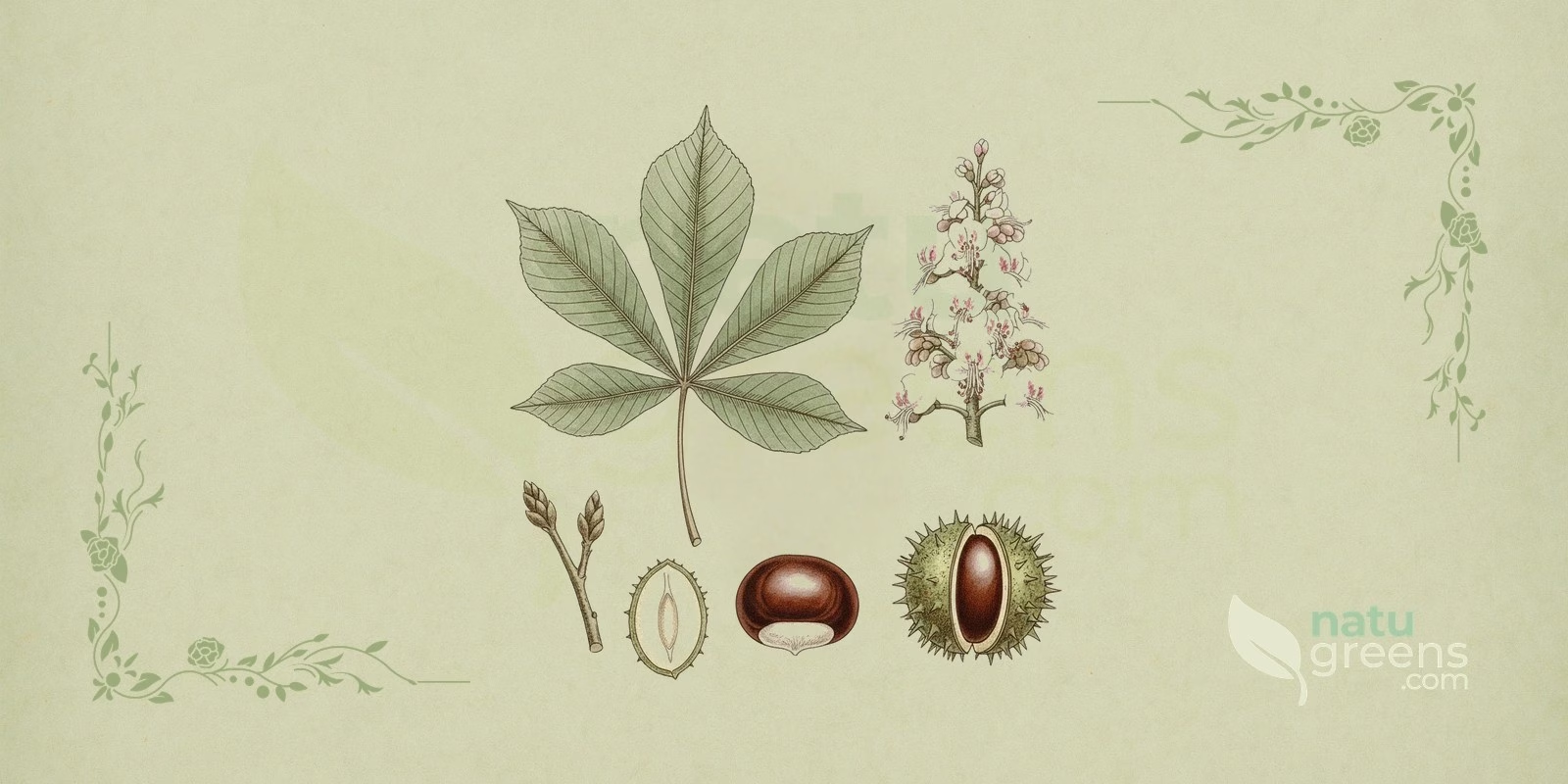
Horse chestnut displays traits typical of the Sapindaceae family, with palmate leaves and distinctive spiny fruits, and belongs to a group notable for producing triterpenoid saponins, compounds that lend medicinal properties to many species. Pharmacological research has focused intensively on this family, contributing to the development of new phytopharmaceuticals.
Parts of Horse Chestnut Used
- Bark
- Flowers
- Leaves
- Seeds (horse chestnuts)
Ethnobotanical and Traditional Uses
- Anti-inflammatory use
- Circulatory issues (hemorrhoids)
- Circulatory issues (phlebitis)
- Circulatory issues (varicose veins)
- Topical use for joint pain
- Topical use for muscle pain
Therapeutic Properties of Horse Chestnut
- Anti-inflammatory (studied inhibitory effect on inflammatory mediators, reducing edema)
- Antiedematous (studied effect in reducing swelling, particularly in chronic venous insufficiency)
- Antioxidant (in vitro studies indicate protective effects against free radicals)
- Venotonic (studied effect on venous tone, improving blood flow)
- Vasoprotective (studied protective effect on the integrity of blood vessels)
Detailed Phytochemical Profile of Horse Chestnut
Horse chestnut is rich in several bioactive compounds that contribute significantly to its therapeutic properties, including triterpenoid saponins, flavonoids, and coumarins. Aescin is the most studied component and is responsible for most of the observed medicinal effects, the result of a complex interaction among the plant’s various phytochemicals.
Aescin: The Main Active Component
Aescin, a mixture of glycosides, is the most relevant triterpenoid saponin in the plant, with beta-aescin as its most active and most researched fraction. This compound is fundamental to the venotonic action of horse chestnut, since it acts directly on the walls of blood vessels and is considered crucial to the effects observed on circulation.
Flavonoids and Coumarins
Flavonoids such as quercetin, kaempferol, and rutin are also present and contribute antioxidant and anti-inflammatory properties, while coumarins, including esculin and fraxin, round out the phytochemical profile. Esculin, in particular, is a toxic glycoside in the raw plant, but it is removed from the standardized extracts intended for medicinal use.
Other Components
Tannins are also found in horse chestnut, with possible astringent and antioxidant effects, and the synergy among all these phytochemicals enhances the therapeutic effects observed in the plant. Ongoing studies seek to clarify the complexity of its composition, allowing for better use of its benefits.
Preparation and Administration Forms of Horse Chestnut
- Capsules (standardized seed extract)
- Creams for topical use
- Gels for topical use
- Infusions (of leaves and flowers, with caution)
- Tinctures
Synergy with Other Medicinal Plants
Although there is no specific information on synergies with other plants in a medicinal context, horse chestnut is frequently combined with other venotonics in commercial formulations, with the aim of enhancing the beneficial effects observed on circulation. Combining different extracts may optimize results, but it is important to consult a healthcare professional before combining medicinal plants.
Recipes and Usage Protocols of Horse Chestnut
Because of the toxicity of the raw plant, there are no safe home recipes for ingesting horse chestnut: its medicinal use must be limited exclusively to standardized extracts, formulated to ensure safety and consistent quality. Dosage and administration should always be guided by a healthcare professional, since self-medicating with the raw plant is dangerous and inadvisable.
The preparations above follow traditional records and do not replace professional guidance. Before any internal use, review the contraindications and interactions described in this article.
Associated Therapies
Phytotherapy
In phytotherapy, horse chestnut is widely used, and its standardized extracts are employed in the management of chronic venous insufficiency (CVI), hemorrhoids, and varicose veins. Modern phytotherapy supports the use of this plant based on scientific studies investigating its safety and its effects on circulation, establishing it as a natural option in this context.
Homeopathy
In homeopathy, Aesculus hippocastanum is a remedy commonly indicated for conditions such as varicose veins and hemorrhoids, using highly diluted doses of the plant with the aim of stimulating the body’s self-healing capacity, following the principle that “like cures like.” It is used as a complementary therapy for circulatory problems.
Contraindications and Side Effects of Horse Chestnut
Ingesting raw seeds, leaves, bark, and flowers of horse chestnut is toxic due to the presence of esculin, and can cause nausea, vomiting, diarrhea, and tremors, and in severe cases can progress to kidney failure and even risk of death. It is essential to avoid consuming the plant without proper processing, as safety is an absolute priority in medicinal use.
Side Effects of Standardized Extracts
Standardized extracts are generally safe when used correctly, but some side effects can occur, with dizziness, headache, and stomach discomfort being the most common, along with itching reported by some individuals. It is important to follow recommended dosages and to report any adverse reaction to a doctor.
Drug Interactions and Contraindications
Horse chestnut can enhance the effect of anticoagulant medications, increasing the risk of bleeding, and it is contraindicated during pregnancy and breastfeeding; patients with kidney disease should avoid high doses. It is always recommended to consult a healthcare professional before starting use, especially for those already taking other medications.
Historical Notes and Interesting Facts
Origin of the Name
The popular name “horse chestnut” has uncertain origins: one theory suggests that the seeds were used in Turkey to treat horses with respiratory ailments, while another points to the resemblance between the leaf scar left on the branch and a horseshoe. Both explanations are considered plausible.
Ornamental and Cultural Use
Horse chestnut is a very popular ornamental tree, often planted in parks and avenues in cities around the world, such as the Champs-Élysées in Paris. The tree behind Anne Frank’s house in Amsterdam was a horse chestnut that became a symbol of hope and resilience, and the species also appears among the symbols of Kyiv, the capital of Ukraine.
The Game of “Conkers”
In Britain and Ireland, horse chestnut seeds are used in a children’s game known as “conkers,” in which two players swing their chestnuts tied to strings with the aim of breaking their opponent’s chestnut. It is a beloved folk tradition, especially among children, and a fun part of local culture.
Frequently Asked Questions about Horse Chestnut
Is Horse Chestnut Edible?
No. Raw horse chestnut seeds are toxic, as they contain esculin, a compound that can cause serious health problems and trigger nausea, vomiting, diarrhea, and other severe symptoms. It is crucial not to confuse horse chestnut with the edible chestnut, which belongs to a different botanical family.
What Is Horse Chestnut Extract Used For?
Standardized horse chestnut extract is used mainly in the management of chronic venous insufficiency (CVI) and for relieving symptoms of varicose veins and hemorrhoids, since its venotonic and anti-inflammatory action supports circulation and helps reduce the swelling and pain associated with these conditions. It is one of the most studied phytotherapeutics for this purpose.
What Are the Side Effects?
Standardized extracts can cause mild side effects, such as dizziness, headache, stomach discomfort, and itching, while ingesting the raw plant can lead to much more serious effects, such as kidney failure, tremors, and loss of coordination. For this reason, always use standardized products under medical guidance, since safety is a priority.
Can It Be Used During Pregnancy?
No. The use of horse chestnut is contraindicated during pregnancy and breastfeeding, as there are not enough studies to confirm its safety for pregnant and nursing women. It is essential to avoid any potential risk to mother and baby, always consulting a doctor before using any phytotherapeutic during these periods.
Notice: this content is for informational purposes and does not replace professional medical advice. Consult a physician or herbal practitioner before using medicinal plants, especially during pregnancy, breastfeeding, or alongside medication.
References and Scientific Studies
Peer-Reviewed Scientific Studies (1)
- PMC2012 Horse chestnut seed extract for chronic venous insufficiency. Pittler, M. H., & Ernst, E. (2012). Cochrane Database of Systematic Reviews.
Institutional Sources (1)
- GOV Horse Chestnut: Usefulness and Safety. National Center for Complementary and Integrative Health (NCCIH).
Supplementary Readings (3)
- Horse Chestnut. Dr. Hauschka.
- Horse chestnut in other languages. Botanical-online.com.
- A Modern Herbal | Chestnut, Horse. Botanical.com.