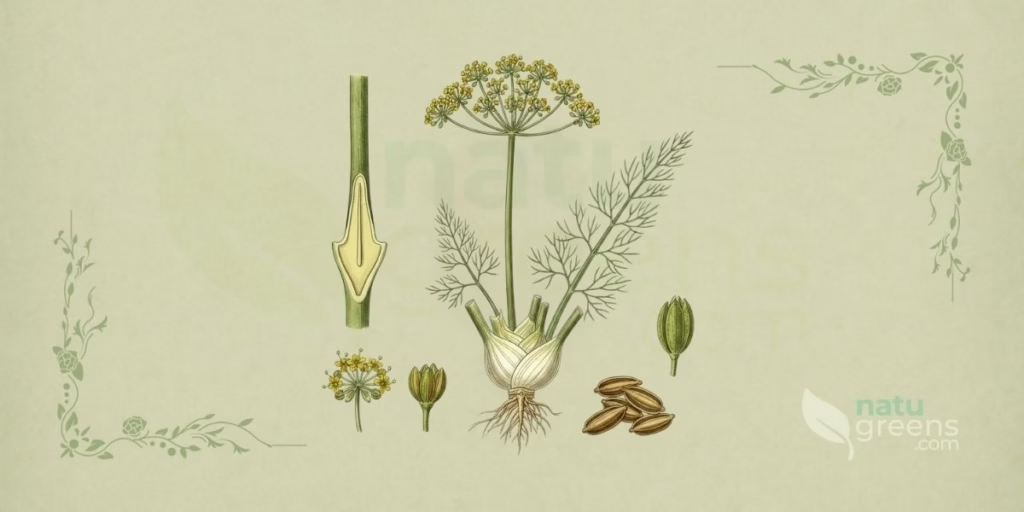
Foeniculum vulgare is a tall, glaucous, intensely aromatic perennial herb that anyone recognises by its anise scent the moment a leaf is crushed between the fingers. It belongs to the Apiaceae, the carrot and celery family, and stands apart within it through a rare combination of traits: leaves dissected into almost hair-like segments, yellow umbels with no bracts whatsoever at the base, and oblong fruits with prominent ribs. English usage separates the plant cleanly from true anise, but that clarity is not universal, and in several languages fennel and Pimpinella anisum share a common name, which has caused persistent confusion in the spice trade.
The species is native to the Mediterranean basin and travelled with the civilisations that organised themselves around that sea. From kitchen gardens it moved to field-scale agriculture and from there to naturalised status across virtually every temperate and subtropical region of the planet. In some of them the success proved excessive: in California and in several Australian states fennel ranks among the invasive plants with the heaviest impact on native vegetation.
Three independent features make the plant remarkable from a strictly botanical standpoint. The first is the morphological plasticity accumulated over millennia of selection, which produced everything from slender wild forms to the fleshy false bulb of Florence fennel. The second is the existence of sharply defined chemotypes, separated by the ratio between anethole and fenchone, capable of giving visually identical plants completely different aromatic profiles. The third is a nomenclatural history that remains unsettled, with recent proposals to dissolve the genus back into Anethum. This profile covers the plant itself, its taxonomy, morphology, cultivation and chemistry, without addressing applications in health.
For the traditional uses, properties and preparation methods of this plant, see the article Fennel (Foeniculum vulgare): Properties and Benefits.
In English, fennel is kept clearly apart from true anise, although several other languages use a single common name for both plants.
Taxonomy
The accepted name is Foeniculum vulgare Mill., published by Philip Miller in the eighth edition of the Gardeners Dictionary, entry number 1, on 16 April 1768. Miller did not make a new combination but proposed a new name, which is why the authorship carries no parentheses. The earlier Linnaean name Anethum foeniculum L., from the Species Plantarum of 1753, is now treated as a synonym. A later homonym published by John Hill in The British Herbal of 1756 also circulates in the literature; it was never adopted by the reference catalogues and should not be mistaken for Miller’s name.
The full classification is set out below.
- Kingdom: Plantae
- Division: Tracheophyta (angiosperms)
- Class: Magnoliopsida (eudicots)
- Order: Apiales
- Family: Apiaceae (Umbelliferae)
- Subfamily: Apioideae
- Tribe: Apieae
- Genus: Foeniculum Mill., 1754
- Species: Foeniculum vulgare Mill., 1768
One misconception that runs through much of the secondary literature, including widely cited review articles, is worth correcting here: Foeniculum is not a monotypic genus. Plants of the World Online recognises five accepted species, and the restricted ranges of the other four explain why they attract so little attention.
- Foeniculum piperitum (Ucria) C.Presl: the bitter fennel of the Mediterranean and Macaronesia, long treated as a subspecies of F. vulgare.
- Foeniculum sanguineum Triano & A.Pujadas: endemic to southern Spain and northern Morocco, described only in recent years.
- Foeniculum scoparium Quézel: confined to the Tibesti massif in Chad, in a desert setting.
- Foeniculum subinodorum Maire, Weiller & Wilczek: endemic to Morocco.
- Foeniculum vulgare Mill.: the species covered here, by far the most widely distributed.
The nomenclature of the group is not settled either. In a paper published in 2021 in the Botanical Journal of the Linnean Society, Reduron and Spalik proposed on molecular phylogenetic grounds to fold Foeniculum back into Anethum, which would reverse Miller’s separation and return fennel to formal proximity with dill. The corresponding combinations have been published and are registered in the International Plant Names Index, but Plants of the World Online still maintains Foeniculum as an independent genus. While the catalogues disagree, Miller’s name remains the one in current use.
Synonyms
Recognised homotypic and heterotypic synonyms include, in alphabetical order:
- Anethum dulce DC.
- Anethum foeniculum L.
- Anethum foeniculum var. dulce (Mill.) Nois.
- Anethum minus Gouan
- Anethum panmorium Roxb.
- Anethum rupestre Salisb.
- Foeniculum officinale All.
- Foeniculum officinale subsp. pateri Prodan
- Foeniculum officinale subsp. sativum (C.Presl) Arcang.
- Foeniculum officinale var. dulce (Mill.) Alef.
- Foeniculum panmorium (Roxb.) DC.
- Foeniculum rigidum Brot. ex Steud.
- Foeniculum sativum (C.Presl) Bertol.
Cultivar Groups
Horticultural selection has generated an abundant infraspecific nomenclature, with dozens of varieties and convarieties described through the nineteenth and twentieth centuries. In agronomic practice three groups account for everything that is grown, and the difference between them is one of harvested product before it is one of botany.
- Florence fennel (var. azoricum (Mill.) Thell., also treated as convar. azoricum): the sheathing bases of the lower petioles thicken and overlap to form a white, fleshy false bulb harvested as a vegetable. It is not a true bulb, since neither scales nor an underground stem are involved.
- Bitter fennel (var. vulgare): the forms closest to the wild type, with fruits rich in fenchone and a comparatively low anethole content.
- Sweet fennel (var. dulce (Mill.) Thell.): selected for fruit production, with anethole dominating the essential oil and fenchone much reduced.
Etymology
The generic name Foeniculum is the Latin diminutive of faenum, hay, and means something close to little hay, a reference both to the scent the dried plant gives off and to the fineness of the foliage. The epithet vulgare is the Latin adjective for common, chosen by Miller to set the widespread form apart from the local variants known to him. The English word fennel descends from the same Latin root through Old English fenol, itself an early borrowing, and has obvious cognates in Spanish hinojo, Italian finocchio, French fenouil and Portuguese funcho.
Morphological Description
A perennial herb, often managed as a biennial or even an annual in commercial cultivation, robust, glabrous throughout and covered by a bluish wax that gives it its characteristic glaucous cast. Height ranges from 100 to 250 centimetres in the reproductive phase, the tallest individuals belonging to well established wild populations. The whole plant releases an anise aroma when bruised, and that scent serves as the first field criterion.
Leaves
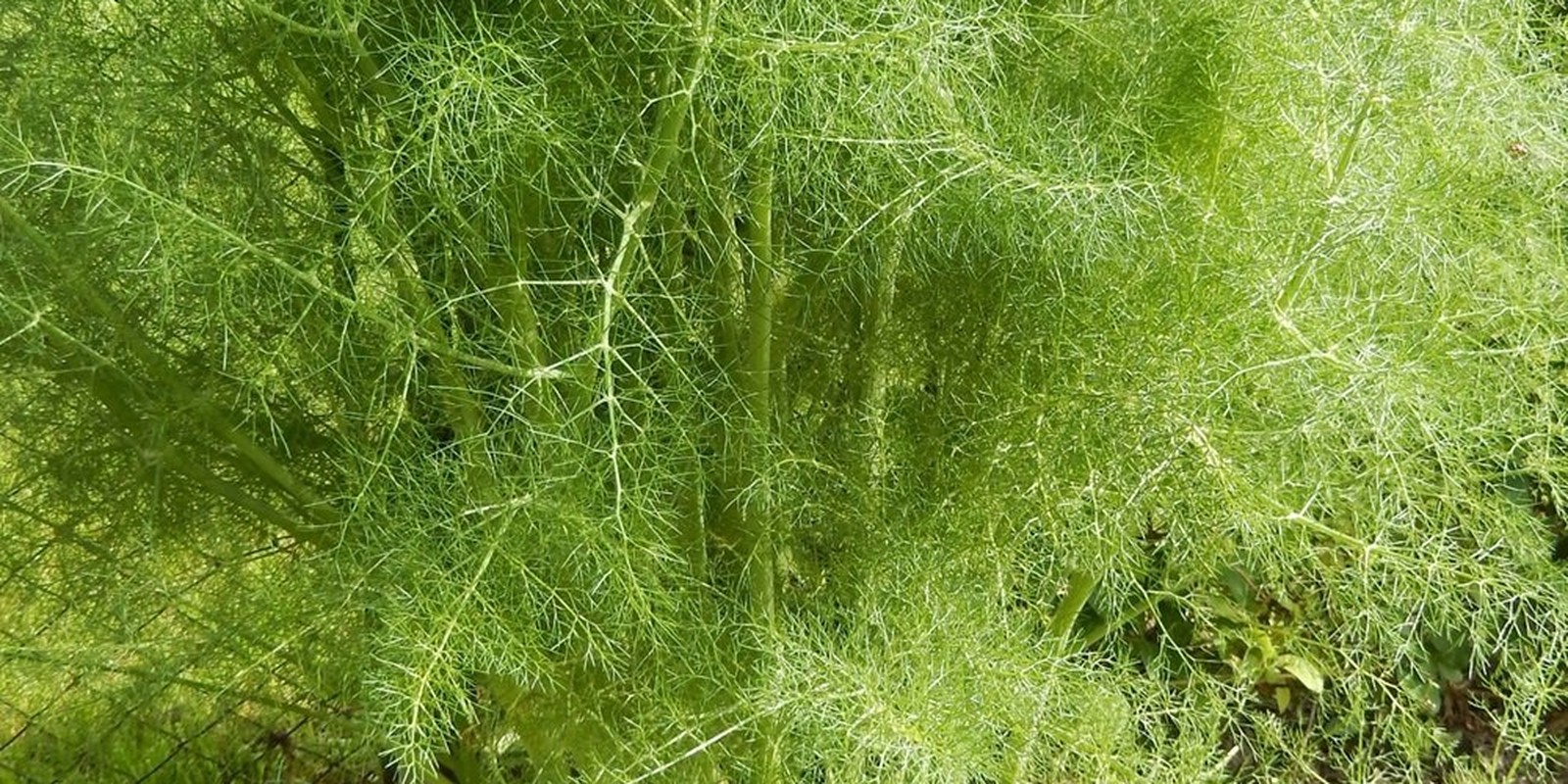
Dissected three to four times over, the blade ends in filaments barely a millimetre wide. It is this repeated division, rather than the outline of any single leaf, that gives fennel its feathery texture.
The leaves are alternate, triangular to oblong in outline, and measure 15 to 40 centimetres in total length. The blade is three to four times pinnately dissected, and the division goes so far that the ultimate segments are reduced to hair-like filaments 0.5 to 5 centimetres long and less than a millimetre wide, giving the foliage an unmistakable feathery texture. The colour is blue-green, and bronze-leaved ornamental cultivars exist. The petiole widens at the base into a broad clasping sheath, and it is precisely the thickening of these sheaths that produces the false bulb of Florence fennel. Cauline leaves become progressively smaller towards the apex, until they are reduced to little more than the sheath.
Flowers
The inflorescence is a terminal compound umbel 5 to 15 centimetres across, carried on 10 to 40 unequal rays. Involucre and involucels are absent or reduced to vestiges, and that absence is the most practical diagnostic character for separating fennel from other yellow-flowered umbellifers. The individual flowers are hermaphrodite and minute, with five golden-yellow petals whose tips curve strongly inwards, five stamens with yellow anthers and an inferior bicarpellate ovary crowned by a conical stylopodium that acts as an exposed nectary. The central umbel matures ahead of the lateral ones, which staggers fruiting within a single plant.
Fruits and Seeds
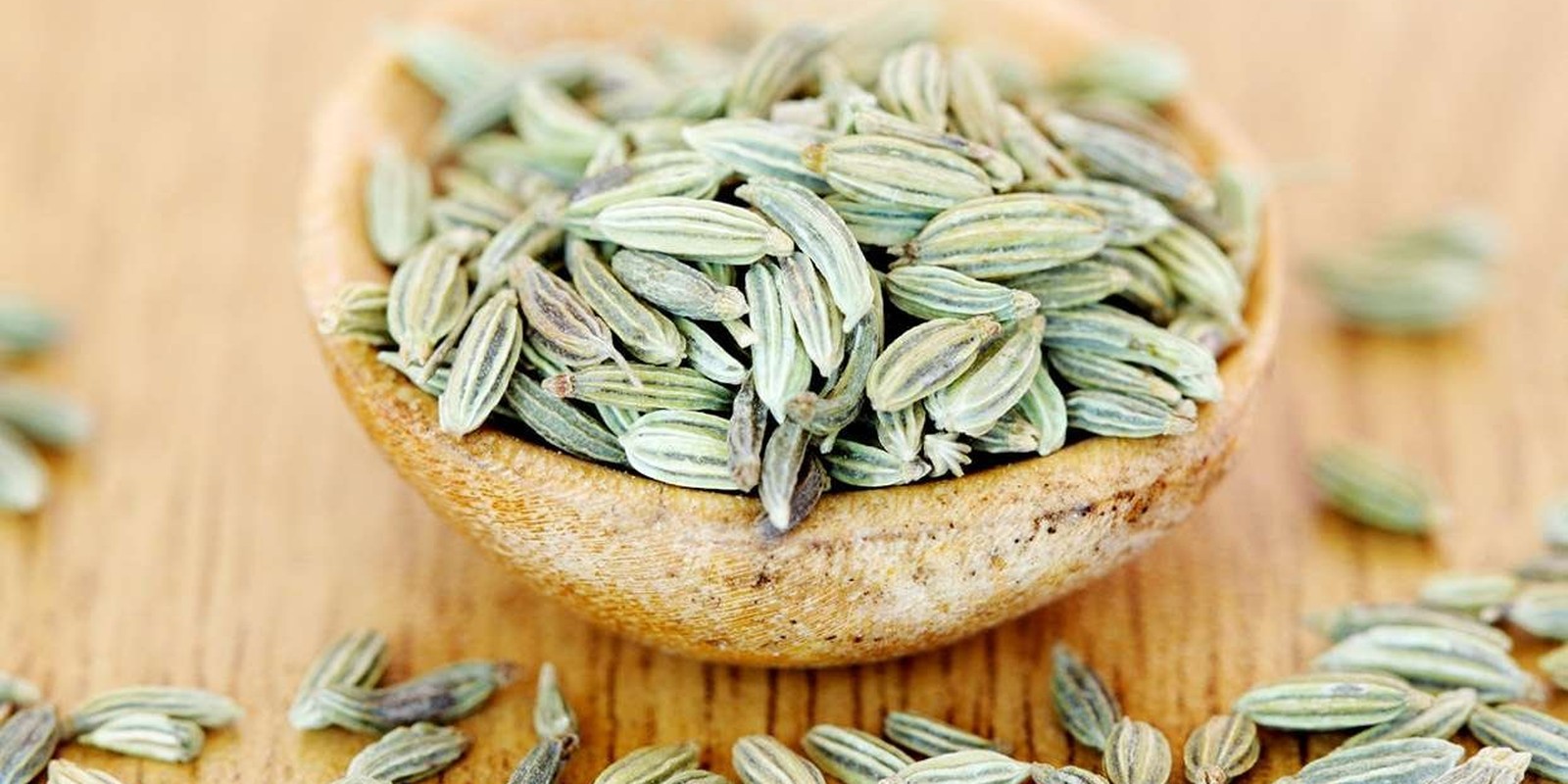
Sold everywhere as fennel seed, this is in fact the whole dry fruit. The pale ribs run the length of each mericarp, and the essential oil sits in the vittae between them.
The fruit is a schizocarp that splits into two mericarps, the cremocarp typical of the family. It measures 3.5 to 10 millimetres depending on the variety, is oblong-ovoid and slightly curved, and turns greenish brown at maturity. Each mericarp bears five prominent longitudinal primary ribs, nearly winged in some material, and between them run the secretory canals known as vittae, where the essential oil accumulates. What the spice trade sells as fennel seed is the entire mericarp, a dry fruit complete with pericarp, rather than the botanical seed.
Root and Stem
The root is a stout, fusiform, fleshy taproot, whitish and anise-scented, descending 50 to 100 centimetres into the soil profile. That depth accounts for the species’ notable drought tolerance once established. In perennial individuals of several years the root becomes woody and thickens in its upper portion, forming a crown from which multiple stems arise. The stem is cylindrical, finely striate lengthwise, solid when young and hollow between the nodes at maturity, branched in the upper third and uniformly blue-green, without spots or pigmentation of any kind. That absence of spots is a field observation of real importance when separating fennel from dangerous lookalikes in the same family.
Distribution and Habitat
Plants of the World Online circumscribes the native range to the Mediterranean region in the broad sense: southern Europe from Portugal to the Balkans and Greece, North Africa from Morocco to Egypt, and the western fringe of Asia taking in Anatolia, Syria, Iraq and Iran. As with almost any plant cultivated since antiquity, the exact boundary between genuinely native populations and very old escapes from cultivation cannot be drawn with precision across much of that area.
Beyond its Mediterranean cradle the species is naturalised in practically every inhabited temperate and subtropical region. The list includes, in alphabetical order, Argentina, Australia, Brazil, Canada, Chile, India, Japan, Mexico, New Zealand, South Africa and the United States, along with oceanic archipelagos such as the Azores, the Canaries, Hawaii and Madeira. In Brazil fennel occurs as a subspontaneous plant mainly in the south and southeast, on waste ground, road verges and abandoned farmland, where it finds the temperate to subtropical climate it prefers.
The typical habitat brings together disturbed ground, dry slopes, road embankments, degraded pasture and coastal areas on well drained soil, from sea level up to about 1,500 metres. The plant tolerates calcareous and slightly saline soils, thrives at a pH between 5.5 and 8.0, and responds badly only to waterlogged or compacted ground. Its optimal thermal range lies between 15 and 25 degrees Celsius, with resistance to light frosts down to minus 5 degrees and declining performance above 30 degrees.
Cultivation of Fennel
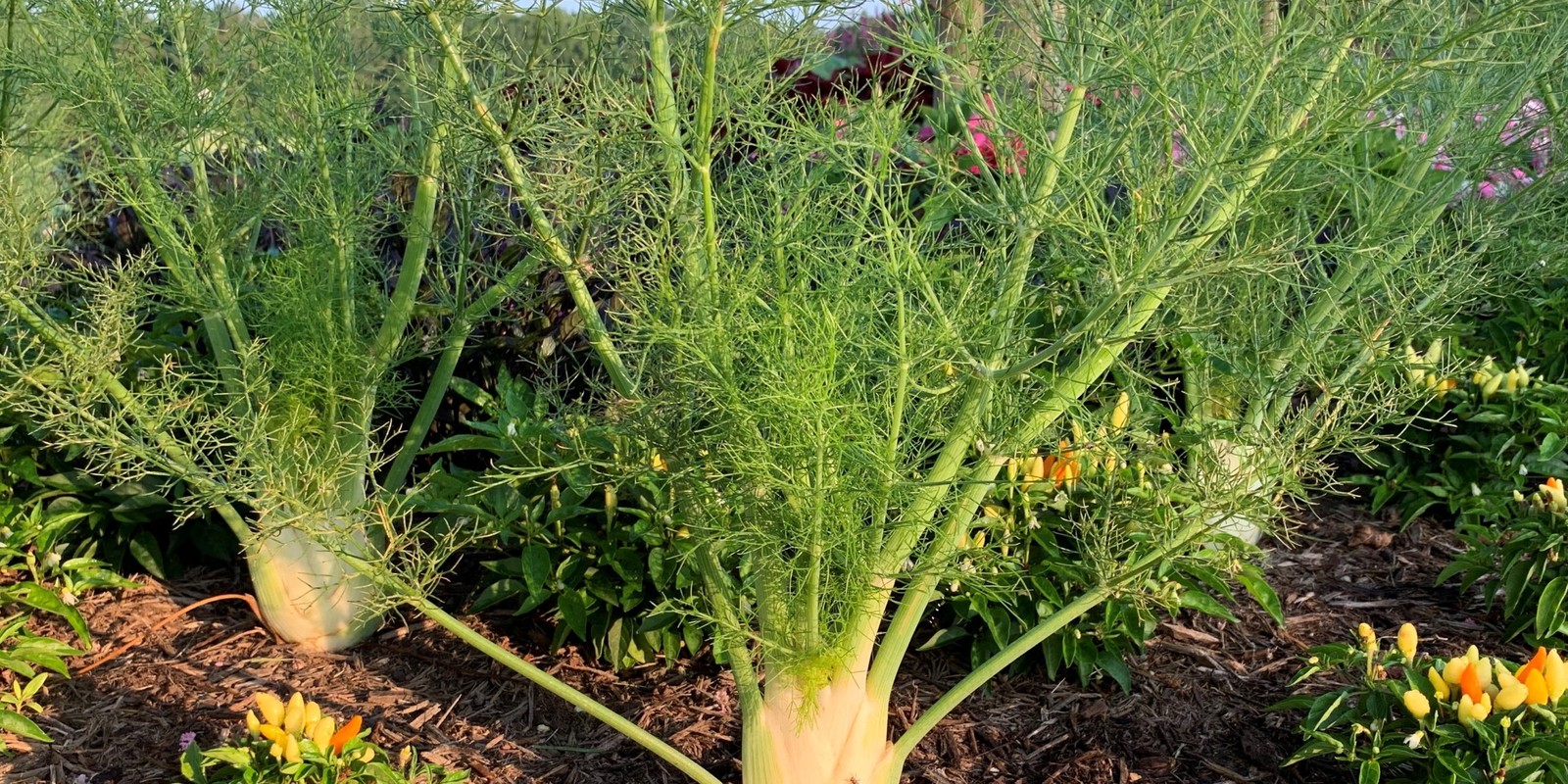
In a mulched bed in full sun the swollen sheaths sit above soil level rather than below it, a useful reminder that the Florence fennel harvest is a stack of leaf bases and not a bulb at all.
Propagation is chiefly by seed, or more strictly by the entire dry fruit. Germination takes 10 to 14 days at temperatures between 18 and 22 degrees Celsius, behaviour far more predictable than that of other cultivated umbellifers, and sowing is done at about one centimetre depth, either direct or in trays for later transplanting. Perennial forms grown in gardens can be divided in spring, although division always means losing part of the taproot and a slow recovery.
The crop demands full sun without compromise. Shading reduces essential oil production and prevents the false bulb from thickening in the bulbing varieties. Fertilisation should be moderate, and excess nitrogen is counterproductive for two reasons at once: it dilutes the aroma and brings bolting forward. Organic compost worked in before planting, on the order of 5 to 10 tonnes per hectare, meets the crop’s demand on most soils. Spacing varies with the intended harvest, running from 25 to 30 centimetres within the row for bulbing varieties to 30 to 40 centimetres for seed varieties, with proportionally wider inter-row distances.
Water management follows opposite logics depending on the product. Bulbing varieties need uniform moisture, because any fluctuation translates into fibrous or split bulbs, whereas seed varieties respond to moderate water deficit with a rise in essential oil concentration. Bulb crops are also earthed up, soil being drawn around the base to promote blanching through partial etiolation. Sowing of bulbing varieties is shifted to summer or autumn precisely to escape the long photoperiod that triggers premature bolting.
The most frequent pests include, in alphabetical order, the aphid Hyadaphis foeniculi, specific to the crop, which forms dense colonies on developing umbels; the caterpillar of Papilio machaon, the swallowtail butterfly, whose damage to foliage is usually tolerated in gardens; and the slug Deroceras reticulatum, which attacks newly emerged seedlings. Among diseases the notable ones are Cercospora foeniculi, responsible for brown leaf spots; Erysiphe heraclei, the umbellifer powdery mildew, recognisable by its white powdery coating; Plasmopara nivea, the downy mildew agent, which produces yellowish patches on the upper leaf surface and whitish sporulation beneath; and Sclerotinia sclerotiorum, the white mould that attacks the stem base and the false bulb in damp, poorly aerated soils.
False bulbs are harvested 90 to 120 days after sowing, once they reach 8 to 12 centimetres in diameter, by cutting close to the ground. In seed crops the harvest point is the turn of the primary umbels to greenish brown, whole umbels being cut and then dried in the sun or in a drier at 35 to 40 degrees Celsius. Seed varieties begin producing in their second year and hold satisfactory yields for three to five cycles, while perennial garden plants persist for five to ten years before losing vigour.
Phenology
Flowering is concentrated between July and September in the northern hemisphere, shifting to the December to March window in the southern hemisphere, and fruiting follows between September and October at northern temperate latitudes. In the subtropical climates of Brazil the calendar blurs, and individuals in flower outside the expected season are not unusual. Floral induction responds to long photoperiod, and that dependence is the root of the premature bolting problem that plagues bulb crops.
The umbels are protandrous, a general condition in the family: anthers shed pollen several days before the stigmas of the same flower become receptive, an arrangement that favours cross-pollination without entirely preventing selfing within one plant. Visitation is entomophilous and markedly generalist, with flies, small hymenopterans, wasps, beetles and butterflies among the callers, drawn by nectar exposed on the stylopodium. Few flowers are as accessible to insects with short mouthparts as those of the umbellifers, and fennel is often cited as an abundant floral resource on field margins.
Dispersal is essentially barochorous. The mericarps lack functional wings, hooks or plumose appendages and fall by gravity near the parent plant, forming dense patches of regeneration. Movement over greater distances depends on surface runoff, on soil disturbance and above all on human agency, whether through the seed trade or through the movement of farm machinery and earthworks material. That last vector explains much of the species’ association with road embankments in the areas where it has naturalised.
Related Species and Confusions
Within the genus, the four accepted congeners have restricted ranges and rarely come into contact with common fennel outside the western Mediterranean. The exception is Foeniculum piperitum, bitter fennel, treated for decades as a subspecies of F. vulgare and still listed that way in older regional floras. It is separated by its smaller fruits and its sharp, pungent flavour, and the distinction continues to be debated among taxonomists.
The real risks of confusion come from outside the genus. The species most often mistaken for fennel are listed below in alphabetical order, along with the characters that settle each case.
- Anethum graveolens L. (dill): the closest relative in the tribe Apieae and the commonest confusion among feathery-leaved plants. It is separated by its smaller stature, 40 to 100 centimetres, by its annual cycle and above all by its dorsally flattened fruits with a marginal wing, against the oblong, wingless fruits of fennel. The scent of dill is herbaceous and less anise-like.
- Carum carvi L. (caraway): shares the finely divided foliage and the use of the fruit as a spice, but is far smaller, bears white to pinkish flowers and produces curved fruits of an entirely different aroma.
- Conium maculatum L. (poison hemlock): the most dangerous confusion of all, especially at the juvenile stage, when both plants form rosettes of dissected foliage on disturbed ground. Hemlock contains coniine and related piperidine alkaloids, and ingestion of small quantities is lethal to people and animals. It is distinguished by the sharp purple blotches on the stem, by white flowers, by leaves with much broader triangular segments and by a foetid odour, likened to mouse urine, with no trace of anise.
- Ferula communis L. (giant fennel): a Mediterranean plant of even greater stature, capable of exceeding 300 centimetres, with a far thicker stem, broader leaf segments and no anise scent at all.
- Levisticum officinale W.D.J.Koch (lovage): similar in stature and habit, but with broad lobed leaflets instead of filiform ones, and a pronounced celery aroma.
- Pimpinella anisum L. (anise): the most frequent substitution in the spice trade, where both species circulate under overlapping common names in several languages. Anise is annual, reaches 30 to 60 centimetres, has entire or three-lobed basal leaves with toothed margins rather than filiform ones, white flowers instead of yellow and smaller, hairy fruits.
- Ridolfia segetum (L.) Moris (corn parsley): a Mediterranean weed of very similar appearance, with equally hair-like foliage and yellow umbels, separable by its smaller fruits and strictly annual cycle.
The practical field rule combines three quick observations: scent, flower colour and stem. A clear anise aroma, yellow umbels with no bracts at the base and a smooth glaucous stem point to fennel. An unpleasant odour, white flowers or a stem with purple blotches call for stopping the identification and turning to a botanical key or a specialist.
Phytochemistry
The chemical composition of the species is among the best documented in the family and varies sharply between varieties, organs and geographic origins. This section describes what the plant accumulates and where, without addressing effects in people.
The essential oil accounts for 2 to 6 per cent of the dry weight of the fruits and much smaller fractions in leaves and stems. Its composition defines clearly separated chemotypes. trans-Anethole, a phenolic ether responsible for the anise aroma, dominates the profile of sweet fennel lines, where it can represent 60 to 80 per cent of the total. Fenchone, a monoterpene ketone with a camphoraceous, bitter taste, occupies the opposite end of the balance and ranges from 1 to 25 per cent, the high values concentrated in wild forms and in bitter fennel. Estragole, also known as methylchavicol, completes the picture at 3 to 10 per cent, alongside limonene, alpha-pinene, myrcene and phellandrene in the monoterpene fraction.
Among the non-volatile phenolic compounds the prominent ones are glycosylated flavonoids, with quercetin-3-O-glucuronide, kaempferol-3-O-glucuronide and isorhamnetin derivatives as the major constituents, together with caffeic, chlorogenic and rosmarinic acids. The coumarins form a group of their own and include umbelliferone, simple in structure, and the furanocoumarins bergapten, imperatorin and xanthotoxin, distributed across leaves, petioles and fruits.
Two toxicological points deserve explicit note. The furanocoumarins listed above are phototoxic: prolonged skin contact with the sap, followed by sun exposure, can trigger phytophotodermatitis, a burn-like reaction with erythema and blistering that mainly affects people handling large volumes of the plant during harvest. Estragole, in turn, is the subject of specific regulatory assessment in the European Union, where the Scientific Committee on Food classified it as genotoxic and carcinogenic in rodent assays. The concentrated essential oil of the fruits, in which these compounds occur at orders of magnitude above their levels in the fresh plant, is not equivalent to the leaf or the bulb from a toxicological standpoint.
The fixed oil of the seeds has one peculiarity of industrial interest: 60 to 75 per cent of its composition is petroselinic acid, a monounsaturated eighteen-carbon fatty acid with the double bond at position 6, an arrangement rare among vegetable oils and practically confined to the Apiaceae and the Araliaceae. The dry fruits also contain 15 to 20 per cent protein, and the leaves accumulate carotenoids and ascorbic acid at levels comparable to those of other aromatic leafy plants.
History and Ethnobotany
Fennel has accompanied the written history of the Mediterranean since its earliest records. The Greeks called it marathon, and the plain northeast of Athens where the plant grew in abundance took its name from it, becoming Marathon, the setting of the battle of 490 before the common era. The link between the toponym and the species is accepted by Hellenists and stands as one of the rare cases in which a plant names a central episode of ancient military history.
Latin authors recorded the plant abundantly. Pliny the Elder devoted extensive passages to it in the Naturalis Historia, cataloguing dozens of applications that Roman medicine ascribed to it, and the agricultural treatises of the period describe its cultivation in kitchen gardens. In the Middle Ages fennel appears among the species Charlemagne ordered planted on the royal estates through the Capitulare de Villis, a document of about 795, and European monastic gardens kept the plant in continuous cultivation throughout the period. English and Germanic folklore records from the same interval describe fennel stems hung on doors on Midsummer Eve as protection against witchcraft, a practice documented into the nineteenth century.
The generic separation was Philip Miller’s doing. In 1768 he removed the species from Linnaeus’s Anethum on the basis of the fruits: oblong with prominent ribs in fennel, flattened and furnished with a marginal wing in dill. The criterion held for two and a half centuries, until molecular data reopened the discussion in favour of reuniting the two genera.
Fennel reached the Americas with European settlers and became firmly established in several regions. In Brazil it arrived with Portuguese colonists in the sixteenth century and was reinforced by Italian immigration in the nineteenth, which wove it lastingly into the cuisine of the south, in breads, cured sausages and liqueurs. In California it spread from Spanish and later Anglo settlement into the coastal landscape it now dominates in many places, a trajectory that is examined in the conservation section below.
Conservation
The species has no published assessment on the Red List of the International Union for Conservation of Nature, so its status is Not Evaluated. Nor does it appear in any CITES appendix. The absence of an assessment is what one expects for a globally cultivated plant with immense populations and no dependence on natural habitat to persist.
The conservation problem attached to fennel is the inverse of the usual one: the issue is not protecting the species but containing its spread. In California the California Invasive Plant Council places the plant in the highest impact category of its inventory. Fennel forms dense single-species stands in coastal prairie and riparian areas, suppresses the regeneration of native vegetation through shading and root competition, and alters the fuel load available to fire. On the Channel Islands off the Californian coast, eradication campaigns on the scale of thousands of hectares were needed to recover degraded island habitats. The picture repeats itself in several Australian states, where the species appears on official environmental weed lists.
There is an indirect effect on fauna that illustrates how complex these invasions become. By occupying serpentine grassland and coastal fields, fennel displaces the host plants on which native butterflies with specialised diets depend, among them species holding legal protection in the United States. At the same time it serves as an alternative host for generalist lepidopterans of the family Papilionidae, which produces opposite responses within the insect community and complicates any simple accounting of the ecological balance.
Interesting Facts
- The plain of Marathon owes its name to fennel, and by extension the modern race commemorating the battle of 490 before the common era carries in its name the plant that covered the ground.
- The false bulb of Florence fennel is not a bulb. It is the overlapping set of thickened basal petiole sheaths, with neither scales nor an underground stem, which makes it structurally closer to a leek than to an onion.
- The absence of involucre and involucels is the single most useful character for identifying the genus in the field. Few yellow-flowered umbellifers dispense entirely with bracts at the base of the umbel.
- What is sold as fennel seed is the whole mericarp, a dry fruit complete with pericarp, ribs and oil canals. The botanical seed proper sits inside it and never reaches the consumer on its own.
- Petroselinic acid, dominant in the fixed oil of the seeds, interests industrial chemistry because oxidative cleavage of its double bond at position 6 yields lauric acid and adipic acid, large-scale feedstocks for surfactants and for nylon manufacture.
- Fennel is one of the three classic aromatics of absinthe, alongside Artemisia absinthium and Pimpinella anisum, and contributes to the milky clouding the drink takes on when water is added.
Notice: this content is for informational purposes and does not replace professional medical advice. Consult a physician or herbal practitioner before using medicinal plants, especially during pregnancy, breastfeeding, or alongside medication.
References and Scientific Studies
View All 13 Cited References
- American Society for the Prevention of Cruelty to Animals. Toxic and Non-Toxic Plants: Fennel (Foeniculum vulgare). ASPCA Animal Poison Control Center. Available at: aspca.org.
- California Invasive Plant Council. Foeniculum vulgare (fennel). Cal-IPC Inventory. Berkeley, California. Available at: cal-ipc.org.
- 2006 Díaz-Maroto, M. C.; Pérez-Coello, M. S.; Esteban, J. et al. Comparison of the Volatile Composition of Wild Fennel Samples (Foeniculum vulgare Mill.) from Central Spain. Journal of Agricultural and Food Chemistry, v. 54, n. 18, p. 6814-6818. 2006.
- 2001 European Commission, Scientific Committee on Food. Opinion of the Scientific Committee on Food on Estragole (1-Allyl-4-methoxybenzene). SCF/CS/FLAV/FLAVOUR/6 ADD2 FINAL. Brussels. 2001.
- International Plant Names Index. Foeniculum vulgare Mill. The Royal Botanic Gardens Kew, Harvard University Herbaria and Australian National Herbarium. Available at: ipni.org.
- 2026 International Union for Conservation of Nature. The IUCN Red List of Threatened Species, version 2026-1. Available at: iucnredlist.org.
- Linnaeus, C. Species Plantarum, volume 1. Holmiae, p. 263. 1753.
- Miller, P. The Gardeners Dictionary, eighth edition, entry Foeniculum n. 1. London. 1768.
- 2001 Piccaglia, R.; Marotti, M. Characterization of Some Italian Types of Wild Fennel (Foeniculum vulgare Mill.). Journal of Agricultural and Food Chemistry, v. 49, n. 1, p. 239-244. 2001.
- Plants of the World Online. Foeniculum vulgare Mill. Royal Botanic Gardens, Kew. Available at: powo.science.kew.org.
- 2007 Reduron, J.-P. Ombellifères de France, volume 3. Bulletin de la Société Botanique du Centre-Ouest, special issue 27. 2007.
- 2021 Spalik, K.; Reduron, J.-P. et al. Taxonomic Rearrangements in Anethum and Allied Genera (Apiaceae). Botanical Journal of the Linnean Society, v. 198, n. 1, p. 1-30. 2021.
- 1968 Tutin, T. G. et al. (eds.). Flora Europaea, volume 2: Rosaceae to Umbelliferae. Cambridge University Press. 1968.