Quick summary
Morus alba L. / White Mulberry, commonly known as white mulberry, common mulberry or silkworm mulberry, is a tree of the Moraceae family native to China, where it has a long history of use in traditional medicine and where its many properties have always been highly valued.
Main caution: The use of Morus alba should be avoided by people with a known allergy to the plant or its pollen and by anyone with diarrhea, because the plant may worsen the condition. The ripe fruit is food, but the unripe fruit and…
Morus alba L. / White Mulberry, commonly known as white mulberry, common mulberry or silkworm mulberry, is a tree of the Moraceae family native to China, where it has a long history of use in traditional medicine and where its many properties have always been highly valued.
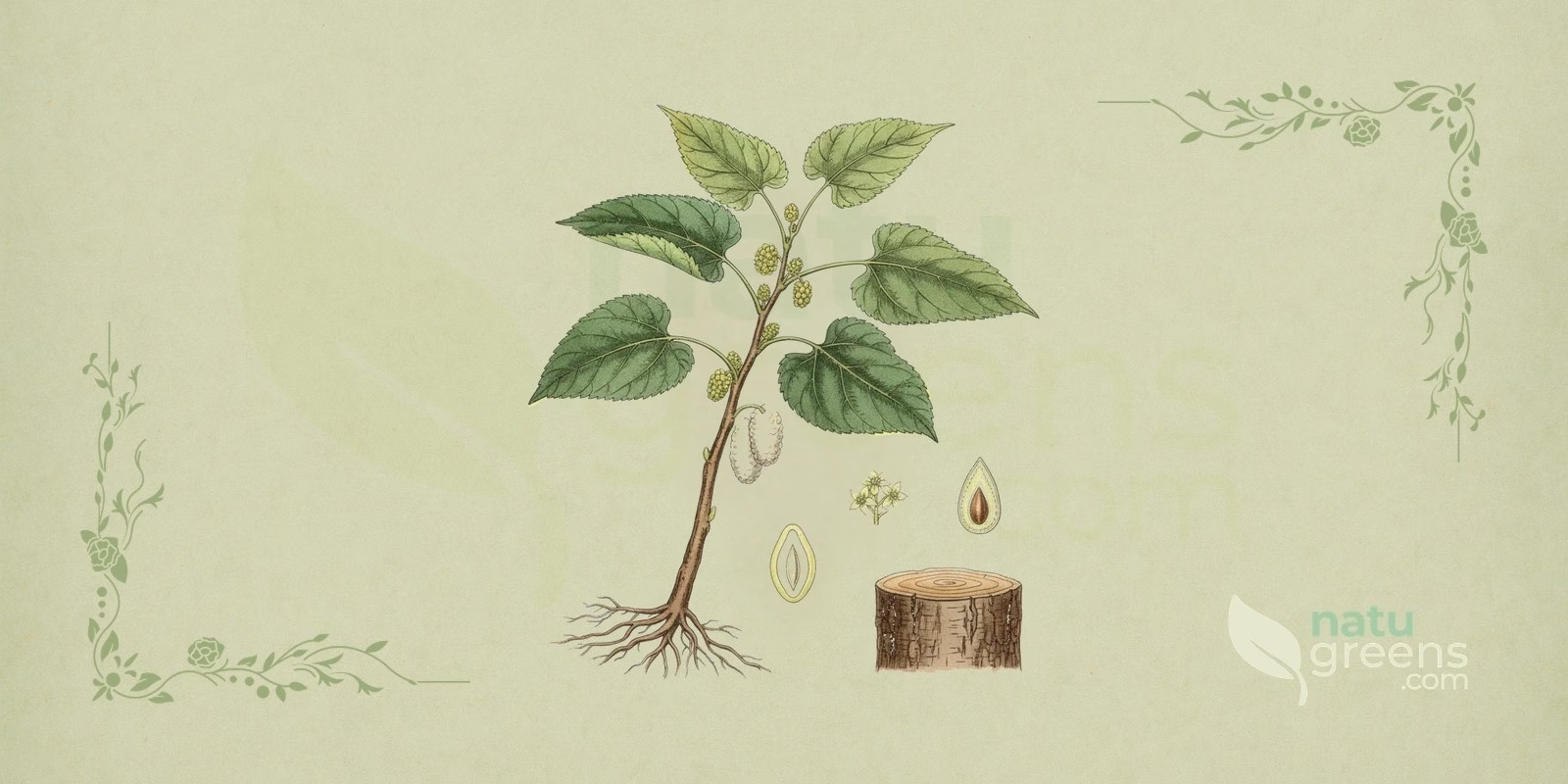
Leaves, fruits, bark and roots all go into traditional preparations, and the rich phytochemical makeup of white mulberry helps explain the interest the plant attracts both in folk medicine and in research laboratories.
In traditional Chinese medicine, Morus alba has been used for centuries for fever and high blood pressure, as well as for liver and eye problems, and its importance extends to sericulture, since the leaves are the main food of the silkworm.
Modern scientific research has been investigating many of these traditional uses, with particular attention to the analgesic, anti-inflammatory and antioxidant potential observed in laboratory studies and to the blood-sugar-lowering effect of the leaf, seen in clinical trials that are still small. This versatility has made white mulberry a plant studied all over the world, always as an adjunct under study and never as a substitute for medical treatment.
Popular and International Names of White Mulberry
- English: common mulberry, silkworm mulberry, white mulberry.
- French: mûrier blanc.
- German: Maulbeerbaum, Weiße Maulbeere.
- Italian: gelso bianco.
- Portuguese: amora-branca, amoreira-branca, amoreira-comum, amoreira-do-bicho-da-seda.
- Spanish: mora blanca, morera blanca.
Botanical Synonyms of Morus alba
- Morus alba var. tatarica (L.) Ser.
- Morus atropurpurea Roxb.
- Morus intermedia Perr.
- Morus italica Poir.
Morus italica Poir. is a botanical synonym often associated with Morus alba, and the name reflects historical and regional taxonomic variations, although Morus alba L. is the scientific name accepted and recognized by most botanical authorities. Knowing these synonyms is useful for research and for identifying the plant accurately in different scientific and traditional contexts.
The other synonyms, such as Morus atropurpurea Roxb., Morus alba var. tatarica (L.) Ser. and Morus intermedia Perr., represent different classifications or varieties of the species described over time.
An important caution for readers: black mulberry (Morus nigra) is not a synonym of white mulberry but another species of the same genus, and it is the “amora” linked to the menopause tea sold in Brazil. Because Brazilian products sold as “chá de amora” (mulberry tea) often mix the two species, it is worth checking which species is named on the label. White mulberry should also not be confused with blackberry (Rubus spp.), which belongs to a different botanical family.
Botanical Family: Moraceae
The Moraceae family is a diverse group of flowering plants that includes trees, shrubs and, occasionally, herbs, and it is characterized by the presence of latex and by the production of multiple fruits, such as mulberries and figs. It comprises about 40 genera and more than 1,000 species, distributed mainly in tropical and subtropical regions, and besides Morus alba it includes other plants of great economic and cultural importance, such as the fig tree (Ficus carica) and the jackfruit tree (Artocarpus heterophyllus).
As a member of the Moraceae family, Morus alba shares botanical traits that make it adaptable to very different environments. The family is known for producing a wide range of biologically active secondary compounds, and phytochemical research on its species has revealed flavonoids, alkaloids and terpenoids that help explain the medicinal uses attributed to many of them.
Parts of White Mulberry Used
- Branches
- Fruits
- Leaves
- Root bark
Ethnobotanical and Traditional Uses
- Aphrodisiac and aid for throat, skin and liver complaints, according to records from some cultures.
- Food for the silkworm, alongside a folk use of the leaves as a diuretic, blood-sugar-lowering and blood-pressure-lowering remedy.
- Historical use for jaundice, dysentery and sore throat in various parts of the world, without clinical proof.
- Nourishing yin and blood through the fruits, according to traditional Chinese medicine, which also recommends them for the kidneys, weakness, fatigue and anemia.
- Pain relief, including pain in the side, in folk medicine records.
- Support during infections, a traditional use associated with antibacterial activity observed in the laboratory.
- Topical use of the latex against pain in some regions, a traditional record that calls for caution, because the latex irritates the skin.
- Traditional Chinese medicine: almost every part of the plant is used for fever, high blood pressure, liver and eye problems and diabetes, in the latter case as an adjunct under study.
Therapeutic Properties of White Mulberry
- Anthelmintic (traditional record against intestinal worms, attributed to the root bark)
- Antibacterial (activity observed in laboratory studies)
- Anti-inflammatory (effect observed in preclinical studies)
- Antioxidant (action on free radicals shown in the laboratory)
- Antirheumatic (traditional record for relieving rheumatic pain)
- Diuretic (traditional record of increased urine volume)
- Hypoglycemic (effect of leaf DNJ observed in small clinical trials; an adjunct under study, never a substitute for medication)
- Hypotensive (traditional record and preliminary studies on blood pressure)
- Laxative (traditional use as an aid to bowel movements)
- Nutritive (fruit rich in nutrients; in traditional Chinese medicine, it nourishes yin and blood)
Detailed Phytochemical Profile of White Mulberry
- Alkaloids (e.g. 1-deoxynojirimycin, the DNJ of the leaves)
- Amino acids
- Anthocyanins
- Flavonoids (e.g. quercetin, rutin)
- Glycosides
- Macronutrients
- Minerals
- Phenolic acids (e.g. chlorogenic acid)
- Saponins
- Tannins
- Terpenoids
- Vitamins (B, C, K)
The leaves and fruits of Morus alba are particularly rich in bioactive compounds, and the presence of flavonoids such as rutin and quercetin is linked to the antioxidant and anti-inflammatory action observed in the laboratory. Among the alkaloids, the leaf’s 1-deoxynojirimycin (DNJ) acts as an inhibitor of alpha-glucosidase, the enzyme that digests carbohydrates, which explains the blood-sugar-lowering effect seen in small clinical trials, while other glycosides may be involved in the hypotensive effects described. This complex composition is the starting point of research on white mulberry and helps explain why the plant holds a prominent place in both traditional medicine and modern studies.
Preparation and Administration Forms of White Mulberry
- Decoctions (of the root bark)
- Extracts
- Fruits (fresh or in culinary preparations, such as jams and compotes)
- Teas (leaf infusions)
- Tinctures
The ripe fruit is eaten as food, fresh or in culinary preparations, but the unripe fruit should not be eaten, because folk literature reports gastrointestinal and nervous effects linked to it. Leaf teas, extracts and tinctures call for more care, especially in people taking diabetes medication, as detailed in the contraindications section.
Synergy with Other Medicinal Plants
Ginseng and Skin Pigmentation
Preliminary studies are looking at the combination of Morus alba with ginseng (Panax ginseng, listed in formulations as Ginseng Radix Alba) in cosmetic preparations aimed at skin pigmentation. The hypothesis is that the bioactive compounds of the two plants act in a complementary way on melanogenesis and skin tone evenness, but the available data are still early and do not allow the claim that the combination outperforms either plant used alone.
Synergistic Action of Phytocompounds
The phytocompounds of Morus alba themselves seem to act together in some activities observed in the laboratory, such as the antibacterial one. According to these studies, the combination of different classes of compounds, such as flavonoids, alkaloids and phenolic acids, may inhibit the growth of pathogenic microorganisms more strongly than each compound alone, and this internal synergy is one of the factors cited for the broad spectrum of pharmacological activities described for white mulberry.
Recipes and Usage Protocols of White Mulberry
Root Bark Decoction for Topical Use
A preparation traditionally used in compresses and washes on the skin, recorded in folk medicine and associated with the anti-inflammatory and antibacterial activity described for the root bark.
Ingredients: 10 g of dried white mulberry root bark, 500 ml of water.
Preparation: Place the root bark and water in a pan and let it boil for about 15 to 20 minutes. After boiling, strain the decoction and wait for it to cool before using the liquid in compresses or washes on areas with skin irritation, applied 2 to 3 times a day according to the traditional record. Test it first on a small patch of skin, and do not apply it to open or extensive wounds without guidance from a healthcare professional.
White Mulberry Jam
A culinary recipe that makes use of the ripe fruit, traditionally eaten as food, and a tasty way to include Morus alba in a varied diet.
Ingredients: 500 g of ripe white mulberry fruits, 250 g of sugar (or to taste), juice of 1 lemon.
Preparation: Wash the fruits well, making sure they are fully ripe, and put them in a pan with the sugar and lemon juice. Cook over low heat, stirring now and then, until the fruits break down and the mixture reaches a jam consistency, which takes about 30 to 40 minutes, then store in sterilized jars. Because it contains sugar, the jam should be eaten in moderation, especially by people with diabetes.
White Mulberry Leaf Infusion
An infusion recorded in traditional Chinese medicine, made with the dried leaves of the plant.
Ingredients: 1 tablespoon of dried white mulberry leaves, 250 ml of boiling water.
Preparation: Place the dried leaves in a cup, add the boiling water, cover and let steep for 5 to 10 minutes, then strain and drink the infusion warm.
Warning for people with diabetes: the leaf contains 1-deoxynojirimycin (DNJ), an alpha-glucosidase inhibitor with a blood-sugar-lowering effect shown in small clinical trials, which creates a risk of additive hypoglycemia with insulin, sulfonylureas and acarbose. Anyone taking these medications should monitor their blood sugar and tell their doctor before drinking the infusion, which is an adjunct under study and never replaces medication.
The preparations above follow traditional records and do not replace professional guidance. Before any internal use, check the contraindications and interactions described in this article.
Associated Therapies
Acupuncture
Within traditional Chinese medicine, acupuncture often appears alongside Morus alba preparations in integrative approaches to conditions such as diabetes and hypertension, since both belong to the same system of thought focused on the body’s energetic balance. There are, however, no studies evaluating the combination of the two practices, and any such pairing should be supervised by the responsible physician, without stopping conventional treatment.
Western Herbal Medicine
In Western herbal medicine, Morus alba may be part of multi-herb formulations aimed at metabolic and inflammatory disorders, valued for the blood-sugar-lowering and antioxidant effects studied in its leaves. It is often paired with plants such as Gymnema sylvestre, also investigated for blood sugar, or Curcuma longa, studied for its anti-inflammatory action, and this approach seeks standardized extracts and scientific validation to ensure safety and efficacy, always with the caveat that combining blood-sugar-lowering plants increases the risk of a drop in blood sugar.
Functional Nutrition
In functional nutrition, Morus alba, especially its fruits and leaves, is seen as a source of nutrients and bioactive compounds that can be part of a varied and balanced diet. The ripe fruits can be eaten fresh, dried or in jams, while the leaves appear in teas or added to juices and smoothies, and studies in this field explore the potential of white mulberry on the gut microbiota, oxidative stress and metabolic health, still without definitive clinical conclusions.
Contraindications and Side Effects of White Mulberry
General Contraindications
The use of Morus alba should be avoided by people with a known allergy to the plant or its pollen and by anyone with diarrhea, because the plant may worsen the condition. The ripe fruit is food, but the unripe fruit and the latex deserve attention: folk literature reports gastrointestinal and nervous effects linked to them, so the unripe fruit should not be eaten, and the latex irritates the skin. Before any use of the leaf, extract or bark, consulting a healthcare professional is recommended, especially for at-risk groups and people with pre-existing conditions.
Pregnancy, Breastfeeding and Children
During pregnancy, the fruit as food is permitted, but the leaf in extract form should not be used, owing to a lack of safety data. During breastfeeding and in children, only the ripe fruit should be eaten, avoiding teas, extracts and tinctures of the leaf or bark.
Drug Interactions
The leaf contains 1-deoxynojirimycin (DNJ), an alpha-glucosidase inhibitor with a blood-sugar-lowering effect shown in small clinical trials, so there is a risk of additive hypoglycemia with insulin, sulfonylureas and acarbose: anyone taking these medications should monitor their blood sugar and tell their doctor. Use in diabetes is an adjunct under study and never replaces medication. People taking anticoagulants should keep their intake constant and tell their doctor, avoiding starting or stopping use abruptly.
Common Side Effects
Although Morus alba is generally well tolerated, high intake may cause bloating, gas, diarrhea, constipation and loose stools, as well as nausea and dizziness in some people and increased urination, an effect also frequently reported. Most of these symptoms are mild and short-lived, but if they persist or worsen, medical evaluation is needed.
Rare and Potential Effects
Allergic reactions are rare but can occur, especially in people sensitive to birch pollen, and usually show up as skin rashes or other allergic symptoms. The most relevant risk is hypoglycemia, that is, a drop in blood sugar levels, particularly in people with diabetes or who already take medication to control their blood sugar, and any unusual symptom warrants seeking medical advice.
Menopause and Other Mulberry Species
The use for menopause, attributed in Brazil to Morus nigra, is unproven and remains under study, and this information does not refer to this species. When buying “chá de amora” (mulberry tea), check the label to see which species it contains, since many products mix white mulberry and black mulberry.
Historical Notes and Interesting Facts
White Mulberry and Sericulture
Morus alba is world-famous as the main food source of the silkworm (Bombyx mori), an insect essential to sericulture and silk production. This close relationship between plant and insect drove the spread of white mulberry cultivation from China, its homeland, to many parts of Asia and later to Europe, so the history of silk is closely tied to that of Morus alba, which played a decisive role in the economic and cultural development of many civilizations over the centuries.
Global Spread and Historical Uses
Native to China, Morus alba spread to other continents because of its importance in silk production and was even introduced to places such as the United States with the aim of establishing a silk industry. Beyond its role in silk production, the plant was also valued for its medicinal properties in many cultures, appearing in different traditional medicine systems long before modern scientific research, and the species’ adaptability to diverse climates favored this wide spread.
Etymology and Botanical Features
The word “alba” in the scientific name Morus alba refers to the white color of the fruits of some of its most common varieties, although there are white mulberry varieties with purple and even black fruits. The tree grows quickly and can reach 20 meters in height, and its deciduous leaves, the silkworms’ favorite part, vary greatly in shape and may be lobed or entire depending on the variety and the age of the plant.
Frequently Asked Questions about White Mulberry
What Is the Difference between White Mulberry and Black Mulberry?
They are different species of the same genus: white mulberry (Morus alba) usually bears white to pinkish fruits when ripe, although there are dark-fruited varieties, while black mulberry (Morus nigra) produces dark purple to black fruits with a more acidic taste. Morus nigra is the “amora” linked to the menopause tea sold in Brazil, an unproven use that remains under study and whose information does not refer to Morus alba. Since many “chá de amora” (mulberry tea) products mix the two species, check the label, and do not confuse either of them with blackberry (Rubus spp.).
Does White Mulberry Help with Weight Loss?
Some studies are investigating whether Morus alba extracts may help with weight control, mainly because the 1-deoxynojirimycin (DNJ) in the leaves inhibits enzymes that digest carbohydrates and reduces glucose absorption. The results are still preliminary, and white mulberry should not be seen as a weight-loss solution but at most as a complement to a balanced diet and a healthy lifestyle, always with professional supervision.
Is It Safe to Drink White Mulberry Leaf Tea Every Day?
In healthy adults, moderate consumption of leaf tea is usually well tolerated, but excess may cause bloating, diarrhea and a drop in blood sugar. Pregnant women should not use the leaf in extract form owing to a lack of safety data, and breastfeeding women and children should stick to the ripe fruit only. Before making the tea a daily habit, talk to a healthcare professional to rule out specific contraindications.
Can People Taking Diabetes Medication Drink White Mulberry Tea?
Only with medical guidance, because the leaf’s DNJ has a blood-sugar-lowering effect shown in small clinical trials and may cause additive hypoglycemia with insulin, sulfonylureas and acarbose. Anyone taking these medications should monitor their blood sugar and tell their doctor, bearing in mind that use in diabetes is an adjunct under study and never replaces medication.
Can Pregnant Women, Breastfeeding Women and Children Consume White Mulberry?
During pregnancy, the ripe fruit as food is permitted, but the leaf in extract form is not, owing to a lack of safety data. During breastfeeding and in childhood, the recommendation is to eat only the ripe fruit, never the unripe fruit, and to avoid teas, extracts and tinctures.
Which Properties of White Mulberry Are Most Studied?
Research focuses on the blood-sugar-lowering action of the leaf, already observed in small clinical trials, and on the antioxidant, anti-inflammatory, hypotensive and antibacterial activities, most of them verified in the laboratory. The fruits are valued for their antioxidant and nutrient content, while tradition attributes diuretic and anthelmintic action to the root bark, properties related to the presence of flavonoids, alkaloids and phenolic acids.
Notice: this content is for informational purposes and does not replace professional medical advice. Consult a physician or herbal practitioner before using medicinal plants, especially during pregnancy, breastfeeding, or alongside medication.
How to cite this article
NATUGREENS. White Mulberry (Morus alba): Properties and Benefits. Natugreens, 4 Nov. 2026. Disponível em: https://natugreens.com/white-mulberry-morus-alba/. Accessed: Nov. 4, 2026.
Natugreens. (2026). White Mulberry (Morus alba): Properties and Benefits. Natugreens. https://natugreens.com/white-mulberry-morus-alba/
References and Scientific Studies
- PMC2023 Batiha GE, et al. Morus alba: a comprehensive phytochemical and pharmacological review. Naunyn Schmiedebergs Arch Pharmacol. 2023.
- PMC2016 Chan EW, et al. Phytochemistry, pharmacology, and clinical trials of Morus alba. Chin J Nat Med. 2016.
- PMC2022 Taghizadeh M, et al. Morus Alba leaf extract affects metabolic profiles, biomarkers inflammation and oxidative stress in patients with type 2 diabetes mellitus: A double-blind clinical trial. Clin Nutr ESPEN. 2022.
- PMC2024 Wang Y, et al. Comprehensive overview of different medicinal parts from Morus alba L.: chemical compositions and pharmacological activities. Front Pharmacol. 2024.
- PMC2017 Yuan Q, et al. The Mulberry (Morus alba L.) Fruit-A Review of Characteristic Components and Health Benefits. J Agric Food Chem. 2017.