Quick summary
Boswellia sacra, commonly known as frankincense or olibanum, is a small deciduous tree native to the arid regions of the Arabian Peninsula and the Horn of Africa, prized for thousands of years for the aromatic resin it exudes when the bark is cut. This resin, used in religious practice, perfumery, cosmetics and many…
Main caution: Ingesting frankincense resin in quantity can cause nausea, reflux, diarrhea and abdominal pain, and people with a known hypersensitivity to any component of the resin should avoid it. The essential oil should not be…
Boswellia sacra Flück. / Frankincense
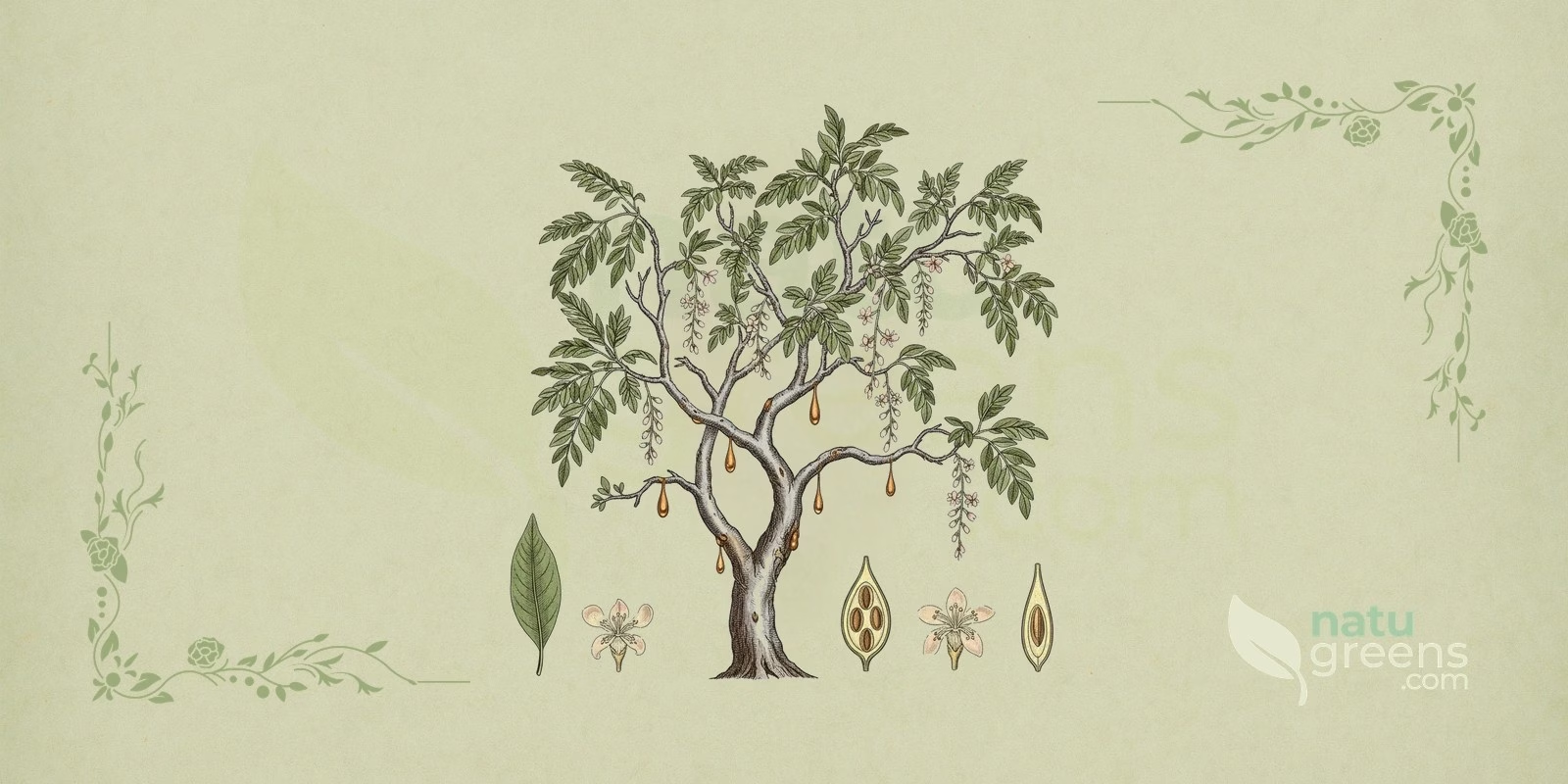
Boswellia sacra, commonly known as frankincense or olibanum, is a small deciduous tree native to the arid regions of the Arabian Peninsula and the Horn of Africa, prized for thousands of years for the aromatic resin it exudes when the bark is cut. This resin, used in religious practice, perfumery, cosmetics and many systems of traditional medicine, is rich in bioactive compounds that attract growing scientific interest, especially in laboratory studies on the inflammatory response. At the same time, the frankincense harvest supports local communities in Oman, Yemen and Somalia, which gives the species a cultural and economic importance that coexists with mounting pressure on wild populations.
Popular and International Names of Frankincense
- English: frankincense, olibanum tree.
- French: arbre à encens, oliban.
- German: Olibanum, Weihrauchbaum.
- Italian: albero dell’incenso, olibano.
- Portuguese: árvore-do-incenso, franquincenso, incenso, incenso-verdadeiro, olíbano.
- Spanish: árbol del incienso, incienso, olíbano.
Botanical Synonyms of Boswellia sacra
- Boswellia bhaw-dajiana Birdw.
- Boswellia bhaw-dajiana var. serrulata Engl.
- Boswellia carteri Birdw.
- Boswellia carteri var. subintegra Engl.
- Boswellia carteri var. undulatocrenata Engl.
- Boswellia undulatocrenata (Engl.) Engl.
The accepted name is Boswellia sacra Flück., and Boswellia carteri Birdw. is treated as a synonym by the reference taxonomic databases, so the Somali or Omani frankincense sold under the name B. carteri belongs to the same species. Boswellia serrata, known as Indian frankincense, is a separate species native to India and should not be confused with the Arabian and African frankincense described in this article.
Botanical Family: Burseraceae
Boswellia sacra belongs to the Burseraceae family, which comprises a few hundred species spread across roughly twenty genera and is known precisely for producing aromatic resins and balsams. Alongside the genus Commiphora, the source of myrrh, the genus Boswellia is one of the most emblematic members of the family, whose plants are common in tropical and subtropical regions and are often adapted to dry climates and stony soils. Frankincense resin is a good illustration of the chemistry typical of this botanical family, rich in volatile terpenes and triterpenes.
Parts of Frankincense Used
- Essential oil (obtained by distilling the resin)
- Resin (oleo-gum resin)
Ethnobotanical and Traditional Uses
Frankincense has a long history of ethnobotanical use across many cultures and civilizations, and in antiquity it was burned in religious rituals and ceremonies as a highly valued commodity. Traditional medicine records describe the use of the resin for dental infections, dysentery, vomiting, fevers and swellings, while sources linked to ancient Egypt mention its use for fevers, colds and asthma and to stop bleeding. In Rome, Pliny the Elder recorded its use as an antidote to hemlock poisoning, an indication that today has historical value only. In traditional Arabic and Islamic medicine, where the resin is called luban, frankincense was valued as a rejuvenating agent and remembered in the context of joint comfort, mental clarity, detoxification and menstrual comfort. To this day the resin is chewed, prepared as a traditional decoction, burned as incense and added to cosmetics and perfumes, which shows its versatility and its cultural importance over the centuries.
Therapeutic Properties of Frankincense
- Analgesic (traditional record and effect observed in animal studies)
- Anti-inflammatory (inhibition of 5-lipoxygenase observed in laboratory studies)
- Antimicrobial (activity against bacteria and fungi observed in laboratory tests)
- Antioxidant (action against oxidative damage observed in experimental studies)
- Antiplatelet (theoretical effect suggested by laboratory studies, relevant to interactions with anticoagulants)
- Antiproliferative (activity observed in laboratory studies, with no clinical evidence)
- Cardioprotective (effect investigated in preliminary animal studies)
- Hepatoprotective (effect investigated in preliminary animal studies)
- Immunomodulatory (modulation of the immune response observed in experimental studies)
- Neuroprotective (effect investigated in preliminary studies, with no clinical evidence)
Detailed Phytochemical Profile of Frankincense
The resin of Boswellia sacra contains a complex mixture of compounds, and the boswellic acids, pentacyclic triterpenes, are the most studied because they inhibit the enzyme 5-lipoxygenase in laboratory assays, a mechanism considered the basis of the anti-inflammatory action observed in those models. Among them, 3-O-acetyl-11-keto-β-boswellic acid (AKBA) stands out as the most potent in experimental studies. The volatile fraction contains monoterpenes such as limonene, α-pinene, sabinene and α-thujene, which account for the characteristic aroma and for the antimicrobial activity recorded in bench tests, along with sesquiterpenes such as β-caryophyllene and diterpenes such as incensole and incensole acetate. The gum, which makes up about 30% to 36% of the resin, completes, together with the volatile oils, the phytochemical profile behind the many aromatic and traditional applications of frankincense.
Preparation and Administration Forms of Frankincense
Frankincense resin can be used in different ways depending on the purpose, and the oldest and most widespread form is the raw resin, burned as incense in aromatic and ritual settings. In the traditions of the Arabian Peninsula, the resin tears are also chewed or prepared as a decoction, while the essential oil, obtained by steam distillation of the resin, is used mainly in aromatherapy, diffused into the room or applied topically, always diluted. The market also offers a range of pharmaceutical forms, such as capsules, creams, gels, granules, liquids, ointments, patches, pills, powders and tablets, but many of the extracts standardized for boswellic acids and sold in capsules are made from Boswellia serrata, not from Boswellia sacra, so the label deserves close attention. These preparations allow topical, inhaled and oral use, and the choice of the right form for each case should be guided by a healthcare professional.
Synergy with Other Medicinal Plants
Specific research on combinations of Boswellia sacra with other plants is limited, but tradition often pairs frankincense with other herbs in compound preparations. The pairing with turmeric (Curcuma longa) appears frequently in formulas traditionally used for joint comfort, since it brings together two plants whose anti-inflammatory profile has been studied in the laboratory, and ginger (Zingiber officinale) joins similar blends as a warming spice traditionally associated with digestion. The oldest combination, however, is with myrrh (Commiphora myrrha), a resin from the same botanical family that has accompanied frankincense since antiquity in incenses, ointments and preparations traditionally used for oral hygiene and skin care. These records reflect traditional practice and do not prove any enhanced effect, and any combination for internal use should be discussed with a healthcare professional.
Recipes and Usage Protocols of Frankincense
Chewed Resin and Traditional Decoction
In the Arabian Peninsula, small tears of frankincense resin are traditionally chewed as an aromatic gum or soaked and then boiled in water, a preparation of traditional record associated with fresh breath and digestive comfort. Because ingesting resin in quantity can cause nausea, reflux, diarrhea and abdominal pain, and no safely established doses exist for this use, the amount and frequency should be set with qualified guidance; consult a healthcare professional before ingesting the resin.
Essential Oil for Aromatherapy
In aromatherapy, frankincense essential oil is traditionally used in spaces for meditation and relaxation. For diffusion, add 3 to 5 drops to an ultrasonic diffuser in a well-ventilated room, and for topical use dilute 1 to 2 drops in 5 ml of a carrier vegetable oil, such as jojoba or sweet almond, applying it with a gentle massage after testing the blend on a small patch of skin. Never apply the undiluted oil to the skin and do not ingest it, since there are no safety data for oral use of the essential oil.
Topical Ointments and Creams
Ointments and creams with frankincense extract are traditionally used in massages over joints and muscles and in skin care products. Apply a small amount to the desired area, massaging until fully absorbed, at the frequency stated by the manufacturer, which usually ranges from two to three times a day. Always check the Boswellia species and the extract concentration in the formula, stop use if redness or itching appears and follow the product’s specific instructions.
Standardized Extract Capsules (a Boswellia serrata Product)
Capsules and tablets of extract standardized for boswellic acids, including AKBA, are generally products of Boswellia serrata, Indian frankincense, the species on which clinical trials with this type of extract have focused. Those results do not automatically carry over to Boswellia sacra, which is why information on these supplements is found in the article dedicated to Boswellia serrata; the use of any capsule should be assessed by a healthcare professional.
The preparations above follow traditional records and do not replace professional guidance. Before any internal use, check the contraindications and interactions described in this article.
Associated Therapies
Aromatherapy
In aromatherapy, frankincense essential oil is valued for its resinous aroma and is traditionally used to create a calm atmosphere, support meditation practice and accompany moments of relaxation, and it is also added to diluted massage oils applied to muscles and joints. Practitioners associate inhaling the aroma with a sense of mental clarity and general well-being, but these accounts come from tradition and preliminary studies, and the smoke of incense burned indoors can irritate the airways.
Clinical Phytotherapy
In clinical phytotherapy, the standardized Boswellia extracts studied in trials for osteoarthritis and inflammatory bowel disease are mostly from Boswellia serrata, and clinical data specific to Boswellia sacra remain scarce and preliminary. For this reason, using frankincense preparations for health purposes requires an individual assessment by a qualified professional, who should consider the source species of the product, the formulation, the condition of the person who will use it and any medications being taken.
Traditional Arabic and Ayurvedic Medicine
In traditional Arabic and Unani medicine, frankincense from Boswellia sacra is a classic ingredient, remembered as a rejuvenating agent and used in joint, respiratory and digestive contexts, and it is also associated with mental clarity and menstrual comfort. In Ayurveda, the species most often used is the related Boswellia serrata, known as shallaki, found in compound formulas traditionally used to balance the doshas, and frankincense should not be confused with guggul, the resin of Commiphora wightii.
Nanotechnology
Nanotechnology is an emerging field of research on Boswellia sacra, and laboratory studies are exploring the encapsulation of frankincense essential oil and extracts in nanoparticles to improve the bioavailability, stability and targeting of active compounds such as boswellic acids. These formulations are being tested in experimental models of inflammation, infection and tumor cell lines, but the results are limited to laboratory assays and do not support any claim of clinical use.
Contraindications and Side Effects of Frankincense
Ingesting frankincense resin in quantity can cause nausea, reflux, diarrhea and abdominal pain, and people with a known hypersensitivity to any component of the resin should avoid it. The essential oil should not be ingested, as there are no safety data for oral use, and for topical use it must always be diluted, since it can cause contact sensitization. The smoke of incense burned indoors irritates the airways and is not recommended for people with asthma or for children.
Because of its theoretical antiplatelet and anti-inflammatory effects, caution is needed with anticoagulants and with nonsteroidal anti-inflammatory drugs (NSAIDs), and anyone taking medication for diabetes or for autoimmune diseases should consult a healthcare professional before any use, given the possibility of interactions. Frankincense should be avoided during pregnancy and breastfeeding, since tradition uses it as an emmenagogue and there are insufficient safety data, and the same caution applies to children. Anticancer activity has been observed only in vitro, and frankincense must not be presented or used as a cancer treatment.
Do not confuse the species: Boswellia serrata, Indian frankincense, is the species behind the extracts standardized for boswellic acids (AKBA) with clinical trials in osteoarthritis and inflammatory bowel disease, while frankincense from Boswellia sacra is used mainly as incense, as chewed resin or in a traditional decoction and as an essential oil, and the trials on B. serrata do not carry over to B. sacra. Finally, since the populations in Oman, Yemen and Somalia suffer from overharvesting, choose resins and oils from sustainably managed sources, and always seek medical advice before using any plant-based preparation, especially if you have pre-existing health conditions or are taking other medications.
Historical Notes and Interesting Facts
The history of frankincense is marked by religious, cultural and economic uses, and the resin became famous as one of the gifts the Magi offered to Jesus in the biblical narrative, alongside gold and myrrh, which gives it an almost mythical status in the West. Since antiquity, frankincense has been burned in rituals and ceremonies across many cultures, valued for an aroma considered purifying and for its spiritual meaning, and the trade routes that carried it from Arabia to the Mediterranean were among the most lucrative of the ancient world. Its production still moves significant sums today, especially in Somalia, where it ranks among the main export products.
Growing demand and poor harvesting practices, such as excessive tapping of the trees, grazing and the conversion of native land, threaten the wild populations of Boswellia sacra, which appears in conservation assessments as a near-threatened species. That is why sustainable management initiatives and a preference for traceable resin are important to protect this resource and keep it available for future generations.
Frequently Asked Questions about Frankincense
What Is Frankincense?
Frankincense is the aromatic resin of Boswellia sacra, a deciduous tree native to the Arabian Peninsula and the Horn of Africa, also known as olibanum. The resin has been valued for thousands of years in religious, cosmetic and traditional medicine settings, and the tree, which grows in arid conditions, is the main source of high-quality frankincense.
What Is Frankincense Traditionally Used For?
Traditionally, frankincense is burned as incense in rituals and to scent rooms, and the resin is chewed or prepared as a decoction in traditional records associated with fevers and digestive and respiratory discomfort. It also appears in topical ointments and creams and, as a diluted essential oil, in aromatherapy. These uses reflect tradition and preliminary studies, with no clinical evidence for Boswellia sacra.
What Are the Main Active Compounds in Frankincense?
The most studied compounds are the boswellic acids, a group of pentacyclic triterpenes, among which AKBA stands out for inhibiting the enzyme 5-lipoxygenase in laboratory studies. The resin also contains monoterpenes, sesquiterpenes and diterpenes, which account for the aroma and for activities observed in experimental tests.
What Is the Difference between Frankincense and Boswellia serrata?
Boswellia serrata, Indian frankincense, is the species behind the extracts standardized for boswellic acids (AKBA) with clinical trials in osteoarthritis and inflammatory bowel disease. Frankincense from Boswellia sacra is used mainly as incense, as chewed resin or in a traditional decoction and as an essential oil, and the trials on B. serrata do not carry over to B. sacra, so it is worth checking the species on the label of any product.
Does Frankincense Have Side Effects or Contraindications?
Resin ingested in quantity can cause nausea, reflux, diarrhea and abdominal pain, and the essential oil should not be ingested; it should be used on the skin only when diluted, because of the risk of contact sensitization. Incense smoke indoors is not recommended for people with asthma or for children, and frankincense should be avoided during pregnancy and breastfeeding. Anyone taking anticoagulants, anti-inflammatory drugs, or medication for diabetes or autoimmune diseases should consult a healthcare professional before use.
Can Frankincense Be Used in Cancer Treatment?
No. Laboratory studies with cultured cells have observed cytotoxic activity of the essential oil and of boswellic acids in tumor cell lines, but these findings are limited to in vitro assays and there is no clinical evidence of benefit. Frankincense should not replace or delay cancer treatment, and any use during that treatment must be discussed with the medical team.
Notice: this content is for informational purposes and does not replace professional medical advice. Consult a physician or herbal practitioner before using medicinal plants, especially during pregnancy, breastfeeding, or alongside medication.
How to cite this article
NATUGREENS. Frankincense (Boswellia sacra): Properties and Benefits. Natugreens, 4 Nov. 2026. Disponível em: https://natugreens.com/frankincense-boswellia-sacra/. Accessed: Nov. 4, 2026.
Natugreens. (2026). Frankincense (Boswellia sacra): Properties and Benefits. Natugreens. https://natugreens.com/frankincense-boswellia-sacra/
References and Scientific Studies
- PMC2023 Al-Kharousi ZS, et al. Antimicrobial Activity of Frankincense (Boswellia sacra) Oil and Smoke against Pathogenic and Airborne Microbes. Foods. 2023.
- PMC2025 Khan F, et al. Phytochemical Analysis and Pharmaceutical Applications of Monoterpenoids Present in the Essential Oil of Boswellia sacra (Omani Luban). Adv Pharmacol Pharm Sci. 2025.
- PMC2022 Miran M, et al. Taxonomical Investigation, Chemical Composition, Traditional Use in Medicine, and Pharmacological Activities of Boswellia sacra Flueck.. Evid Based Complement Alternat Med. 2022.
- PMC2021 Rashan L, et al. Chemical Composition, Antibacterial Activity, and Antibiotic Potentiation of Boswellia sacra Flueck. Oleoresin Extracts from the Dhofar Region of Oman. Evid Based Complement Alternat Med. 2021.
- PMC2011 Suhail MM, et al. Boswellia sacra essential oil induces tumor cell-specific apoptosis and suppresses tumor aggressiveness in cultured human breast cancer cells. BMC Complement Altern Med. 2011.