The Surinam cherry, Eugenia uniflora L., holds an unusual place among South American fruit trees: it is wild, domestic and urban all at once. It grows on its own in the coastal sandplain scrub known as restinga and along forest edges in eastern Brazil, it turns up in backyards across most of the country, and it has been planted as hedging in warm cities all over the world. The native range takes in eastern and southern Brazil, Uruguay, Paraguay, Bolivia and northern Argentina.
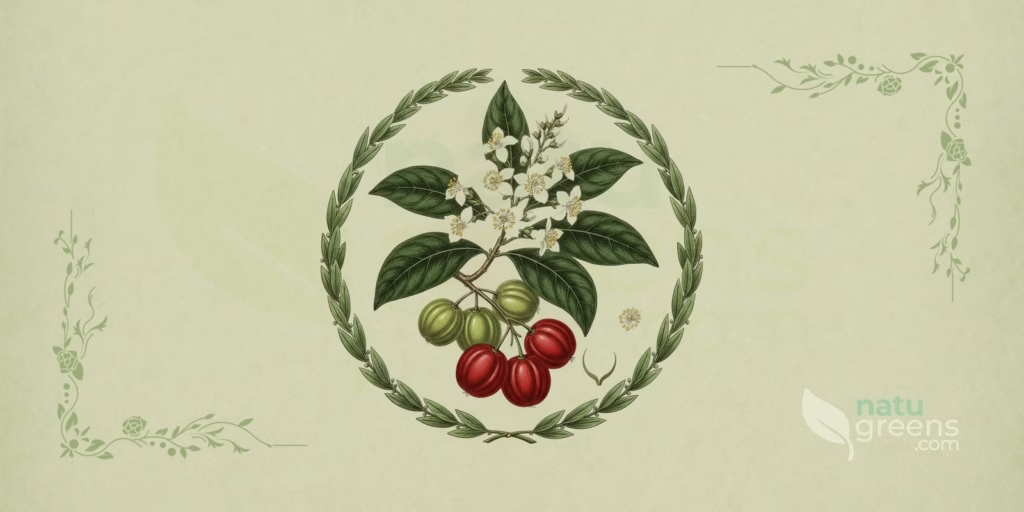
Myrtaceae, the family it belongs to, includes several household names, among them the guava, the jaboticaba and the eucalypts, and the Surinam cherry carries every hallmark of the group: opposite leaves dotted with translucent glands, white flowers bristling with stamens, and bark that flakes away in thin plates. What sets it apart at first glance is the fruit, a flattened berry scored by seven to ten deep longitudinal ribs that give it the outline of a miniature pumpkin.
The genus Eugenia is one of the largest in the flowering plants, with more than a thousand accepted species and a heavy concentration in Brazil. Within it, Eugenia uniflora is the most studied species and the most widely spread beyond its homeland, which has earned it a double reputation: a prized dooryard fruit tree in some places, a declared invasive plant on islands and in tropical regions where it was introduced. This profile covers the species from a botanical standpoint, from formal nomenclature through to its conservation status.
The Surinam-cherry grows on its own in the coastal restinga scrub of eastern Brazil and along forest edges, with a native range that also takes in Bolivia, northern Argentina, Paraguay and Uruguay.
In warm cities around the world the Surinam-cherry has also been planted as hedging, which makes it wild, domestic and urban at the same time.
Taxonomy
The binomial Eugenia uniflora L. was published by Linnaeus in Species Plantarum, page 470, in 1753, and it still stands. The name corresponds to record 596263-1 in the International Plant Names Index, and Plants of the World Online, maintained by the Royal Botanic Gardens, Kew, keeps it as an accepted name within Myrtaceae. The full classification appears below.
- Kingdom: Plantae
- Clade: Angiosperms
- Clade: Eudicots
- Clade: Rosids
- Order: Myrtales
- Family: Myrtaceae Juss.
- Subfamily: Myrtoideae
- Tribe: Myrteae
- Genus: Eugenia P.Micheli ex L.
- Species: Eugenia uniflora L., 1753
The synonymy of the species is bulky, with roughly forty-six names recorded in Plants of the World Online. Two causes worked together. Fruit colour, size and shape vary widely between populations, which led nineteenth-century botanists to describe local variants as separate species, and cultivated material travelled far from the native range, generating independent descriptions in Asia and the Pacific. The synonyms most often cited in the literature are listed alphabetically below.
- Eugenia arechavaletae Herter
- Eugenia costata Cambess.
- Eugenia dasyblasta (O.Berg) Nied.
- Eugenia michelii Lam.
- Eugenia myrtifolia Salisb.
- Eugenia oblongifolia (O.Berg) Nied.
- Myrtus brasiliana L.
- Myrtus willdenowii Spreng.
- Plinia petiolata L.
- Stenocalyx costatus (Cambess.) O.Berg
- Stenocalyx michelii (Lam.) O.Berg
- Stenocalyx uniflorus (L.) Kausel, the only homotypic synonym on the list
As for etymology, the generic name Eugenia honours Eugene of Savoy (1663 to 1736), a soldier and patron who funded gardens and botanical collections in Vienna. The epithet uniflora joins the Latin unus, one, to flos, flower, and refers to flowers borne singly in the leaf axils, although in practice they often appear in pairs or in small clusters. The Brazilian common name pitanga comes from Tupi and alludes to the red of the ripe fruit.
Morphological Description
An evergreen shrub or small tree, 3 to 10 metres tall in most populations and reaching 12 metres in old individuals growing in closed forest. The crown is dense and rounded, branching low, with slender and pliable twigs, a trait that explains why the species is so often used for hedges and topiary. Growth is slow to moderate, and mature trees keep bearing for several decades.
Leaves
The leaves are simple, opposite and decussate, with an ovate to ovate-lanceolate blade, a shortly acuminate tip and an obtuse to subcordate base. They measure 2.5 to 6 centimetres long by 1.5 to 3.5 centimetres wide, are hairless, papery to slightly leathery in texture, and dark glossy green above. The petiole is very short, only 2 to 4 millimetres. Held against the light, the blade shows translucent glandular dots throughout, cavities that store essential oil and release a resinous scent when the leaf is crushed. New shoots flush reddish to bronze before turning green, a useful character for recognising the plant in the field.
Flowers
The flowers are bisexual, white and delicate, 1 to 1.5 centimetres across, borne singly or in groups of two to four in the leaf axils on slender stalks 1 to 2 centimetres long. The calyx has four persistent sepals, which stay at the tip of the fruit until it ripens, and the corolla has four free petals, obovate and clawed, 8 to 12 millimetres long. The androecium gathers fifty to sixty stamens with long white filaments and yellow anthers, a bundle that gives the flower the look of a small brush. There is a single style, and the ovary is inferior with two locules.
Fruits and Seeds
The fruit is a flattened globose berry 1.5 to 3 centimetres across, scored by seven to ten strongly marked longitudinal ribs, with the persistent calyx crowning the tip. Colour moves from green through yellow and orange to red, and in some populations on to an almost black purple, a range tied to the relative amounts of anthocyanins and carotenoids. The pulp is juicy and melting, sweet and sour with a distinctive resinous undertone. Each fruit holds one or two spherical to ellipsoid seeds, 5 to 10 millimetres across, wrapped in resinous tissue. The seeds are recalcitrant, meaning they tolerate neither drying nor long storage, and they lose viability within a few weeks of harvest.
Root and Stem
The root system is taprooted in young plants and becomes mostly lateral and fibrous with age, concentrated in the first metre or two of soil. The trunk is erect and usually single, 15 to 30 centimetres in diameter in mature trees. The outer bark is smooth and greyish brown while the tree is young, then begins to shed in thin irregular plates, exposing paler patches underneath. This flaking is common across Myrtaceae and helps place the species in its family even before flowers or fruit appear.
Distribution and Habitat
The native distribution of Eugenia uniflora spans eastern and southern South America, with records from north-eastern, south-eastern and southern Brazil, Bolivia, north-eastern and north-western Argentina, Paraguay and Uruguay. In Brazil the species is tied above all to the Atlantic Forest, with a strong presence in the coastal restinga and in seasonal forests, and it extends into Cerrado and transitional areas. It is a plant of the understorey and of forest edges, tolerant of partial shade, though it fruits far better in full sun.
Climatically, the species thrives across the humid tropical and subtropical belt, from sea level to about 1,500 metres, with annual rainfall of 800 to 1,500 millimetres. Once established it withstands moderate dry spells and survives light, brief frosts, but severe and prolonged cold damages the foliage and the young shoots. On the soil side it adapts well to sandy substrates and to ground of middling fertility, provided drainage is good, and it favours a slightly acid to neutral reaction.
Beyond its native range, the Surinam cherry was carried to virtually every tropical and subtropical region on the planet from the colonial period onwards, first as a dooryard fruit tree and later as an ornamental hedge. In several of those regions it escaped cultivation and naturalised. The Global Invasive Species Database and local environmental agencies record invasive populations in Hawaii, Florida, Bermuda, Australia, South Africa and the Antilles, where the species forms dense thickets, cuts the light reaching the forest floor and displaces native vegetation. That capacity to take over an understorey comes from heavy fruiting, efficient dispersal by birds and tolerance of poor soils working together.
Surinam-cherry Cultivation
Seed propagation remains the commonest method, in nurseries and in home production alike. Because the seeds are recalcitrant, they need to be cleaned of pulp, washed and sown quickly, ideally within two to four weeks of harvest, or germination drops sharply. Under those conditions seedlings emerge between thirty and sixty days later, at high rates. Vegetative propagation is harder: cuttings root poorly and unevenly even with hormone treatment, while air layering works better on branches taken from mature plants. To fix fruit characters, grafting or budding onto rootstocks of the same species is the most reliable route, and it brings the first crop forward to two or three years, against four to six years for seedlings.
In managed plantings, spacing usually runs from 4 to 6 metres between trees, which works out at somewhere between 280 and 625 trees per hectare. The species responds well to organic matter worked into the planting hole and to balanced fertilising through the cycle. Irrigation is decisive only during establishment and through flowering and fruit filling. Formative pruning shapes the crown in the early years, and light annual pruning keeps the tree at a height compatible with hand picking, a common practice where the plant is trained as a 2 to 4 metre shrub.
Among pests, the South American fruit fly, Anastrepha fraterculus, is the main obstacle to the fresh fruit market, joined by Ceratitis capitata in some regions. Scale insects and aphids attack twigs and new growth, usually with moderate damage. Among diseases, anthracnose caused by Colletotrichum gloeosporioides produces lesions on leaves and fruit in wet spells, and nurseries can suffer seedling rots. Harvesting is done by hand, fruit by fruit, because the pulp is fragile and ripening is uneven within a single tree. Ripe fruit is highly perishable and calls for processing or freezing within one or two days, a constraint that explains why most of the Brazilian commercial crop goes to frozen pulp rather than to the fresh market.
Phenology
The Surinam cherry flowers in mass at the population level, with well-defined peaks and strong synchrony between neighbouring trees. In tropical Brazil there are two to four flowering events a year, often tied to the turn from the dry season into the first rains, while in the subtropical south the pattern is seasonal and concentrated in spring. Each individual flower is short-lived: it opens early in the day, in step with the rest, and wilts by late afternoon, so the pollination window of any one flower amounts to a few hours.
Pollination is by insects. Apis mellifera is the most frequent visitor and the main pollinator in the populations studied, since it arrives right at the start of anthesis and touches both androecium and stigma on the same visit, but native stingless bees and flies take part as well. The gap between pollination and ripe fruit is short for a tree, thirty to sixty days, which allows several crops a year and explains the impression that the tree is perpetually loaded.
Dispersal is by animals, birds above all. Thrushes, kiskadees, tanagers and other medium-sized frugivores swallow the fruit whole and drop the seeds far from the parent plant, while small mammals round out the job on a smaller scale. That same dispersal efficiency underpins the invasive behaviour of the species wherever it has been introduced.
Related Species and Confusions
The genus Eugenia accounts for several hundred species in Brazil, a number of which bear edible fruit and circulate under similar common names. The grumixama, Eugenia brasiliensis Lam., also an Atlantic Forest tree, has a rounded, smooth fruit without ribs, wine-red to almost black. The cereja-do-rio-grande, Eugenia involucrata DC., from southern Brazil, produces a smooth, elongated red berry with conspicuous bracts at the base of the flower. The uvaia, Eugenia pyriformis Cambess., bears a yellow, pear-shaped, velvety fruit. The cagaita, Eugenia dysenterica DC., typical of the Cerrado, has a yellow flattened fruit whose shallow grooves sometimes mislead anyone working from photographs. In every one of these cases, seven to ten deep and regular ribs together with the persistent sepals at the tip identify the Surinam cherry with confidence.
Other confusions arise from nomenclature rather than morphology. Names such as Eugenia caryophyllata and Eugenia jambolana still surface in older texts, but they belong to species now placed in Syzygium, an Asian and African genus with no close tie to the Surinam cherry beyond shared family membership. In English, the label Brazilian cherry covers both this fruit and the timber of Hymenaea courbaril, a plant from another family altogether, which causes muddles in trade catalogues. It is also worth noting that ornamental Myrtaceae with red fruit, grown in gardens, can pass for a Surinam cherry from a distance, and a look at the ribbed fruit settles the question.
Phytochemistry
The chemical profile of the species is well documented and differs sharply between organs. Ripe fruit is dominated by pigments of two groups: anthocyanins, with cyanidin-3-glucoside and delphinidin-3-glucoside among the most abundant in red and purple fruited populations, and carotenoids, including lycopene, beta-carotene and gamma-carotene. Alongside them come simple sugars, mostly fructose and glucose, organic acids such as citric and malic, ascorbic acid at levels that vary a great deal between populations, and a volatile fraction responsible for the aroma, in which caryophyllene, germacrene D, selina-1,3,7-triene, alpha-pinene and beta-elemene figure.
The leaves concentrate a different set. The essential oil, obtained at yields of roughly 1 to 3 per cent, is dominated by sesquiterpenes, notably curzerene, selina-1,3,7-triene, germacrene D and caryophyllene, alongside monoterpenes such as alpha-pinene, beta-pinene and limonene. The non-volatile fraction brings together hydrolysable tannins in high amounts, phenolic acids such as gallic and ellagic, glycosylated flavonols of the myricitrin and quercitrin type, and pentacyclic triterpenes, among them betulinic, oleanolic and ursolic acids. Bark and twigs accumulate tannins in proportions comparable to those of the leaves.
The seeds deserve a separate note for reasons of safety rather than composition as such: they concentrate resinous compounds, they are not edible, and they are discarded along with the pulp clinging to them. Veterinary reports link the swallowing of whole fruit with seeds by dogs to gastrointestinal upset. No formal toxicological assessment of the species exists for companion animals, so the state of knowledge on that point remains undefined.
History and Ethnobotany
The Surinam cherry entered European literature in 1648, when Georg Marcgrave and Willem Piso described Brazilian plants in Historia Naturalis Brasiliae, a work produced from the Dutch expedition to Pernambuco. It was on records of that kind that Linnaeus based the binomial he formalised in 1753. The common name, however, long predates any scientific description: it comes from Tupi and circulated among the peoples of the Atlantic coast well before Europeans arrived, who gathered the fruit straight from the forest.
Chroniclers and travellers of the eighteenth and nineteenth centuries noted the plant in clearings and around villages all along the Brazilian coast, and recorded a curious domestic custom: on feast days, leaves of the tree were scattered over house floors so that footsteps would release the resinous scent through the rooms. Rural communities in the south of the country kept up the habit of planting the species as a living fence around vegetable gardens, taking advantage of its low branching and its response to pruning. Portuguese navigators carried seeds to the colonies of Asia and Africa during the colonial period, and from the nineteenth century onwards the plant spread through the Antilles, the Pacific and Florida, where it was promoted as an ornamental hedge before becoming an environmental problem.
Conservation
The species was assessed for the Red List of the International Union for Conservation of Nature in 2020, with publication in 2021, and was placed in the Least Concern category, abbreviated LC. The rationale brings together its wide distribution across South America, its occurrence in varied habitats including disturbed ground, and its firmly established presence in cultivation. The species is absent from the appendices of the Convention on International Trade in Endangered Species of Wild Fauna and Flora, so no international trade restriction applies.
None of that means there is no pressure. Wild populations are concentrated in the Atlantic Forest, a biome that has lost most of its original cover and remains fragmented, which reduces gene flow between subpopulations and threatens the genetic diversity built up in local variants. Germplasm collections answer part of that risk: the collection held by the Empresa Pernambucana de Pesquisa Agropecuária at the Itambé Experimental Station brings together dozens of accessions, and Brazilian research institutions maintain banks with material from different provenances. Outside South America the conservation problem is inverted, and the Surinam cherry appears instead in invasive species control programmes.
Interesting Facts
- Linnaeus named the same plant twice. Besides Eugenia uniflora, he published Myrtus brasiliana, a name now treated as a heterotypic synonym of the species.
- Each flower lives a single day. It opens in the morning in step with its neighbours and wilts the same afternoon, which compresses all pollination activity into a few hours.
- The epithet uniflora is, to a degree, a slip by its own author. The species quite often produces flowers in pairs or in groups of up to four.
- Cytogenetically the species is diploid, with 2n equal to 22 chromosomes, and it has a small genome, which made it a convenient model in genomic studies of neotropical Myrtaceae.
- The very trait that makes it valuable as a hedge, that is, dense low branching combined with vigorous regrowth after cutting, is what makes it hard to eradicate in regions where it behaves as an invader.
Notice: this content is for informational purposes and does not replace professional medical advice. Consult a physician or herbal practitioner before using medicinal plants, especially during pregnancy, breastfeeding, or alongside medication.
References and Scientific Studies
View All 8 Cited References
Peer-Reviewed Scientific Studies (1)
- DOI2020 IUCN Red List of Threatened Species. Eugenia uniflora. Assessed 2020, published 2021. ↗
Supplementary Readings (7)
- Plants of the World Online. Eugenia uniflora L. Royal Botanic Gardens, Kew. ↗
- International Plant Names Index. Eugenia uniflora L., Sp. Pl.: 470 (1753). Record 596263-1. ↗
- Flora e Funga do Brasil. Eugenia uniflora L. Rio de Janeiro Botanical Garden. ↗
- World Flora Online. Eugenia uniflora L. Record wfo-0000959411. ↗
- Global Invasive Species Database. Eugenia uniflora. Invasive Species Specialist Group, IUCN. ↗
- Embrapa. Pitanga, Eugenia uniflora. In: Espécies Nativas da Flora Brasileira de Valor Econômico Atual ou Potencial, chapter on food plants. ↗
- Linnaeus, C. Species Plantarum. Stockholm, 1753. ↗