



Quick summary
Sarcomphalus joazeiro (Mart.) Hauenschild / Juazeiro is a thorny tree in the Rhamnaceae family that scientists knew for decades as Ziziphus joazeiro Mart. Native to Brazil, it grows mainly in the Caatinga, the dry scrubland of the country's semi-arid Northeast, where it stands out by keeping a green canopy through the…
Main caution: Juazeiro bark is rich in saponins, and when swallowed in high doses these substances can irritate the stomach and intestines, causing nausea, vomiting, abdominal pain and diarrhea. For this reason, the bark…
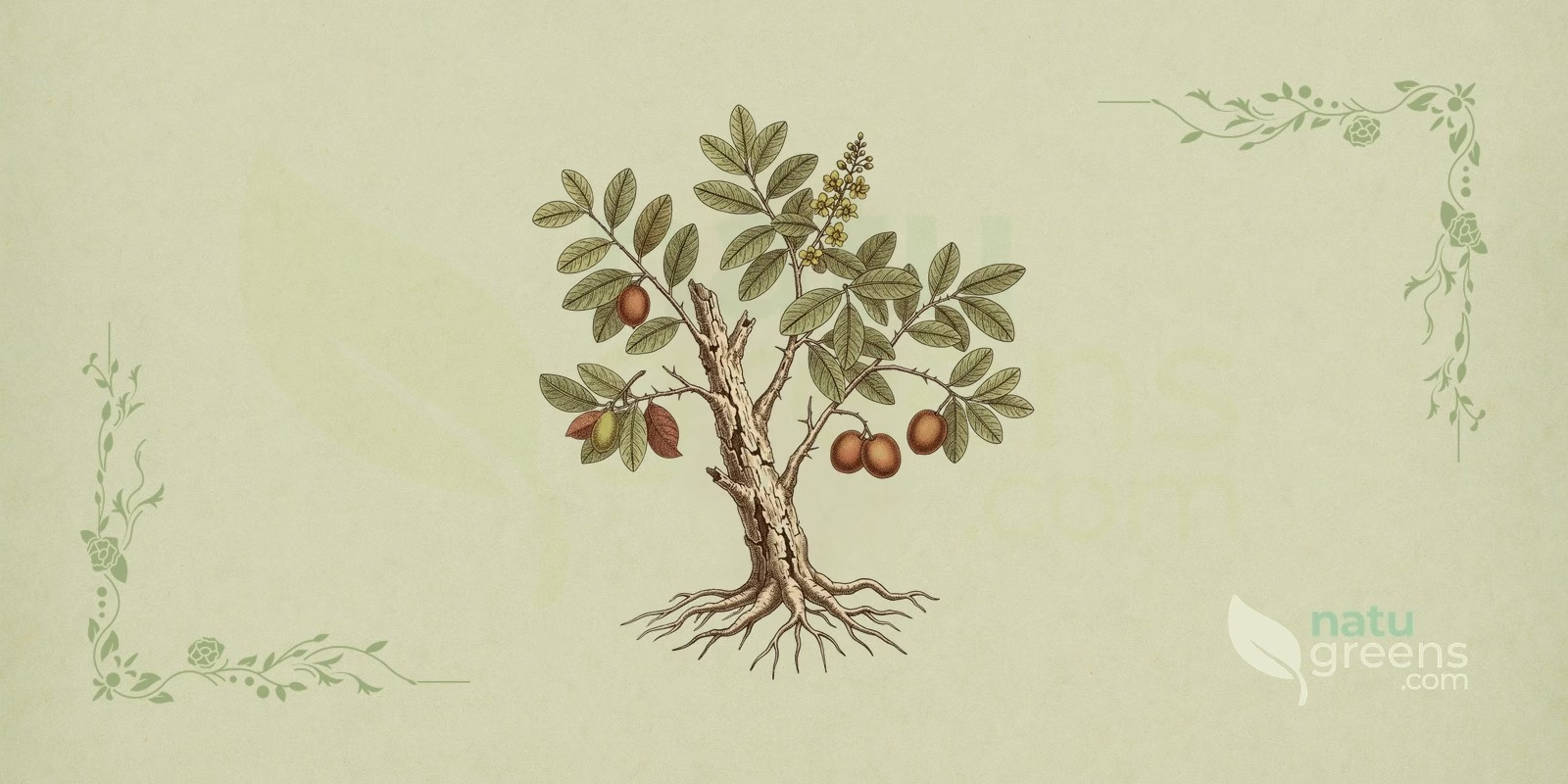
Sarcomphalus joazeiro (Mart.) Hauenschild / Juazeiro is a thorny tree in the Rhamnaceae family that scientists knew for decades as Ziziphus joazeiro Mart. Native to Brazil, it grows mainly in the Caatinga, the dry scrubland of the country's semi-arid Northeast, where it stands out by keeping a green canopy through the driest months of the year, when almost all the surrounding vegetation has dropped its leaves. Its bark is rich in saponins that lather on contact with water, and for generations this has supported the folk use of juazeiro, also called juá, for cleaning the teeth and washing the hair, as well as its traditional role as an expectorant in homemade syrups. The effects attributed to the plant rest on ethnobotanical records and laboratory experiments rather than clinical studies in people, so none of its health benefits can be considered proven.
Common and International Names of Juazeiro
- English: juazeiro, joazeiro, juá (loanwords from Portuguese used in scientific publications, since the species has no common name of its own in English).
- Portuguese: joá, juá, juá-espinho, juá-fruta, juazeiro, juazeiro-do-sertão, laranjeira-de-vaqueiro.
- Spanish: juazeiro, joazeiro (Spanish-language sources usually keep the Brazilian name, with no established vernacular name of their own).
Not to Be Confused with Other Plants Called Juá or Joá
In rural Brazil, the names juá and joá are also given to several spiny plants of the genus Solanum, in the nightshade family, whose yellowish fruits look vaguely like those of juazeiro but should not be eaten. Before any use, then, it is essential to be sure the plant in question is the tree Sarcomphalus joazeiro, which has a woody trunk, branches with paired thorns and leaves with three prominent veins running from the base. The species should not be confused with jujube (Ziziphus jujuba) either, an Asian relative in the same family whose fruit is sold dried or candied, and whose properties cannot simply be carried over to the Brazilian juazeiro.
Botanical Synonyms of Juazeiro
The currently accepted name for the species is Sarcomphalus joazeiro (Mart.) Hauenschild. The combination was published after a phylogenetic study of the Rhamnaceae, which appeared in the journal Taxon in 2016, showed that the American species formerly placed in Ziziphus form a separate group and revived the old genus Sarcomphalus for them. The most important synonym is Ziziphus joazeiro Mart., also spelled Zizyphus joazeiro, the name under which virtually all chemical, pharmacological and ethnobotanical research on the plant was published, and still the most useful search term for anyone looking for studies on juazeiro. Taxonomic databases such as GBIF also list Ziziphus gardneri Reissek and Zizyphus cotinifolia Reissek as synonyms, names described in the nineteenth century from specimens collected in northeastern Brazil.
Botanical Family: Rhamnaceae
Juazeiro belongs to the Rhamnaceae, known in English as the buckthorn family, which includes around 900 species of trees, shrubs and climbers spread across tropical and temperate regions of the world. Many members of the family produce triterpene saponins and anthracene compounds, which explains the traditional medicinal use of several of them, such as cascara sagrada (Frangula purshiana), whose bark is known as a laxative. Juazeiro's closest relatives include the jujubes of the genus Ziziphus, grown in Asia for their fruit, and other American species of Sarcomphalus, all with thorny branches and leaves marked by three main veins that spread from the base of the blade.
Parts of Juazeiro Used
The most widely used part of juazeiro is the stem bark, especially its inner layer, which is scraped off and sold at street markets across northeastern Brazil as raspa de juá (juá bark shavings) for brushing the teeth, washing the hair and making teas and syrups. The leaves also turn up in ethnobotanical surveys, usually prepared as an infusion or crushed in water to produce a lather used to clean the scalp. The fruits, small yellow drupes with sweet, slightly mucilaginous white flesh, are eaten fresh by people in the backlands and feed wildlife and cattle, while the leaves and young shoots serve as fodder during long droughts.
Ethnobotanical and Traditional Uses of Juazeiro
Juazeiro ranks among the medicinal plants of greatest relative importance in the Caatinga, according to a quantitative review that brought together 21 ethnobotanical inventories carried out with rural and Indigenous communities in northeastern Brazil. Its most widespread use is as a natural tooth cleaner: the bark shavings are rubbed straight onto the teeth or mixed with water until they foam, a habit so rooted in the backlands that it inspired commercial toothpastes made with juá extract. The same lather is traditionally used to wash the hair and, according to folk accounts, to keep dandruff and an oily scalp in check. In home medicine, teas and syrups made from the bark are taken as expectorants for coughs and bronchitis, and compilations of medicinal plants from the Northeast also record the plant's use for digestive complaints and skin conditions. In a survey conducted in the state of Sergipe, juazeiro was one of the four plants residents mentioned most often as a home remedy for fungal skin infections, which prompted laboratory research into this traditional use.
Medicinal Properties of Juazeiro
The properties listed below come from laboratory work, carried out on microbial cultures or in chemical assays, and from folk tradition. None of them has been confirmed in clinical trials in humans.
- Antibacterial (inner bark extracts inhibited bacteria linked to tooth decay and gum disease in in vitro tests, with a weaker effect than other plants assessed in the same study, and betulinic acid derivatives isolated from the bark were active against Gram-positive bacteria in the lab)
- Antifungal (an aqueous infusion of the bark inhibited fungi such as Trichophyton rubrum and Candida albicans in laboratory assays, a result that has not yet been reproduced in people)
- Antioxidant (aqueous extracts and saponins isolated from juá were able to neutralize free radicals in chemical tests, which is not the same as a proven antioxidant effect in the body)
- Detergent and foaming (a physical property of saponins, which lower the surface tension of water and account for the traditional use of the bark to clean teeth and hair)
- Expectorant (traditional use in cough syrups and teas, attributed to the saponins, with no clinical studies assessing this action in juazeiro)
Detailed Phytochemical Profile of Juazeiro
Research on juazeiro's chemistry has focused mainly on the stem bark, where the triterpenes and saponins behind the plant's typical lather are concentrated, and all the available studies were published under the name Ziziphus joazeiro.
- Alphitolic acid (a pentacyclic triterpene isolated from the bark extract, also found in other species of the Rhamnaceae family)
- Betulinic acid and derivatives (besides betulinic acid itself, three previously unknown derivatives esterified with phenolic acids were described, and these were active against Gram-positive bacteria in the lab)
- Phenolic compounds (associated with the antioxidant activity seen in aqueous extracts of the inner bark)
- Triterpene saponins (the main group of compounds in the bark, responsible for the lather, the detergent action and the possible gastrointestinal irritation when swallowed in large amounts)
- Ursolic acid (a triterpene widely distributed in the plant kingdom, identified in the dichloromethane extract of the bark)
Preparation and Administration of Juazeiro
In backland tradition, the most common use is external: the inner bark shavings are rubbed straight onto the teeth or moistened into a foaming paste, which is then rinsed out without being swallowed. For the hair, the shavings or the leaves are crushed in warm water and shaken until they lather, and the foam is applied to the scalp as a natural shampoo and rinsed off with plenty of water. Traditional internal use involves teas made by simmering small pieces of bark and homemade syrups prepared with sugar or honey, always in small amounts because of the saponins. The Brazilian market also offers toothpastes, shampoos and soaps containing juá extract, cosmetic products for external use that should not be mistaken for herbal medicines.
Synergy with Other Medicinal Plants
Traditional Oral Hygiene
In the folk medicine of northeastern Brazil, juazeiro shares space with other Caatinga plants used for oral hygiene, such as aroeira-do-sertão (Myracrodruon urundeuva, now also classified as Astronium urundeuva), whose bark is used in mouth rinses, and catingueira (Cenostigma pyramidale), which has been tested alongside juá in studies of activity against oral bacteria. No research has tested these plants together, so any combination should be understood as a folk practice rather than a pairing with demonstrated effectiveness.
Coughs and the Airways
In homemade backland syrups, juá bark often appears alongside plants traditionally used for coughs, such as cumaru bark (Amburana cearensis) and the sap or bark of jatobá (Hymenaea courbaril). These blends reflect knowledge handed down by raizeiros (traditional herbalists) and folk healers, with no studies assessing their safety or combined effect, which makes it advisable to talk to a health professional before using them, especially for children.
Recipes and Usage Protocols for Juazeiro
Juá Bark Shavings for Brushing
In traditional practice, a small amount of dried inner bark shavings, about half a teaspoon, is moistened on the toothbrush or in the palm of the hand and rubbed over the teeth and gums until it foams, followed by a thorough rinse with water. The key point with this use is not to swallow the foam, since the saponins can irritate the stomach and intestines, and for the same reason the shavings should not be used by young children who cannot yet spit reliably.
Juá Lather for the Hair
In the folk recipe, a tablespoon of bark shavings or a handful of fresh leaves is crushed in a glass of warm water and shaken until it lathers. The foam is applied to the damp scalp, massaged in for a few minutes and rinsed carefully to keep it out of the eyes. Before the first use, it is wise to try the lather on a small patch of skin to check for redness or itching. These uses follow traditional records and do not replace professional advice, particularly from dentists and dermatologists when symptoms in the mouth or on the scalp persist.
The preparations above follow traditional records and do not replace professional guidance. Before any internal use, check the contraindications and interactions described in this article.
Associated Practices for Juazeiro
Clinical Herbal Medicine
Juazeiro does not appear in the official monographs of the Brazilian Pharmacopoeia or on the lists of medicinal plants with uses regulated by Anvisa, Brazil's health regulatory agency, and no herbal medicine based on the species is registered. In herbal medicine, interest in the plant centers on research into oral care products and plant-derived antimicrobial agents, a line of inquiry that still needs safety studies and clinical trials before it can move beyond the laboratory.
Folk Medicine of the Brazilian Backlands
There is no documented homeopathic use of juazeiro, whose tradition of use belongs to the folk medicine of Brazil's semi-arid region, passed down orally by raizeiros, midwives and folk healers. In this setting, the plant is valued as much for its medicinal uses as for its symbolic role as a tree that withstands drought, gives shade along dirt roads and feeds people and animals when almost nothing else in the landscape is green.
Contraindications and Side Effects of Juazeiro
Juazeiro bark is rich in saponins, and when swallowed in high doses these substances can irritate the stomach and intestines, causing nausea, vomiting, abdominal pain and diarrhea. For this reason, the bark, concentrated teas and the foam should not be ingested in large amounts, and it is worth remembering that the traditional use for brushing teeth and washing hair is external, with a complete rinse and without swallowing the product. There are no robust safety data on concentrated internal use of juazeiro during pregnancy and breastfeeding, so as a precaution pregnant and breastfeeding women should avoid teas, syrups and extracts of the plant. Young children should not use the shavings in the mouth either, because of the risk of swallowing the foam. Since saponins irritate mucous membranes, the lather should be kept away from the eyes, and if contact occurs, the area should be rinsed immediately under running water. People with gastritis, ulcers or other digestive disorders should avoid internal use, and any unwanted reaction is a reason to stop using the plant and seek medical care.
Drug Interactions
There are no studies on interactions between juazeiro and medicines, which means a lack of information, not proof of safety. Because saponins can alter the surface of the intestinal lining and, in theory, the absorption of other substances, anyone taking medication on an ongoing basis should avoid internal use of the plant or, at the very least, talk to a doctor or pharmacist first and mention any juá teas or syrups they take.
Curiosities and Historical Facts
The name juá, of Tupi origin, gave rise to juazeiro, a word that names two important cities in northeastern Brazil: Juazeiro, in Bahia, on the banks of the São Francisco River, and Juazeiro do Norte, in Ceará, both founded where large trees of the species offered shade to travelers and mule drivers. The epithet joazeiro, chosen by the German naturalist Carl Friedrich Philipp von Martius when he described the plant in the nineteenth century, is simply the Latinized form of the Brazilian common name. The tree also holds a prominent place in backland culture and appears in songs, cordel folk poetry and the work of northeastern writers as a symbol of resilience, because it stays green through droughts thanks to a deep root system that can reach the moisture stored underground.
Frequently Asked Questions About Juazeiro
Are Juazeiro and Ziziphus joazeiro the Same Plant?
Yes. Ziziphus joazeiro was the scientific name used for more than a century, until a phylogenetic revision published in 2016 moved the species to the genus Sarcomphalus. The accepted name today is Sarcomphalus joazeiro, but most studies still turn up in searches under the old name.
Can Juá Bark Shavings Be Used to Brush Teeth?
This is the plant's best-known traditional use in northeastern Brazil, and laboratory studies have shown that bark extracts inhibit some oral bacteria. Even so, there are no clinical trials comparing juá shavings with fluoride toothpaste, and the foam should not be swallowed because of the saponins.
Is the Juazeiro Fruit Edible?
Yes, the ripe fruit, called juá, is traditionally eaten in the backlands, with sweet, slightly sticky flesh around a large stone. You do need to be certain of the identification, though, because other plants popularly called juá or joá, in the genus Solanum, bear fruits that should not be eaten.
Can Pregnant Women Drink Juazeiro Tea?
It is not recommended. There are no safety data on concentrated internal use of the plant during pregnancy and breastfeeding, and the saponins in the bark can cause gastrointestinal irritation, so the advice is to avoid teas, syrups and extracts during these periods.
Does Juazeiro Help with Dandruff?
Juá lather is traditionally used to wash the scalp and keep dandruff under control, and the bark has shown activity against some fungi in the lab. However, no studies in people have confirmed this effect, and persistent dandruff should be assessed by a dermatologist.
Notice: this content is for informational purposes and does not replace professional medical advice. Consult a physician or herbal practitioner before using medicinal plants, especially during pregnancy, breastfeeding, or alongside medication.
How to cite this article
NATUGREENS. Juazeiro (Sarcomphalus joazeiro): Uses, Saponins and Safety. Natugreens, 22 Nov. 2026. Disponível em: https://natugreens.com/juazeiro-sarcomphalus-joazeiro/. Accessed: Nov. 22, 2026.
Natugreens. (2026). Juazeiro (Sarcomphalus joazeiro): Uses, Saponins and Safety. Natugreens. https://natugreens.com/juazeiro-sarcomphalus-joazeiro/
References and Scientific Studies
View All 8 Cited References
Peer-Reviewed Scientific Studies (7)
- DOI2007 Albuquerque, U. P., Medeiros, P. M., Almeida, A. L. S., Monteiro, J. M., Lins Neto, E. M. F., Melo, J. G., & Santos, J. P. (2007). Medicinal plants of the caatinga (semi-arid) vegetation of NE Brazil: a quantitative approach. Journal of Ethnopharmacology, 114(3), 325-354. ↗
- DOI2007 Agra, M. F., Freitas, P. F., & Barbosa-Filho, J. M. (2007). Synopsis of the plants known as medicinal and poisonous in Northeast of Brazil. Revista Brasileira de Farmacognosia, 17(1), 114-140. ↗
- DOI2008 Alviano, W. S., Alviano, D. S., Diniz, C. G., Antoniolli, A. R., Alviano, C. S., Farias, L. M., Carvalho, M. A., Souza, M. M., & Bolognese, A. M. (2008). In vitro antioxidant potential of medicinal plant extracts and their activities against oral bacteria based on Brazilian folk medicine. Archives of Oral Biology, 53(6), 545-552. PMID: 18243157. ↗
- DOI2007 Cruz, M. C., Santos, P. O., Barbosa, A. M., Jr., Mélo, D. L., Alviano, C. S., Antoniolli, A. R., Alviano, D. S., & Trindade, R. C. (2007). Antifungal activity of Brazilian medicinal plants involved in popular treatment of mycoses. Journal of Ethnopharmacology, 111(2), 409-412. PMID: 17234376. ↗
- DOI2016 Hauenschild, F., Matuszak, S., Muellner-Riehl, A. N., & Favre, A. (2016). Phylogenetic relationships within the cosmopolitan buckthorn family (Rhamnaceae) support the resurrection of Sarcomphalus and the description of Pseudoziziphus gen. nov. Taxon, 65(1), 47-64. ↗
- DOI2013 Ribeiro, B. D., Alviano, D. S., Barreto, D. W., & Coelho, M. A. Z. (2013). Functional properties of saponins from sisal (Agave sisalana) and juá (Ziziphus joazeiro): critical micellar concentration, antioxidant and antimicrobial activities. Colloids and Surfaces A: Physicochemical and Engineering Aspects, 436, 736-743. ↗
- DOI1999 Schühly, W., Heilmann, J., Calis, I., & Sticher, O. (1999). New triterpenoids with antibacterial activity from Zizyphus joazeiro. Planta Medica, 65(8), 740-743. PMID: 10630117. ↗
Supplementary Readings (1)
- 2024 GBIF Secretariat. (2024). Sarcomphalus joazeiro (Mart.) Hauenschild, accepted name and synonyms. GBIF Backbone Taxonomy. ↗
You May Also Like


Take your time and tell us everything you think, details included. Every response is read by someone on our editorial team and goes into the article's revision. An honest critique helps us more than a polite compliment.
Take your time and tell us everything you think, details included. Every response is read by someone on our editorial team and goes into the article's revision. An honest critique helps us more than a polite compliment.