



Quick summary
Vismia guianensis (Aubl.) Pers. / Lacre is a shrub or small tree in the family Hypericaceae. It ranges from Central America to northern South America and grows in several regions of Brazil, above all in the Amazon, where it is common in secondary growth, along forest edges and in open land that is reverting to…
Main caution: Lacre latex is rich in anthraquinones and benzophenones and is irritating to the skin and mucous membranes, so internal use is not recommended in any form, whether as pure latex, tea, bottled folk tonic (garrafada) or…
Vismia guianensis (Aubl.) Pers. / Lacre is a shrub or small tree in the family Hypericaceae. It ranges from Central America to northern South America and grows in several regions of Brazil, above all in the Amazon, where it is common in secondary growth, along forest edges and in open land that is reverting to woodland. The common name comes from the orange latex that oozes from the branches when they are cut, and it is precisely this latex that folk medicine in northern and northeastern Brazil applies to the skin for fungal infections, wounds and other skin complaints. In recent years, leaf and bark extracts have been studied in the laboratory for their activity against fungi, but everything known so far comes from traditional use and from cell and animal experiments, with no human study confirming either efficacy or safety.
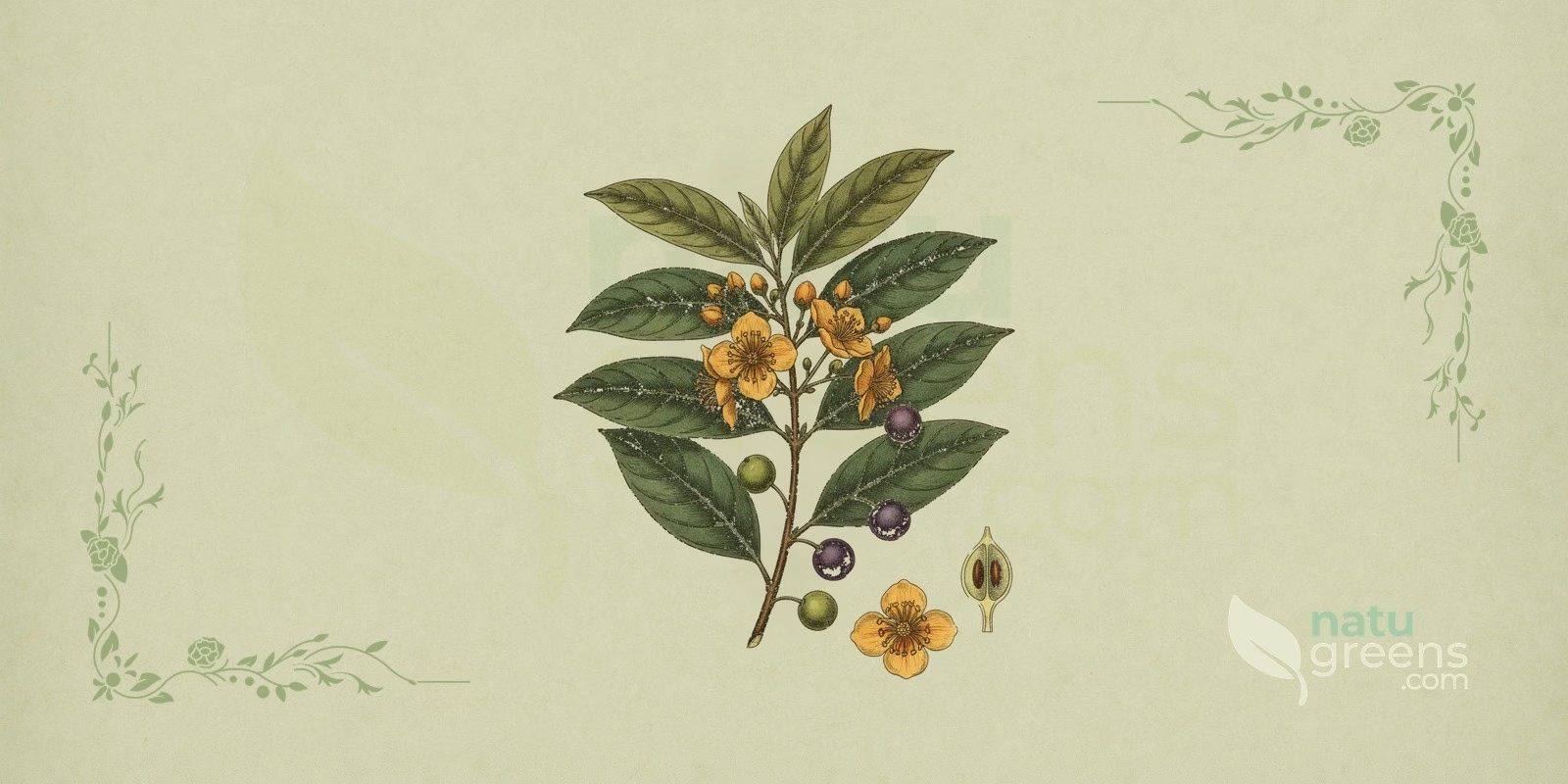
Common and International Names of Lacre
- Portuguese: lacre, pau-de-lacre.
- Trinidad and Tobago French Creole: la craie.
Not to Be Confused with Vismia guineensis
The scientific name of lacre differs by a single letter from Vismia guineensis, an African plant in the same family that is now usually treated as Psorospermum guineense. Because both names turn up often in databases and in papers on medicinal plants, studies on the African species are sometimes credited to the American one, and the other way round. Whenever you read anything about lacre, it pays to check that the epithet really is guianensis, a reference to the Guianas. Other Vismia species that also bleed orange latex may be called lacre in the Amazon too, which makes correct botanical identification essential before any use.
Botanical Synonyms of Lacre
The species was first described by the French botanist Fusée Aublet, from material collected in French Guiana, under the name Hypericum guianense Aubl., which is its basionym. The authorship of the combination in the genus Vismia varies with the source consulted: the Kew catalogue gives Vismia guianensis (Aubl.) Pers., while Flora e Funga do Brasil uses Vismia guianensis (Aubl.) Choisy. Synonyms listed in taxonomic catalogues include Caopia guianensis (Aubl.) A.Lyons, Hypericum acuminatum Lam., Vismia acuminata (Lam.) Pers., Vismia cearensis Huber, Vismia guaramirangae Huber and Vismia latifolia Kunth, along with several varieties described by the botanist M. E. van den Berg, who studied the genus in Brazil.
Botanical Family: Hypericaceae
Lacre belongs to the family Hypericaceae, the same as St John's wort (Hypericum perforatum), a group of a few hundred species in which the genus Hypericum accounts for the vast majority. For a long time Vismia was placed in the family Clusiaceae, also known as Guttiferae, which is why many older works still list it there. DNA-based phylogenetic studies have since confirmed Hypericaceae as a family in its own right, with Vismia sitting in the tribe Vismieae alongside African genera such as Harungana and Psorospermum. Lacre forms fast-growing shrubs or small trees typical of secondary vegetation, with simple, opposite leaves whose undersides are usually covered in rusty hairs, small flowers clustered in panicles at the branch tips and fleshy berries, and its branches release the yellow-orange latex characteristic of the genus.
Parts of Lacre Used
The part tradition remembers best is the orange latex that seeps from the branches, to which researchers attribute the main antimicrobial activity reported in folk use. The leaves also appear in the records, mostly in external preparations for inflammatory and infectious skin conditions, and they were the raw material for the extracts tested in the laboratory in the most recent studies. The stem bark and roots serve mainly for chemical research, while the fruits supplied the essential oil analysed in a Brazilian study of its composition.
Ethnobotanical and Traditional Uses of Lacre
Records of lacre use are concentrated in the Amazon and in parts of northeastern Brazil, and they almost always involve applying the plant directly to the skin. The uses described in the literature are listed below, always as traditional practice and not as proven efficacy:
- Dermatomycoses, or fungal skin infections, with topical application of the latex
- Herpes lesions
- Inflammatory and infectious skin conditions, with leaf preparations for external use
- Wounds and skin ulcers
Medicinal Properties of Lacre
The properties below come from traditional use and from laboratory experiments with leaf, bark and fruit extracts, carried out in culture plates and in mice. None of them has been assessed in humans, and the results cannot be carried over directly to home use of the latex.
- Antibacterial action (the fruit essential oil inhibited the bacterium Staphylococcus lentus in an in vitro test, with no data on human infections)
- Antifungal action (ethanolic leaf and bark extracts inhibited Sporothrix schenckii, the fungus behind sporotrichosis, in culture and lowered the fungal load in the spleen of infected mice)
- Antioxidant action (free radical scavenging by aerial part extracts and by the fruit oil in laboratory assays)
- Inhibition of Candida virulence factors (a hydroethanolic leaf extract reduced, in vitro and at high concentrations, traits that help Candida albicans and Candida glabrata cause infection)
- Reduction of inflammatory markers (lower nitric oxide and pro-inflammatory cytokines, with higher IL-10, in mice given leaf and bark extracts)
Detailed Phytochemical Profile of Lacre
The chemistry of the genus Vismia is dominated by phenolic compounds, and reviews of the subject regard anthraquinones and vismiones as markers of the group. In lacre, the following constituents have been described from the leaves, bark, roots and fruits:
- Anthraquinones (the most frequent class in the leaves, with vismiaquinone A isolated from the aerial parts)
- Benzocoumarins (aromatic compounds isolated from the chloroform extract of the roots)
- Flavonoids (kaempferol, quercetin, vitexin and O-glycosylated flavonoids in the leaves)
- Phytosterols (beta-sitosterol and stigmasterol in the aerial parts)
- Prenylated benzophenones (16 derivatives detected in leaf and bark extracts, plus new compounds described from the roots)
- Sesquiterpenes (38 components in the fruit essential oil, chiefly beta-caryophyllene, alpha-copaene and delta-cadinene)
- Vismiones (prenylated anthranoids typical of the genus, such as vismione D, flagged in a computer simulation as a possible inhibitor of an essential Candida enzyme)
- Xanthones (phenolic compounds reported in the leaves in smaller amounts)
Preparation and Administration of Lacre
According to folk records, the latex is collected by cutting or nicking a branch and gathering the orange liquid that runs out, which is then dabbed straight onto the affected patch of skin. The leaves appear in preparations intended for external use only. There is no standardised dose, and the concentration of anthraquinones and other compounds in the latex varies from plant to plant, so there is no way of knowing how much is being applied. The extracts studied in the laboratory were made by macerating the leaves in alcohol and water under controlled conditions that cannot be reproduced at home, and as far as the literature consulted shows, there is no registered herbal product based on lacre. No reliable record indicates the latex for swallowing, and internal use is not recommended.
Synergy with Other Medicinal Plants
Other Amazonian Plants Used on the Skin
In Amazonian folk practice, lacre is usually used on its own, but it sits alongside other traditional remedies applied to the skin, such as andiroba oil (Carapa guianensis) and copaiba oil (Copaifera spp.). No studies have looked at combining these plants with lacre latex, and layering several plant products on the same area raises the chance of irritation and allergic reaction, besides making it harder to tell which one is to blame if the skin reacts badly.
Combination with Conventional Antifungals Under Study
The authors of the Sporothrix schenckii study started from the idea that extracts acting on the inflammatory response might one day complement pharmacy antifungals, and they compared lacre extracts with itraconazole in mice. This hypothesis has not yet been tested in people, so lacre latex or extracts should not be combined with antifungal medicines on your own initiative, nor used in their place.
Recipes and Usage Protocols for Lacre
Traditional Application of the Latex to the Skin
According to folk accounts, the fresh latex is dabbed directly onto the fungal patch, and people who follow this tradition tend to use only a small amount, applied with a cotton swab and confined to the lesion rather than spread over the surrounding skin. Before any wider application, prudence calls for a test on a small area of intact skin, such as the inner forearm, watching for one to two days for redness, itching, burning or blisters. These uses follow traditional records and do not replace professional advice, especially since skin lesions that look like a fungal infection can have other causes and need a proper diagnosis.
External Preparations with the Leaves
The records mention the leaves in external preparations for skin problems, with no standardised recipe and no proportions described consistently in the literature. For that reason no safe formula can be recommended, and any preparation should be kept to intact skin, away from the eyes, mouth and mucous membranes, and never swallowed.
Therapies Associated with Lacre
Clinical Herbal Medicine
In clinical herbal medicine, lacre is still a plant of experimental interest, with no official monograph and no established usage protocol. Published studies focus on the search for compounds active against the fungi behind skin mycoses and candidiasis, a field where resistance to current medicines is driving research on plants, but the results are still confined to the laboratory and to animal models.
Amazonian Traditional Medicine
There is no record of any widespread homeopathic preparation made from Vismia guianensis. Lacre belongs instead to the traditional medicine of the Amazon, handed down among riverside, Indigenous and rural communities who know the plant from secondary growth and use it mainly for skin problems, and this knowledge prompted much of the research carried out on the species at Brazilian universities.
Contraindications and Side Effects of Lacre
Lacre latex is rich in anthraquinones and benzophenones and is irritating to the skin and mucous membranes, so internal use is not recommended in any form, whether as pure latex, tea, bottled folk tonic (garrafada) or homemade extract. Even the traditional topical use on dermatomycoses calls for caution: before putting the latex on a larger area, you need to test it on a small patch of intact skin and wait one to two days, stopping use at any sign of redness, itching, burning, swelling or blisters. The latex should not be applied near the eyes, in the mouth, on mucous membranes, on large open wounds or over large areas of the body, and it should not be used on babies and young children. It should be avoided during pregnancy and breastfeeding, because there are no human safety data. Reviews of the genus Vismia report that some vismiones and other anthranoids are toxic to cells in laboratory tests, another reason to keep the latex well away from ingestion; the low toxicity seen with the leaf extract in mouse cells does not apply to the pure latex. Fungal infections that spread, affect the nails or scalp, do not improve within a few days or appear in people with diabetes or weakened immunity call for medical assessment, and lacre should never replace a prescribed antifungal.
Drug Interactions
There are no studies on interactions between lacre and medicines. Since internal use is not recommended, the main precaution is to avoid applying the latex to the same area where pharmacy creams or ointments are being used, such as antifungals, corticosteroids or topical antibiotics, without professional guidance, because the irritation caused by the latex may interfere with how these products work and cloud the assessment of the lesion. When swallowed, anthraquinones tend to irritate the intestinal tract, which reinforces the advice not to swallow the latex or any preparation of the plant, and anyone on long-term medication should tell their doctor about plants applied to the skin.
Curiosities and Historical Facts
The epithet guianensis recalls the origin of the material described by Fusée Aublet in his work on the plants of French Guiana, published in 1775, when the species was still placed in the genus Hypericum, the same as St John's wort. That kinship shows up in the chemistry as well: hypericin, the reddish pigment of St John's wort, belongs to the same large family of anthranoids that gives lacre latex its colour. The Brazilian common name refers to the sealing wax once used to seal letters and documents, because of the colour and consistency of the liquid that runs from the branches, and in Trinidad and Tobago the plant is recorded under the Creole name la craie, which sounds curiously similar. In the Amazon, Vismia species are among the first trees to colonise abandoned pastures and clearings, forming secondary thickets dominated by them.
Frequently Asked Questions About Lacre
Can You Drink Lacre Tea?
It is not recommended. Lacre latex is irritating and rich in anthraquinones and benzophenones, there are no safety studies on internal use in people, and reliable traditional records describe the plant for external use on the skin.
Does Lacre Latex Work Against Fungal Skin Infections?
Using the latex on fungal skin infections is an Amazonian tradition, and leaf and bark extracts have shown activity against fungi in the laboratory and in mice. Even so, no study has assessed the effect in people, and persistent or widespread fungal infections should be examined by a doctor, who can prescribe antifungals of proven efficacy.
How Can You Patch Test Lacre on the Skin Safely?
The cautious approach is to apply a tiny amount to a small area of intact skin, such as the inner forearm, and wait one to two days. If redness, itching, burning or blisters appear, stop using it, and even with no reaction the latex should not be extended to large areas, mucous membranes or open wounds.
Are Lacre and Vismia guineensis the Same Plant?
No. Vismia guianensis is the American species known as lacre, while Vismia guineensis is an African plant now generally treated as Psorospermum guineense. The near-identical names mean that studies on one are fairly often credited to the other.
Can Pregnant Women and Children Use Lacre?
Use should be avoided during pregnancy, while breastfeeding and in babies and young children, because there are no human safety data and the latex is irritating to the skin.
Notice: this content is for informational purposes and does not replace professional medical advice. Consult a physician or herbal practitioner before using medicinal plants, especially during pregnancy, breastfeeding, or alongside medication.
How to cite this article
NATUGREENS. Lacre (Vismia guianensis): Latex, Fungal Skin Infections and Safety. Natugreens, 26 Nov. 2026. Disponível em: https://natugreens.com/lacre-vismia-guianensis/. Accessed: Nov. 26, 2026.
Natugreens. (2026). Lacre (Vismia guianensis): Latex, Fungal Skin Infections and Safety. Natugreens. https://natugreens.com/lacre-vismia-guianensis/
References and Scientific Studies
View All 10 Cited References
Peer-Reviewed Scientific Studies (8)
- DOI2012 Hussain, H., Hussain, J., Al-Harrasi, A., Saleem, M., Green, I. R., van Ree, T., et al. (2012). Chemistry and biology of genus Vismia. Pharmaceutical Biology, 50(11), 1448-1462. ↗
- DOI2017 Oliveira, A. H., Oliveira, G. G., Carnevale Neto, F., Portuondo, D. F., Batista-Duharte, A., Carlos, I. Z. (2017). Anti-inflammatory activity of Vismia guianensis (Aubl.) Pers. extracts and antifungal activity against Sporothrix schenckii. Journal of Ethnopharmacology, 195, 266-274. ↗
- DOI2022 Motta, E. P., Farias, J. R., Costa, A. A. C., Silva, A. F., Lopes, A., Cartágenes, M. S. S., Nicolete, R., Abreu, A. G., Fernandes, E. S., Nascimento, F. R., Rocha, C. D., Monteiro, C., Guerra, R. (2022). The Anti-Virulence Effect of Vismia guianensis against Candida albicans and Candida glabrata. Antibiotics, 11(12), 1834. ↗
- DOI2000 Seo, E. K., Wani, M. C., Wall, M. E., Navarro, H., Mukherjee, R., Farnsworth, N. R., Kinghorn, A. D. (2000). New bioactive aromatic compounds from Vismia guianensis. Phytochemistry, 55(1), 35-42. ↗
- DOI2012 Silvestre, R. G., Moraes, M. D., Lins, A. C. S., Ralph, M. T., Lima-Filho, J. V., Câmara, C. A., Silva, T. M. S. (2012). Chemical composition, antibacterial and antioxidant activities of the essential oil from Vismia guianensis fruits. African Journal of Biotechnology, 11, 9888-9893. ↗
- DOI2016 Lins, A. C. S., Agra, M. F., Conceição, D. C. O., Pinto, F. C. T., Câmara, C. A., Silva, T. M. S. (2016). Chemical Constituents and Antioxidant Activity from Aerial Parts of Clusia paralicola and Vismia guianensis. Revista Virtual de Química, 8, 157-168. ↗
- DOI2021 Diel, K. A., Meirelles, G. C., Bridi, H., von Poser, G. (2021). Drawing a parallel between phytochemistry and other features of Vismieae species. Phytochemistry Reviews, 20, 1109-1159. ↗
- DOI2011 Ruhfel, B. R., Bittrich, V., Bove, C. P., Gustafsson, M. H. G., Philbrick, C. T., Rutishauser, R., Xi, Z., Davis, C. C. (2011). Phylogeny of the clusioid clade (Malpighiales): Evidence from the plastid and mitochondrial genomes. American Journal of Botany, 98(2), 306-325. ↗
Supplementary Readings (2)
You May Also Like
 St. John's WortHypericum perforatum
- Harungana madagascariensis: Properties and BenefitsHarungana madagascariensis
- Yellow Uxi (Endopleura uchi): Properties and UsesEndopleura uchi
- Brazilian Joyweed (Alternanthera brasiliana): Uses and SafetyAlternanthera brasiliana
- Mangaba Tree (Hancornia speciosa): Properties and UsesHancornia speciosa
Take your time and tell us everything you think, details included. Every response is read by someone on our editorial team and goes into the article's revision. An honest critique helps us more than a polite compliment.
Take your time and tell us everything you think, details included. Every response is read by someone on our editorial team and goes into the article's revision. An honest critique helps us more than a polite compliment.