Ligusticum porteri is a large perennial herb of the Apiaceae, the family that also holds carrot, celery and fennel. It grows only in the mountains of western North America, where it occupies subalpine meadows and the open understorey of conifer and aspen woodland. In the Spanish of New Mexico the plant answers to “osha”, a name that carried over into English and into the popular botanical literature of the American Southwest.
The first thing that stands out in the field is not the foliage, which could belong to any of dozens of umbellifers, but the smell. Scraped, the rhizome releases a penetrating aroma usually described as celery crossed with caramel, and it lingers on the hands for hours. That olfactory signature is the most dependable diagnostic character the species has and, as will become clear below, it is also the line that separates Ligusticum porteri from lethally toxic relatives growing on the same slopes.
The species is remarkable for three reasons that reinforce one another. It is exacting enough to resist cultivation away from its own habitat, it grows slowly enough that a harvested plant represents many years of accumulation, and it concentrates in its rhizome a phthalide chemistry that has kept it under continuous phytochemical study since the 1990s. This profile describes the plant itself: taxonomy, morphology, ecology, phenology, chemistry and conservation.
Osha is the name this plant answers to in the Spanish of New Mexico, a name that carried over into English.
In addition, osha grows only in the mountains of western North America, in subalpine meadows and the open understorey of conifer and aspen woodland.
Taxonomy
The placement of Ligusticum porteri has never been the subject of serious dispute. The name was published in 1888 by John Merle Coulter and Joseph Nelson Rose in their revision of the North American umbellifers, and it remains accepted both in the International Plant Names Index and in Kew’s Plants of the World Online.
- Kingdom: Plantae
- Division: Tracheophyta (vascular plants)
- Class: Magnoliopsida (eudicots)
- Order: Apiales
- Family: Apiaceae (Umbelliferae)
- Subfamily: Apioideae
- Genus: Ligusticum L.
- Species: Ligusticum porteri J.M.Coult. & Rose (1888)
Synonyms and Infraspecific Taxa
The synonymy is short. Ligusticum brevilobum Rydb., published in 1917 in the flora of the Rocky Mountains, was later reduced to Ligusticum porteri var. brevilobum (Rydb.) Mathias & Constance in 1941. Current treatments fold that material into the species, so the two names now circulate as synonyms. Some North American agencies still cite the variety separately, above all in state occurrence listings, which introduces noise into distribution databases.
It is worth noting that the genus Ligusticum, holding somewhere between forty and sixty circumboreal species depending on the treatment followed, is being dismantled by recent molecular work. The Asian and the North American lineages do not form a coherent group, and part of the species once gathered under the name have moved to other genera. Ligusticum porteri stays where it is.
Etymology
The generic name points to Liguria, the region of north-western Italy where the European species of the genus had been known since antiquity. The specific epithet honours Thomas Conrad Porter (1822-1901), an American botanist and clergyman who assembled one of the most important nineteenth-century collections of Colorado plants.
The common names have murkier origins. “Osha” is a word from New Mexican Spanish whose etymology has never been settled, possibly borrowed from an Indigenous language of the region. One recurrent hypothesis in the literature links it to the Zuni term for bear, though no firm linguistic demonstration exists. “Chuchupate”, current in northern Mexico, is generally attributed to a Spanish adaptation of a Nahuatl term for bitter herb.
Morphological Description
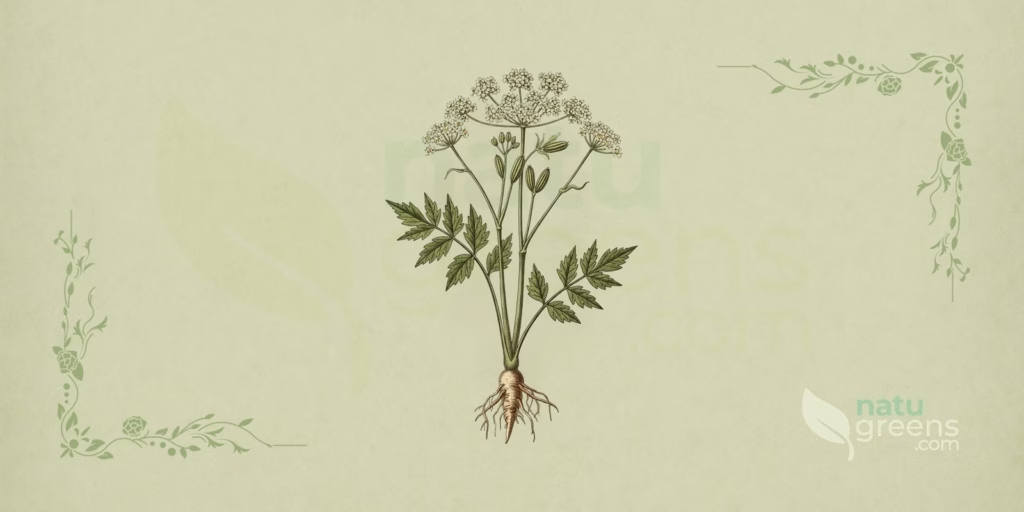
A robust perennial herb with erect stems ranging from moderately slender to stout and reaching 42 to 150 centimetres in height. The base of the stem is wrapped in the fibrous remains of petioles from earlier seasons, forming a distinctive crown of greyish fibre over the rhizome. All aerial growth dies back in winter and the plant resprouts from the underground system.
Leaves
Basal leaves are few, zero to two per plant, borne on long petioles of 7 to 24 centimetres that widen into a sheath at the insertion. The blade is divided three to four times, occasionally five, in a pinnate to ternate-pinnate pattern, which gives the foliage the lacy look typical of umbellifers. Terminal leaflets are ovate, rarely lanceolate, measure 1 to 4.6 centimetres and have an incised to toothed margin. Cauline leaves number one to four, growing smaller and simpler towards the tip. Crushed between the fingers they give off a strong celery smell.
Flowers
The inflorescence is a terminal compound umbel, flat-topped to slightly rounded, which in fruit reaches 4.5 to 15.4 centimetres across, exceptionally as little as 3.3 centimetres. Most plants carry between twelve and twenty-one primary rays, with recorded extremes of six to thirty-four, each ray 3.8 to 8 centimetres long. Involucral bracts are usually absent, or a single ovate to oblong bract appears. The bractlets of the involucel are linear and 1 to 6 millimetres long. Individual flowers are small, with five white or rarely pinkish petals and roughly 2 to 5 millimetres across overall; the sepals are obsolete, as is the rule in the family.
Fruits and Seeds
The fruit is an oblong-ellipsoid schizocarp, flattened dorsiventrally, 5.2 to 7.5 millimetres long, with extremes recorded from 4.4 to 8 millimetres. The ribs are well developed and modified, and three to five vittae, the secretory canals that store the volatile compounds, run in the intervals between them. Ripe mericarps take on a brownish to reddish tone. Each schizocarp splits into two one-seeded mericarps at dispersal.
Rhizome and Root
The underground organ is the most distinctive structure the species has. It is a thick, woody, branched rhizome covered on the outside by wrinkled dark brown bark and topped by the fibrous crown already mentioned. Inside it is yellowish to pale tan and shows resin canals visible to the naked eye in cross section. The aroma is intense and complex. Fresh, the tissue is astringent and irritates the lining of the mouth, an effect that disappears on drying.
Osha Distribution and Habitat
The species is native to the mountains of western North America. The core range covers Arizona, Colorado, Nevada, New Mexico, Utah and Wyoming, with further occurrences documented in Idaho and Montana, and it extends into northern Mexico through the states of Chihuahua, Durango and Sonora, in the Sierra Madre Occidental.
The recorded elevational gradient runs from 1,400 to 3,700 metres, though the bulk of the populations sit between 2,200 and 3,400 metres. There is a clear latitudinal shift: at the southern edge of the range the plant is confined to the highest ground, while in Utah and Wyoming it descends to considerably lower elevations. Typical habitat takes in open subalpine meadows, clearings and the understorey of Abies, Picea, Populus tremuloides and Pseudotsuga forest, along with the banks of mountain streams. Sagebrush stands are frequent neighbours along the drier margins of the range.
Soil requirements hold consistent across the whole area of occurrence: deep substrate, rich in organic matter, moist but well drained. The species tolerates anything from full sun to dense shade, which explains its presence in meadows as much as under closed canopy. There is no record of Ligusticum porteri naturalising outside its native range, nor any sign of invasive behaviour.
Cultivation
Ligusticum porteri has a well-established reputation as a difficult plant, and the horticultural literature is consistent in reporting failure whenever it is grown away from the montane conditions it comes from. Dependence on mycorrhizal associations in native soil is one of the factors put forward, alongside the need for prolonged winter cold and a wide day-to-night temperature swing.
Propagation from seed runs into deep dormancy. Prolonged cold stratification is required, in some cases combined with moist stratification, and even then germination is erratic. In the wild, recruitment from seed is a rare event, and population patches are maintained above all by growth and branching of the rhizome. Rhizome division is technically workable when the fragments carry viable buds, but establishment is slow and takes years.
Growth is the central bottleneck. Current estimates put plants with a developed rhizome at more than ten years of age, which makes any production cycle incompatible with conventional agricultural scales. The most successful experiences are not cultivation in the strict sense but assisted propagation within the natural populations themselves, with sowing and management carried out on site.
On the phytosanitary side, the species presents no serious problems in natural habitat. Aphids colonise inflorescences and young stems, swallowtail caterpillars use the foliage as a host plant, which is common across the Apiaceae, and root rots appear where the soil stays waterlogged without drainage. Browsing by ungulates and trampling by livestock weigh more heavily than any pest in the strict sense.
Phenology
Flowering happens in summer, packed into the short favourable window of the mountain cycle, peaking between late June and August according to elevation and latitude. Fruiting follows from late summer into early autumn, and the dry umbels stand upright on the plant for some weeks before the mericarps drop.
As throughout the family, the umbels draw a broad spectrum of floral visitors, among them bees, beetles, flies and wasps. Pollination studies in the Apiaceae do distinguish casual visitors from effective pollinators, and this second group includes bees of the families Andrenidae, Colletidae and Halictidae. Halictid bees were observed visiting flowers of the species in the Chiricahua Mountains of Arizona in September 2003.
Dispersal is the most limiting point in the cycle. The mericarps are neither carried by animals nor moved efficiently by wind, and field observation shows them falling and staying in the immediate vicinity of the parent plant. This essentially barochorous dispersal explains the clumped pattern of the populations and the slowness with which the species recolonises ground it has been cleared from.
Related Species and Confusions
Within the genus, a handful of species come up repeatedly in comparisons and identification keys:
- Ligusticum canadense (L.) Britton, of eastern North America, coarser in foliage and a plant of deciduous woodland.
- Ligusticum chuanxiong S.H.Qiu et al., a Chinese taxon with a long agricultural history, now often treated under the name Ligusticum striatum DC.
- Ligusticum filicinum S.Watson, a congener of the central Rockies with still more finely divided leaves and a less aromatic rhizome.
- Ligusticum grayi J.M.Coult. & Rose, of the Cascade Range and the Sierra Nevada, visibly smaller in stature.
- Ligusticum mutellina (L.) Crantz, a European alpine species of the Alps and the Pyrenees.
- Ligusticum scoticum L., a coastal plant of northern Europe and north-eastern North America, with fleshy glossy leaves.
Dangerous Look-alikes
This is the most important safety point in the profile. Ligusticum porteri is vegetatively similar to two lethal umbellifers that occur in western North America, and mistaken identification has already resulted in fatal poisonings.
- Cicuta douglasii and Cicuta maculata: the water hemlocks contain cicutoxin and rank among the most toxic plants in the North American flora. Swallowing a small amount of rhizome brings on convulsions and death. They are told apart by their habitat of waterlogged ground, marsh or the edge of standing water at generally lower elevations, by a rhizome with transverse internal chambers that ooze a yellowish liquid when cut, by an unpleasant smell and by fruits of a different shape.
- Conium maculatum: poison hemlock, introduced from Europe and now widely naturalised, contains piperidine alkaloids such as coniine, and every part of it is toxic. It is recognised by the purple blotches or streaks on its hairless stem, by a smell described as musty or like mouse urine, by a white, fleshy, thin-skinned root, and by the absence of a fibrous crown at the collar.
The most reliable practical test combines three observations: the crown of greyish fibre at the top of the rhizome, the wrinkled dark brown outer bark, and the unmistakable celery aroma with its sweet note. Neither hemlock shows that combination. A stem with purple blotches and a white root without a pleasant aroma point to a toxic plant, and the standing rule among field botanists is that any doubt about the identity of a wild umbellifer settles the matter.
Phytochemistry
The rhizome of Ligusticum porteri accumulates essential oil in secretory canals spread through the cortex, and that fraction is where analytical interest in the species is concentrated. The classes of compound characterised so far are the following.
- Coumarins and furanocoumarins: present at modest concentrations compared with other Apiaceae.
- Dimeric phthalides: diligustilide, riligustilide and tokinolide B, characterised from hexane extracts of the rhizome.
- Monomeric phthalides: Z-ligustilide, Z-butylidenephthalide and senkyunolides F and I.
- Phenolic acids: ferulic acid, identified in organic extracts of the rhizome.
- Polyacetylenes: falcarinol and falcarindiol, a common occurrence in the family.
- Terpenes: sabinene and p-cymene dominate the monoterpene hydrocarbons; trans-sabinyl acetate accounts for most of the oxygenated monoterpene fraction. Alpha-pinene, beta-phellandrene and myrcene also appear in the analyses.
In analyses of root essential oil, phthalides accounted for around 44% of the total and sesquiterpenes for roughly 11%. Quantification by high-performance liquid chromatography put Z-ligustilide content between 0.15% and 2.5% and diligustilide between 0.002% and 1.0%, wide ranges that reflect differences in provenance, age of the material and drying conditions. Distribution within the plant is uneven: rhizome and root concentrate the volatile fraction, while leaves and fruits show less rich profiles, even though the fruits too have well-developed vittae.
History and Ethnobotany
The species received its formal description in 1888, from material collected in the Colorado Rockies, but it had already circulated for centuries in the botanical knowledge of the peoples of the region. Ethnographic records gathered through the twentieth century document use of the rhizome by nations of the American Southwest, among them the Apache, Diné, Pueblo peoples and Tarahumara, as well as its later adoption by the Hispanic communities of New Mexico, where the plant became known as oshá de la sierra.
The ethnobotanical literature records that the rhizome was prepared as infusions and tinctures, and that the hollow stems were smoked in certain contexts. Twentieth-century sources also describe external application of root preparations. These are historical records of practices documented by ethnographers, not descriptions of current procedures.
The name “bear root” has an observational origin. Accounts collected among peoples of the Rockies describe bears digging up and chewing the rhizomes on emerging from hibernation, and rubbing the material into their fur. The observation travelled widely and was taken up both in Indigenous narratives and in nineteenth-century natural history writing, becoming the most frequently cited fact about the plant outside botanical circles.
On the academic side, the species came onto the North American commercial radar late in the twentieth century. Rising demand for dried root through the 1990s led the United States Forest Service to impose, in 1999, a three-year moratorium on collection in two of its administrative regions, an episode that marks the beginning of Ligusticum porteri being treated as a conservation matter.
Conservation
The global assessment by the International Union for Conservation of Nature listed the species as Least Concern (LC) in 2020, on the basis of the breadth of its range and the relative abundance of the known populations. That assessment sits alongside more cautious regional readings. NatureServe assigned the species the category G3, vulnerable at global scale, and ranks the populations as S3 in Colorado and Utah and S4 in Wyoming.
Ligusticum porteri appears in no CITES appendix. It was put forward for consideration in the year 2000, on the strength of a report produced by a university conservation biology programme, but the proposal went no further. Nor does it figure in United States federal listings of threatened species, and no western state prohibits collection on state land. United Plant Savers keeps it on its at-risk species list.
The documented threats compound one another in unfavourable fashion:
- Climate change: warming tends to squeeze the suitable elevational band, pushing viable habitat into ever narrower ground.
- Destructive harvest: taking the rhizome removes the whole plant, and slow growth means population replacement takes more than a decade.
- Logging and off-road vehicles: both alter the canopy and compact the soil of subalpine meadows.
- Overgrazing: browsing by livestock cuts into seed production that is already naturally scarce.
An underlying aggravating factor is the shortage of data. No comprehensive population monitoring programmes exist for the species, and the available information covers its area of occurrence unevenly. Early studies suggest that populations may withstand low levels of rhizome removal, but the long-term effects remain poorly characterised.
Interesting Facts
- Every North American place name containing the element “Osha” lies in New Mexico, invariably near historic Hispanic communities, which helped linguists trace the regional spread of the name.
- The species is one of the few plants of commercial interest to have resisted, consistently, every serious attempt at agricultural domestication, to the point that the recommended management strategy is to sow within the wild populations themselves.
- The aroma of the rhizome is so specific that it works as a field identification criterion more reliable than any leaf character, an unusual situation in descriptive botany.
- The collection moratorium imposed in 1999 by the United States Forest Service had a lasting commercial effect: trade in dried wild root never again reached even 10% of previous volumes, and cultivated material gained ground in the market from 2002 onwards.
- The genus Ligusticum, spread across the temperate Northern Hemisphere, is proving artificial under molecular analysis, and the redistribution of its species among other genera is one of the rearrangements under way in Apiaceae systematics.
Notice: this content is for informational purposes and does not replace professional medical advice. Consult a physician or herbal practitioner before using medicinal plants, especially during pregnancy, breastfeeding, or alongside medication.
References and Scientific Studies
View All 13 Cited References
Peer-Reviewed Scientific Studies (1)
- PEER NatureServe. NatureServe Explorer: Ligusticum porteri. Arlington, Virginia. ↗
Supplementary Readings (12)
- 2014 Collin, G.; Gagnon, H. Composition of the essential oil and the hydrosol of the roots of Ligusticum porteri. American Journal of Essential Oils and Natural Products. 2014.
- Coulter, J. M.; Rose, J. N. Revision of North American Umbelliferae. Crawfordsville. 1888.
- 1992 Delgado, G. et al. Phthalides and Monoterpenes of the Hexane Extract of the Roots of Ligusticum porteri. Heterocycles. 1992.
- Flora of North America Editorial Committee. Ligusticum porteri. Flora of North America North of Mexico, vol. 13. Oxford University Press, New York and Oxford.
- International Plant Names Index (IPNI). Ligusticum porteri J.M.Coult. & Rose. Royal Botanic Gardens, Kew; Harvard University Herbaria; Australian National Herbarium. ↗
- 2020 IUCN. The IUCN Red List of Threatened Species: Ligusticum porteri. Version 2020. ↗
- 2011 León, A. et al. Phthalides and other constituents from Ligusticum porteri. Natural Product Research, 25(13). 2011.
- Mathias, M. E.; Constance, L. Studies in the Umbelliferae. Bulletin of the Torrey Botanical Club, 68, 123. 1941.
- Pollinator Partnership. Medicinal Plant Fact Sheet: Ligusticum porteri / Osha. San Francisco, California.
- POWO. Plants of the World Online: Ligusticum porteri J.M.Coult. & Rose. Royal Botanic Gardens, Kew. ↗
- Rydberg, P. A. Flora of the Rocky Mountains and Adjacent Plains. New York. 1917.
- United Plant Savers. Species At-Risk Assessment: Osha, Ligusticum porteri. Rutland, Ohio. ↗