Rumex acetosella is a small perennial herb of the family Polygonaceae, the same lineage that gave us buckwheat and rhubarb, and it is recognised in the field by its lance-tip leaves and by the frankly sour taste that earned it the name sheep sorrel. The species is native to Europe and temperate western Asia, but it travelled with the spread of European agriculture and now occurs as a naturalised plant across almost every temperate and subtropical region of the planet, from the Canadian Arctic to the subantarctic islands.
What makes the plant remarkable is not its stature, which rarely exceeds forty centimetres, but the combination of strategies that allowed it to prosper where few herbaceous plants establish at all. It multiplies by seed and by adventitious buds formed on creeping roots, it tolerates sandy, acidic, base-poor soils, it builds seed banks that remain viable for decades, and it answers soil disturbance by producing more shoots than were there before. That resilience has turned sheep sorrel into one of the most thoroughly studied volunteer plants in temperate agronomy, recorded from at least seventy countries.
Taxonomically, Rumex acetosella is a good deal more complicated than its modest appearance suggests. The name covers a polyploid complex with diploid, tetraploid, hexaploid and octoploid races whose delimitation into subspecies remains under revision. This profile brings together the classification confirmed by IPNI and Plants of the World Online, the morphology as set out in primary floristic treatments, the documented distribution, the agronomic behaviour, the phenology, the descriptive chemistry, the historical record and the conservation status of the species.
The sheep-sorrel is a small perennial herb of the Polygonaceae, the same lineage as buckwheat and rhubarb.
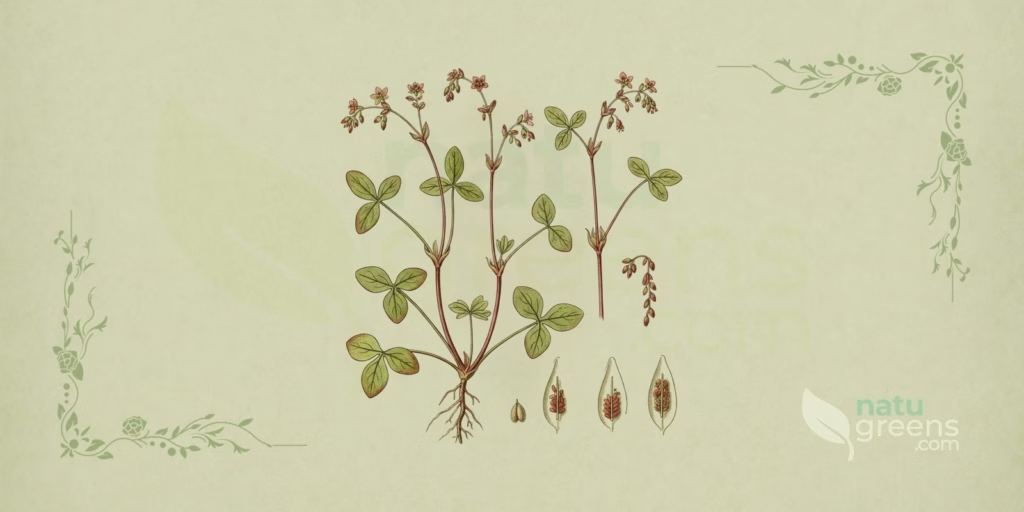
Native to Europe and temperate western Asia, sheep-sorrel travelled with the spread of European agriculture and now grows as a naturalised plant across almost every temperate and subtropical region.
Taxonomy
The binomial Rumex acetosella was published by Carl Linnaeus in Species Plantarum, volume 1, page 338, in 1753, and it remains the accepted name in Plants of the World Online, maintained by the Royal Botanic Gardens Kew, under IPNI identifier 224391-2. The hierarchy adopted here follows POWO, with the rank of class recorded as in the Flora e Funga do Brasil, which applies the circumscription most familiar in the Brazilian literature.
- Kingdom: Plantae
- Division: Tracheophyta
- Class: Magnoliopsida
- Order: Caryophyllales
- Family: Polygonaceae A. Juss.
- Subfamily: Polygonoideae
- Tribe: Rumiceae
- Genus: Rumex L.
- Species: Rumex acetosella L., Sp. Pl. 1: 338 (1753)
It is worth noting that the databases part company at the level of class: POWO places the species in Equisetopsida, subclass Magnoliidae, within a broad classification of the vascular plants, while the Flora e Funga do Brasil uses Magnoliopsida. The disagreement is one of formal arrangement between databases and does not touch the identity of the species itself.
Synonyms
Plants of the World Online recognises six homotypic synonyms, all of them derived from the Linnaean type and all resulting from transfers of genus proposed between the eighteenth and twentieth centuries:
- Acetosa acetosella (L.) Mill.
- Acetosella acetosella (L.) Small
- Lapathum acetosella (L.) Scop.
- Pauladolfia acetosella (L.) Börner
- Rumex acetosella var. vulgaris Roth
- Rumex infestus Salisb.
The Flora of North America treatment adds Acetosa hastata Moench and Acetosella vulgaris Fourr. to the synonymy, which illustrates how taxonomic schools differ in the extent to which they absorb the segregates of Rumex.
Accepted Subspecies
Six subspecies stand as accepted in POWO, and the distinction between them rests chiefly on chromosome number, on the shape of the basal lobes of the leaf and on whether the inner tepals adhere to the achene:
- Rumex acetosella subsp. acetosella
- Rumex acetosella subsp. acetoselloides (Balansa) Den Nijs
- Rumex acetosella subsp. angiocarpus (Murb.) Murb.
- Rumex acetosella subsp. arenicola Y. Mäkinen ex Elven
- Rumex acetosella subsp. multifidus (L.) Schübl. & G. Martens
- Rumex acetosella subsp. pyrenaicus (Pourr. ex Lapeyr.) Akeroyd
The race with an almost cosmopolitan distribution, and the one that predominates among naturalised populations outside Eurasia, is hexaploid, has lateral leaf lobes that are not multifid, and is angiocarpic, meaning that its inner tepals remain fused to the ripe fruit. For decades it went under the name Rumex angiocarpus Murb. or subsp. angiocarpus, an attribution that den Nijs corrected in his 1984 revision and that Akeroyd fixed nomenclaturally in 1991 as subsp. pyrenaicus.
Etymology
The generic name Rumex comes from classical Latin, where Roman authors applied it to the sorrels and docks, and it is often linked to the word for a kind of javelin, an allusion to the outline of the sagittate leaves. The epithet acetosella is the diminutive of acetosa, a Latin adjective built on acetum, vinegar, and it points at once to the sour taste of the foliage and to the plant’s smaller stature beside the cultivated sorrel, Rumex acetosa.
Morphological Description
Sheep sorrel is a glabrous perennial herb with a vertical main root and horizontal creeping roots that give rise to adventitious buds. The stems arise in variable numbers from the base, stand erect or ascending, branch in their upper half and reach ten to forty centimetres in height, exceptionally forty-five. The dense colonies the species forms on open ground are almost always a single individual spread by vegetative means rather than a crowd of neighbouring seedlings. The plant is dioecious, with male and female individuals on separate plants.
Leaves
The leaves are the most reliable diagnostic structure. The blade measures two to six centimetres long by three millimetres to two centimetres wide, with an outline ranging from obovate-oblong to lanceolate and occasionally almost linear. The base is hastate, with two divergent lobes that are entire or sometimes multifid, although leaves without obvious lobes and with a broadly cuneate base do occur. The margin is entire and flat, the apex acute to obtuse. The colour runs from light to mid-green and takes on reddish tones on strongly acidic soils or under water stress. At the base of the petiole sits an ocrea, the tubular membranous sheath characteristic of the Polygonaceae, brownish in its lower portion and silvery and torn in its upper half.
Flowers
The inflorescence is terminal, generally occupies the distal two-thirds of the stem and forms a lax, interrupted panicle, broad or narrow according to the vigour of the plant. The pedicels measure one to three millimetres and the flowers are arranged in whorls of five to eight, occasionally three to ten. The inner tepals enlarge little or not at all as the fruit ripens and measure 1.2 to 1.7 millimetres long by 0.5 to 1.3 millimetres wide, with a cuneate base and an obtuse to subacute apex. Male flowers show a yellowish cast that reddens at anthesis, while female flowers turn from greenish to reddish brown as they set fruit, which is what gives infested fields their characteristic rusty tone in late spring.
Fruits and Seeds
The fruit is a trigonous achene, smooth and glossy, brown to dark brown, measuring 0.9 to 1.5 millimetres long by 0.6 to 0.9 millimetres wide. In the angiocarpic races the inner tepals stay fused to the ripe achene and do not part from it easily, whereas in the gymnocarpic races the fruit sheds clean. The absence of expanded fruiting valves and of conspicuous tubercles separates the species from most other sorrels and docks in the genus.
Root and Stem
The underground system combines a woody vertical axis at the base of the plant with horizontal organs that run through the surface layer of the soil and bear buds capable of giving rise to new aerial shoots. The nature of these organs is described variously in the literature, sometimes as creeping rhizomes, as in the Flora of North America treatment, and sometimes as bud-bearing roots, as in the Canadian agronomic review of the species, and the distinction has practical consequences only for those studying the anatomy of the system. This architecture explains the plant’s persistence: small fragments severed by harrowing or hoeing regenerate complete individuals, and working the soil functions as a method of propagation rather than of control. The aerial stems are slender, longitudinally grooved and often reddish at the base.
Distribution and Habitat of the Sheep-Sorrel
The native range of Rumex acetosella corresponds to temperate Eurasia, with a probable centre of diversification in southern Europe and south-western Asia, the region where the polyploid complex shows its greatest variation. Outside that belt, every known population results from introduction, chiefly as a contaminant of seed, fodder and agricultural ballast from the sixteenth century onwards. The Flora of North America is explicit in classifying the species as introduced throughout the North American continent, from Greenland and the Yukon to Florida and Texas, which corrects a claim of American nativity that still circulates in secondary sources.
In Brazil, the Flora e Funga do Brasil records the species as naturalised and non-endemic in six states, all of them within the Atlantic Forest domain: Minas Gerais, Paraná, Rio de Janeiro, Rio Grande do Sul, Santa Catarina and São Paulo. The associated vegetation types are anthropic areas, high-altitude grassland, ombrophilous forest and mixed ombrophilous forest, a fair description of the plant’s niche in the country, tied to upland pasture, secondary scrub and roadsides in mountain regions of mild climate.
Its preferred habitat takes in roadsides, cultivated fields, waste ground, disturbed areas, lawns, meadows, railway ballast and sandy or muddy shores, nearly always on acidic soils. The altitudinal range runs from sea level to around 2,700 metres. Abundant sheep sorrel works as a bioindicator of acidity: it signals soils poor in exchangeable bases, with low pH and high levels of available aluminium and manganese, a condition that limits most commercial crops and forage species.
In several jurisdictions the plant appears on lists of invasive alien species. The Global Invasive Species Database documents invasion in Australia, Canada, Greenland, the Falkland Islands, New Zealand, Réunion, Saint Helena, South Africa and South Georgia and the South Sandwich Islands, where it forms dense stands that displace native grasses and herbs and slow natural succession.
Cultivation
Sheep sorrel is grown only on a household scale or in collections of unconventional vegetables, since no commercial cultivars of the species have been selected. In European horticulture the role of leaf vegetable fell historically to larger-leaved relatives, above all Rumex acetosa and Rumex patientia. Anyone keeping it in cultivation is therefore working with wild material, and the main concern is containment, because the plant escapes from beds with great ease.
Vegetative propagation is the most efficient route and proceeds by dividing the horizontal roots, which take root when planted a few centimetres deep. Propagation from seed calls for disturbed soil and exposure to light, a requirement that mirrors the plant’s behaviour as a coloniser of broken ground. The seeds are small and produced in quantity, and a single flowering stem can yield one hundred and twenty-four to one hundred and fifty of them, with French records of more than one thousand six hundred per stem.
As for its requirements, the plant asks for full sun and will not tolerate prolonged shade, prefers sandy, well-drained, nutrient-poor soils with a pH between 4.5 and 6.5, and needs no irrigation in climates of moderate rainfall. Its cold hardiness is striking and includes populations established at subarctic latitudes. Among associated organisms, the insect fauna is dominated by Polygonaceae specialists: larvae of Ametastegia equiseti consume the leaves, larvae of Apion feed at the roots and induce galls on the inflorescences, and Rhinoncus castor completes part of its cycle on the plant. Among the fungi, the rust Uromyces acetosae parasitises living tissue, Ramularia pratensis causes leaf spots and Venturia rumicis appears on senescing foliage. The leaf beetle Gastrophysa viridula, often cited as a biological control agent in the genus, is associated chiefly with Rumex crispus and Rumex obtusifolius rather than with sheep sorrel.
Where the plant is gathered, the material taken consists of the young basal leaves, cut before the flowering stems elongate, while the blade is still tender. In an agricultural setting the interest usually runs the other way. The management strategies documented for reducing infestation in pasture combine liming to raise the pH, correction of soil fertility and the establishment of a dense, competitive sward. Mechanical control on its own tends to make matters worse, because it fragments the roots, and both burning and heavy grazing favour the expansion of the stands.
Phenology
In the northern hemisphere flowering is concentrated between spring and summer, peaking from May to August according to latitude. In the naturalised populations of southern and south-eastern Brazil the calendar is inverted and the flowering stems are produced from spring into the austral summer, roughly from October to February. Fruiting follows closely on flowering, and the female plants take on their characteristic reddish colour as the achenes ripen.
Being dioecious, the species depends entirely on cross-pollination, which is carried out by the wind. The flowers have neither functional nectaries nor visual attractants for insects, and the compensation comes through sheer volume of pollen: estimates credit a single plant with hundreds of millions of grains. That abundance has a well-known consequence for public health, since Rumex pollen is a recognised aeroallergen and ranks among the moderate triggers of seasonal allergic rhinitis in regions where the plant is common.
Dispersal of the achenes is predominantly passive, by gravity, at the foot of the parent plant, which produces dense patches rather than diffuse colonisation. Long-distance dispersal depends on secondary vectors, among them running water, adhesion to animal hair and hooves, contaminated hay, nursery stock, tyres and farm machinery. Closing the cycle, the seed bank is remarkably persistent: seeds recovered beneath a stand of Pinus strobus more than eighty years old have been recorded germinating, and controlled trials show viability preserved after more than a decade of burial, with substrate moisture as the main determinant of longevity.
Related Species and Confusions
The genus Rumex comprises around two hundred species of temperate regions, several of them naturalised in Brazil, and identifying sheep sorrel calls for attention to its close relatives and to a few look-alikes from other families.
- Convolvulus arvensis and related bindweeds: they share the sagittate leaf outline, but they are twining climbers with showy funnel-shaped flowers and they have no ocrea at the base of the petiole. The absence of that membranous sheath settles the question at once.
- Oxalis spp.: known as wood sorrels and sour grasses in many regions, they taste similarly acid, also on account of oxalates, but they bear trifoliolate leaves with obcordate leaflets and flowers with five free petals. They belong to the Oxalidaceae and are not closely related to Rumex.
- Rumex acetosa: common sorrel is a more robust plant, reaching a metre in height, with much larger leaves whose basal lobes point downwards rather than diverging, and it produces distinctly expanded fruiting valves at maturity.
- Rumex crispus: curly dock comfortably exceeds a metre, has oblong leaves with strongly wavy margins and no basal lobes, and a thick yellowish taproot.
- Rumex obtusifolius: broad-leaved dock has large leaves with a cordate base, toothed fruiting valves and a far greater stature, and it occupies rich, moist soils, in contrast to sheep sorrel’s preference for poor, acidic ground.
Within the acetosella complex itself, telling the subspecies apart cannot be done reliably by eye. It depends on chromosome counts, on examining how firmly the tepals adhere to the achene and on the shape of the leaf lobes, and even specialists disagree about where the boundaries between the races lie.
Phytochemistry
The chemical composition of sheep sorrel follows the pattern of the genus Rumex, in which more than one hundred and thirty molecules have been described, distributed among anthranoids, naphthalenes, flavonoids, stilbenoids, terpenoids and assorted phenolic compounds. What follows is strictly compositional and implies no effect on any organism.
- Anthraquinones and anthranoids: chrysophanol, emodin and physcion are among the derivatives identified, at uneven concentrations between organs. Liquid chromatography of methanolic extracts shows the roots to be the fraction richest in anthranoids, the leaves intermediate and the fruits the poorest.
- Catechins and proanthocyanidins: epigallocatechin is among the compounds recorded in the roots, alongside condensed tannins.
- Flavonoids: quercetin and its glycosides, together with myricetin and flavone derivatives such as apigenin and luteolin, occur chiefly in the leaves, which hold the highest flavonoid content of any organ in the plant.
- Oxalates and oxalic acid: distributed through leaves and stems, they account for the sour taste that characterises the species and for its common name in several languages.
- Sterols: gamma-sitosterol appears as a major component in analyses of the aerial parts by gas chromatography coupled to mass spectrometry.
One point of safety needs to be recorded in the present tense, not as a historical episode. The leaves and stems accumulate soluble oxalates, and ingestion of large quantities of green material causes poisoning in sheep, cattle and horses, with fatal cases documented on heavily infested pasture. For the same reason the plant is listed as toxic to dogs, cats and horses in reference databases of plants hazardous to companion animals.
History and Ethnobotany
The species entered modern botanical nomenclature with Linnaeus in 1753, but it had circulated long before that in the European herbal literature under vernacular names tied to the acidity of its leaves. In Antiquity and the Middle Ages, Greek and Latin authors and their medieval compilers treated a range of sour-tasting plants together under designations such as oxalis, which makes it risky to attribute ancient mentions specifically to Rumex acetosella rather than to congeners or to members of the Oxalidaceae.
In the peasant economies of northern and eastern Europe, ethnographic records describe the young leaves being eaten as a wild food, raw or worked into soups, most notably in Irish, Scandinavian and Slavic tradition. The plant was gathered on poor ground where subsistence crops failed, and its availability in lean years gave it the role of a supplementary food resource. In North America, ethnobotanical sources from the nineteenth and early twentieth centuries document that Indigenous peoples, among them the Algonquin, the Cherokee and the Iroquois, took leaves and stems of the by then naturalised plant as food.
In the twentieth century sheep sorrel acquired notoriety of another kind as one of the four plants in the mixture publicised as Essiac, put together by the Canadian nurse Rene Caisse in the 1920s and attributed by her to Ojibwa herbal knowledge. The other components recorded in the formula were the root of Arctium lappa, the bark of Ulmus rubra and the root of Rheum palmatum. The episode is of interest here as a fact in the cultural history of plants and in the circulation of herbal formulas in interwar Canada.
Conservation
Rumex acetosella has no published global assessment on the IUCN Red List, which leaves it formally not evaluated. In this case the absence of an assessment does not point to a gap in knowledge about the species but rather to the absence of any cause for concern: this is an abundant plant with an enormous range and with stable or expanding populations documented across its native area. The species likewise does not appear in the CITES appendices.
The conservation agenda attached to sheep sorrel is, in practice, an inverted one. Interest falls on the impacts it causes outside its native range, where it forms dense stands that compete with native flora in grassland, dunes and oceanic islands, and where the persistence of the seed bank and regrowth from root fragments hamper restoration programmes. On island ecosystems and in high-altitude grassland, environments with specialised floras and low functional redundancy, that effect is felt more keenly.
In Brazil, the species is listed in the Flora e Funga do Brasil as naturalised in six states, without protected status and absent from official lists of threatened species, a situation consistent with its condition as an exotic plant well established in disturbed areas.
Interesting Facts
- Sheep sorrel is one of the classic examples of a polyploid complex among the flowering plants, with races running from 2n equal to 14 up to 2n equal to 56, that is, from diploid to octoploid, all housed under the same species name.
- The seed bank of the species is among the longest-lived documented for herbs of temperate climates. Seeds germinated after being recovered from soil beneath a stand of eastern white pine more than eight decades old, meaning they had lain buried since before the trees were planted.
- The rusty colour that takes over entire fields in late spring does not come from dry foliage but from the female plants in fruit, which redden en masse and betray the extent of an infestation from a distance.
- Agricultural advisers use the plant’s abundance as a quick reading of the soil. Where it dominates, the expectation is low pH, reduced base saturation and available aluminium at levels that limit conventional forage species.
- Despite its diminutive size, a single plant can release hundreds of millions of pollen grains in a season, a meaningful contribution to the aeroallergen calendar of the temperate regions where the species is common.
Notice: this content is for informational purposes and does not replace professional medical advice. Consult a physician or herbal practitioner before using medicinal plants, especially during pregnancy, breastfeeding, or alongside medication.
References and Scientific Studies
View All 9 Cited References
Peer-Reviewed Scientific Studies (1)
- DOI2011 Stopps, G. J., White, S. N., Clements, D. R., Upadhyaya, M. K. The biology of Canadian weeds. 149. Rumex acetosella L. Canadian Journal of Plant Science, 91(6), 1037-1052. 2011. ↗
Supplementary Readings (8)
- 1991 Akeroyd, J. R. Protologue of Rumex acetosella subsp. pyrenaicus (Pourr. ex Lapeyr.) Akeroyd. Botanical Journal of the Linnean Society, 106(2): 99. 1991.
- 1984 den Nijs, J. C. M. Protologue of Rumex acetosella subsp. acetoselloides (Balansa) den Nijs. Feddes Repertorium, 95(1-2): 60. 1984.
- Flora e Funga do Brasil. Rumex acetosella L. Rio de Janeiro Botanical Garden. ↗
- Global Invasive Species Database. Rumex acetosella. IUCN SSC Invasive Species Specialist Group. ↗
- International Plant Names Index. Rumex acetosella L., record 224391-2. The Royal Botanic Gardens Kew, The Harvard University Herbaria and Australian National Herbarium. ↗
- Linnaeus, C. Species Plantarum, vol. 1, p. 338. Stockholm. 1753.
- 2005 Mosyakin, S. L. Rumex acetosella. In: Flora of North America Editorial Committee (eds.). Flora of North America North of Mexico, vol. 5. New York and Oxford. 2005. ↗
- Plants of the World Online. Rumex acetosella L. Royal Botanic Gardens Kew. ↗