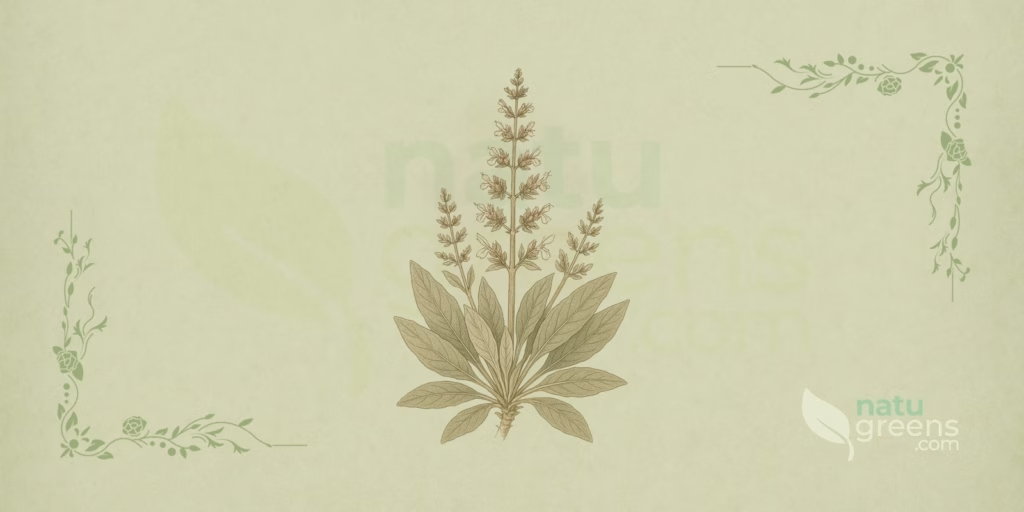
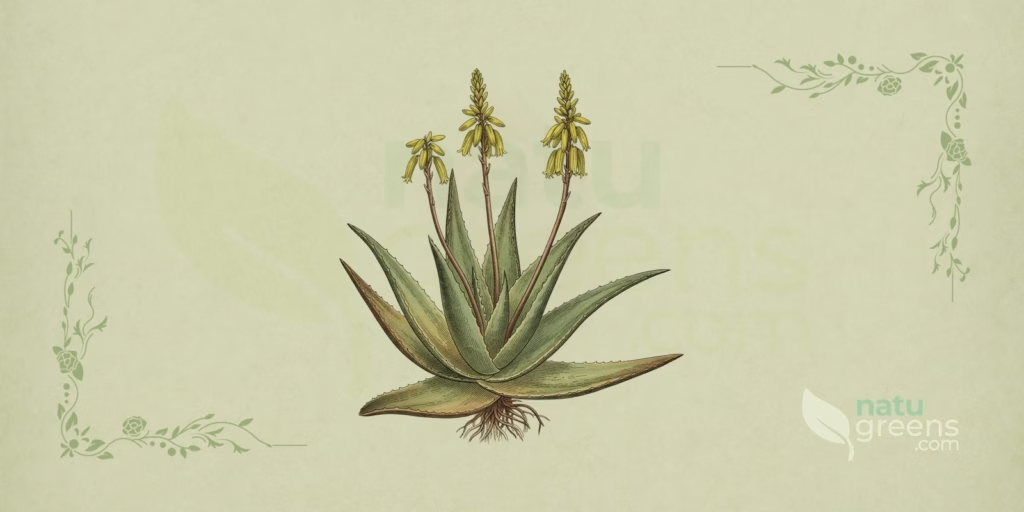
Aloe vera is a perennial succulent in the family Asphodelaceae that builds a tight basal rosette of thick, stiff leaves edged with hard white teeth, usually with no visible stem. The species originates in the Arabian Peninsula and now turns up cultivated or naturalised across virtually the entire tropical and subtropical belt, which has made it one of the most recognisable plant silhouettes in the world and, at the same time, one of the most frequently misidentified.
The genus Aloe holds roughly 600 species concentrated in continental Africa, Madagascar, the Arabian Peninsula and the islands of the Indian Ocean. Within that large assemblage Aloe vera occupies an odd position. It is by far the most widely grown member of the group, yet its genuinely wild populations are the hardest of all to pin down, because centuries of human transport blurred the natural range into the cultivated one until the two became nearly impossible to separate in the field.
This profile deals strictly with the botany of the species: nomenclature and synonymy, comparative morphology, distribution, growing requirements, phenology, descriptive chemistry, historical record and conservation status.
For the traditional uses, properties and preparation methods of this plant, see the article Aloe Vera (Aloe vera): Properties and Benefits.
Taxonomy
The classification below follows the APG IV system and the treatment accepted by the Royal Botanic Gardens, Kew.
- Kingdom: Plantae
- Clade: Angiosperms
- Clade: Monocots
- Order: Asparagales
- Family: Asphodelaceae
- Subfamily: Asphodeloideae
- Genus: Aloe L., 1753
- Species: Aloe vera (L.) Burm.f., 1768
The accepted binomial was published by Nicolaas Laurens Burman in Flora Indica in 1768. Its basionym is Aloe perfoliata var. vera L., established by Linnaeus in the first edition of Species Plantarum in 1753, and the corresponding record in the International Plant Names Index carries the identifier 530017-1. Family placement shifted repeatedly through the twentieth century: Aloe was assigned first to Liliaceae, then to Aloeaceae and later to Xanthorrhoeaceae, before current usage settled on Asphodelaceae as the correct family name.
The accumulated synonymy is long, a predictable outcome for a species described again and again from cultivated material in different parts of the world. The names below are now treated as heterotypic or homotypic synonyms of the accepted name.
- Aloe barbadensis Mill.
- Aloe chinensis (Haw.) Baker
- Aloe elongata Murray
- Aloe flava Pers.
- Aloe indica Royle
- Aloe lanzae Tod.
- Aloe perfoliata var. barbadensis (Mill.) Aiton
- Aloe perfoliata var. vera L.
- Aloe rubescens DC.
- Aloe vulgaris Lam.
Of these, Aloe barbadensis Mill. deserves separate mention because it still circulates on commercial labels and in older technical literature, frequently as though it referred to a distinct species. The epithet barbadensis points to Barbados, where the plant was farmed at scale in the eighteenth century, and says nothing about any Caribbean origin.
On etymology, the generic name Aloe most likely derives from Arabic alloeh or Hebrew ahal, both tied to a bitter substance. The epithet vera is Latin for true and was applied to set this plant apart from the other aloes that supplied the European drug trade.
Morphological Description
The plant is a perennial succulent herb, stemless or very short stemmed, arranging its leaves into a dense and slightly spiralled basal rosette. Mature specimens reach 60 to 100 centimetres in height, and the steady production of lateral offsets means that a single individual eventually builds a compact clump of clonal ramets.
Leaves
Leaves are linear lanceolate, markedly fleshy and tapering gradually to the tip. They measure 30 to 60 centimetres long in mature plants, 6 to 10 centimetres wide at the base and 2 to 3 centimetres thick in the basal portion. Colour ranges from pale green to greyish glaucous green, darkening or flushing reddish under strong sun and water stress. The margins carry hard, cartilaginous white teeth spaced every 1 to 2 centimetres. Young plants usually show elongated white blotches across the leaf surface, markings that fade as the individual matures.
In cross section the leaf reveals three clearly distinct zones. The outer epidermis is cutinised and photosynthetic, with sunken stomata. Immediately beneath it lies a layer of elongated pericyclic cells associated with the vascular bundles, which secretes a yellow exudate rich in anthraquinones. The centre is filled by a bulky water storing parenchyma of large thin walled cells, whose colourless mucilage makes up most of the leaf mass.
Flowers
The inflorescence is a dense terminal raceme borne on a scape that rises from the centre of the rosette and reaches 60 to 120 centimetres, occasionally branched in its upper part. Flowers are tubular and pendulous, 2.5 to 3.5 centimetres long, ranging from pale yellow to orange. The perianth consists of six partly fused tepals, and six stamens carry filaments that project slightly beyond the floral tube at anthesis. The ovary is superior and tricarpellate. Pollination depends on insects and nectar feeding birds, a role filled by sunbirds in the native range and by hummingbirds across much of the Americas where the plant was introduced.
Fruits and Seeds
The fruit is a dry, loculicidal, three chambered capsule that splits into three valves at maturity and releases numerous small angular seeds with a dark coat, often bearing a narrow wing. Fruiting is rare in cultivation. The widespread commercial clones show low fertility, and vegetative multiplication is so efficient that the sexual route is seldom engaged in plantations or in home gardens.
Root and Stem
The stem is reduced to a short, somewhat woody base, often hidden under the sheathing lower leaves. The root system is fibrous and distinctly shallow, with most roots concentrated in the top 20 to 30 centimetres of soil. That architecture is typical of plants adapted to sparse and unreliable rainfall, since it captures light showers before the water evaporates. The trade off is severe: prolonged waterlogging quickly rots both roots and leaf bases.
Distribution and Habitat
The native range of the species is confined to the Arabian Peninsula, with records from Oman and Yemen, including the Socotra archipelago. Everything beyond that area consists of introduced, cultivated or naturalised populations, now found around the Mediterranean basin, in Macaronesia, across North Africa, throughout the Caribbean, in Central America, over much of tropical South America, in India, in Southeast Asia and in Australia. In Brazil the plant has settled into backyards and disturbed ground nationwide, most densely in the semi arid Northeast.
Typical habitat corresponds to rocky slopes and sandy plains under arid to semi arid climate, on stony or frankly sandy soils that drain freely. The altitudinal range runs from sea level to about 1,500 metres. The species tolerates moderate salinity, which explains how often it appears along coastal strips, and endures long rainless spells thanks to the water reserve stored in its leaf parenchyma.
Cultivation
Growing this plant is first and foremost a drainage problem. Sandy to sandy loam soils with a pH between 6.0 and 8.0 offer the best conditions, whereas compacted substrates or any site prone to standing water will defeat the crop even under a favourable climate. The ideal thermal band sits between 20 and 28 degrees Celsius; plants tolerate minima near 5 degrees for short spells, but sustained frost destroys leaf tissue and usually kills the individual. Full sun produces thicker, more compact leaves, while partial shade yields a looser rosette with elongated foliage.
Commercial propagation runs almost entirely on basal offsets. Suckers formed around the mother plant are detached once they reach 15 to 20 centimetres, left in the shade for one to three days so the cut surface can callus, and then set out in the field, where establishment rates commonly exceed 90 per cent. Seed is little used, both because germination is slow and because the resulting genetic variability is unwelcome in plantations built around uniformity. Tissue culture serves as an alternative in programmes multiplying selected cultivars.
In field planting, spacing runs around 0.5 to 1.0 metre between plants and 1.0 to 1.5 metres between rows. Drip irrigation suits the crop best, with infrequent deep watering rather than frequent wetting, and the foliage should be kept dry. Organic matter worked in at planting improves soil structure, while excess nitrogen is worth avoiding since it drives rapid vegetative growth at the expense of reserve accumulation in the parenchyma. The most common phytosanitary problems include scale insects, mites, anthracnose caused by Colletotrichum, and root rots associated with Fusarium oxysporum and Pythium species, nearly always traceable to poor drainage.
Phenology
Aloe vera runs crassulacean acid metabolism, opening its stomata at night to fix carbon dioxide as malate and processing it the following day with the stomata shut. This pattern cuts water loss sharply and governs the growth rhythm, which concentrates in warm months with some available moisture and all but stops during cold or severely dry periods.
Flowering begins in plants at least three to four years old and typically occurs in late winter and spring under subtropical climates, extending into summer in some localities. In equatorial regions, where seasons carry no marked thermal contrast, scape production tends to be irregular and can happen at any time of year. Anthesis of a single raceme spans two to four weeks, with flowers opening acropetally. Capsule maturation, when it happens at all, takes a further two to three months. Offset production, unlike flowering, continues throughout the life cycle and represents the main route by which the species perpetuates itself in cultivation.
Related Species and Common Confusions
Within the genus, the species most often confused with Aloe vera is Aloe ferox Mill. from South Africa, which develops an erect stem up to three metres tall and bears thicker leaves with larger teeth frequently scattered across the leaf face as well as along the margins. Aloe arborescens Mill. grows a branched woody stem topped by smaller rosettes, with distinctly narrower and recurved leaves. Aloe maculata All., widely known under the synonym Aloe saponaria, shows persistent white blotches arranged in transverse bands that never fade with age, a character that separates it easily from juvenile Aloe vera. Aloe perryi Baker, endemic to Socotra, and Aloe striata Haw., with smooth toothless margins, round out the set of close relatives that remain reasonably simple to identify.
It is worth recording that recent phylogenetic revisions split the old broadly circumscribed Aloe, moving several well known species into segregate genera. The quiver tree of the Namib became Aloidendron dichotomum, the small lace edged ornamental became Aristaloe aristata, and the species with three ranked banded leaves became Gonialoe variegata. The old Aloe names still circulate widely in horticulture.
Outside the genus, the commonest mix up involves plants of the genus Agave, family Asparagaceae. Agaves have fibrous, far more rigid leaves ending in a stout apical spine, and they flower once and then die, a monocarpic habit absent from the aloes. The genera Gasteria and Haworthia, both related within Asphodelaceae, are told apart by their much smaller stature and, in the case of Gasteria, by leaves arranged in opposite pairs rather than a spiral rosette.
Phytochemistry
The chemical makeup of the species splits sharply between its two main leaf tissues, and that separation is the key to reading any laboratory analysis of the plant.
The central water storing parenchyma is dominated by polysaccharides, chief among them acemannan, a long chain acetylated mannan regarded as a chemotaxonomic marker for the genus, alongside glucomannans, arabinans and galactans. The non polysaccharide fraction includes free amino acids, enzymes such as catalase, peroxidase, amylase and bradykininase, plant sterols including beta sitosterol, campesterol and lupeol, plus mineral salts and low levels of water soluble vitamins. Water content exceeds 98 per cent of the fresh mass of this tissue.
The yellow exudate produced by the pericyclic cells presents a completely different profile, dominated by anthraquinones and their precursors. The most abundant components are the C glycosidic anthrones aloin A and aloin B, historically referred to jointly as barbaloin, together with isobarbaloin, aloe emodin, chrysophanol, aloesin and the aloeresins. These are secondary metabolites whose ecological function is defence against herbivory, and their concentration varies with leaf age, season and growing conditions.
On the primary metabolism side, the CAM pattern imposes a circadian swing in organic acid content within the leaf, with malate accumulating overnight and being consumed by day, a phenomenon measurable as a shift in cell sap pH across a 24 hour cycle.
As for toxicity, the yellow exudate irritates the digestive tract because of its anthraquinone content, and this is a present day risk rather than a merely historical note. The American Society for the Prevention of Cruelty to Animals classifies plants of the genus Aloe as toxic to dogs, cats and horses, attributing the clinical signs observed to the saponins and anthraquinones present in the leaf.
History and Ethnobotany of Aloe
Few plants carry so long a documentary record. Sumerian clay tablets from the third millennium before the common era already mentioned preparations based on aloes, and the Ebers Papyrus, written in Egypt around 1550 BCE, listed formulas in which the plant appeared among the ingredients. Dioscorides described the plant material in De Materia Medica in the first century, and Pliny the Elder recorded comparable observations in his Naturalis Historia. In every one of those cases the traded commodity was the dried exudate, a dark bitter solid obtained by draining cut leaves, and not the inner mucilage, which only became an industrial product in the twentieth century.
The island of Socotra served as a production centre and a waypoint in the ancient aloes trade, feeding routes that linked Arabia to the Mediterranean. Through the Middle Ages the material appeared in the inventories of European apothecaries and later in the official pharmacopoeias of the eighteenth and nineteenth centuries, always under names that paired the drug with its port of origin, as the labels referring to Socotra and to Barbados attest.
Arrival in the Americas came in the sixteenth century with Iberian navigators and colonists, and the plant naturalised quickly across the Caribbean and the coastal zones of tropical America. In Barbados, eighteenth century cultivation was prominent enough to name one of the most durable synonyms of the species. Industrial interest in the mucilaginous parenchyma, as distinct from the historically traded exudate, took hold only in the second half of the twentieth century.
Conservation
Aloe vera has no published global assessment on the Red List of the International Union for Conservation of Nature, which leaves it in the not evaluated category. That absence signals no risk whatsoever: the species is farmed at industrial scale across dozens of countries and its survival as a taxon is not threatened under any plausible scenario.
Its regulatory situation is remarkable. The whole genus Aloe, along with the segregate genera Aloidendron, Aloiampelos, Aristaloe, Gonialoe and Kumara, appears in the Appendices of the Convention on International Trade in Endangered Species of Wild Fauna and Flora, the group as a whole listed in Appendix II and around twenty species in Appendix I. Aloe vera is the single exception, having been removed from the Appendices in February 1995 precisely because the abundance of cultivated material renders pressure on wild populations irrelevant.
The genuine conservation concerns lie elsewhere. Truly wild populations on the Arabian Peninsula are scarce, poorly delimited and little studied, which frustrates any diagnosis of the original genetic diversity of the species. Commercial farming, meanwhile, rests on a small number of vegetatively propagated clones, a situation that narrows the available genetic base and raises vulnerability to new pathogens. Germplasm banks in South Africa, India and Mexico maintain accessions that help offset that narrowing.
Interesting Facts
- The species is the only member of the entire aloe group left outside the CITES Appendices, a status secured in 1995 and held ever since.
- The white blotches on juvenile leaves vanish with maturity, which leads plenty of growers to believe they bought one plant and ended up with another a few years later.
- The epithet barbadensis, still printed on countless labels, points to Barbados because of colonial cultivation on the island and not because of any link to its origin.
- CAM metabolism makes the internal acidity of the leaf swing over the course of a day, so a sample taken at dawn and one taken at dusk register measurably different pH values.
- Because world trade depends almost entirely on clonal propagation, plantations on different continents are often genetically very close to one another.
- The genus name shares a Semitic root with several regional words for the plant, all of them tied to the bitterness of the exudate.
Notice: this content is for informational purposes and does not replace professional medical advice. Consult a physician or herbal practitioner before using medicinal plants, especially during pregnancy, breastfeeding, or alongside medication.
References and Scientific Studies
View All 9 Cited References
Peer-Reviewed Scientific Studies (3)
- DOI2013 Grace, O. M., Klopper, R. R., Smith, G. F., Crouch, N. R., Figueiredo, E., Ronsted, N., van Wyk, A. E. A revised generic classification for Aloe (Xanthorrhoeaceae subfam. Asphodeloideae). Phytotaxa, 76(1), 7-14. 2013. ↗
- DOI2004 Reynolds, T. (Ed.). Aloes: The Genus Aloe. CRC Press, Boca Raton. 2004. ↗
- DOI2016 The Angiosperm Phylogeny Group. An update of the Angiosperm Phylogeny Group classification for the orders and families of flowering plants: APG IV. Botanical Journal of the Linnean Society, 181(1), 1-20. 2016. ↗
Supplementary Readings (6)
- Burman, N. L. Flora Indica. Cornelium Haek, Lugduni Batavorum, p. 83. 1768. ↗
- Linnaeus, C. Species Plantarum, vol. 1. Laurentius Salvius, Stockholm, p. 320. 1753. ↗
- International Plant Names Index. Aloe vera (L.) Burm.f. Royal Botanic Gardens Kew, Harvard University Herbaria and Australian National Herbarium. ↗
- Plants of the World Online. Aloe vera (L.) Burm.f. Royal Botanic Gardens, Kew. ↗
- CITES. Appendices I, II and III of the Convention on International Trade in Endangered Species of Wild Fauna and Flora. ↗
- World Flora Online. Aloe vera (L.) Burm.f. ↗