Ligustrum lucidum is an evergreen tree in the Oleaceae, the family that also holds the olive, the ash and the jasmine. English speakers know it as glossy privet, broad-leaf privet or simply tree privet, and its compact crown became a familiar sight in the squares and pavements of Brazilian cities such as Curitiba, Porto Alegre and São Paulo across the twentieth century. The native range covers an Asian arc running from Nepal and northeastern Myanmar into central and southern China, taking in the island of Hainan and the southern portion of South Korea.
What makes the species remarkable is not only the almost varnished gloss of its foliage, the trait behind the epithet lucidum. It is the combination of broad ecological tolerance, massed flowering and heavy bird-dispersed fruiting, a package of attributes that turned a discreet ornamental into one of the most closely studied invasive woody plants of the subtropical world. In Argentina, southern Brazil, Australia and the southeastern United States, glossy privet has walked out of the flower beds and formed dense stands inside remnants of native forest.
This profile gathers what the botanical literature records about the species: classification and synonymy, diagnostic morphology, behaviour in cultivation and on invaded ground, the chemistry described for leaves and fruit, and the historical record of its economic exploitation in imperial China.
English speakers call this tree glossy-privet, broad-leaf privet or tree privet.
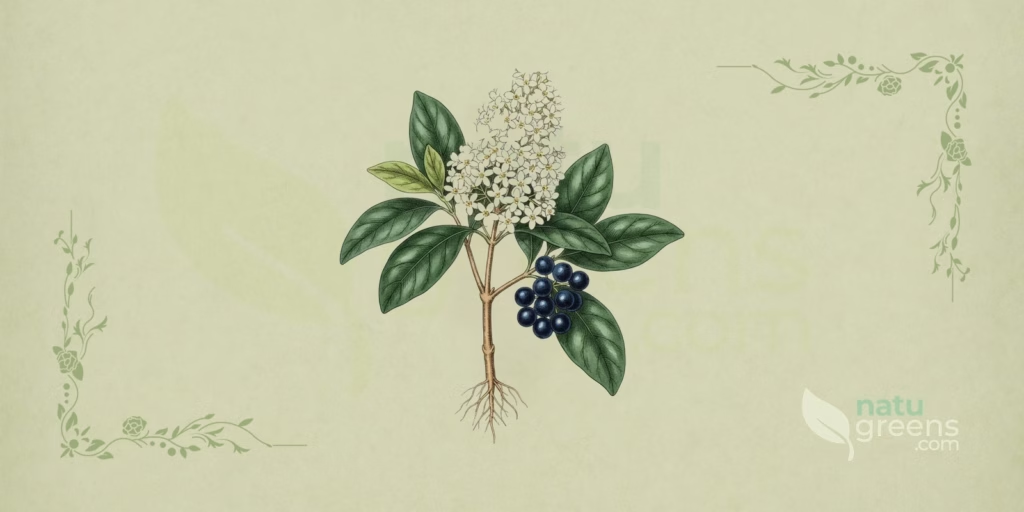
The compact crown of the glossy-privet became a familiar sight in the squares and pavements of Brazilian cities such as Curitiba, Porto Alegre and Sao Paulo across the twentieth century.
Taxonomy
The species belongs to the Oleaceae, a cosmopolitan family of some 25 genera and 600 species that brings together plants as different as the olive, the forsythia and the lilac. Within it, Ligustrum sits in the tribe Oleeae and accounts for roughly 50 species of shrubs and trees, almost all of them Eurasian. The accepted classification runs as follows:
- Kingdom: Plantae
- Division: Magnoliophyta (angiosperms)
- Class: Magnoliopsida (eudicots)
- Order: Lamiales
- Family: Oleaceae Hoffmanns. & Link
- Tribe: Oleeae
- Genus: Ligustrum L., 1753
- Species: Ligustrum lucidum W.T.Aiton, 1810
The protologue appeared in the second edition of the Hortus Kewensis, the catalogue of plants grown at the Royal Botanic Gardens at Kew and compiled by William Townsend Aiton. The material behind it came from living specimens introduced from China at the end of the eighteenth century, and the name has stood unchallenged ever since.
Accepted Synonyms
- Esquirolia sinensis H.Lév.
- Ligustrum esquirolii H.Lév.
- Ligustrum magnoliifolium Dippel
- Ligustrum roxburghii Blume
- Ligustrum wallichii Vis.
- Olea chinensis Sweet
- Olea clavata G.Don
- Phillyrea paniculata Roxb.
- Phillyrea terminalis B.Heyne ex Wall.
- Visiania paniculata (Roxb.) DC.
One detail deserves attention because it regularly muddles database searches: the IPNI index records three homonymous combinations under the binomial Ligustrum lucidum. Besides the name published by Aiton in 1810, there are Ligustrum lucidum Buch.-Ham. ex Wall., which appeared in the Numerical List of 1831, and Ligustrum lucidum hort. ex K.Koch, from the Dendrologie of 1872. Both are later and illegitimate homonyms. Any correct reference to the species must carry the authority W.T.Aiton.
Etymology
The generic name Ligustrum comes from classical Latin and appears in Virgil and in Pliny the Elder, applied to a white-flowered shrub that tradition identifies with the European privet, Ligustrum vulgare. One long-standing etymological reading links the word to the verb ligare, to bind, in reference to the pliant shoots that Roman farmers used as ties. The specific epithet lucidum means shining or glossy and describes the upper leaf surface with real precision, since the blade throws back light as though it had been waxed.
Morphological Description
A medium-sized evergreen tree, 8 to 15 metres tall in most cultivated settings, with exceptional records that reach 25 metres where conditions are ideal. Under shade or repeated pruning it behaves as a shrub branched from the base. The crown is dense and rounded, holds its foliage all year and branches freely enough to cast deep shade on the ground beneath. The trunk is cylindrical, with grey bark that is smooth in young trees and takes on shallow fissures and conspicuous lenticels with age. The whole plant is glabrous, a useful character in identification.
Leaves
The leaves are opposite and decussate, simple, leathery to papery, 6 to 17 centimetres long and 3 to 8 centimetres wide. The blade ranges from ovate to elliptic or lanceolate, with a rounded to slightly tapering base and an acute to acuminate tip that is occasionally blunt. The margin is entire and flat, without a trace of toothing. The upper surface is lustrous and dark green, the lower one paler and matt, and both are entirely free of hairs. The midrib is impressed above and raised beneath, flanked by 4 to 9 pairs of faint lateral veins. The petiole measures 1 to 3 centimetres and carries a groove on its upper face.
Flowers
The inflorescence is a broad terminal panicle, 8 to 20 centimetres long and 8 to 25 centimetres wide, with an angular rachis that stays rigid into fruiting. The flowers are sessile or nearly so, very numerous and small, creamy white in colour. The corolla has a short tube and four lobes that curl back at anthesis, measuring 3 to 5 millimetres in all. The two stamens are exserted and project visibly beyond the lobes, giving the panicle a slightly downy look at close range. The scent is sweet and penetrating, and carries several metres at peak bloom.
Fruits and Seeds
The fruit is a fleshy drupe, kidney-shaped to oblong, 7 to 12 millimetres long. Green at first, it ripens through dark blue to a purplish black and is coated in a whitish waxy bloom that rubs away at a touch. Each drupe holds one or two ellipsoid seeds of 5 to 7 millimetres. Production is notoriously prolific: a mature specimen can carry tens of thousands of fruits in a single season, and the infructescences hang on the tree for months after ripening.
Root and Stem
The root system combines a moderately developed taproot with a vigorous and fairly shallow lateral network. That architecture explains two behaviours observed in the field: the capacity to resprout from the stump and from the roots after cutting, which complicates eradication programmes, and the tendency to lift pavements and interfere with pipework in poorly planned urban plantings. Young shoots are glabrous, greenish and dotted with pale lenticels, turning grey as they lignify.
Distribution and Habitat of the Glossy-Privet
The native range documented by Plants of the World Online covers Nepal, northeastern Myanmar, central and southern China, the island of Hainan and southern South Korea. One error that circulates freely in gardening literature is worth correcting here: Japan is insistently cited as part of the area of origin, yet the primary taxonomic sources treat the Japanese occurrence as the result of cultivation and naturalisation rather than natural distribution. In the Chinese provinces of Guizhou, Hubei, Sichuan and Yunnan the species occupies valleys, wooded slopes and ravine margins, from the lowlands up to altitudes that comfortably exceed 2,000 metres.
Outside Asia, glossy privet is naturalised in practically every subtropical and warm temperate region of the planet. South Africa, eastern Australia, New Zealand, southern Europe and the southeastern United States all report established populations. In South America the picture is particularly severe. In southern Brazil the species invades the Araucaria moist forest, riparian woodland and the edges of fragments in Paraná, Rio Grande do Sul and Santa Catarina, and it is listed in the Flora e Funga do Brasil as a naturalised exotic. In Argentina it occupies the Chaco Serrano of Córdoba and the Yungas of Tucumán and Salta, where it forms single-species stands with an impoverished understorey.
Ecological breadth is the engine of that expansion. The plant thrives in acid or alkaline soils, poor or fertile, sandy or heavy, tolerates rainfall regimes ranging from 600 to more than 2,000 millimetres a year and withstands moderate frost. The dense shade it casts cuts the light available in the lower storey to levels incompatible with the regeneration of many native trees, and the effect accumulates year after year.
Cultivation
Vegetative propagation from cuttings is the standard nursery method. Semi-hardwood cuttings of 15 to 20 centimetres, taken in summer, root within a few weeks and show high success rates even without hormone. From seed the process is simpler still, since fresh drupes germinate readily once the pulp has been removed and a short cold stratification has passed. That same ease accounts for a good share of the environmental problem the species represents.
In terms of requirements, glossy privet is famously undemanding. It accepts full sun or partial shade, though it flowers far more heavily in the open. It grows across a wide pH range, needs no feeding in soils of average fertility and calls for irrigation only through its first year of establishment, becoming drought-hardy after that. It tolerates drastic and repeated pruning, the trait that historically secured its place in formal hedges and topiary.
The commonest pests are scale insects of the genus Ceroplastes, whose sugary secretion encourages sooty mould on the foliage, the caterpillar Palpita unionalis, which partially defoliates the crown, and thrips, responsible for the silvering of young leaves. Among leaf diseases, the spots caused by fungi of the genera Cercospora and Pseudocercospora stand out. None of them usually threatens the survival of the plant.
Fruit harvesting, where it is practised, takes place with the drupes fully ripe and dark, generally from the fourth or fifth year of life, once the tree reaches reproductive age. Before any planting, though, local law is worth checking: several Brazilian municipalities and environmental authorities in Argentina, Australia and the United States restrict or forbid growing the species precisely because of its invasive behaviour.
Phenology
Flowering is concentrated between May and July in the northern hemisphere and shifts to the window from November to January in the southern one. Fruiting follows from July to December at northern latitudes and from April to July at southern ones, with the drupes persisting in the crown well after they ripen.
Pollination is predominantly entomophilous. Bees, flies and beetles visit the panicles in great numbers, drawn by the volume of nectar and the strong scent. A considerable fraction of the pollen, however, also travels on the wind, and that anemophilous dispersal has documented consequences for respiratory health in cities where the species was planted en masse.
Seed dispersal is ornithochorous and forms the decisive link in the invasion cycle. Generalist frugivorous birds eat the pulp and void viable seeds at distances that can reach kilometres from the parent tree. In the Southern Cone the dispersers most often recorded are the rufous-bellied thrush, Turdus rufiventris, and the sayaca tanager, Thraupis sayaca, both abundant in urban settings and along forest edges, exactly the contact zones between ornamental planting and native vegetation.
Related Species and Confusions
The genus Ligustrum holds several cultivated species of similar appearance, and telling them apart rests above all on stature, leaf size and whether the foliage persists.
- Ligustrum japonicum Thunb.: shrubby, 3 to 5 metres, with smaller leaves of 4 to 10 centimetres, thicker and less brightly polished. Confusion with L. lucidum is the commonest of all, and adult stature usually settles it.
- Ligustrum obtusifolium Siebold & Zucc.: deciduous, with blunt-tipped leaves and short lateral inflorescences rather than the broad terminal ones of glossy privet.
- Ligustrum ovalifolium Hassk.: semi-evergreen, with medium oval leaves, much used in formal hedges in the northern hemisphere despite the common name California privet.
- Ligustrum sinense Lour.: deciduous to semi-evergreen shrub, with far smaller leaves of 2 to 7 centimetres, reduced panicles and fruit, and hairy young shoots that L. lucidum does not have.
- Ligustrum vulgare L.: European species, semi-deciduous, with narrow lanceolate leaves, shrubby habit and smaller fruit.
Outside the genus, the confusion that calls for the greatest care involves cherry laurel, Prunus laurocerasus, grown in the same landscaping situations and with foliage every bit as leathery and lustrous. Three characters separate them beyond doubt: cherry laurel has alternate rather than opposite leaves, a finely toothed rather than entire margin, and flowers held in erect elongated racemes rather than pyramidal panicles. It belongs, moreover, to the Rosaceae, and its leaves and seeds contain cyanogenic glycosides, which makes correct identification a question of safety and not merely of botanical rigour.
Phytochemistry
Ripe fruits are the part of the plant most thoroughly investigated chemically and concentrate two dominant classes. Secoiridoids occur in the greater quantity, led by nuzhenide, a marker characteristic of the species, alongside ligustroside, oleoside and oleuropein, the last of these shared with the olive and other members of the Oleaceae. Pentacyclic triterpenes form the second major class, with oleanolic acid accounting for something between 2% and 4% of the dry weight of the drupes, accompanied by its isomer, ursolic acid.
The leaves carry a partly different profile. Flavonoids predominate there, among them luteolin, quercetin and rutin, generally in glycoside form, together with phenylpropanoids of the acteoside type, also known as verbascoside, and phenolic acids such as caffeic acid. A thick waxy cuticle covers the upper surface, and it is to that layer that the blade owes its characteristic shine.
Phytosterols such as beta-sitosterol and daucosterol occur diffusely in several parts of the plant, alongside polysaccharide fractions isolated from the fruit. The whitish bloom that coats ripe drupes is made of long-chain epicuticular waxes.
One safety point belongs here, and in the present tense. Every part of the plant contains terpenoid glycosides, and veterinary toxicology centres classify Ligustrum lucidum and its congeners as plants toxic to dogs, cats and horses. Ingestion of leaves or fruit causes gastrointestinal disturbance in these animals, and larger quantities are associated with cardiovascular and neurological changes. The pollen, for its part, is a recognised aeroallergen, responsible for allergic rhinitis and asthma in urban populations exposed during the flowering period.
History and Ethnobotany
Records from imperial China document the cultivation of Ligustrum lucidum over more than two thousand years. The dried fruits received the name nü zhen zi (女贞子) and appear from antiquity among the plant materials listed in the Chinese compilations of materia medica, which makes the species one of the earliest plants in the country to hold a written record. The expression nü zhen (女贞) translates roughly as chaste woman or virtuous maiden, and the Chinese literary tradition tied the name to foliage that crosses the winter without losing its colour, read as an emblem of constancy.
The most singular economic chapter in the story of the species, however, has nothing to do with the fruit. Between the thirteenth and the nineteenth centuries, the production of what was called Chinese white wax depended directly on glossy privet. Breeders in the provinces of Sichuan and Yunnan fixed to the branches the nymphs of the scale insect Ericerus pela, which fed on the sap and laid down a hard white waxy secretion over the bark. After some weeks the branches were cut and the wax scraped off and melted. The product supplied the making of clean-burning candles, the finishing of paper and the polishing of furniture, and the trade involved remarkable logistics, with porters carrying the nymphs each year between the breeding regions and the producing ones. European naturalists and missionaries described the operation in detail through the nineteenth century, and it lost relevance only when industrial paraffins took over the market.
The western career of the plant begins at Kew. Specimens that arrived from China at the end of the eighteenth century were grown in the British royal gardens and served as the basis for the formal description published by William Townsend Aiton in 1810. Through the nineteenth century the species spread across European gardens as an ornamental tree and a hedging plant, prized for its persistent foliage and for taking the shears without complaint. It reached Brazil early in the twentieth century, within the street-tree programmes of the southern and southeastern capitals, and decades went by before invasive potential entered the calculations of those who signed off the landscape designs.
Conservation
Ligustrum lucidum has no published assessment on the IUCN Red List and therefore remains in the condition of a species not evaluated. That absence signals no worrying gap: this is a common tree, widely distributed across its native range, grown on a global scale and showing no sign whatever of population decline. Nor does the species appear in the CITES appendices.
The conservation question here is the inverse of the usual one. Rather than a threatened species, glossy privet figures as an agent of threat in several of the ecosystems where it was introduced. In Brazil it belongs on the invasive alien species lists of the southern states and is the target of control and removal programmes in protected areas of Paraná and Rio Grande do Sul, where it compromises the regeneration of the Araucaria forest. In Argentina, the invasion of the Córdoba Chaco Serrano was monitored by remote sensing across decades and is associated with a documented reduction in forest bird diversity. Australia ranks the species among its high-impact invaders, and several jurisdictions restrict its sale.
A further effect weighs on urban public health. Massed flowering in cities where the tree was planted on a large scale raises the load of allergenic pollen in the air sharply, and urban centres such as Buenos Aires and Porto Alegre record seasonal peaks in respiratory consultations that coincide with the period of anthesis.
Interesting Facts
- Chinese white wax, produced on the branches of glossy privet by a scale insect, was for centuries a Chinese export valuable enough to justify dedicated routes for carrying the nymphs of the insect between provinces.
- Studies of allergic sensitisation conducted in Buenos Aires pointed to the pollen of Ligustrum lucidum as the most prevalent cause of pollen sensitisation among children aged 5 to 10, at around 61.5% of the cases assessed.
- Three homonymous combinations of the binomial Ligustrum lucidum were published between 1810 and 1872, and only Aiton’s is legitimate, a reminder of why the authority of a scientific name is not bibliographic ornament.
- The advance of the species over the Chaco Serrano of Córdoba was reconstructed from Landsat satellite imagery covering the period from 1983 to 2006, one of the rare cases in which the spread of an invasive tree could be mapped decade by decade.
- The foliage survives pruning that removes almost the entire crown, a capacity that secured its place in topiary and that, in the field, turns clear-felling into a stimulus to resprout rather than a method of eradication.
Notice: this content is for informational purposes and does not replace professional medical advice. Consult a physician or herbal practitioner before using medicinal plants, especially during pregnancy, breastfeeding, or alongside medication.
References and Scientific Studies
View All 10 Cited References
Peer-Reviewed Scientific Studies (4)
- DOI2020 Fernandez, R. D., Ceballos, S. J., Aragón, R., et al. A Global Review of Ligustrum lucidum (Oleaceae) Invasion. The Botanical Review, 86, 93-118. 2020. ↗
- DOI2010 Hoyos, L. E., Gavier-Pizarro, G. I., Kuemmerle, T., et al. Invasion of glossy privet (Ligustrum lucidum) and native forest loss in the Sierras Chicas of Córdoba, Argentina. Biological Invasions, 12(9), 3261-3275. 2010. ↗
- DOI2020 Torres, C., Villaverde, A., Riera, N., et al. Ligustrum pollen: New insights into allergic disease. World Allergy Organization Journal, 13(2), 100104. 2020. ↗
- DOI2011 Zenni, R. D., Ziller, S. R. An overview of invasive plants in Brazil. Revista Brasileira de Botânica, 34(3), 431-446. 2011. ↗
Supplementary Readings (6)
- Aiton, W. T. Hortus Kewensis, or a Catalogue of the Plants Cultivated in the Royal Botanic Garden at Kew. Longman, Hurst, Rees, Orme and Brown, London, 2nd ed., vol. 1. 1810.
- Flora e Funga do Brasil. Ligustrum lucidum W.T.Aiton. Jardim Botânico do Rio de Janeiro. ↗
- 2006 Green, P. S. A revision of Ligustrum (Oleaceae). Kew Bulletin, 61(1), 5-31. 2006.
- International Plant Names Index (IPNI). Ligustrum lucidum W.T.Aiton. The Royal Botanic Gardens Kew, Harvard University Herbaria and Australian National Herbarium. ↗
- Plants of the World Online (POWO). Ligustrum lucidum W.T.Aiton. Royal Botanic Gardens, Kew. ↗
- 1996 Wu, Z. Y., Raven, P. H., Hong, D. Y. (eds.). Flora of China, vol. 15: Myrsinaceae through Loganiaceae. Science Press, Beijing, and Missouri Botanical Garden Press, St. Louis. 1996.