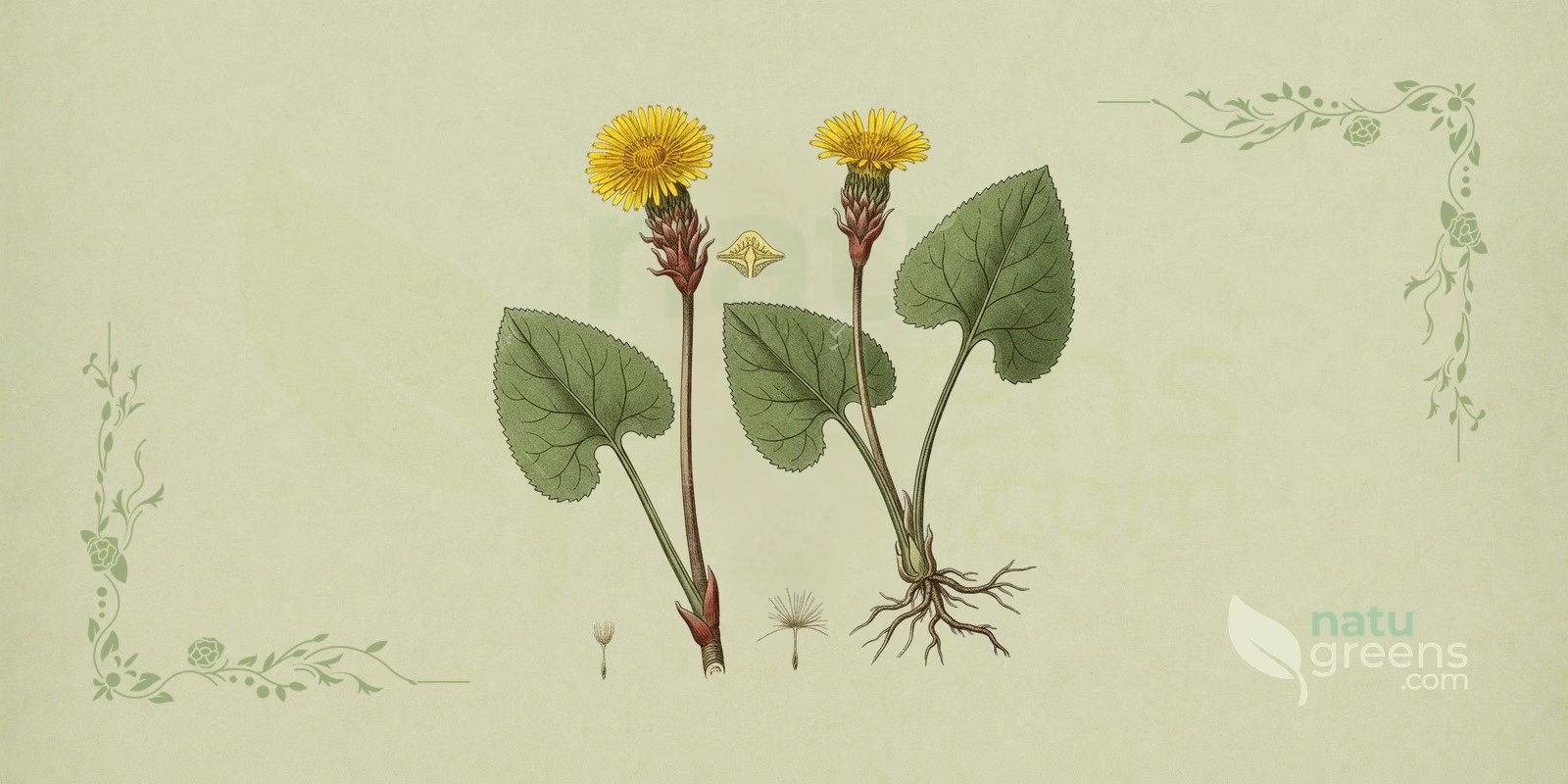
Tussilago farfara L. / Coltsfoot, commonly known as coltsfoot, is a perennial herbaceous plant of the Asteraceae family. Native to Europe and Western Asia, this species has spread across several continents because of its recognized medicinal properties. Coltsfoot has been used for millennia in traditional medicine and is mentioned in ancient texts as a remedy for respiratory complaints. Its yellow flowers, which appear before the leaves, are gathered for the preparation of infusions, extracts, and other herbal products.
In European herbal tradition, coltsfoot holds a prominent place as an expectorant and anti-inflammatory plant, with applications ranging from the relief of gastrointestinal disturbances to respiratory conditions, supported by a phytochemical composition rich in pyrrolizidine alkaloids (PAs), flavonoids, and sesquiterpenes. Modern scientific research has validated many of coltsfoot’s traditional uses, but it has also raised significant concerns about the toxicity of PAs, which demands redoubled caution before any use.
Popular and International Names of Coltsfoot
- English: ass’s foot, Bull’s foot, colt’s foot, coltsfoot, coughwort, English tobacco, farfara, fieldhove, foal’s foot, foalswort, hallfoot, horse foot, horsehoof, tash plant, winter heliotrope.
- Spanish: espatas, fárfara, gordolobo, pata de asno, pata de caballo, pata de mulo, pata de vaca, patabuey, pie de caballo, pie de mulo, potas, sombrerera, tussilago, uña de asno, uña de caballo.
- Portuguese: erva-de-São-Quirino, farfária, farfugio, tussilagem, unha-de-asno, unha-de-cavalo.
- French: chou de vigne, filius ante patrem, herbe aux pattes, herbe de Saint-Quirin, pas d’âne, pas de cheval, pied de cheval, racine de peste, taconnet, tussilage, tussilage farfara, tussilage pas-d’âne.
- Italian: farfara, farfugio, paparacchio, passo d’asino, tossilaggine, tossilagine comune, unghia cavallina.
- German: gemeiner Huflattich, Huflattich, Sauplotschen.
Botanical Synonyms of Tussilago farfara
Tussilago farfara L. is the accepted scientific name. However, other synonyms, though less common, can be found in the literature. Correct botanical identification is essential to avoid confusion with other species.
Botanical Family: Asteraceae
Tussilago farfara belongs to the Asteraceae family, one of the largest families of flowering plants, comprising more than 32,000 species. This family is characterized by capitulum inflorescences, in which numerous small flowers cluster together to form a structure resembling a single flower. Asteraceae plants are known for producing bioactive compounds, such as sesquiterpene lactones, flavonoids, and essential oils, which give many of their species medicinal properties.
Coltsfoot shares morphological traits typical of the family, including flower heads composed of tubular disc florets at the center and ligulate ray florets at the margins, and this chemical diversity has been the subject of intense pharmacological research, contributing to the development of phytopharmaceuticals and dietary supplements.
Parts of Coltsfoot Used
- Flowers
- Leaves
- Roots (less common)
Ethnobotanical and Traditional Uses
- Relief of cough and bronchitis
- Anti-inflammatory for respiratory conditions
- Expectorant to facilitate mucus clearance
- Treatment of asthma and whooping cough
- External use for skin problems and inflammation
Therapeutic Properties of Coltsfoot
- Anti-inflammatory (effect studied for reducing inflammation)
- Antispasmodic (traditional use for relieving muscle spasms, especially in the respiratory tract)
- Antitussive (suppresses coughing)
- Expectorant (facilitates the expulsion of mucus)
- Neuroprotective (protective effect studied on brain cells)
Detailed Phytochemical Profile of Coltsfoot
- Flavonoids (including quercetin, kaempferol, and apigenin, with antioxidant and anti-inflammatory properties)
- Mucilages (polysaccharides that provide demulcent and soothing properties)
- Phenolic Acids (such as caffeic acid and chlorogenic acid, with antioxidant properties)
- Pyrrolizidine Alkaloids (PAs) (such as senecionine and senkirkine, with hepatotoxic potential)
- Sesquiterpenes (such as tussilagone, with anti-inflammatory and antitussive activity)
Preparation and Administration Forms of Coltsfoot
- Dried Extract
- Fluid Extract
- Ointment
- Poultice
- Syrup
- Tea (infusion)
Synergy with Other Medicinal Plants
Coltsfoot and Licorice for Respiratory Conditions
The combination of coltsfoot with licorice (Glycyrrhiza glabra) is frequently used, in herbal tradition, to enhance the expectorant and anti-inflammatory effects for respiratory conditions, since licorice, with its demulcent properties, complements coltsfoot’s action by helping to soothe irritated airways and support the clearance of mucus. This traditional combination is referenced mainly for cases of bronchitis, persistent cough, and asthma, always under the guidance of a healthcare professional given the risks already described for coltsfoot.
Coltsfoot and Mallow for Throat Irritation
For throat irritation and dry cough, coltsfoot is traditionally combined with mallow (Malva sylvestris), rich in mucilages that form a protective layer over the mucous membranes, easing irritation and inflammation. Together, according to folk use, these plants offer a soothing and protective effect indicated for calming cough and sore throat, without this replacing medical evaluation.
Recipes and Usage Protocols of Coltsfoot
Traditional Infusion for Cough and Congestion
Ingredients: a small amount of dried coltsfoot leaves, boiling water, honey (optional).
Preparation: place the leaves in a cup and cover with freshly boiled water, letting it steep for a few minutes before straining and sweetening with honey, if desired. Due to the documented hepatic toxicity of the pyrrolizidine alkaloids present in this species, this infusion should not be prepared or consumed without the guidance and supervision of a healthcare professional, who will determine whether such use is appropriate and for how long.
Traditional Poultice for Skin Inflammation
Ingredients: fresh coltsfoot leaves, hot water.
Preparation: mash the fresh leaves into a paste and warm it gently in hot water, without boiling, before applying it to the affected area of skin, such as wounds, ulcers, or areas of inflammation, covering with a clean cloth for 30 minutes to 1 hour and repeating up to twice a day. This poultice is associated, in folk tradition, with a soothing and protective effect on irritated skin, but even external use should be discontinued at the first sign of any reaction and evaluated by a healthcare professional.
The preparations above follow traditional records and do not replace professional guidance. Before any internal use, consult the contraindications and interactions described in this article.
The preparations above follow traditional records and do not replace professional guidance. Before any internal use, check the contraindications and interactions described in this article.
Associated Therapies
Aromatherapy
Although coltsfoot is not commonly used in aromatherapy because it lacks a widely commercialized essential oil, its volatile components may play a role in herbal blends for inhalation, whose vapors from coltsfoot infusions may help relieve respiratory symptoms such as cough and congestion, providing a soothing effect on the airways.
Herbal Medicine
In herbal medicine, coltsfoot is valued for its expectorant, antitussive, and anti-inflammatory properties, and is used in the form of extracts, tinctures, and teas for a variety of respiratory conditions, including bronchitis, asthma, and persistent cough. Modern herbal medicine seeks to isolate and standardize the plant’s active compounds, such as sesquiterpenes, to maximize therapeutic benefits and minimize the risks associated with pyrrolizidine alkaloids, which remain the main limiting factor for the use of this species.
Contraindications and Side Effects of Coltsfoot
Despite its traditional uses, coltsfoot (Tussilago farfara) presents serious safety concerns because of its content of pyrrolizidine alkaloids (PAs), which are hepatotoxic and can cause acute and chronic liver damage, in addition to being carcinogenic and mutagenic. There is even a documented fatal case of liver damage in a newborn whose mother consumed coltsfoot tea during pregnancy, which illustrates the severity of the risk. For this reason, use of the plant is strongly discouraged, and in countries such as Germany and Austria it is subject to regulatory prohibition or restriction: Austria bans the flower in teas, and Germany only allows products with a pyrrolizidine alkaloid content below the regulatory safety limit.
Main Contraindications
- Allergy to Asteraceae: people with a known allergy to plants in the Asteraceae family (such as ragweed, chrysanthemums, and marigolds) may experience allergic reactions.
- Children: use in children is strictly contraindicated, due to their greater sensitivity and lower detoxification capacity at that age.
- Liver Disease: individuals with pre-existing liver conditions are particularly vulnerable to the toxic effects of PAs.
- Long-Term or Frequent Use: prolonged or repeated use, even in small doses, increases the risk of PA accumulation in the liver and irreversible liver damage, and should therefore be avoided under any circumstance.
- Pregnancy and Breastfeeding: coltsfoot is formally contraindicated during pregnancy and breastfeeding, as PAs can cross the placenta and be excreted in breast milk, causing harm to the fetus or infant.
Potential Side Effects
- Allergic Reactions: contact dermatitis, skin rashes, and, in rare cases, anaphylaxis.
- Blood Clots: case reports link coltsfoot consumption to clot formation.
- Drug Interactions: possible interaction with medications that affect the liver or with anticoagulants.
- Liver Damage: the most serious complication, which can lead to cirrhosis and liver failure.
Given this profile, any use of Tussilago farfara should only occur under strict medical guidance and with products that guarantee the absence of pyrrolizidine alkaloids, something rare and difficult to ensure in traditional preparations; in practice, it is advisable to avoid the plant altogether, especially during pregnancy, while breastfeeding, in children, and for any prolonged use.
Historical Notes and Interesting Facts
Origin of the Name
The genus name, Tussilago, derives from the Latin tussis (cough) and ago (to act or drive), reflecting its traditional use as a remedy for coughing, while the specific epithet farfara, also of Latin origin, refers to the shape of its leaves, which resemble a horse’s hoof, hence the popular English name coltsfoot.
Symbol of Spring
Coltsfoot is often considered one of the first signs of spring, since its bright yellow flowers appear in late winter or early spring, frequently before the leaves emerge, a phenomenon that earned it the popular name filius ante patrem (son before the father) in some cultures.
Ancient and Folk Use
Historically, coltsfoot was widely used across many cultures, from traditional Chinese medicine to European herbal practices, and it was common to smoke the dried leaves to relieve asthma and bronchitis, a practice now discouraged because of the toxicity of pyrrolizidine alkaloids.
Frequently Asked Questions about Coltsfoot
Is Coltsfoot Safe to Consume?
Because of the presence of pyrrolizidine alkaloids (PAs), which are toxic to the liver and potentially carcinogenic, consuming coltsfoot is not recommended, and countries such as Germany and Austria restrict or ban its sale. It is essential to avoid coltsfoot products that are not certified as PA-free.
What Are the Main Traditional Uses of Coltsfoot?
Traditionally, coltsfoot was used for cough, bronchitis, asthma, and congestion, as well as external applications for skin problems and inflammation, but these uses are now questioned given the risks of liver toxicity associated with the plant.
Are There Safe Alternatives to Coltsfoot for Respiratory Problems?
Yes: safer alternatives are already documented on this site for respiratory complaints, such as mullein and thyme, as well as ginger, licorice (in moderation and free of PAs), mallow, and chamomile, and it is always advisable to consult a healthcare professional or herbalist before any use.
Can Coltsfoot Be Used During Pregnancy or Breastfeeding?
No. Coltsfoot is strictly contraindicated during pregnancy and breastfeeding, since pyrrolizidine alkaloids cross the placenta and are excreted in breast milk, potentially causing serious harm to the fetus or infant; there is even a record of a fatal case linked to this use.
How Can I Identify Coltsfoot?
Coltsfoot (Tussilago farfara) is easily identified by its bright yellow flowers, which appear in early spring before the leaves; the leaves, once they appear, are shaped like a horse’s hoof, with a green upper surface and a whitish, woolly underside.
Notice: this content is for informational purposes and does not replace professional medical advice. Consult a physician or herbal practitioner before using medicinal plants, especially during pregnancy, breastfeeding, or alongside medication.
References and Scientific Studies
- PMC2020 Chen, S., Dong, L., Quan, H., Zhou, X., Ma, J., Xia, W., Zhou, H., & Fu, X. (2020). A review of the ethnobotanical value, phytochemistry, pharmacology, toxicity and quality control of Tussilago farfara L. (coltsfoot). Journal of Ethnopharmacology, 267, 113478. Recuperado de PMC PubMed Central
- PMC2026 Zheng H, Li Y, Zhang Y, et al. Sesquiterpenoids from Tussilago farfara: full structure elucidation, anti-diabetic and anti-inflammatory signaling pathways. Chinese Journal of Natural Medicines. 2026.
- PMC2025 Kolarijani NR, Zamani S, Gharibshahian M, et al. Accelerating burn wound healing using alginate/carboxymethyl cellulose nanogel containing Tussilago farfara and ZnO nanoparticle. Burns. 2025.