Passiflora incarnata L. / Passionflower, popularly known as maypop, is a perennial climbing vine of the family Passifloraceae, native to the Americas, whose intricate, exotic flower, crowned with a ring of filaments reminiscent of Christ’s crown of thorns, inspired its common name. Passionflower is widely cultivated both for its ornamental qualities and for its notable medicinal properties, making it one of the most studied plants in modern phytotherapy as a traditional aid for anxiety and insomnia.
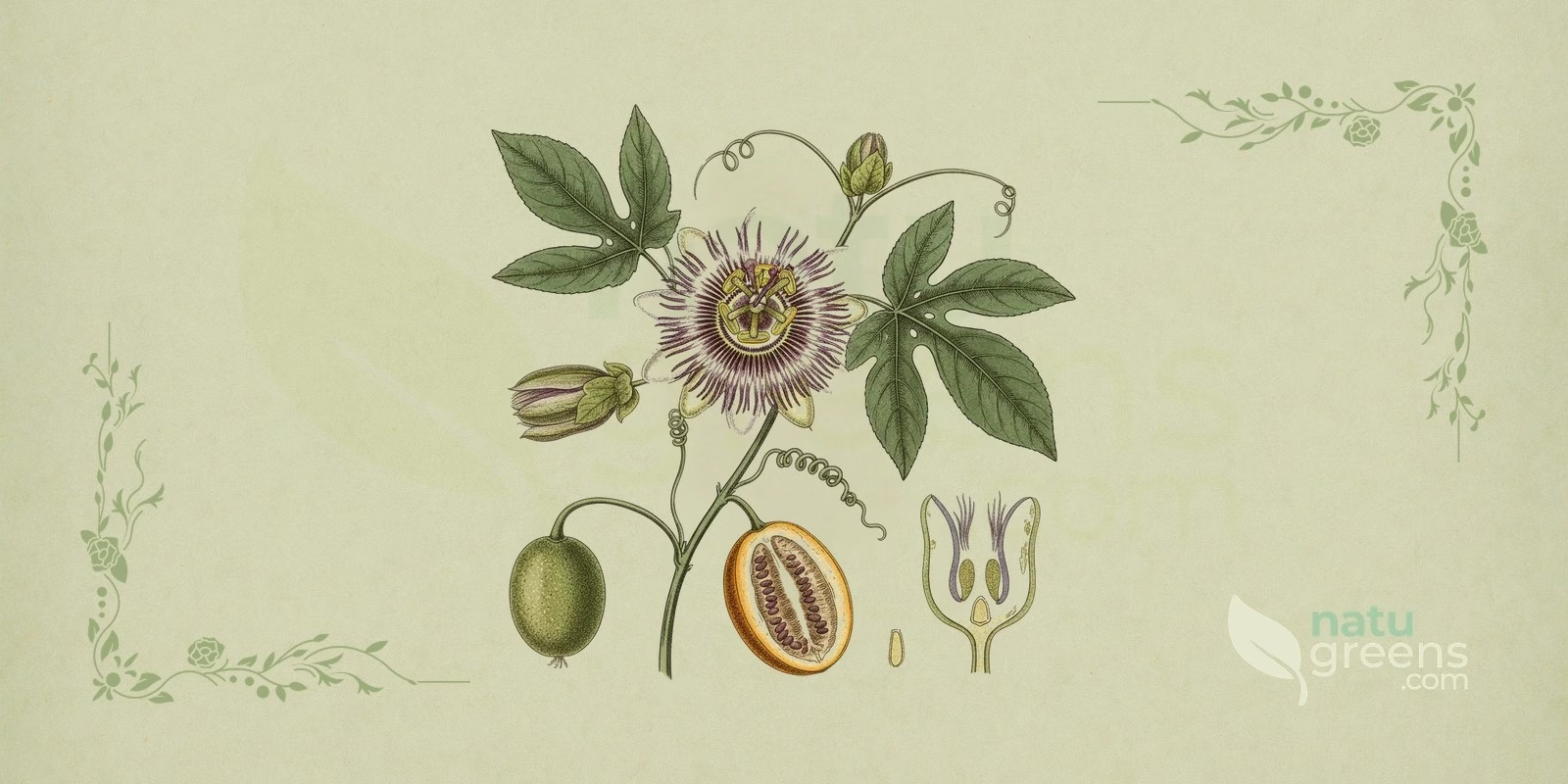
In traditional medicine, passionflower has a long history of use: Native Americans employed the plant for a variety of purposes, from treating wounds and earaches to easing anxiety and insomnia, and European colonizers quickly adopted its use. Today, Passiflora incarnata is officially recognized as an herbal medicine by the European Medicines Agency, and numerous scientific studies investigate its safety and pharmacological action, corroborating traditional uses and exploring new applications.
Popular and International Names of Passionflower
- English: maypop, passion flower, purple passionflower, true passionflower, wild apricot, wild passion vine.
- Spanish: flor de la pasión, maracuyá silvestre, pasionaria.
- Portuguese: flor-da-paixão, maracujá, maracujá-de-comer, maracujá-do-mato, maracujá-doce, maracujá-roxo, maracujá-silvestre, passiflora.
- French: fleur de la passion, passiflore officinale.
- Italian: fiore della passione, passiflora.
- German: Fleischfarbene Passionsblume, Passionsblume.
Botanical Synonyms of Passiflora incarnata
There are no widely accepted botanical synonyms for Passiflora incarnata L. beyond variations of its own name, since the scientific and botanical literature consistently refers to this species by its original binomial.
Botanical Family: Passifloraceae
The Passifloraceae family comprises around 18 genera and more than 750 species, distributed mainly across the tropical and subtropical regions of the New World, with the genus Passiflora being the most representative, counting more than 500 species. Plants in this family are predominantly climbers or lianas, characterized by showy, complex flowers and berry- or capsule-type fruits, and many of its species are cultivated for their ornamental value, their edible fruit (such as passion fruit), or their medicinal properties.
Parts of Passionflower Used
- Aerial parts (leaves and flowers)
- Flowers
- Fruit (edible)
- Leaves
- Roots (in some traditional uses)
Ethnobotanical and Traditional Uses
- ADHD (Attention-Deficit/Hyperactivity Disorder)
- Anxiety and nervousness
- Burns
- Diarrhea
- Dysmenorrhea
- Earaches
- Hysteria
- Infant weaning support
- Insomnia and sleep disturbances
- Liver ailments
- Neuralgia
- Reducing inflammation in wounds
- Skin problems
Therapeutic Properties of Passionflower
- Analgesic (traditional use for pain relief)
- Anticonvulsant (studied in seizure prevention)
- Antioxidant (activity studied against free radicals)
- Antispasmodic (traditional use for easing muscle spasms)
- Anti-inflammatory (effect studied in reducing inflammation)
- Anxiolytic (effect studied in reducing anxiety)
- Diuretic (effect studied on urine production)
- Hypnotic (sleep-inducing effect observed in studies)
- Neuroprotective (protective effect studied on the nervous system)
- Sedative (effect studied on relaxation)
Detailed Phytochemical Profile of Passionflower
- Alkaloids (harman, harmine, harmalol)
- Cyanogenic glycosides
- Essential oils
- Flavonoids (apigenin, luteolin, quercetin, kaempferol, vitexin, isovitexin, orientin, isoorientin)
- Maltol
- Mucilages
- Phenolic compounds
- Tannins
Preparation and Administration Forms of Passionflower
- Capsules
- Extracts (fluid or dry)
- Infusions (teas)
- Juices (from the fruit)
- Poultices
- Supplements
- Tablets
- Tinctures
Synergy with Other Medicinal Plants
Anxiety and Insomnia
Combining passionflower with Valeriana officinalis and Matricaria chamomilla is a classic pairing used traditionally to reinforce sedative and anxiolytic effects: passionflower, with its alkaloids and flavonoids, is thought to work alongside valerenic acid from valerian and apigenin from chamomile, favoring, according to tradition, a deeper relaxation and better sleep quality.
Stress and Restlessness
The pairing of passionflower with Melissa officinalis and Humulus lupulus is traditionally used to ease symptoms of stress and restlessness, as passionflower is thought to calm the nervous system, while lemon balm contributes its soothing properties and hops its sedative effect, resulting in a sense of tranquility and well-being.
Recipes and Usage Protocols of Passionflower
Infusion for Anxiety and Insomnia
Ingredients: 1 to 2 teaspoons of dried passionflower leaves and flowers, 250 ml of boiling water.
Preparation: Place the herbs in a cup and pour the boiling water over them, cover and let steep for 10 to 15 minutes. Strain and drink one cup 2 to 3 times a day for anxiety, or one cup 30 to 60 minutes before bed for insomnia.
Tincture for Relaxation
Ingredients: 50 g of dried passionflower aerial parts, 250 ml of 45% alcohol.
Preparation: Place the herbs in a glass jar and cover with the alcohol, seal tightly and let macerate for 2 to 4 weeks, shaking daily. Filter and store in a dark glass bottle. Take 20 to 40 drops diluted in water, up to 3 times a day.
The preparations above follow traditional records and do not replace professional guidance. Before any internal use, check the contraindications and interactions described in this article.
Associated Therapies
Clinical Phytotherapy
In clinical phytotherapy, passionflower is widely used in the form of standardized extracts, capsules, and tablets as a traditional aid for anxiety, insomnia, stress, and other nervous system disturbances, with dosage adjusted individually according to the patient’s condition and the concentration of bioactive compounds in the product.
Homeopathy
In homeopathy, the remedy Passiflora is prepared from the fresh plant and is traditionally indicated for insomnia, especially in children and the elderly, when there is agitation, restlessness, and mental exhaustion, and it is also associated with nervous cough and asthma.
Contraindications and Side Effects of Passionflower
Passionflower is generally considered safe when consumed at recommended doses, but it can cause drowsiness and dizziness in some people; caution should therefore be exercised when driving or operating machinery. It is not recommended for pregnant or breastfeeding women, due to a lack of safety studies in these groups. People taking sedatives, anxiolytics, or other central nervous system depressants should consult a healthcare professional before using passionflower, as it may potentiate these effects.
Historical Notes and Interesting Facts
The name “passionflower” was given by Spanish missionaries in the 16th century, who saw in the flower’s intricate structure a symbolic representation of the Passion of Christ: the three stigmas were said to represent the three nails, the five anthers the five wounds, the crown of filaments the crown of thorns, and the ten petals and sepals the ten apostles (excluding Peter and Judas).
Frequently Asked Questions about Passionflower
Is Passionflower Tea Addictive?
No, passionflower tea is not considered addictive. It is seen as a natural alternative to medications used for anxiety and insomnia, without the risk of dependence associated with many synthetic drugs.
Can I Give Passionflower Tea to Children?
The use of passionflower tea in children should be done with caution and under the guidance of a healthcare professional. Although it is traditionally used for childhood insomnia, the dosage must be adjusted carefully.
How Long Does Passionflower Tea Take to Work?
The time passionflower tea takes to work can vary from person to person. Generally, the relaxing effects can be felt between 30 and 60 minutes after consumption.
What Are the Contraindications of Passionflower Tea?
The tea is inadvisable during pregnancy and breastfeeding, due to a lack of safety studies in these groups, and should be used with caution by those taking sedatives, anxiolytics, or other central nervous system depressants. Drowsiness and dizziness are the most common side effects.
How Do I Prepare Passionflower Tea at Home?
Simply place 1 to 2 teaspoons of dried leaves and flowers in a cup, cover with 250 ml of boiling water, and let steep for 10 to 15 minutes before straining. The beverage can be drunk throughout the day for anxiety or about thirty minutes to an hour before bed to support sleep.
What Is the Difference Between Medicinal and Edible Passionflower?
The leaves and flowers of Passiflora incarnata, covered in this article, are the part traditionally used for their calming effects, while the widely consumed fruit sold as passion fruit comes mainly from other species of the genus, such as Passiflora edulis, cultivated chiefly for its pulp.
Notice: this content is for informational purposes and does not replace professional medical advice. Consult a physician or herbal practitioner before using medicinal plants, especially during pregnancy, breastfeeding, or alongside medication.
References and Scientific Studies
- DOI2020 Janda, K., Wojtkowska, K., Jakubczyk, K., Antoniewicz, J., & Skonieczna-Żydecka, K. (2020). Passiflora incarnata in Neuropsychiatric Disorders, A Systematic Review. Nutrients, 12(12), 3894. ↗
- DOI2013 Miroddi, M., Calapai, G., Navarra, M., Minciullo, P. L., & Gangemi, S. (2013). Passiflora incarnata L.: ethnopharmacology, clinical application, safety and evaluation of clinical trials. Journal of Ethnopharmacology, 150(3), 791-804. ↗
- DOI2017 Kim, M., Lim, H. S., Lee, H. H., & Kim, T. H. (2017). Role Identification of Passiflora Incarnata Linnaeus: A Mini Review. Journal of menopausal medicine, 23(3), 156-159. ↗