Rheum tanguticum is a large perennial herb of the family Polygonaceae, endemic to the mountains of north-western China and to the eastern margins of the Qinghai-Tibet Plateau. It forms broad basal rosettes of deeply cut leaves above a thick rhizome with an orange interior, and in summer it throws up a hollow flowering stem that can exceed two metres, crowned by a dense panicle of small reddish flowers. The same family holds buckwheat, the sorrels of the genus Rumex and the garden rhubarb grown in kitchen gardens across Europe.
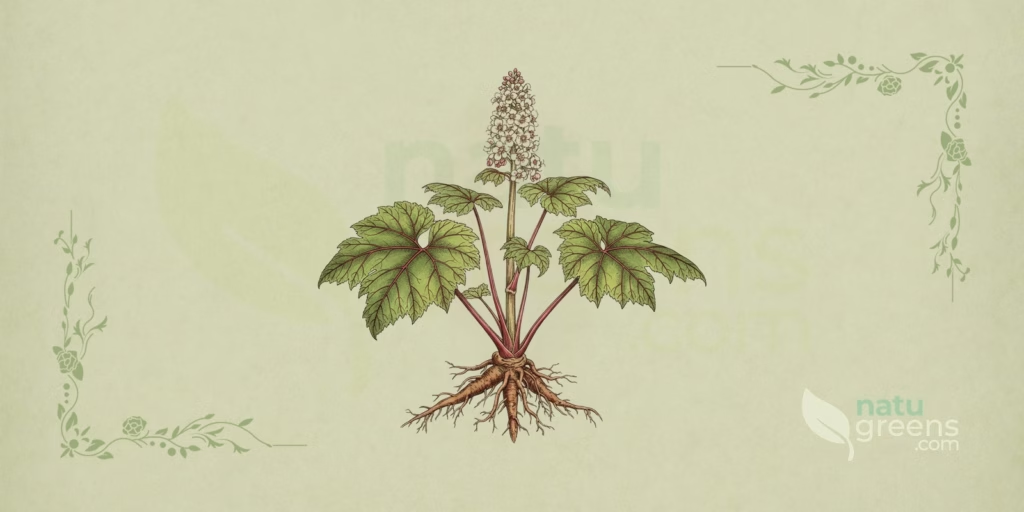
What sets the species apart within the genus is the cut of its leaves. Where the closest relatives carry palmate blades with broad lobes, here the three central lobes are pinnatisect, divided almost to the vein into narrow, sharply pointed segments. That detail earned the plant its Chinese name 鸡爪大黄 (ji zhua da huang), roughly “chicken-foot da huang”, and it is also the character that underpins its recognition as an autonomous species, a discussion that has run through the botanical literature for more than a century without reaching consensus.
This profile gathers what the botanical literature records about the taxon: taxonomic position and synonymy, comparative morphology, high-altitude ecology, cultivation, phenology, distinction from its congeners, descriptive chemical composition, collecting history and conservation status.
Taxonomy
The accepted name is Rheum tanguticum (Maxim. ex Regel) Balf., published in 1879 in the Transactions of the Botanical Society of Edinburgh and registered in IPNI under the identifier 696803-1. The basionym is Rheum palmatum var. tanguticum Maxim. ex Regel, which accounts for the compound authorship. The elevation to species rank by Isaac Bayley Balfour was never unanimous, and a considerable share of later floras kept the taxon as a variety or a subspecies of Rheum palmatum. The Flora of China itself, while accepting the species, notes that one of the authors of the treatment regards it as a synonym of R. palmatum.
- Kingdom: Plantae
- Division: Tracheophyta
- Class: Magnoliopsida
- Order: Caryophyllales
- Family: Polygonaceae Juss., 1789
- Subfamily: Polygonoideae
- Tribe: Rumiceae (older treatments use Rheeae)
- Genus: Rheum L., 1753
- Species: Rheum tanguticum (Maxim. ex Regel) Balf., 1879
Synonyms and Infraspecific Taxa
The accepted synonyms point straight back to the period when the taxon circulated as subordinate to R. palmatum:
- Rheum palmatum subsp. tanguticum (Maxim. ex Regel) Stapf, 1930
- Rheum palmatum var. tanguticum Maxim. ex Regel, 1874 (basionym)
Two varieties are recognised within the species, separated by stature and by density of indumentum:
- Rheum tanguticum var. liupanshanense C. Y. Cheng & T. C. Kao, 1975, 0.6 to 1 metre tall, with a densely pubescent stem and a sparingly branched inflorescence
- Rheum tanguticum var. tanguticum, 1.5 to 2 metres tall, with a glabrous stem or one strigose only at the upper nodes, and a much branched inflorescence
Etymology of the Binomial
The generic name Rheum comes from the ancient Greek rha, the classical designation of the dried rhizome that reached the Mediterranean along the overland routes. Early authors linked the word to the Rha, the Greek name of the river Volga, along which part of the material moved westward, although the etymology remains debated. The epithet tanguticum honours the Tanguts, a Tibeto-Burman speaking people who founded the Xixia empire and occupied the highlands of Gansu and Qinghai, precisely the area from which the first scientific collections of the plant came.
Morphological Description
This is a robust perennial herb, 0.6 to 2 metres tall, which spends the winter reduced to its underground system and resprouts in spring from buds on the rhizome. The habit is that of a wide basal rosette from which a single erect flowering stem rises, hollow and finely grooved, glabrous in some individuals and pubescent in others. The architecture is that of a plant adapted to short growing seasons, one that packs the production of large leaves and of a bulky inflorescence into a few weeks.
Leaves
The basal leaves are the diagnostic character of the species. The blade is orbicular to broadly ovate, 30 to 60 centimetres across, with five main veins radiating from the subcordate base and a palmate cut into five lobes. The three central lobes are pinnatisect, that is, subdivided almost to the midvein into narrow segments with narrowly acute tips, which gives the whole leaf a far more lacy look than that of its congeners. The underside is pubescent and the upper surface is papillose to muricate, slightly rough to the touch. The petiole is stout and often stained red, above all in young plants and in populations exposed to strong radiation. The cauline leaves are few and much smaller, likewise deeply cut, and come with broad ocreae, pubescent on the outer face, that clasp the stem at the point of insertion.
Flowers
The inflorescence is a large terminal panicle with converging branches that rises above the foliage. The individual flowers are small and go unnoticed at close range, yet the whole makes a considerable visual impression through sheer number. Each flower has six orbicular tepals in two whorls, the three inner ones larger and measuring about 1.5 millimetres. The colour ranges from purplish red to pale pink, rarely greenish. The pedicel is slender, 2 to 3 millimetres long, jointed below the middle. The ovary is broadly ovoid, with a short style and an inflated stigma.
Fruits and Seeds
The fruit is a trigonous achene enclosed by the membranous wings that develop from the persistent floral parts. The whole measures 8 to 9.5 millimetres long by 7 to 7.5 millimetres wide, oblong-ovoid to oblong in outline, with wings 2 to 2.5 millimetres wide crossed by longitudinal veins close to the margin. The colour shifts from green to reddish brown as ripening advances. The seeds are ovoid and black, small and light, which favours transport by wind.
Root and Stem
The underground system consists of a thick rhizome and of the tuberous roots associated with it, both yellow to orange when cut. In mature plants this underground mass can exceed several kilograms and develops slowly over years. One anatomical peculiarity marks the cut surface of the rhizome: anomalous vascular bundles arranged in a radiating pattern produce a marbled figure of light and dark dots, known in the Chinese literature as jin wen. The aerial stem, by contrast, is annual, hollow and short-lived, and disappears after fruiting.
Distribution and Habitat
The species is endemic to China, with confirmed occurrence in Gansu, Qinghai, Shaanxi and Xizang, which corresponds to the eastern edge of the Qinghai-Tibet Plateau and to the adjoining mountain ranges, among them Min Shan, Qilian Shan and Qionglai Shan. The total area of occupancy is restricted and fragmented, with populations separated by valleys and watersheds, a trait that sets it apart from R. palmatum and its wider distribution.
The Flora of China records the habitat as valleys between 1600 and 3000 metres, the belt where herbarium collections concentrate. Field ecological work on the plateau documents populations at higher elevations, associated with alpine meadows, stony slopes and stream banks, which suggests a wider altitudinal range than the classic floristic treatment records. The climate of these areas is cold continental, with long harsh winters, short summers, a pronounced daily temperature range and high ultraviolet radiation owing to the altitude. Preferred soils are deep, well drained and loose in texture, a requirement tied to the expansion of the rhizome.
In the communities where it occurs, the plant grows alongside alpine shrubs of the genera Rhododendron and Salix and meadows dominated by Kobresia. There is no record of naturalisation outside the native range, nor of invasive behaviour in any region. The species is grown as a foliage ornamental in temperate gardens in Europe, generally under the horticultural label of a variety of R. palmatum, with no established escapes known.
Cultivation
Propagation is by seed or by division of the rhizome. Seeds germinate best after a period of moist cold, a condition supplied in nature by autumn sowing and by the months spent under snow until spring. Dividing established clumps at the end of the growing season, using segments that carry viable buds, shortens the time to maturity and preserves the characteristics of the parent plant, a relevant advantage wherever uniform material is wanted.
The plant requires full sun and a deep, fertile, very well drained soil with a pH tending to neutral, and it tolerates waterlogging at no stage. Cold hardiness is remarkable, consistent with its origin, but humid heat at low elevation is limiting and explains why commercial growing in China concentrates in the highlands of Gansu and Qinghai. Growth is slow: seed-raised plants take several years to reach harvest size, and high-altitude growing programmes work with long cycles, typically from the fourth to the seventh year.
Among the phytosanitary problems most often cited are rhizome rot, caused by opportunistic fungi in poorly drained soils or in ground waterlogged during the thaw, and attack by weevil larvae that bore into underground tissues. In high-altitude plantings, rodents and lagomorphs, above all pikas of the genus Ochotona, damage roots and rhizomes. Harvest takes place in autumn, once the aerial parts have dried, and the material is washed, sectioned and dehydrated by slow drying in the sun or in a kiln at moderate temperature.
Phenology
Flowering occurs in June and fruiting between July and August, a compressed calendar that reflects how brief the summer is in the highlands. Young plants stay vegetative for several years before their first flowering stem, and not every mature individual flowers in every season, a common pattern among alpine perennials that depend on reserves stored in the rhizome.
Pollination in the genus Rheum is predominantly entomophilous, involving flies, fungus gnats of the family Sciaridae and small bees, the groups that dominate the floral visitor fauna at the altitudes where the plant grows. The small, clustered flowers with coloured tepals are consistent with this set of generalist visitors. Dispersal is anemochorous: the membranous wings of the fruit act as a drag surface, and the strong winds typical of the plateau carry the diaspores over short to medium distances, with additional help from surface runoff on the slopes and from transport across packed snow. The conservation literature points to the limited efficiency of this dispersal as one of the factors that keep populations fragmented.
Related Rheum Species and Confusions
Separating the species from Rheum palmatum is the classic problem, and it remains difficult even for specialists. The most reliable criterion lies in the leaf cut: in R. tanguticum the central lobes are pinnatisect, subdivided into narrow segments, whereas in R. palmatum the lobes are broad, triangular and merely toothed or shallowly incised. Where the two grow side by side, intermediate forms are frequent, which feeds the hypothesis of introgression and helps explain the taxonomic instability.
Other congeners with which it is confused or compared:
- Rheum officinale Baill., of more southerly distribution, with leaves of five to seven shallow, broad lobes, far less deeply cut
- Rheum przewalskyi A. Los., also from the plateau, much smaller in stature and with leathery leaves bearing characteristic dark blotches
- Rheum rhabarbarum L. and the garden hybrid Rheum × hybridum Murray, the culinary rhubarb, unmistakable for their cordate leaves with a merely wavy margin, never lobed, and for their thick reddish petioles
Outside the genus, the likeliest confusion arises at the vegetative stage, when the basal rosette recalls that of Arctium lappa L., the greater burdock, and those of robust Rumex species. Burdock is told apart by its entire cordate leaves with a white-tomentose underside, and the sorrels by their smaller leaves with different venation and ocreae. One safety point is worth recording independently of identification: the leaf blades of Rheum species accumulate soluble oxalates in high concentration and are toxic if eaten, both by people and by dogs, cats and horses, with effects that involve digestive irritation and kidney damage.
Phytochemistry
The chemical profile of the rhizome and the roots is dominated by anthraquinones and their glycosylated derivatives. Among the free aglycones described are aloe-emodin, chrysophanol, emodin, physcion and rhein, accompanied by conjugated forms such as chrysophanol 1-O-beta-D-glucoside, chrysophanol 8-O-beta-D-glucoside and physcion 8-O-beta-D-glucoside. These molecules account for the orange-yellow colour that appears as soon as the rhizome is cut.
Alongside the anthraquinones, analyses by chromatography coupled to mass spectrometry have identified in material of this species dianthrones of the sennoside group, glycosylated stilbenes derived from resveratrol and rhapontigenin, galloylglucoses and other hydrolysable tannins, flavans and proanthocyanidins, phenylbutanones, glycosylated naphthalenes and simple phenolic acids. The set documented for the pharmacopoeial rhubarb species runs to more than a hundred distinct compounds.
The distribution of these metabolites within the plant is uneven. Anthraquinones and tannins concentrate in the underground system; petioles and stems owe their red pigmentation to anthocyanins; and the leaf blades accumulate soluble oxalates preferentially. Metabolomic studies comparing populations along altitudinal gradients record marked quantitative variation in the profiles, with total anthraquinone contents that shift consistently according to the elevation the material came from.
History and Ethnobotany
The dried rhizome of Asian rhubarb travelled the overland trade routes for centuries before the identity of the plant that produced it was settled. European records from the sixteenth to the eighteenth century named the material after the route it had taken, and from that came trade names such as Turkey rhubarb and Muscovy rhubarb. Early Chinese treatises, among them the Shennong Bencao Jing, already recorded the material under the name da huang, and the later imperial pharmacopoeias kept that nomenclature.
The Russian monopoly on the trade, run from the Kiakhta trading post through the eighteenth century, kept the botanical origin a deliberate commercial secret. Suppliers delivered rhizomes already cleaned and sectioned, without leaves, flowers or any structure that might allow identification, and European botanists spent generations framing hypotheses from dried fragments. Species easier to grow in Europe and in Siberia, among them Rheum rhaponticum L. and Rheum rhabarbarum L., were successively put forward as candidates for the source of the Asian material, attributions that proved mistaken.
The question was settled only when the Russian expeditions into the interior of Asia reached the wild populations. Nikolai Przhevalsky, between 1870 and 1873, and Grigory Potanin, in the following decade, collected fertile material on the eastern Tibetan Plateau and allowed the identity to be established on botanical grounds. Eduard Regel described the taxon in 1874 as a variety of R. palmatum from that material, and Balfour raised it to species five years later. The Tanguts honoured in the epithet inhabited the region of those collections, and the current Chinese name, ji zhua da huang, records the popular reading of the leaf shape.
Conservation
To date no global assessment has been published for the species on the IUCN Red List, a situation that formally leaves it as not evaluated. Chinese conservation literature and population genetics work, however, treat the taxon as threatened time and again, and the Vulnerable category appears frequently in those sources, backed by national and regional assessments. Nor does the species figure in the CITES appendices, so international trade is not covered by that instrument of control.
The documented pressures compound one another unfavourably. The distribution is naturally restricted and fragmented; the life cycle is long and the reproductive rate low; wind dispersal covers modest distances and hampers the recolonisation of emptied areas. On top of that comes the collection of wild plants, historically intense because of market demand, which removes precisely the mature individuals with the largest rhizomes. Grazing by yaks and sheep in the alpine meadows degrades the habitat, and the accelerated warming of the Qinghai-Tibet Plateau, faster than the global average, tends to squeeze the climatically suitable belt towards higher elevations, reducing the area available.
The responses under way run through high-altitude cultivation under standardised good agricultural practice protocols, promoted by Chinese government programmes as a substitute for wild harvesting, and through distribution modelling studies meant to guide the planning of conservation areas. Genetic diversity work published from molecular markers indicates relevant variation between populations, a finding that reinforces the need to conserve multiple nuclei rather than a handful of localities.
Interesting Facts
- The Chinese name of the species, ji zhua da huang, literally means “chicken-foot da huang”, a direct reference to the narrow, spreading leaf lobes that recall the toes of a bird.
- The cut surface of the rhizome shows a marbled pattern of radiating dots, the result of anomalous vascular bundles and not of any processing step, a feature that serves as an anatomical criterion for identifying the dried material.
- During the eighteenth century the dried rhizome ranked among the most expensive goods by unit weight imported into Europe from Asia, and the secrecy around its botanical origin was part of its commercial value.
- The Przhevalsky expedition ended a scientific dispute of more than two centuries by bringing back the first fertile plants observed by Europeans in natural habitat, settling once and for all which species produced Asian rhubarb.
- The genus Rheum includes one of the most singular alpine plants in the world, Rheum nobile Hook. f. & Thomson, from the Himalaya, whose stacked translucent bracts form a structure that works as a miniature greenhouse and warms the flowers inside.
Notice: this content is for informational purposes and does not replace professional medical advice. Consult a physician or herbal practitioner before using medicinal plants, especially during pregnancy, breastfeeding, or alongside medication.
References and Scientific Studies
View All 12 Cited References
- Balfour, I. B. Protologue of Rheum tanguticum. Transactions of the Botanical Society of Edinburgh, 13 (Appendix): cxlvi. 1879.
- 2020 Chinese Pharmacopoeia Commission. Pharmacopoeia of the People’s Republic of China. China Medical Science Press, Beijing. 2020.
- 1992 Foust, C. M. Rhubarb: The Wondrous Drug. Princeton University Press, Princeton. 1992.
- 2012 Hu, Y. et al. Genetic variation in Rheum palmatum and Rheum tanguticum (Polygonaceae), two medicinally and endemic species in China, using ISSR markers. PLOS ONE, 7 (12): e51667. 2012.
- 2026 IPNI. International Plant Names Index. Royal Botanic Gardens Kew, Harvard University Herbaria and Australian National Botanic Gardens. Record urn:lsid:ipni.org:names:696803-1. Accessed 2026.
- 2026 IUCN. The IUCN Red List of Threatened Species. International Union for Conservation of Nature. Accessed 2026.
- 2003 Li, A. J. et al. Polygonaceae. In: Wu, Z. Y.; Raven, P. H.; Hong, D. Y. (eds.). Flora of China, vol. 5, p. 345. Science Press, Beijing, and Missouri Botanical Garden Press, Saint Louis. 2003.
- 2026 POWO. Plants of the World Online. Royal Botanic Gardens Kew. Accessed 2026.
- 2017 Qin, H. N. et al. Threatened species list of China’s higher plants. Biodiversity Science, 25 (7): 696 to 744. 2017.
- Regel, E. Protologue of Rheum palmatum var. tanguticum. Gartenflora, 23: 305. 1874.
- 2011 Sanchez, A.; Schuster, T. M.; Kron, K. A. Taxonomy of Polygonoideae (Polygonaceae): a new tribal classification. Taxon, 60 (1). 2011.
- Stapf, O. Protologue of Rheum palmatum subsp. tanguticum. Curtis’s Botanical Magazine, 153: t. 9200. 1930.