Rheum palmatum ranks among the most imposing herbaceous plants of the inland Chinese mountains, able to push a flowering stalk two meters above a rosette of leaves that pass half a meter in width. It belongs to the Polygonaceae, the family of the sorrels and of buckwheat, and it occupies stony slopes and valley floors between 1,500 and 4,400 meters of altitude, along the arc running from Inner Mongolia to eastern Tibet. The epithet palmatum describes with precision what catches the eye in the field: a leaf blade cut into deep lobes that spread open like the fingers of a hand.
Below ground the plant builds a thick rhizome and a stout main root whose inner tissue carries a characteristic yellow coloring. That anatomical detail is what gave the plant its Chinese name, da huang (大黃), literally “great yellow”, under which the dried root travelled for centuries along the trade routes that linked Central Asia to the Mediterranean and, later on, to northern Europe.
This page gathers the botanical profile of the species: formal taxonomy as confirmed in the nomenclatural indices, detailed morphology, distribution, habitat, cultivation, phenology, its relationships with the neighboring species of the palmatum complex, descriptive chemical composition, historical record and conservation status.
Chinese-rhubarb is the English name most often used for Rheum palmatum outside China.
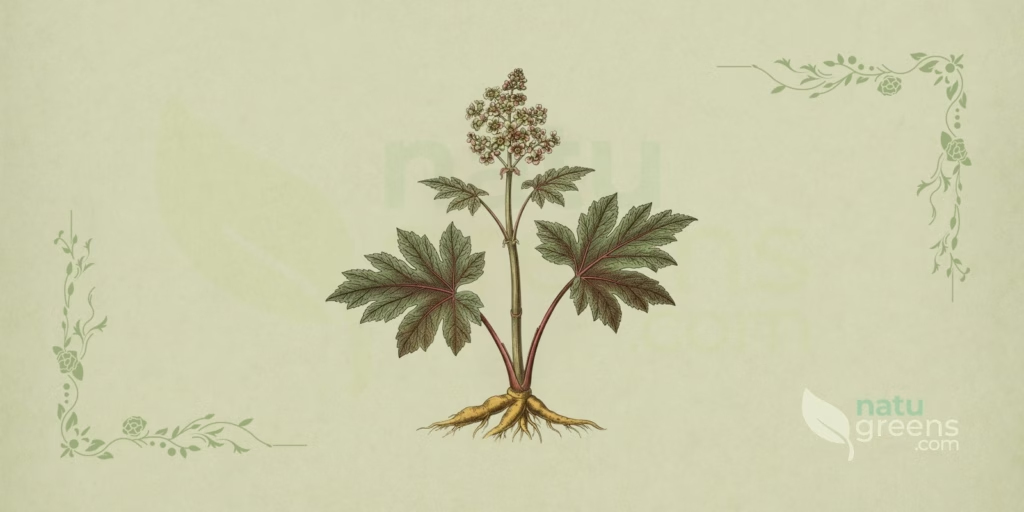
Chinese-rhubarb plants occupy stony slopes and valley floors between 1,500 and 4,400 meters, along the arc running from Inner Mongolia to eastern Tibet.
Taxonomy
The name Rheum palmatum L. was published by Carl Linnaeus in 1759, in the tenth edition of Systema Naturae (volume 2, page 1010), and it remains accepted in the reference nomenclatural indices. The Polygonaceae bring together some fifty genera of predominantly temperate distribution across the northern hemisphere, and the genus Rheum concentrates roughly sixty species in the mountain ranges and plateaus of Asia.
- Kingdom: Plantae
- Division: Magnoliophyta (angiosperms)
- Class: Magnoliopsida (eudicots)
- Order: Caryophyllales
- Family: Polygonaceae Juss.
- Subfamily: Polygonoideae
- Tribe: Rheeae
- Genus: Rheum L.
- Species: Rheum palmatum L., 1759
Accepted Synonyms
Three names stand today as heterotypic or homotypic synonyms of the species:
- Rhabarbarum palmatum (L.) Moench
- Rheum potaninii Losinsk.
- Rheum qinlingense Y. K. Yang, D. K. Zhang & J. K. Wu
It is worth recording that Rheum tanguticum and Rheum officinale, frequently folded into R. palmatum in the older literature, remain accepted as autonomous species, even though the boundary between them is the object of continuing debate among taxonomists.
Etymology of the Binomial
The generic name goes back to the Greek rheon, a form tied to the old trade name of the dried root, rha. Some authors connect the term to the Rha, the classical designation of the river Volga, one of the axes along which the merchandise reached western ports. The epithet comes from the Latin palmatus, “shaped like the palm of a hand”, in direct reference to the outline of the basal leaf.
Morphological Description
This is a large perennial herb, with a broad basal clump and an erect flowering stem that reaches 1.5 to 2 meters, occasionally more where cultivation is generous. The stem is hollow and longitudinally grooved, glabrous or very nearly so, with small rough patches concentrated at the nodes. The whole aerial part dies back at the end of the season and resprouts from the underground structure the following spring.
Leaves
The basal leaves are among the largest in the genus and define the look of the plant. The blade measures around 40 to 60 centimeters, is about as wide as it is long, and carries five main veins radiating from the cordate base. The division is palmate, with lobes that deepen until they become pinnatisect, and the tip of each lobe is acuminate or narrowly acute. The lower surface is densely pubescent, while the upper one ranges from grooved to papillose to the touch. The petiole is cylindrical, covered in dense papillae and almost as long as the blade itself. The stem leaves repeat the same pattern at reduced scale as they climb the stem, and the ocrea, the membranous sheath wrapping the node just above the insertion of the petiole, reaches 15 centimeters and has a rough outer surface. That ocrea is the most reliable family marker in the field.
Flowers
The inflorescence is a broad terminal panicle with converging, densely pubescent branches, conspicuous from a distance once flowering takes hold across a whole population. Each flower is minute and sits on a pedicel 2 to 2.5 millimeters long, jointed below the middle. The perianth has six tepals of purplish red coloring, rarely whitish yellow, the three outer ones elliptic to orbicular and smaller, at 1 to 1.5 millimeters. The stamens do not project beyond the perianth. The ovary is rhombic-ovoid, the style curves slightly outward and the stigma is dilated.
Fruits and Seeds
The fruit is a trigonous achene furnished with three membranous wings, oblong-ellipsoid to oblong in outline, measuring roughly 8 to 9 millimeters long by 7 to 7.5 millimeters wide, with both ends slightly notched. The wings are about 2.5 millimeters across and show longitudinal veins close to the margin, a detail that helps in separating related species. The seed is broadly ovoid, with a dark brown to almost black coat.
Root and Stem
The underground system combines a short, thick rhizome with equally stout main roots, which in plants of several years form a single massive piece. The outer surface is brown to dark brown and the inner tissue shows a yellow to orange tone, crossed by a marbled pattern that classical pharmacognosy recorded as radiating striations. That inner coloring is constant enough to serve as a diagnostic character in dried material. Above ground, the flowering stem that rises from this structure is hollow and furrowed, and it perishes entirely at the close of each growing season.
Distribution and Habitat
The native range covers western and northwestern China, with documented records in Gansu, Hubei, Inner Mongolia, Qinghai, Shaanxi, Sichuan, Xizang and Yunnan. The center of diversity of the species and of its closest relatives lies on the eastern Tibetan Plateau and in the ranges that border it. Populations occupy open slopes, valleys, high-altitude meadows and the edges of conifer forest, across a broad altitudinal band running from 1,500 to 4,400 meters.
The climate regime is continental and cold, with harsh winters, short summers and a wide daily temperature swing. Preferred soils are deep, rich in organic matter and well drained, a decisive condition because the rhizome rots easily in waterlogged ground. Beyond its native range, the species was taken to Russia and to western Europe both as a crop and as a garden plant.
In Britain, where it has been in cultivation since 1763, the plant is listed as a neophyte, with a first record outside cultivation in 1954, at Bolton in south Lancashire. It persists in abandoned pastures, streamsides, ditches, roadsides and waste ground, almost always as a relic of planting, with no aggressive invasive behavior documented. In South America the genus has no native representatives, and in Brazil cultivation only makes sense in upland areas with a pronounced winter, where no commercial production has become established.
Chinese-Rhubarb Cultivation
Propagation is by seed or by division of the rhizome. Sowing calls for cold stratification beforehand, germination comes unevenly over several weeks, and seed-raised plants take years to build an adult clump. Dividing the rhizome in late autumn, keeping at least two buds per section, is the route preferred by anyone who wants uniformity between individuals.
The species demands deep, fertile, well-drained soil of slightly acid to neutral reaction, and it responds well to organic matter worked in at planting. It asks for full sun in cold climates and tolerates part shade where summers run hot. The critical point in cultivation is drainage: prolonged waterlogging leads to rot of the rhizome, and continuous subtropical heat simply prevents establishment. Generous spacing is compulsory, since an adult plant easily covers a square meter of leaf projection.
Among the commonest pests are aphids, which act as vectors of mosaic viruses, weevils whose larvae bore into the rhizome, and slugs and snails, which disfigure young leaves through a wet spring. On the disease side, rhizome rot associated with Phytophthora and soft rots of bacterial origin concentrate the losses in poorly drained soils. In plantings aimed at harvesting the underground part, the flowering stalk is usually cut as soon as it appears, and the roots are lifted in autumn, from the fourth year in the field onward.
Phenology
In the native range flowering concentrates in June and fruiting in August, a calendar that shifts by a few weeks with altitude and with the aspect of the slope. Under European cultivation, well-established plants flower between late spring and early summer, and not every clump throws up a flowering stalk every year.
The floral architecture, with reduced tepals, short stamens and an enormous number of flowers per panicle, is compatible both with visits from small generalist insects and with pollen transport by wind, a combination that recurs across the Polygonaceae. Fruit dispersal is predominantly anemochorous, favored by the three membranous wings that work as a drag surface. On sloping ground a good share of the achenes end up moved by gravity and by runoff, which helps explain the clumped distribution of populations along valleys.
Related Species and Confusions
Rheum palmatum belongs to section Palmata of the genus, alongside R. laciniatum, R. officinale and R. tanguticum, the last including the variety liupanshanense. A morphometric study by Wang and co-workers, published in 2014, showed that the degree of blade dissection varies continuously between lobed and parted, and that lobe shape grades without discontinuity from broadly triangular to lanceolate, both within and between populations. The authors went so far as to propose sinking the remaining species of the section under R. palmatum, a proposal not yet taken up by the reference nomenclatural indices.
- Rheum australe D. Don: a Himalayan species, with leaves entire to merely undulate in outline, lacking the characteristic palmate division.
- Rheum × hybridum Murray: a garden hybrid of broad, entire foliage, grown in Europe for its petiole.
- Rheum officinale Baill.: a blade only shallowly lobed, a more compact panicle and greenish flowers, against the deep lobes and purple flowers of R. palmatum.
- Rheum rhabarbarum L.: the garden rhubarb, with an entire, heart-shaped leaf with a wavy margin and fleshy reddish petioles, without any palmate division.
- Rheum tanguticum (Maxim. ex Regel) Balf.: the most frequent confusion in the field, told apart by narrower and more deeply cut lobes and by a distribution concentrated on the Tibetan Plateau.
Outside the genus, plants with large basal leaves tend to raise doubt while still in the vegetative phase, as with burdock (Arctium lappa), whose lower leaf surface is tomentose and unlobed, and with Petasites hybridus, whose blade is orbicular and merely toothed at the margin. Neither of the two has the membranous ocrea wrapping the node, and that single character settles the identification in seconds.
Phytochemistry
The chemical profile of the species is among the best studied in the Chinese flora. Root and rhizome accumulate anthraquinones, present both in free form and bound to sugars, chief among them aloe-emodin, chrysophanol, emodin, physcion and rhein. Alongside these occur dianthrone glycosides of the sennoside type, tannins of gallic and catechin nature, phenolic acids such as gallic acid, and glycosylated stilbenes, a group that includes derivatives of rhapontigenin and of resveratrol. It is these anthraquinones, concentrated in the parenchyma of the cortex and of the central cylinder, that account for the yellow color of the inner tissue.
Distribution of the compounds within the plant is uneven and shifts with the age of the individual and with the season. Leaves and petioles follow another route: they concentrate oxalates, present as free oxalic acid and as crystals of calcium oxalate.
Here a safety fact enters that does not depend on any context of use. The leaves of Rheum palmatum, like those of the other rhubarbs, contain soluble oxalates at high levels and are not edible. Ingestion causes irritation of the digestive tract and, in sufficient quantity, a drop in circulating calcium and kidney damage. The same holds for domestic animals: dogs, cats, horses and other grazing herbivores are susceptible to oxalate poisoning when they have access to the foliage, which is why beds of this genus call for care on properties that keep livestock.
History and Ethnobotany
The dried root of Asian rhubarb was one of the costliest plant commodities in long-distance trade between Asia and Europe. Greek and Roman authors already recorded the product under the name rha, arriving by routes that crossed Central Asia, and Marco Polo noted in the thirteenth century that rhubarb was abundant in the Tangut region, in what is now northwestern China. In Chinese sources the material appears under the name da huang from the early compendia of materia medica onward, and European apothecaries of the sixteenth to eighteenth centuries traded the imported root in their shops.
That trade produced, in the eighteenth century, one of the odder episodes in the history of useful plants: the Russian Empire established a state monopoly over the export of Asian rhubarb, with an inspection depot at Kyakhta on the Chinese border and destruction of the consignments that failed inspection. Clifford Foust reconstructed this commercial circuit in a study devoted to the commodity, published in 1992.
On the botanical side, the species was described by Linnaeus in 1759 from material circulating in Europe along those same routes, and it entered cultivation in Britain in 1763. The wild populations, however, were only properly documented more than a century later, with the Russian expeditions of Nikolai Przhevalsky and Grigory Potanin to the Tibetan Plateau and the neighboring ranges, at the close of the nineteenth century. It was that fieldwork which made it possible to separate the Asian species of the genus on the basis of living plants, and not merely on fragments of dried root arriving at market.
Conservation
The species has no published global assessment on the IUCN Red List, a situation recorded as not evaluated, and it does not appear in the CITES appendices. Nor does it figure in the list of wild plants under national protection compiled for the Qinghai-Tibetan Plateau, even though the Chinese literature treats the wild populations of the palmatum complex as a resource under pressure.
The work of Wang and co-workers, published in 2012 in PLoS ONE on the basis of ISSR markers, sampled twenty-one wild populations spread from Shanxi to central Tibet and found an informative pattern: high genetic diversity across the species as a whole and low diversity within each population. The authors concluded that the observed decline stems chiefly from excessive collection of wild material rather than from genetic impoverishment, and they recommended in situ preservation of the remaining populations together with an expansion of commercial cultivation as a way of easing pressure on the natural stock.
Shifting demand toward established plantings is today the main line of management under way in the producing provinces, with official good agricultural practice programs aimed precisely at replacing wild harvesting with managed cultivation.
Interesting Facts
- The Chinese name da huang means “great yellow” and describes the inner tissue of the root, whose color comes from the anthraquinones stored in the parenchyma.
- The basal leaf of Rheum palmatum is among the largest of any temperate-climate herb grown in gardens, and cultivars with reddish young foliage, such as ‘Atrosanguineum’, are planted purely for ornamental effect.
- Two extremes live side by side in the same family: the petiole of garden rhubarb is a common ingredient in puddings and pies across Europe, while the leaf of any species in the genus is toxic through its oxalate content.
- The Russian Empire held a state monopoly over the export of the dried root through the eighteenth century, with an inspection post on the Chinese border and destruction of rejected consignments.
- Taken to Britain in 1763, the plant was only recorded growing outside cultivation in 1954, almost two centuries after its introduction.
Notice: this content is for informational purposes and does not replace professional medical advice. Consult a physician or herbal practitioner before using medicinal plants, especially during pregnancy, breastfeeding, or alongside medication.
References and Scientific Studies
View All 9 Cited References
Peer-Reviewed Scientific Studies (2)
- DOI2012 Wang, X. M. et al. Genetic variation in Rheum palmatum and Rheum tanguticum (Polygonaceae), two medicinally and endemic species in China using ISSR markers. PLoS ONE, 7(12): e51667. 2012. ↗
- DOI2014 Wang, X. M. et al. Morphological variation in leaf dissection of Rheum palmatum complex (Polygonaceae). PLoS ONE, 9(10): e110760. 2014. ↗
Supplementary Readings (7)
- American Society for the Prevention of Cruelty to Animals. Rhubarb (Rheum rhaponticum). Toxic and Non-Toxic Plants Database. ↗
- Botanical Society of Britain and Ireland. Rheum palmatum L. BSBI Online Plant Atlas. ↗
- 2003 Flora of China Editorial Committee. Rheum palmatum Linnaeus. Flora of China, vol. 5, p. 345. Science Press and Missouri Botanical Garden Press. 2003. ↗
- 1992 Foust, C. M. Rhubarb: The Wondrous Drug. Princeton University Press. 1992.
- International Plant Names Index. Rheum palmatum L., Syst. Nat. ed. 10, 2: 1010. 1759. Royal Botanic Gardens Kew, Harvard University Herbaria and Australian National Botanic Gardens. ↗
- Linnaeus, C. Systema Naturae, ed. 10, vol. 2, p. 1010. Stockholm. 1759.
- Plants of the World Online. Rheum palmatum L. Royal Botanic Gardens, Kew. ↗