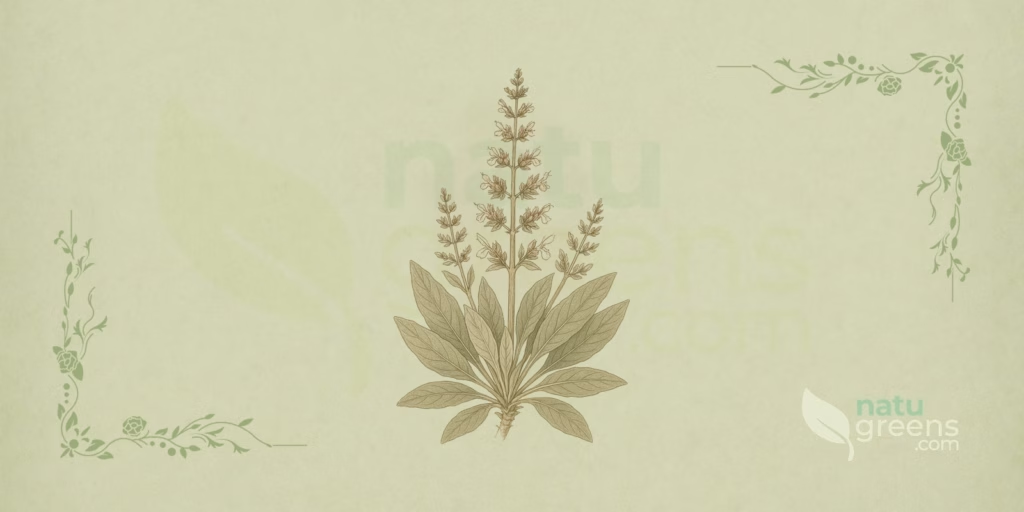
Self-heal (Prunella vulgaris L.) is one of the most widely distributed herbaceous plants on the planet, native to almost the whole temperate and subtropical belt of the Northern Hemisphere, from Scandinavia to North Africa and from Alaska down to Central America. It belongs to the Lamiaceae, the same family as rosemary, mint and sage, and it carries every classic character of that group: a stem square in cross section, opposite leaves and a two-lipped corolla. What makes the species remarkable is the combination of geographical reach and sheer inconspicuousness. Anyone who walks past it on a lawn rarely suspects they are looking at a plant that has held a continuous place in European botanical literature since the sixteenth century.
For field botany, the interesting thing about self-heal is its plasticity. The same species that forms creeping mats a few centimetres high in closely grazed pasture will send up erect stems half a metre tall in deep, moist ground, and leaf shape shifts from one population to the next. That variation fed decades of independent descriptions, and the result was an extensive synonymy that only modern taxonomic work managed to tidy up. Today the consensus recognises a single polymorphic species divided into a handful of accepted subspecies.
This profile gathers what the botanical literature documents about Prunella vulgaris: formal classification and etymology, detailed morphology, distribution and habitat, cultivation requirements, the phenological calendar, closely related species that cause identification problems, a descriptive account of its chemistry, historical records of use by different cultures and its conservation status.
In addition, self-heal shows every classic character of the Lamiaceae, from the square stem to the opposite leaves and the two-lipped corolla.
Taxonomy
Self-heal was described by Carl Linnaeus in 1753, in the second volume of Species Plantarum, and the name has stood unchanged ever since. The International Plant Names Index records the protologue at Sp. Pl. 2: 600, with a lectotype designated in the Clifford herbarium, now held at the Natural History Museum in London. The full classification is set out below.
- Kingdom: Plantae
- Division: Tracheophyta
- Class: Magnoliopsida
- Order: Lamiales
- Family: Lamiaceae
- Subfamily: Nepetoideae
- Tribe: Mentheae
- Subtribe: Prunellinae
- Genus: Prunella L., 1753
- Species: Prunella vulgaris L., 1753
The genus Prunella is a small one. Plants of the World Online accepts around eight species, concentrated in temperate Eurasia and the Mediterranean, and only P. vulgaris has achieved a genuinely global distribution. A few natural hybrids of local occurrence round out the genus, formed wherever two of its species share the same meadow.
Synonyms and Infraspecific Names
The synonymy of the species is long, and it reflects the morphological variation that confused authors throughout the eighteenth and nineteenth centuries. Among the names now treated as synonyms are the following.
- Brunella vulgaris (L.) Moench
- Prunella officinalis Crantz
- Prunella vulgaris f. nana J.Erikson
- Prunella vulgaris subsp. parviflora Ehrh.
- Prunella vulgaris var. nemoralis H.Post
At infraspecific level, the current Kew treatment accepts five subspecies: asiatica (Nakai) H.Hara, from eastern Asia; estremadurensis Franco, confined to the Iberian Peninsula; hispida (Benth.) Hultén, distributed across western North America and northeastern Asia; lanceolata (W.P.C.Barton) Piper & Beattie, North American and narrower leaved; and the typical subspecies vulgaris. Dozens of varieties and forms described over the years have been folded into those five units.
Etymology
The generic name has an uncertain and much debated origin, though the most widely accepted explanation traces Prunella back to the earlier form Brunella, itself thought to derive from “die Bräune”, an old German term for an inflammation of the throat. Tournefort favoured the spelling with a B in 1700, the one with a P took hold with Linnaeus, and the two forms went on coexisting in the literature for decades, right through to the end of the nineteenth century. The epithet vulgaris, from the Latin, means common or ordinary, a direct reference to how often the plant turns up in the meadows and open ground of Europe.
Morphological Description
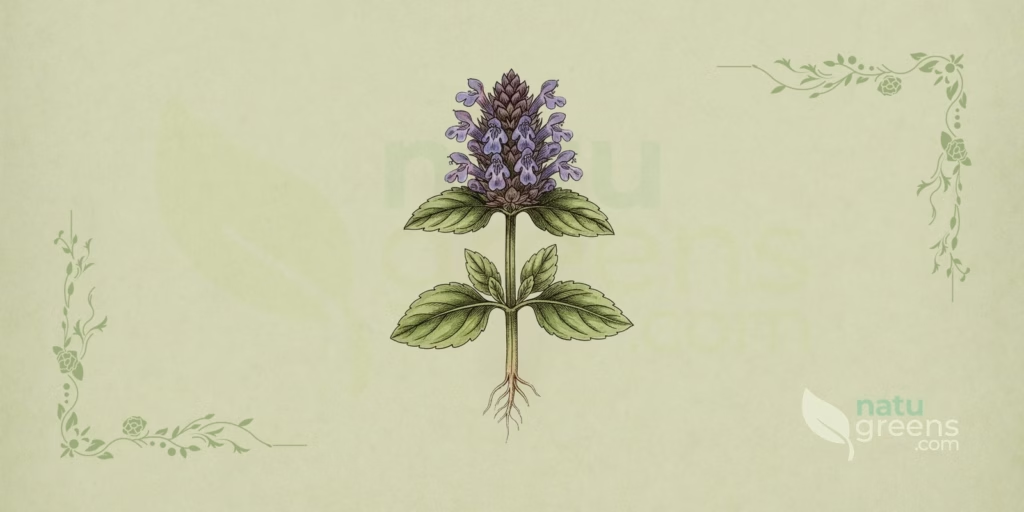
Prunella vulgaris is a low growing perennial herb whose habit ranges from prostrate to erect depending on the setting. On mown lawns and trampled pasture it stays between 5 and 15 centimetres; on fertile, moist soil with no competition for light, the flowering stems can pass 30 centimetres and reach half a metre. The plant spreads sideways by stolons that root at the nodes, building up dense clonal patches that take ground gradually and hold it.
Leaves
The leaves are opposite and simple, on a short petiole that rarely exceeds 2 centimetres on the middle leaves. The blade measures 1.5 to 6 centimetres long by 0.6 to 2.5 centimetres wide, with a shape that swings from ovate to lanceolate within a single population. The base is rounded or attenuate and the apex obtuse to slightly acute. The margin is usually entire or only faintly crenate, without the deep teeth found in other creeping Lamiaceae. Venation is pinnate, with three to seven pairs of lateral veins branching off the midrib. Both surfaces bear sparse simple hairs, denser on the stems and around the nodes.
Flowers
The inflorescence is the most reliable diagnostic character of the species. The flowers gather into a compact cylindrical terminal spike, 2 to 5 centimetres long, made up of six to twelve overlapping verticillasters. Each verticillaster sits on a pair of broad, heart-shaped bracts, ciliate along the margin and often tinged with purple, arranged in an imbricate pattern that gives the spike its characteristic scaly look.
The calyx is two-lipped, 7 to 10 millimetres long, persistent and green suffused with purple. The corolla measures 10 to 15 millimetres, is tubular at the base and ends in two lips: the upper one forms a concave hood, the lower one opens into three lobes, the middle one fringed along its margin. Violet-blue dominates, with white and pink variants cropping up sporadically in any population. The four stamens are didynamous and shelter under the hood of the upper lip, a position that forces the pollinator to brush against them while reaching for nectar at the bottom of the tube.
Fruits and Seeds
The fruit is a schizocarp that breaks into four nutlets, the standard arrangement in the Lamiaceae. Each nutlet measures 1.5 to 2 millimetres, is oblong in outline with a smooth, glossy surface, and darkens from brown to almost black as it ripens. The nutlets stay wrapped in the persistent calyx even after the spike has withered, and that dry structure works both as a protective capsule and as a means of dispersal. British records indicate that a plant of average size produces something in the order of 850 nutlets per season, with germination rates around 70 per cent under favourable conditions.
Root and Stem
The stem is square in cross section, often reddish at the base and on the faces exposed to the sun, and branches from the leaf axils. The root system is fibrous and shallow: in compacted ground most of the roots sit within the top 15 centimetres, reaching 30 centimetres in looser substrates. Short rhizomes and surface stolons complete the picture and account for clonal spread, which in practice outstrips seed reproduction as the mechanism of local occupation.
Distribution and Habitat
The native range of Prunella vulgaris covers the temperate and subtropical Northern Hemisphere and extends as far as Central America. That takes in the whole of Europe, from Iceland to the Mediterranean, temperate Asia from the Caucasus to Japan, northwestern Africa and much of North America, where native populations occur that are distinct from the European ones. Few herbaceous angiosperms show a comparable natural range.
Beyond that belt the species has established itself as an introduced plant in a number of territories. Australia, New Zealand, Hawaii and several Pacific islands have recorded naturalised populations since the nineteenth century, almost always tied to lawns and pasture laid down by settlers. In Brazil, the Flora e Funga do Brasil treats the species as naturalised, with records from Minas Gerais, Paraná, Rio de Janeiro, Rio Grande do Sul, Santa Catarina and São Paulo, all within the Atlantic Forest domain. Occurrences cluster in disturbed ground, riparian woodland and stretches of mixed ombrophilous forest, above all in the upland regions of the south and southeast where the thermal regime comes close to temperate.
Its preferred habitat brings together meadows, pasture, trail edges, forest clearings and urban lawns. The plant tolerates soils of varied texture, from clay to sand, and thrives on slightly acid to neutral ground, between pH 5.5 and 7.5. It puts up with compaction and low fertility better than most Lamiaceae, which explains its presence along roadsides and in trampled ground. It grows from sea level to around 2,800 metres, with records from alpine zones in both the Alps and the Himalaya. Cold hardiness is notable and extends well below freezing, corresponding to zones 4 to 9 of the North American system.
Cultivation
Self-heal is grown both as an ornamental ground cover and as a crop for the dried plant trade. The central requirement is steady moisture without waterlogging, and its tolerance of partial shade makes it useful in half-shaded spots where other Lamiaceae fail to take.
Propagation
Three routes are used in horticultural practice.
- Division of clumps: the quickest and most predictable method, carried out in spring or autumn, with the divisions replanted straight away.
- Rooted stolons: segments that have already produced roots at the nodes can be detached from the parent plant and transplanted directly.
- Seed: the nutlets are positively photoblastic and should be sown on the surface, without a covering of substrate. Germination follows within two to four weeks at 15 to 20 degrees, and a prior cold stratification improves the evenness of emergence in seed lots of temperate origin.
Requirements and Management
Usual spacing in ground cover planting runs between 20 and 30 centimetres, enough for the stolons to close the ground over a single season. Heavy nitrogen feeding is counterproductive, since it encourages leaf mass at the expense of spike production. Irrigation matters mainly in the first year, while the plant is establishing, after which it sustains itself on rainfall across most temperate climates. Cutting back the spent spikes at the end of the first flush of flowering tends to bring on a second one in autumn.
Pests and Diseases
The species is little troubled by either, a trait that reinforces its colonising behaviour. The problems recorded most often are slugs and snails on seedlings in damp, shaded settings, mites of the genus Tetranychus during prolonged dry spells, powdery mildew caused by Erysiphe spp. where humidity is high and ventilation poor, and leaf spots attributed to Septoria spp., generally with no effect on the vigour of the clump.
Harvesting
In commercial growing aimed at the dried plant material trade, the aerial parts are cut at full flowering, the stage at which biomass and phenolic content peak together. Drying is done in the shade, in a ventilated space at moderate temperature, so as to preserve the colour of the bracts, an attribute used as a visual quality criterion for the batch.
Phenology
In Northern Hemisphere populations, flowering concentrates between late spring and late summer, with a documented peak from June to August and a tail into September in wet years. In the naturalised populations of the Southern Hemisphere, the Brazilian ones included, the calendar shifts to the warm months, roughly November to March. The spike does not open all at once: the verticillasters come into flower in ascending sequence, from the bottom up, which stretches the nectar supply of each inflorescence over several weeks.
Pollination is entomophilous and depends above all on long-tongued bees. Nectar collects at the bottom of the corolla tube, at a depth of 11 to 13 millimetres, a distance that suits bumblebees of the genus Bombus and rules out most short-tongued visitors. Butterflies also work the spikes, transferring pollen less efficiently.
The breeding system varies between populations, and that variation has been studied for decades. Some of the work describes flowers with weak protandry and the capacity to self-pollinate even before anthesis, while other studies record predominantly outcrossing populations. The current reading is of a mixed system, with the balance between selfing and outcrossing shifting according to pollinator availability and the geographical origin of the population.
Fruiting begins a few weeks after each verticillaster reaches anthesis. Dispersal combines three routes: passive fall by gravity close to the parent plant, transport by rainwater running over the ground, with the dry calyx acting as a float, and endozoochory, since the nutlets pass through the digestive tract of birds without losing viability, which opens the way to establishment over long distances.
Related Species and Confusions
In the field, self-heal can be taken for other low growing Lamiaceae with purplish flowers. The decisive characters lie in the inflorescence and the bracts.
- Ajuga reptans (bugle): forms a far more obvious basal rosette and bears blue flowers in loose spikes, with an upper lip so reduced that the corolla looks one-lipped. Self-heal never shows that reduction of the upper lip.
- Glechoma hederacea (ground ivy): has kidney-shaped leaves with a crenate margin and flowers set in small axillary groups along the creeping stem, never in a dense terminal spike.
- Lamium purpureum (red dead-nettle): is annual, with heart-shaped leaves far more strongly crenate and flowers in axillary whorls among reddish leafy bracts, without the compact cylindrical spike.
- Prunella grandiflora: the closest relative and the hardest to separate. It is distinguished by corollas of 20 to 25 millimetres, nearly twice those of P. vulgaris, by a more erect habit and by long-petioled lower leaves. The two species hybridise where they meet, and the hybrids show intermediate characters that make identification awkward.
- Prunella laciniata: has white to cream flowers and deeply cut upper leaves, a character absent in self-heal. It too hybridises with P. vulgaris in European meadows.
No dangerous look-alike is known among the species that grow alongside self-heal in the habitats it occupies. The creeping Lamiaceae that share its niche are not among the plants of any real toxicological concern in the temperate flora.
Phytochemistry
The chemical profile of Prunella vulgaris is well characterised and brings together phenolic compounds, triterpenes, polysaccharides and a volatile fraction whose composition varies by organ. The descriptions below are strictly compositional.
Among the phenolic acids, rosmarinic acid is the major component and reaches high concentrations even by Lamiaceae standards. Studies of variation by organ and phenological stage measured levels close to 15.8 milligrams per gram of dry matter at full flowering, with consistently higher values in the leaves than in the stems. Caffeic acid, chlorogenic acid and derived esters accompany it.
Pentacyclic triterpenes make up the second prominent class. Ursolic acid and oleanolic acid were quantified at around 1.8 and 0.65 milligrams per gram of dry matter respectively, at that same full flowering stage. Additional pentacyclic and hexacyclic triterpenes have been isolated from the roots, and a trihydroxylated derivative of the oleanane skeleton from the leaves and stems.
The flavonoid fraction includes hyperoside, quercetin, rutin and kaempferol. Hyperoside accumulates to its maximum in spikes at the bud stage, a pattern that falls away as the inflorescence matures. The bracts owe their purple colouring to anthocyanins.
An anionic polysaccharide with a molecular mass of around ten kilodaltons has been isolated from the aqueous extract and described in the literature under the name prunellin. Condensed tannins occur throughout the aerial parts. Analysis of the volatile fraction identified dozens of compounds spread across hydrocarbons, aldehydes, sesquiterpenes, monoterpenes, ketones and esters, with squalene appearing as the most abundant component in both the flowers and the roots.
Self-Heal in History and Ethnobotany
The written record of self-heal in Europe predates its Linnaean description by centuries. The plant appears in the great Renaissance herbals under the name Brunella, among them the work of Leonhart Fuchs of 1542, John Gerard’s herbal of 1597 and the compendium of Nicholas Culpeper of 1652. The English vernacular name self-heal, coined in that period, and the German name linked to throat complaints both indicate the reputation the species carried in the herbal imagination of the time.
In China the dried spike was catalogued under the name xia ku cao and appeared among the plant drugs listed in the classical pharmacological compendia, with mentions going back to the Shennong Ben Cao Jing, a work compiled between the first and third centuries of the common era. The Chinese name describes, quite literally, a herb that withers in summer, a reference to the behaviour of the inflorescence, which loses its freshness while the warm season is still under way.
Indigenous groups of North America applied the juice pressed from the aerial parts topically, a practice documented by ethnographers of the nineteenth and early twentieth centuries. European records from the same period describe the young leaves being used in salads and in peasant food preparations during periods of scarcity, which places the species within the field of foraged food plants as well.
None of these records should be read as guidance for use. They are ethnographic and historical descriptions of the practices of particular cultures at particular moments, presented here as part of the documentary trajectory of the species.
Conservation
Prunella vulgaris is assessed on the IUCN Red List as Least Concern, a classification consistent with its continental native range and with the abundance recorded across virtually the whole temperate Northern Hemisphere. The species appears in no CITES appendix and features on no national list of threatened flora.
The conservation concern attached to self-heal runs in the opposite direction to the usual one. In several territories where it was introduced it is treated as a naturalised plant with colonising behaviour, notably in Australia, New Zealand and the Hawaiian archipelago, where it occupies lawns, pasture and disturbed ground. Its ability to resprout from stolons after repeated cutting makes eradication from lawns a slow business and rarely a complete one.
On the positive side of the ecological balance, the species is recognised as a significant floral resource for pollinators. Its long, staggered flowering offers nectar at a point in summer when many other sources have already run dry, and Bombus populations are among the most consistent beneficiaries of that supply.
Interesting Facts
- Self-heal survives the lawnmower as a matter of architecture. With a prostrate habit and meristems close to the ground, it ducks under the blade and answers a cut by putting out spikes lower still, which makes it one of the most persistent spontaneous plants of temperate lawns.
- The dispute between the spellings Prunella and Brunella ran through the entire eighteenth century. Tournefort argued for the second in 1700, Linnaeus enshrined the first in 1753, and botanical books went on alternating between them until the close of the nineteenth century.
- The native range of the species is so wide that it occurs naturally on four continents without any human intervention, an unusual situation among perennial herbs whose dispersal is mostly local.
- In Brazil, exotic though it is, the plant has established itself consistently across six states, always within the Atlantic Forest domain and by preference at altitude, which puts it among the few temperate Lamiaceae naturalised in the Brazilian flora.
- The Chinese name xia ku cao, meaning the herb that withers in summer, is a precise phenological observation turned into a popular botanical designation, a recurring practice in traditional Chinese plant nomenclature.
Notice: this content is for informational purposes and does not replace professional medical advice. Consult a physician or herbal practitioner before using medicinal plants, especially during pregnancy, breastfeeding, or alongside medication.
References and Scientific Studies
View All 8 Cited References
- 2012 Chen, Y., Zhu, Z., Guo, Q., et al. Variation in concentrations of major bioactive compounds in Prunella vulgaris L. related to plant parts and phenological stages. Biological Research, 45(2), 171-175. 2012. ↗
- Flora e Funga do Brasil. Prunella vulgaris L. Rio de Janeiro Botanical Garden. ↗
- IPNI. Prunella vulgaris L. International Plant Names Index. Royal Botanic Gardens, Kew, Harvard University Herbaria and Australian National Herbarium. ↗
- IUCN. Prunella vulgaris. The IUCN Red List of Threatened Species. ↗
- Linnaeus, C. Species Plantarum, vol. 2, p. 600. Stockholm. 1753. ↗
- Northridge, R., Rand, D. Prunella vulgaris L. Fermanagh Species Accounts. Botanical Society of Britain and Ireland. ↗
- POWO. Prunella vulgaris L. Plants of the World Online. Royal Botanic Gardens, Kew. ↗
- Wu, Z. Y., Raven, P. H., Hong, D. Y. (eds.). Prunella vulgaris. Flora of China, vol. 17. Science Press and Missouri Botanical Garden Press. ↗