Petroselinum crispum is at once the most ordinary herb in Western kitchens and one of the umbellifers with the most tangled nomenclatural history. It is a biennial member of the family Apiaceae, with deeply dissected leaves, a thickened taproot and an unmistakable scent that escapes the moment any part of the plant is bruised. English speakers call it simply parsley, and the two forms that share the shelves of every greengrocer, the curly and the flat leaved, belong to the same species despite looking like different plants.
The Apiaceae, also known as the Umbelliferae, gather some 3,800 species spread across every inhabited continent, and parsley is one of the few that crossed the line from kitchen garden to industrial agriculture. The genus Petroselinum is a tiny one. Current taxonomic treatments accept a single species within it, this one, ever since corn parsley was returned to the genus Sison.
What makes the species remarkable in botanical terms is not its culinary career but a combination of three uncommon traits: a fixed oil dominated by a fatty acid rarely found in nature, a notoriously slow germination governed by inhibitors held in the pericarp, and a set of phototoxic furanocoumarins that place it chemically close to far more dangerous relatives in the same family. This profile describes the plant itself, its morphology, distribution, cultivation and chemistry, and does not deal with health applications.
Parsley is a biennial member of the family Apiaceae, with deeply dissected leaves, a thickened taproot and a scent that escapes the moment any part of the plant is bruised.
Taxonomy
The accepted name is Petroselinum crispum (Mill.) Fuss, published by Johann Michael Fuss in Flora Transsilvaniae, page 254, in 1866. The basionym is Apium crispum Mill., described by Philip Miller in the eighth edition of the Gardeners Dictionary, entry number 2, dated 16 April 1768. The attribution of the basionym to Linnaeus, which still circulates in secondary sources, does not hold up: the Linnaean name Apium petroselinum L., from the Species Plantarum of 1753, is older, but it is not the basis of the combination in use today.
The full classification runs as follows.
- Kingdom: Plantae
- Division: Tracheophyta (angiosperms)
- Class: Magnoliopsida (eudicots)
- Order: Apiales
- Family: Apiaceae (Umbelliferae)
- Subfamily: Apioideae
- Tribe: Apieae
- Genus: Petroselinum Hill, 1756
- Species: Petroselinum crispum (Mill.) Fuss, 1866
Three homonymous combinations circulate in the literature, credited to Fuss (1866), to Nyman (1882) and to A. W. Hill (1925). The first has priority and is the one cited by Plants of the World Online. Seeing the authorship written out as “(Mill.) Nyman ex A. W. Hill” in food chemistry papers is common, and it reflects nothing more than that bibliographic legacy, not a distinct botanical entity.
Synonyms
The recognised homotypic and heterotypic synonyms include, in alphabetical order:
- Apium crispum Mill. (basionym)
- Apium petroselinum L.
- Carum petroselinum (L.) Benth. & Hook.f.
- Carum petroselinum var. crispum (Mill.) Beck
- Petroselinum hortense Hoffm.
- Petroselinum sativum Hoffm.
- Petroselinum sativum var. crispum (Mill.) Gaudin
- Petroselinum vulgare Lag.
Cultivar Groups
Two thousand years of horticultural selection left behind a generous infraspecific nomenclature, with dozens of varieties and forms described by Danert in 1959 and revised by Reduron in 2008. In agronomic practice, three groups account for everything that is actually grown.
- Curly parsley group (var. crispum): tightly crisped leaves, compact rosette, milder aroma. It predominates in northern Europe and in the United States.
- Flat leaved group (var. neapolitanum Danert): flat, broad leaflets, taller habit, sharper and more penetrating aroma. This is the dominant group around the Mediterranean basin and in Brazil, and the one most cooks now prefer.
- Root parsley group (var. tuberosum, also treated as subsp. tuberosum): a thickened, spindle shaped white taproot that looks like a pale carrot. It is grown above all in central and eastern Europe, where it is sold as Hamburg parsley.
Etymology
The generic name comes from the Greek petros, rock, joined to selinon, the old name for celery, and amounts to something like rock celery, an allusion to the rocky outcrops and old walls where spontaneous populations tend to settle. The epithet crispum is the Latin adjective for curled, taken from the wavy foliage of the garden forms Miller had in front of him in 1768. Almost every European vernacular name for the herb descends from that same Latin petroselinum, and the English form took a particularly winding route, described further on.
Morphological Description
A glabrous biennial herb, aromatic in every part, 30 to 80 centimetres tall in the vegetative phase. In the first season it produces nothing but a dense basal rosette supported by a taproot. In the second it sends up an erect flowering stem, cylindrical, ridged and branched towards the top, which can pass a metre in height, flowers, fruits and dies. Under commercial cultivation the plant almost never reaches that second cycle, because it is pulled up or replaced first.
Leaves
The leaves are alternate and compound, 10 to 25 centimetres long including the petiole, deep green and glossy on the surface. The blade is two to three times pinnatisect, with cuneate to ovate, serrate margined segments in the flat leaved forms, and strongly crisped, overlapping ones in the curly forms. The petiole measures 5 to 15 centimetres, is channelled on the upper face and widens into a short membranous sheath at the base. The cauline leaves that appear in the second year grow progressively smaller and less divided, until they are reduced to almost linear segments near the inflorescence.
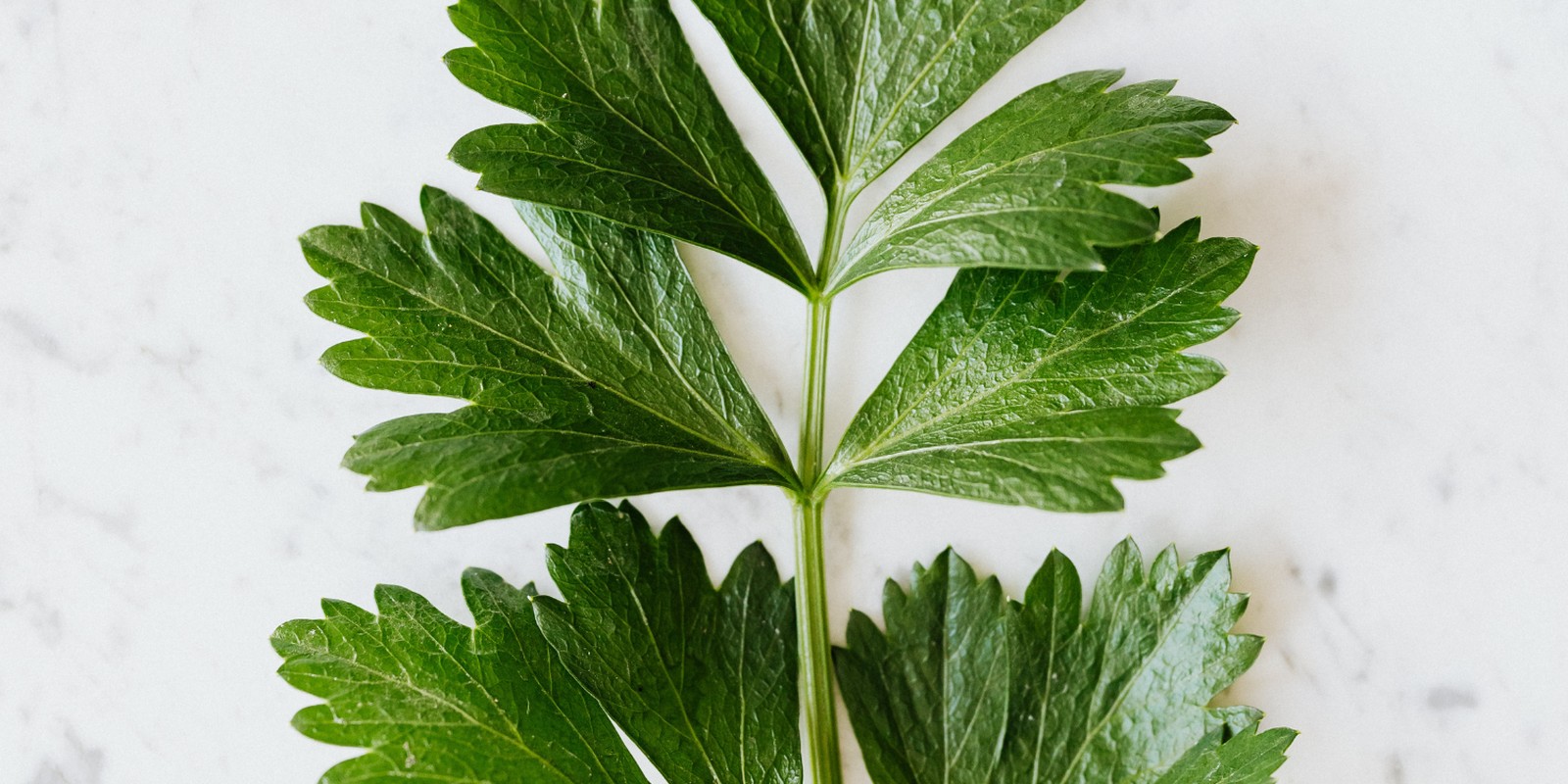
A flat leaved parsley leaf seen from above, with the twice pinnatisect blade and the cuneate, serrate margined segments that set var. neapolitanum apart from the curly forms.
Flowers
The inflorescence is a compound umbel 3 to 8 centimetres across, with 8 to 20 unequal rays. The involucre carries one to three linear bracts, sometimes forked, and the involucels of the umbellules gather several narrow bracteoles. The individual flowers are minute, with five yellowish green petals with incurved tips, five stamens and an inferior bicarpellate ovary topped by a flattened stylopodium. That greenish colour is a useful character in the field, since most of the umbellifers likely to be mistaken for parsley flower white.
Fruits and Seeds
The fruit is a schizocarp that splits into two mericarps, the diachene typical of the family. It measures 2.5 to 3 millimetres, is ovoid and slightly flattened from the sides, and turns greyish brown as it ripens. Each mericarp shows five slender, barely raised primary ribs with secretory canals between them. What the trade sells as parsley seed is the whole mericarp, fruit and all, and it is the pericarp that holds the inhibitors responsible for the slow and uneven germination.
Root and Stem
The root is a taproot, whitish to cream, aromatic, and it descends 20 to 40 centimetres in the leaf groups. In the root group the organ thickens considerably, reaching 5 centimetres across and 25 centimetres in length, with a thick cortex and a fibrous central cylinder. The stem develops only in the second cycle. It is hollow between the nodes, longitudinally ridged and entirely free of blotches or pigment, a detail that gains importance when parsley has to be told apart from toxic look alikes.
Distribution and Habitat
Plants of the World Online circumscribes the native range of the species to north-western Africa and the Balkan Peninsula. Some of the older horticultural literature stretches that origin across the eastern Mediterranean, taking in Anatolia and the Levant, but the evidence for genuinely spontaneous populations outside the Maghreb and the Balkans is thin and probably reflects ancient escapes from cultivation. Subspecies giganteum, described from Morocco, anchors the African half of the range.
As a cultivated plant the species is present on every inhabited continent, and it has escaped into a subspontaneous or naturalised state across a long list of territories, among them Argentina, Australia, Brazil, Canada, Chile, New Zealand, the United States and much of central and western Europe. It is also recorded as introduced on oceanic islands, the Galapagos archipelago included. None of those populations counts as an aggressive invader: parsley lingers on disturbed ground, garden edges and rubble without displacing established native vegetation.
The typical habitat of the spontaneous populations is rocky slopes, crevices in old walls, banks and well drained calcareous soils, from sea level up to around 2,000 metres. The species prefers temperate and subtropical climates, with temperatures between 12 and 22 degrees Celsius, tolerates light frosts down to 5 degrees below zero and suffers above 30, when it bolts early and turns yellow. The ideal soil is deep, fertile, rich in organic matter and of pH between 5.5 and 7.5, well drained and sandy loam in texture.
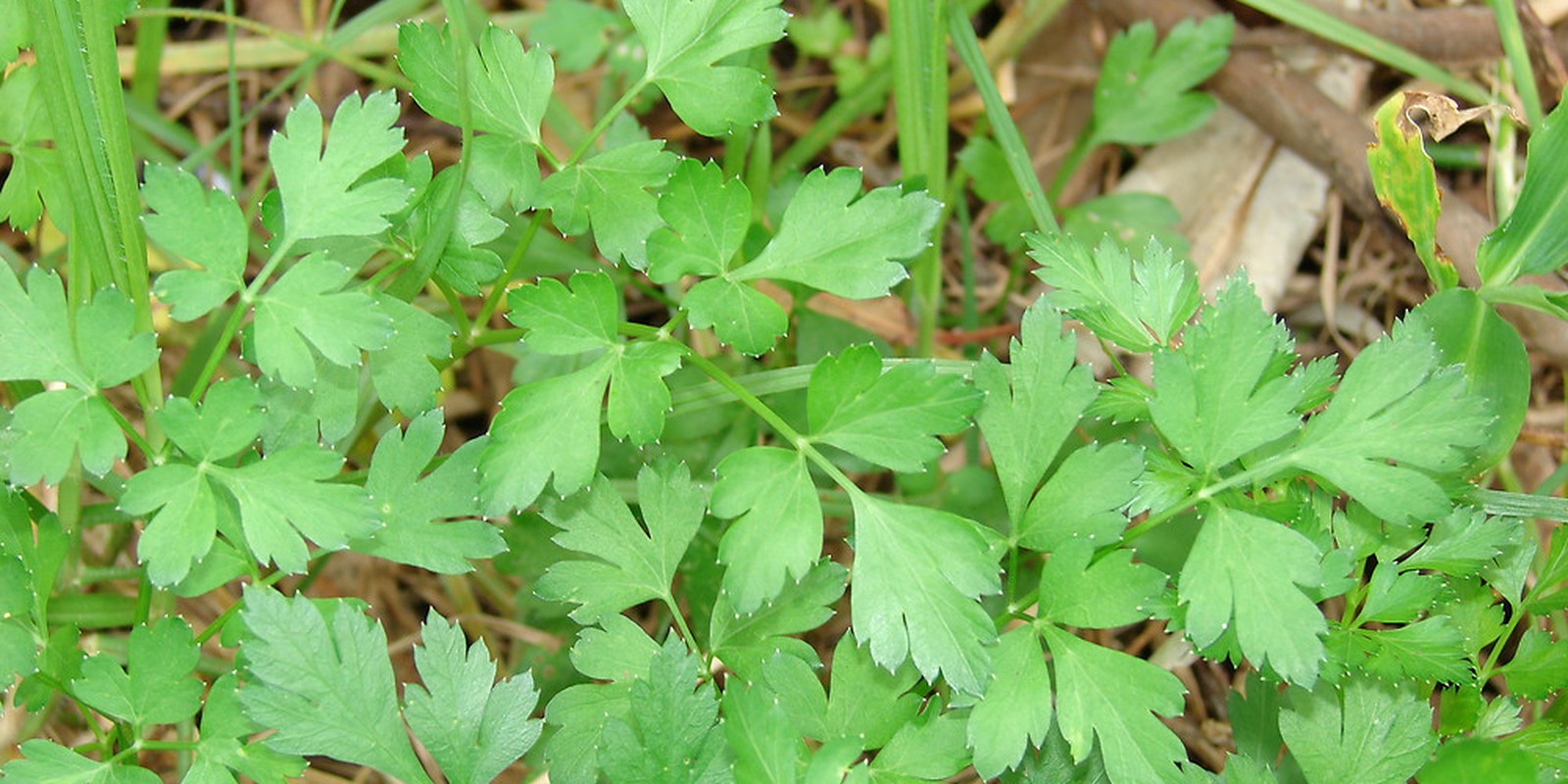
Spontaneous clumps of Petroselinum crispum among grasses and leaf litter, the sort of disturbed ground where the species persists once it has escaped cultivation.
Cultivation
Propagation is by seed alone, or more strictly by the whole dry fruit. There is no practical vegetative route, since the plant sends out no stolons and does not survive clump division without losing its taproot. Germination takes two to five weeks and is notorious for its irregularity, a direct consequence of the inhibitors in the pericarp, which have to be leached out by soil water before the embryo responds. A substrate kept moist and a steady temperature in the range of 20 to 25 degrees Celsius shorten that wait considerably. Seed loses viability quickly, and lots more than two years old usually show a marked drop in emergence.
In direct sowing, the fruits go in about half a centimetre deep, in rows 20 to 30 centimetres apart, thinned afterwards to 5 to 10 centimetres between plants. The crop responds well to organic matter worked in before planting and to periodic nitrogen top dressings through the harvest period. Irrigation has to be regular, because water deficit translates rapidly into yellowing leaves and a loss of market quality. Rotation with species from other families is advisable, since planting umbellifers over and over in the same bed builds up soil borne pathogens.
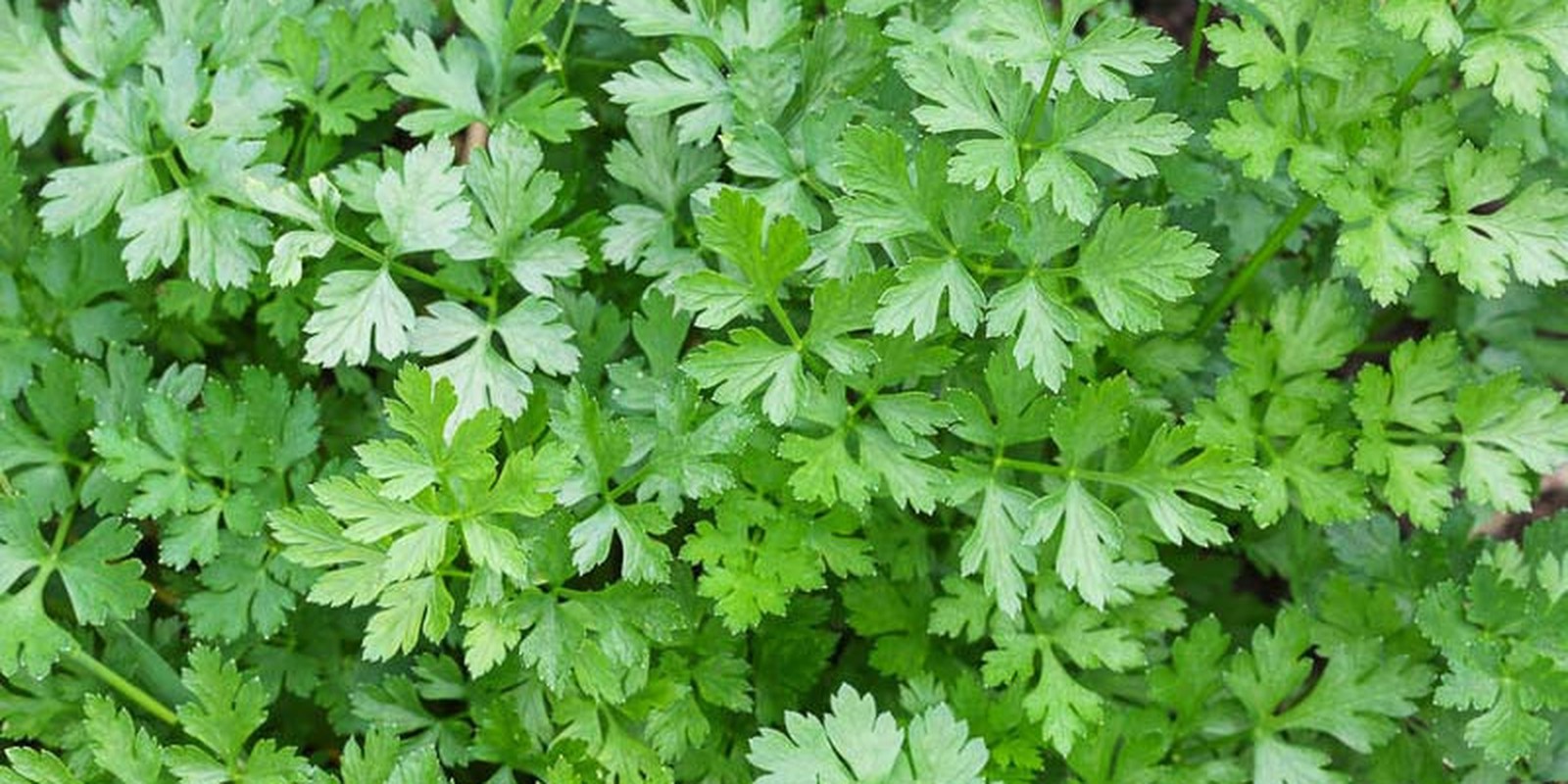
A bed of flat leaved parsley in full vegetative growth, the basal rosettes closing over one another shortly before the first cut of outer leaves.
The commonest pests are, in alphabetical order, the aphid Dysaphis apiifolia, specific to umbellifers, which colonises petioles and the undersides of leaves; the caterpillar of Papilio polyxenes, striped in green, black and yellow, which grazes foliage in American gardens; the fly Psila rosae, whose larvae mine roots and hit the thickened root group hardest; and nematodes of the genus Meloidogyne, which induce root galls and sap the vigour of the plant. Among the diseases, the ones that stand out are Alternaria radicina, the cause of black root rot; Cercospora petroselini, behind brown leaf spots; Erysiphe heraclei, the powdery mildew of the umbellifers; and Septoria petroselini, agent of septoria blight, by far the most destructive foliar disease of the crop, recognisable by necrotic lesions peppered with dark pycnidia.
Leaf harvest starts between 60 and 80 days after sowing and continues through successive cuts, four to six per cycle, always taking the outer leaves and sparing the central meristem so the plant can regrow. The roots of the tuberous group are lifted between 90 and 120 days. In tropical climates the productive cycle shortens, and bolting can turn up as early as three or four months, at which point the foliage loses quality and the planting is renewed.
Phenology
Flowering happens in the second year of life, between June and August in the northern hemisphere, and far more erratically at tropical latitudes, where heat stress can pull bolting forward into the first cycle. Floral induction depends on vernalisation, that is, on a spell of cold the plant has to accumulate before it will elongate a stem. That is why parsley behaves as an annual in warm regions and as a strict biennial in temperate ones.
The umbels are protandrous, a general feature of the family: the anthers shed their pollen before the stigmas of the same flower become receptive, which favours cross pollination. Visitation is mainly entomophilous and generalist, with flies, small hymenopterans and wasps accounting for the bulk of visits, drawn by the nectar exposed on the stylopodium. Fruiting follows between August and September in the northern hemisphere, some six to eight weeks after anthesis.
Dispersal is essentially barochorous. The mericarps have no wings, hooks or plumed appendages, and they drop by gravity a short distance from the mother plant, to be shifted afterwards by runoff or by the turning of the soil. In practice, long distance dispersal of the species is entirely human, driven by the seed trade and by the dumping of garden waste, which explains why the plant turns up on waste ground and near cultivated land.
Parsley Relatives and Common Confusions
With corn parsley moved back into Sison, the genus Petroselinum is now treated as monospecific in the current reference catalogues, although older European floras still list two species. The real risks of confusion therefore come from outside the genus. Below, in alphabetical order, are the species most often mistaken for parsley and the characters that settle each case.
- Aethusa cynapium L. (fool’s parsley): a strong superficial resemblance to flat leaved parsley. The plant contains toxic polyynes of the aethusin group, and eating it causes severe poisoning. It is separated by the long, drooping bracteoles beneath the umbellules, by white rather than greenish flowers and by the unpleasant smell of the crushed tissue.
- Anthriscus cerefolium (L.) Hoffm. (chervil): a culinary relative with finer leaves and more delicate dissection, white flowers and a clear aniseed scent, quite unlike the green herbaceous smell of parsley.
- Apium graveolens L. (celery): comparable foliage, but with much thickened, succulent, grooved petioles, larger and less divided leaflets, and an unmistakable aroma of its own.
- Conium maculatum L. (poison hemlock): the most dangerous confusion of all. The plant contains coniine and related piperidine alkaloids, and swallowing small quantities is lethal to people and animals. It is distinguished by its far greater size, which passes two metres, by the glabrous stem with its characteristic purple blotches, by the white flowers and by a foul smell likened to mouse urine.
- Coriandrum sativum L. (coriander): the swap that catches out shoppers most often. Coriander has broad, rounded lobed basal leaves rather than pinnatisect ones, a marked aldehydic aroma, white to pinkish flowers and globose fruits, against the ovoid fruits of parsley.
- Sison segetum L. (formerly Petroselinum segetum): a wild species of Atlantic Europe, with coarser leaf dissection, fewer segments and a more slender habit.
The practical field rule combines three observations: flower colour, blotches on the stem and smell. Greenish umbels, a clean stem and a fresh green scent point to parsley. White flowers, a blotched stem or an unpleasant odour mean stopping the identification and turning to a botanical key or to a specialist.
Phytochemistry
The chemical make-up of the species is among the best documented of the cultivated umbellifers, and it varies sharply between cultivar groups and between organs of the plant. This section describes what the plant accumulates and where, without dealing with effects in people.
The essential oil accounts for 0.1 to 0.3 per cent of the mass of the fresh leaves and 2 to 7 per cent of the fruits. Its dominant fraction consists of phenylpropanoids, and the ratio between them defines quite distinct chemotypes: apiole prevails in the fruits of many flat leaved lines, while myristicin dominates in many curly leaved ones, either compound accounting for 30 to 60 per cent of the fruit oil. The monoterpene fraction gathers alpha-pinene, beta-pinene, limonene and myrcene, and the compound 1,3,8-p-menthatriene is responsible for much of the green smell of freshly cut foliage.
Among the flavonoids, the flavones apigenin and luteolin occur mostly in glycosylated form, notably as apiin, or apigenin 7-apiosylglucoside, and cosmosiin, or apigenin 7-O-glucoside. The leaves concentrate these compounds at levels that are high for a leafy vegetable.
The furanocoumarins form the chemically most sensitive group in the species and include bergapten, isopimpinellin, oxypeucedanin and psoralen, distributed through leaves, petioles and fruits. These molecules are phototoxic. Prolonged contact of the skin with the sap, followed by exposure to sunlight, causes phytophotodermatitis, a burn like reaction with erythema and blistering that mainly affects workers handling large volumes of the plant at harvest. The concentrated essential oil of the fruits, rich in apiole and myristicin, is toxic, and it is not to be confused with the fresh leaf used as a seasoning.
The fixed oil of the seeds carries a peculiarity of industrial interest: 60 to 75 per cent of its composition is petroselinic acid, a monounsaturated eighteen carbon fatty acid with the unsaturation at position 6, an arrangement rare among vegetable oils and practically confined to the Apiaceae and the Araliaceae. The leaves also accumulate carotenoids, with beta-carotene and lutein foremost, along with high levels of ascorbic acid and of phylloquinone, the latter among the highest recorded in edible leaves.
One point of animal safety is worth recording: the American Society for the Prevention of Cruelty to Animals classes the species as toxic to dogs, cats and horses, attributing the effect precisely to the furanocoumarins and to the photosensitisation they cause when an animal consumes substantial amounts of the plant.
History and Ethnobotany
The ancient Greeks associated the plant with death and mourning rather than with the table. Wreaths woven from the herb decorated tombs and funeral processions, and a proverbial expression best rendered as being in need of parsley described anyone close to the end. One caveat about reading the classical sources is in order: the Greek term selinon covered parsley and celery alike, so the botanical identity of the victory wreaths of the Nemean Games remains disputed among Hellenists and cannot be assigned to this species with any confidence.
It was the Romans who moved the species into the kitchen. The Latin agricultural treatises record the plant grown in household gardens and used as a condiment, a habit that spread with the expansion of the empire across the European continent. In the Middle Ages parsley appears among the species Charlemagne ordered planted on the royal estates through the Capitulare de Villis, a document of around 795, and European monasteries kept it in continuous cultivation right through the period.
The slowness of germination fed a folklore of its own. In rural England it was said that the seeds had to go down to the devil seven times and back before they would sprout, and in several parts of Europe transplanting parsley was held to be a bad omen, a superstition that survived in gardening manuals into the nineteenth century.
Linnaeus formalised the species as Apium petroselinum in the Species Plantarum of 1753. Miller redescribed it as Apium crispum in 1768, Hoffmann proposed the generic separation in 1814, and Fuss settled the present combination in 1866, closing a nomenclatural back and forth of more than a century. Portuguese colonists carried the plant to Brazil in the sixteenth century, and it worked its way into the popular kitchen so completely that the pairing of parsley with spring onion earned a name of its own there, cheiro-verde, and a permanent place in markets across the country.
Conservation
The species has no published assessment on the Red List of the International Union for Conservation of Nature, and its status is therefore Not Evaluated. Nor does it appear in any of the CITES appendices. That is what one would expect of a plant with a global cultivated distribution, immense populations and no dependence on natural habitat in order to persist.
The real conservation concerns lie elsewhere and bear on genetic diversity. The replacement of local varieties by a handful of uniform commercial cultivars has been narrowing the genetic base of the crop, a process well documented in short cycle vegetables. Germplasm collections held by the IPK at Gatersleben in Germany, by the Centre for Genetic Resources in the Netherlands and by the national germplasm system of the United States preserve hundreds of accessions, including wild material and traditional varieties long out of commercial circulation.
In the spontaneous populations of the Mediterranean and the Maghreb, the pressure comes from agricultural intensification and from the loss of rock dwelling habitats and field margins. The picture matches that of other crop wild relatives, a group that has drawn growing attention in conservation strategy precisely because it holds useful variability that modern cultivars have already lost.
Interesting Facts
- Petroselinic acid, dominant in the seed oil, is an uncommon industrial feedstock: oxidative cleavage of its double bond at position 6 yields lauric acid and adipic acid, two large scale inputs, the first for surfactants and the second for the manufacture of nylon.
- The caterpillar of Papilio polyxenes, the black swallowtail of the Americas, uses parsley as a preferred host plant and has earned the nickname parsley worm in the United States. Many gardeners put up with the damage to the foliage in exchange for the adult butterflies.
- What is bought as parsley seed is not a seed at all: it is the whole mericarp, a dry fruit with pericarp and everything else, and it is that pericarp which carries the chemical inhibitors behind the weeks of waiting before emergence.
- The thickened root group is almost unknown in Brazil and barely seen in British and American markets, yet in Polish, German and Hungarian kitchens it plays a part comparable to the carrot, going into stocks and soups as a root rather than as a herb.
- The English word parsley descends from the same Latin petroselinum, by a winding road that passed through Old French peresil and Middle English persely, fusing along the way a form inherited from Old English with the Norman loanword.
Notice: this content is for informational purposes and does not replace professional medical advice. Consult a physician or herbal practitioner before using medicinal plants, especially during pregnancy, breastfeeding, or alongside medication.
References and Scientific Studies
View All 11 Cited References
- American Society for the Prevention of Cruelty to Animals. Toxic and Non-Toxic Plants: Parsley (Petroselinum crispum). ASPCA Animal Poison Control Center. Available at: aspca.org.
- 1959 Danert, S. Zur Systematik der Petersilie. Die Kulturpflanze, Beiheft 2, p. 320-326. 1959.
- Fuss, J. M. Flora Transsilvaniae Excursoria. Cibinii, p. 254. 1866.
- International Plant Names Index. Petroselinum crispum (Mill.) Fuss. The Royal Botanic Gardens Kew, Harvard University Herbaria and Australian National Herbarium. Available at: ipni.org.
- 2026 International Union for Conservation of Nature. The IUCN Red List of Threatened Species, version 2026-1. Available at: iucnredlist.org.
- Linnaeus, C. Species Plantarum, vol. 1. Holmiae, p. 264. 1753.
- Miller, P. The Gardeners Dictionary, eighth edition, entry Apium n. 2. London. 1768.
- Plants of the World Online. Petroselinum crispum (Mill.) Fuss. Royal Botanic Gardens, Kew. Available at: powo.science.kew.org.
- 2008 Reduron, J.-P. Ombellifères de France, vol. 4. Bulletin de la Société Botanique du Centre-Ouest, special issue 29. 2008.
- 1988 Simon, J. E.; Quinn, J. Characterization of Essential Oil of Parsley. Journal of Agricultural and Food Chemistry, v. 36, n. 3, p. 467-472. 1988.
- 1968 Tutin, T. G. et al. (eds.). Flora Europaea, volume 2: Rosaceae to Umbelliferae. Cambridge University Press. 1968.