Hamamelis virginiana is a large deciduous shrub, occasionally a small multi-stemmed tree, that occupies the understorey of the deciduous forests of eastern North America. It belongs to the Hamamelidaceae, a family with a scattered distribution across temperate Asia, North America, southern Africa and Australia, comprising roughly thirty genera and slightly fewer than a hundred woody species. Within that assemblage the genus Hamamelis is small and ancient, and the North American species is the one that covers the largest continuous range.
What makes the plant remarkable is neither its size nor its foliage, but its calendar. While the rest of the temperate understorey slips into dormancy and drops its leaves, this shrub opens yellow flowers with ribbon-like petals between October and December, at a time when almost no other woody plant in the same forest is in anthesis. The reproductive cycle stretches across nearly a full year, so the ripe capsules of the previous season usually hang from the very branches that carry the new flowers. That coexistence of flower and fruit lies behind the name of the genus and is the most reliable field character for identification.
This page gathers the botanical profile of the species: formal classification validated against IPNI and POWO, a morphological description with measurements, natural distribution, cultivation requirements, phenology, how to tell it apart from its congeners and from look-alikes in other families, a descriptive account of its phytochemistry, the historical and ethnobotanical record, and its conservation status.
Taxonomy
The species was described by Linnaeus in 1753, in the first volume of Species Plantarum, and the name has remained accepted without alteration ever since. The classification follows the current circumscription of the order Saxifragales, into which the Hamamelidaceae was moved after the molecular phylogenetic work that dismantled the former order Hamamelidales.
- Kingdom: Plantae
- Division: Tracheophyta
- Class: Magnoliopsida
- Order: Saxifragales
- Family: Hamamelidaceae
- Subfamily: Hamamelidoideae
- Tribe: Hamamelideae
- Genus: Hamamelis Gronov. ex L.
- Species: Hamamelis virginiana L., Sp. Pl. 1: 124 (1753)
IPNI records the protologue in Species Plantarum 1: 124, dated 1753, and POWO recognises the species together with two accepted infraspecific taxa: the typical variety, Hamamelis virginiana var. virginiana, spread across the whole North American range, and Hamamelis virginiana var. mexicana (Standl.) C.Lane, confined to the mountain ranges of Coahuila and Nuevo Leon in northeastern Mexico. The latter was originally published as a species in its own right, Hamamelis mexicana Standl., in 1937, and part of the literature still treats it at that rank.
As for synonymy, POWO accepts Trilopus virginiana (L.) Raf., of 1838, as a homotypic synonym. Several names from the nineteenth and early twentieth centuries circulated in association with the species or its forms, among them Hamamelis androgyna Walter, Hamamelis corylifolia Moench, Hamamelis dioica Walter, Hamamelis macrophylla Pursh and Lomilis ciliata Raf. To these can be added the varieties and forms described by North American authors, such as H. virginiana var. angustifolia Nieuwl., H. virginiana var. orbiculata Nieuwl., H. virginiana f. parvifolia Fernald and H. virginiana f. rubescens Rehder, none of which is recognised by the reference checklists today.
The generic name comes from the ancient Greek hamamelis, a term that classical authors applied to a fruit tree of uncertain identity, most likely a medlar or a service tree. The usual reading breaks the word down into hama, together, and melon, apple or tree fruit, alluding to the simultaneous presence of flowers and fruits on the same branch, a trait the American species displays in striking fashion. The epithet virginiana points to colonial Virginia, the region from which the first collections were sent to Europe.
Morphological Description
A large deciduous shrub to small tree, reaching 3 to 5 metres in most populations and up to 8 metres where conditions favour it, with exceptional records approaching 10 metres. The trunk is short and almost always multiple, the result of vigorous resprouting from the base, which produces open clumps of irregular outline. Branching alternates in zigzag fashion, with ascending branches towards the interior and horizontal ones at the tips, sketching an airy crown that lets a good deal of light through. The bark is smooth and grey to brown in young individuals, becoming slightly scaly and fissured with age, and the young twigs carry a rusty pubescence that is shed in the second year. Growth is slow, on the order of 10 to 20 centimetres of height a year, and century-old specimens are documented in mature forests.
Leaves
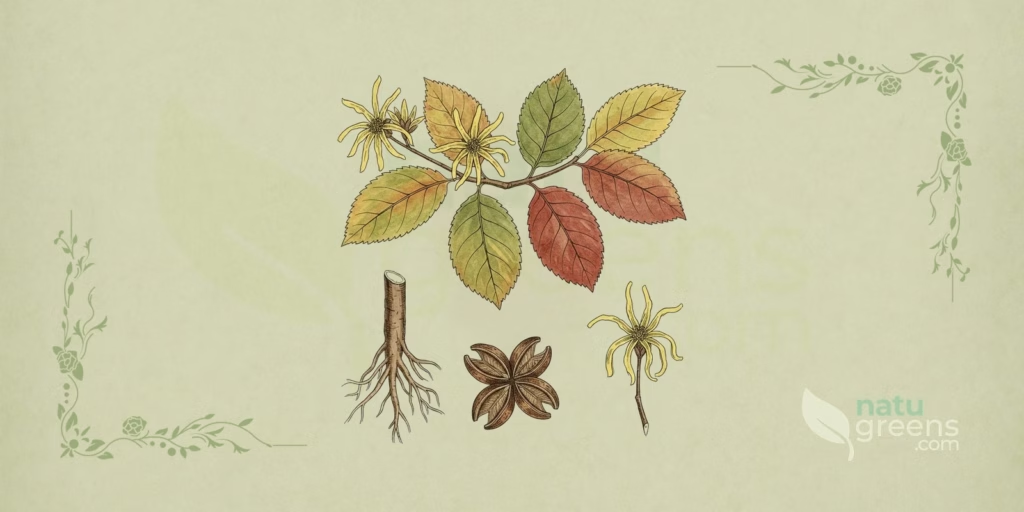
The leaves are alternate, arranged in two ranks, simple and deciduous, with caducous stipules that leave visible scars. The blade is obovate to broadly elliptic, measuring 7 to 15 centimetres long by 5 to 10 centimetres wide, with a rounded to obtuse apex. The base is the most useful character for recognition: distinctly asymmetrical, with one side inserted lower than the other on the petiole, and often subcordate. The margin is undulate-crenate, with broad rounded teeth that give the leaf a sinuous outline. Venation is pinnate, with 5 to 7 pairs of secondary veins running parallel to the margin, impressed on the upper surface and raised on the lower one. The adaxial face is dark green and matt, while the abaxial face is paler and bears stellate hairs along the veins. The petiole measures 5 to 15 millimetres and is hairy. In autumn the foliage turns a uniform golden yellow before falling.
Flowers
The flowers are gathered into short axillary clusters, two to four per axis, distributed along the current year’s branches. Each flower has four short persistent sepals, yellowish green on the inner face and covered in rusty hairs on the outer one, and four linear petals shaped like narrow ribbons, measuring 10 to 20 millimetres. The colour ranges from pale to deep yellow, rarely with a reddish base. In bud the petals are coiled in a spiral and unfurl as the flower opens. The androecium has four short stamens, with anthers opening by hinged valves, alternating with four conspicuously dilated staminodes that act as nectar-bearing structures. The ovary is bicarpellate and partly inferior, topped by two short, spreading styles. The scent is faint and sweet, most noticeable during the warmest hours of the day. In response to falling temperatures the petals coil up again, unrolling once more as the air warms, a cycle that may repeat many times over the weeks of flowering.
Fruits and Seeds
The fruit is a woody ovoid capsule of 10 to 14 millimetres, pubescent, enclosed at the base by the persistent hypanthium and crowned by two horn-like beaks that correspond to the dried styles. Ripening takes about twelve months from anthesis, which explains why new flowers and ripe capsules share the same branch. The opening is explosive: differential drying of the inner layers of the endocarp builds up tension until the valves separate abruptly and shoot the seeds out. Each capsule holds two oblong seeds of 5 to 9 millimetres, black and glossy, with a hard coat and oily endosperm. The throws reach several metres, with field records close to nine metres from the parent plant.
Root and Stem
The root system is diffuse, with a poorly defined taproot and strong lateral development concentrated in the top 60 centimetres of the profile. That arrangement suits the forest soil with its thick litter layer in which the species occurs naturally. The stem base has a high capacity to produce adventitious shoots, both from the collar and from surface roots, and it is this trait that sustains the clumped architecture and the rapid recovery after cutting or mechanical damage. First-order branches have solid pith and pale lenticels, and the buds are naked, without protective scales, exposed and clothed only in hairs.
Distribution and Habitat
The species is native to eastern North America. In Canada it occurs in New Brunswick, Nova Scotia, Ontario and Quebec. In the United States the range covers virtually the whole territory east of the Great Plains, from Maine and Minnesota in the north to Florida, eastern Texas and Louisiana in the south, taking in Alabama, Arkansas, Georgia, Illinois, Indiana, Iowa, Kentucky, Michigan, Mississippi, Missouri, North Carolina, Ohio, Oklahoma, Pennsylvania, South Carolina, Tennessee, Virginia, West Virginia and Wisconsin, along with the smaller northeastern states. In Mexico the variety mexicana occupies isolated patches of montane forest in Coahuila and Nuevo Leon, at the southern limit of the genus in the Americas.
The typical habitat is the understorey of deciduous and mixed forests dominated by maples, birches, oaks and beeches. The plant turns up frequently on half-shaded slopes, in rocky ravines, along wooded stream margins and, in the southeast, on the sandy rises of evergreen vegetation known as hammocks. Its altitudinal range runs from sea level to about 1,500 metres. It prefers acid to slightly acid soils, cool, deep and rich in organic matter, with a good layer of leaf litter, though it tolerates drier profiles on slope positions. The climate of its native range is continental to humid temperate, with harsh winters, and the species withstands very low temperatures without apparent damage to its woody tissues.
Beyond its native range the plant has been grown for more than two centuries in botanical collections and gardens across Europe and eastern Asia, with no invasive behaviour on record. Slow growth, dependence on acid forest soil and short-range dispersal all limit its capacity to escape into natural settings.
Cultivation
Propagation from seed calls for breaking a double dormancy. The capsules have to be gathered before explosive dehiscence, in early autumn, and the seeds go through a warm period followed by a cold one before they will germinate, so emergence generally happens only in the second spring after sowing. Seedlings grow slowly and rarely exceed half a metre in their first year. Cuttings of semi-ripe material collected in early summer will root, though rooting percentages are erratic. For ornamental cultivars, above all those of the hybrid Hamamelis × intermedia, grafting onto a rootstock of H. virginiana is the nursery standard, drawing on the vigour and hardiness of the American species.
As for requirements, the plant grows in half shade as readily as in full sun, but flowers more densely when it receives at least a few hours of direct light. The soil should be acid, in a pH band between 4.5 and 6.5, cool, free-draining and well supplied with organic matter. Calcareous substrates and prolonged waterlogging are the two conditions the species will not tolerate. Suitable rainfall lies between 800 and 1,500 millimetres a year, evenly spread, and a mulch of leaves or bark helps to hold moisture and acidity in the profile. Spacing at planting should allow for adult crowns several metres across. Pruning is limited to removing dead or crossing branches in late winter, since severe intervention disfigures the natural clumped architecture.
Among the associated organisms, the most conspicuous is the aphid Hormaphis hamamelidis, which induces conical galls on the upper leaf surface, striking to the eye but of negligible effect on the vigour of the plant. Defoliating caterpillars such as Alsophila pometaria and Malacosoma americanum appear sporadically. On the disease side, powdery mildew is recorded in late summer, along with leaf spots caused by Phyllosticta hamamelidis and root rot from Armillaria mellea on poorly drained soils or in weakened plants.
Flowering begins between the sixth and the tenth year in seed-raised plants, and earlier in grafted ones. In the North American production chain, branches and bark are harvested during the dormant season, with rotation of stands and regeneration by resprouting, a practice long established in the state of Connecticut, which has concentrated the industrial processing of the species since the nineteenth century.
Phenology
Flowering takes place in autumn and early winter in the northern hemisphere, concentrated between October and November and extending into December in southern populations. At higher latitudes the first flowers may open as early as September, while the foliage is only beginning to yellow. This offset from the calendar of every other woody plant in the same forest is the defining phenological trait of the species, and anthesis often runs on for several weeks because the petals coil up and shelter themselves during cold spells, then unfurl again when the temperature rises.
Pollination is carried out by insects active at the close of the season, when the supply of flowers is at its lowest. Flies of several families and micromoths are among the recorded visitors, and studies of autumn pollination in temperate forests attribute part of the night-time visits to noctuid moths capable of raising their body temperature by shivering before flight. The amount of nectar per flower is small, but the near-total absence of floral competition at that time of year offsets the modest reward.
Fruiting is completed the following autumn. After fertilisation the developing fruit enters a slow phase through the winter, picks up speed in spring and summer and culminates in the ripening of the capsule about twelve months after the flower opened. Primary dispersal is ballistic, with seeds thrown several metres. A secondary stage follows, mediated by ants drawn to the nutritive tissue of the seed, and by small rodents and seed-eating birds, which carry off and bury part of the material. Germination, as already noted, is delayed and generally occurs in the second favourable season.
Related Hamamelis Species and Confusions
The genus Hamamelis holds few species, with a disjunct distribution between North America and eastern Asia. The reference checklists recognise H. japonica Siebold & Zucc., from Japan, H. mollis Oliv., from central and southern China, H. vernalis Sarg., from the south-central United States, and H. virginiana itself. To that core can be added H. ovalis S.W.Leonard, described in 2006 from populations in southern Mississippi and still treated inconsistently across the different taxonomic databases. The horticultural hybrid Hamamelis × intermedia Rehder, a cross between the two Asian species, is the source of most ornamental cultivars in circulation.
The commonest confusion in the field is with H. vernalis, and flowering time settles the matter in most cases: the Ozark species opens its flowers between January and March, in late winter, whereas H. virginiana flowers in autumn. The petals of H. vernalis are also much shorter, often reddish or orange at the base, and its leaves tend to be glaucous beneath. H. ovalis is set apart by larger, rounder leaves and by purple-red petals unique in the genus, but its natural occurrence is confined to a small area of southern Mississippi. The two Asian species flower in winter and, on the American continent, appear only in cultivation.
Outside the genus, the classic look-alike is Corylus americana, the American hazelnut, whose leaves repeat the obovate outline, the crenate margin and the asymmetrical base. Telling them apart is immediate once the reproductive structures are in view: the hazel produces pendulous male catkins in late winter and fruits wrapped in a leafy husk, never yellow flowers with linear petals. Another member of the same family, the genus Fothergilla, also has similar foliage, but its inflorescences are dense whitish spikes made up of stamens alone, without petals, and they appear in spring. In practice, the combination of an oblique leaf base, broad rounded teeth on the margin and yellow four-petalled ribbon flowers in autumn is diagnostic and is matched by no other woody plant in the region.
Phytochemistry
The chemical profile of the species is dominated by phenolic compounds, with hydrolysable tannins in the lead. The characteristic marker is hamamelitannin, a galloyl ester of hamamelose that gives the plant its name in the phytochemical literature, accompanied by galloyl hamameloses at various degrees of substitution and by glucose gallotannins bearing five to ten gallic acid units. The condensed fraction is made up of proanthocyanidins, with procyanidins and prodelphinidins built from catechin, epicatechin and epigallocatechin units, including galloylated derivatives and the benzoic esters described in the bark. Compositional analyses place hydrolysable tannins at around four fifths of the total polyphenols, with proanthocyanidins accounting for the remainder.
The distribution of these compounds varies a great deal between organs, and this is one of the better documented peculiarities of the species. Quantification by liquid chromatography shows hamamelitannin concentrations in the bark far above those of the leaves and the stem, on the order of tens of times greater than the former and close to a hundred times greater than the latter. Reported total tannin contents fall in the range of 8 to 12 per cent in the bark and 3 to 10 per cent in the leaves, varying with the time of harvest and the provenance of the material.
Alongside the tannins come glycosylated flavonoids, among them astragalin and other kaempferol derivatives, isoquercitrin, quercitrin and myricetin, the last more closely associated with the leaves. Free and conjugated phenolic acids round out the picture, with gallic acid and caffeoylquinic acids the most frequently cited. The volatile fraction is small and includes hexenol and other green leaf compounds, eugenol and traces of safrole. One chemical contrast is worth recording: because tannins are not volatile, the distillate obtained by steam stripping from branches contains virtually none of them, unlike the hydroalcoholic extracts derived from the bark, in which the tannin fraction predominates.
History and Ethnobotany
The plant holds a prominent place in the ethnographic record of eastern North America. Surveys from the eighteenth and nineteenth centuries document that peoples such as the Iroquois, the Mohegan, the Osage and the Potawatomi applied the bark and leaves in compresses and baths laid on the skin, and that the wood served other domestic purposes. English settlers took up part of those practices into their own repertoire over the colonial period, and it is from that transfer that the presence of the species in North American popular literature arises.
The English name witch hazel, sometimes rendered literally in other languages as the hazel of witches, has a less picturesque origin than it appears. The first element derives from Middle English wiche or wych, meaning pliant and applied to trees with supple branches, and not from the word for witch, with which it merely converged through phonetic drift. The second element points to the resemblance of the foliage to that of the European hazel. The flexibility of the branches led English settlers to use them as dowsing rods in the search for underground water, a practice brought over from Europe and transplanted to the new territory, which reinforced the mistaken association with witchcraft.
Linnaeus formalised the name in 1753 from material originating in Virginia, having first drawn on the work of Gronovius on the flora of that colony. A century later, in the 1840s, commercial distillation began in Connecticut, associated with the name of Thomas Newton Dickinson, and the state came to concentrate world production of the distillate, a position it has held ever since. Over the twentieth century the product was taken up in official pharmaceutical compendia in several countries, which established the species as one of the few North American woody plants with an industrial chain of its own, unbroken for more than a century and a half.
Its out-of-season flowering has left a mark on literature as well. Henry David Thoreau noted repeatedly in his journals his encounters with the yellow flowers in November, and the image of a plant that blooms once the forest has withdrawn became a recurring figure in the nature writing of New England.
Conservation
The IUCN Red List classifies Hamamelis virginiana as Least Concern, abbreviated LC, in an assessment that acknowledges the breadth of its distribution, its abundance in understorey communities and the absence of any significant population decline. The species appears in none of the CITES appendices and features on no national list of threatened species in the countries where it occurs.
The documented pressures are local and indirect. The most relevant is heavy browsing by white-tailed deer, Odocoileus virginianus, whose populations have grown considerably across much of the eastern United States and which suppresses regeneration of the woody understorey in fragmented forests. Conversion of mature forest to agricultural or urban use reduces the preferred habitat, and commercial harvesting of branches exerts localised pressure, though it is carried out under a rotation system that relies on the strong resprouting capacity of the plant.
The picture is quite different for one North American congener: H. ovalis, restricted to a handful of populations in southern Mississippi, has a very small area of occupancy and is treated as a taxon of concern in regional surveys of the rare flora of the southeastern United States.
Interesting Facts
- Newly opened flowers and ripe capsules from the previous season occupy the same branch at the same time, an unusual situation among temperate woody plants and the likely origin of the name of the genus, which carries the idea of fruit and flower together.
- The opening of the capsule is audible. Collectors who keep ripe fruits in paper bags report cracks and the sound of seeds striking the walls of the container over the course of several days.
- The ribbon petals work as a reversible mechanism of protection against cold: they coil up when the temperature drops and stretch out again in the warmth, which allows a single flower to remain viable for weeks in late autumn.
- The aphid Hormaphis hamamelidis induces conical galls on the upper leaf surface and, in low-altitude populations, alternates generations between witch hazel and river birch, Betula nigra, returning to its plant of origin at the end of summer.
- The distribution of the genus, split between eastern Asia and eastern North America, repeats a pattern that also appears in Liquidambar and Liriodendron and harks back to the more continuous continental floras of the Tertiary, a hypothesis supported by phylogenetic and biogeographic analyses of the group.
Notice: this content is for informational purposes and does not replace professional medical advice. Consult a physician or herbal practitioner before using medicinal plants, especially during pregnancy, breastfeeding, or alongside medication.
References and Scientific Studies
View All 9 Cited References
Peer-Reviewed Scientific Studies (2)
- DOI1988 Vennat, B., Pourrat, H., Pouget, M. P., Gross, D., Pourrat, A. Tannins from Hamamelis virginiana: identification of proanthocyanidins and hamamelitannin quantification in leaf, bark, and stem extracts. Planta Medica, 54(5), 454-457. 1988. ↗
- DOI2010 Xie, L., Yi, T. S., Li, R., Li, D. Z., Wen, J. Evolution and biogeographic diversification of the witch-hazel genus (Hamamelis L., Hamamelidaceae) in the Northern Hemisphere. Molecular Phylogenetics and Evolution, 56(2), 675-689. 2010. ↗
Supplementary Readings (7)
- 1997 Flora of North America Editorial Committee. Hamamelis virginiana L. Flora of North America North of Mexico, vol. 3. Oxford University Press, New York. 1997.
- International Plant Names Index. Hamamelis virginiana L., Sp. Pl. 1: 124 (1753). Royal Botanic Gardens, Kew. ↗
- IUCN. Hamamelis virginiana. The IUCN Red List of Threatened Species. Assessed as Least Concern (LC).
- 2006 Leonard, S. W. A new species of witch-hazel (Hamamelis: Hamamelidaceae) apparently endemic to southern Mississippi. Sida, 22(2), 849-856. 2006.
- Linnaeus, C. Species Plantarum, vol. 1, p. 124. Laurentius Salvius, Stockholm. 1753.
- Plants of the World Online. Hamamelis virginiana L. Royal Botanic Gardens, Kew. ↗
- Standley, P. C. Studies of American plants. Publications of the Field Museum of Natural History, Botanical Series, 17, 192. 1937.