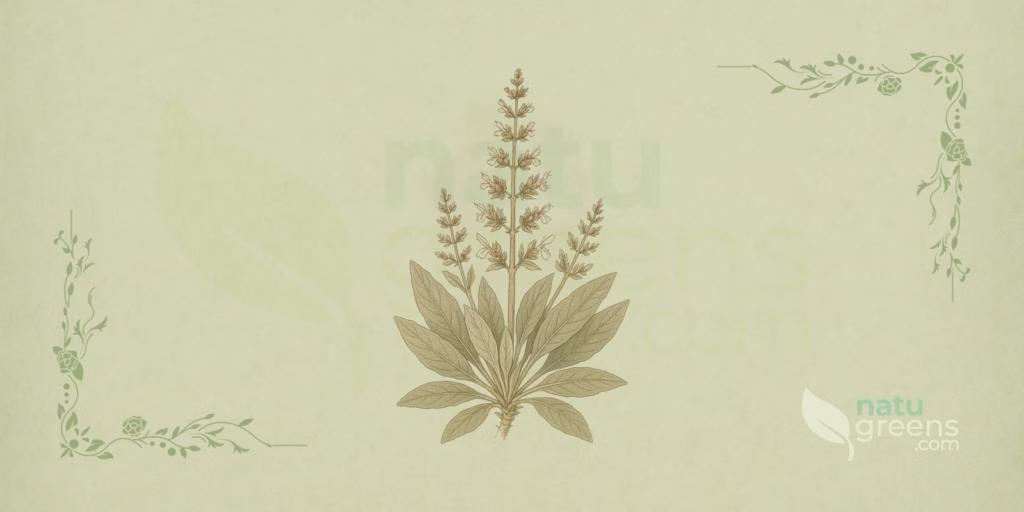
Common sage, Salvia officinalis L., is a perennial subshrub of grey, felted foliage and camphoraceous scent that belongs to the Lamiaceae, the same family as mint, oregano and rosemary. The species grows spontaneously on the stony limestone slopes of southern Europe, from south-western Germany down to the Balkan peninsula, and it has kept company with Mediterranean agriculture for so long that wild and cultivated populations blend into one another across much of its native range.
Salvia is the largest genus in the whole family, with roughly nine hundred to a thousand accepted species and three independent centres of diversification: the Mediterranean basin and western Asia, the Americas, and eastern Asia. Within that vast assemblage, S. officinalis stands out less for floral display than for texture. Its thick, wrinkled leaves, covered in white hairs, give the plant a silvery cast that makes it recognisable well outside the flowering season, while the woody base supports clumps that persist in the same spot for several years.
This profile gathers what the botanical literature records about the species: nomenclature confirmed against primary databases, detailed morphology, natural range, current agronomic practice, phenology, the close relatives that cause identification problems, and the cultural history of the plant in Europe.
Taxonomy
The placement of Salvia officinalis in modern classification systems is stable and raises no controversy at species level. The name was validly published by Linnaeus in 1753 and has been accepted ever since.
- Kingdom: Plantae
- Division: Magnoliophyta (angiosperms)
- Class: Magnoliopsida (eudicots)
- Order: Lamiales
- Family: Lamiaceae Martinov
- Subfamily: Nepetoideae
- Tribe: Mentheae
- Genus: Salvia L.
- Species: Salvia officinalis L., 1753
The protologue appears in Species Plantarum, volume 1, page 23, published on 1 May 1753. The corresponding record in the International Plant Names Index carries the identifier 456833-1, and Plants of the World Online keeps the binomial as an accepted name.
Synonyms
Synonymy at species level is short, which reflects how settled the taxonomic concept is. The heterotypic synonyms listed in the Kew databases include:
- Salvia chromatica Hoffmanns.
- Salvia grandiflora Ten.
- Salvia papillosa Hoffmanns.
A far larger set of infraspecific names, mostly varieties and forms described during the nineteenth century, has been reduced to synonymy over time. At subspecies rank, Plants of the World Online recognises four accepted taxa: S. officinalis subsp. gallica (W.Lippert) Reales, D.Rivera & Obón, S. officinalis subsp. lavandulifolia (Vahl) Gams, S. officinalis subsp. officinalis and S. officinalis subsp. oxyodon (Webb & Heldr.) Reales, D.Rivera & Obón. That broad circumscription is not universally accepted: much of the Iberian literature and most of the essential-oil bibliography still treat Salvia lavandulifolia Vahl as a species in its own right, and the reader will meet both usages in equally reliable sources.
Etymology
The generic name Salvia comes from the Latin salvus, whole or sound, through the verbal root of salvare. The epithet officinalis describes not the plant but the place where it was kept: the officina was the room in a medieval monastery where dried herbs and household preparations were stored, and in Linnaean nomenclature the adjective came to mark the species held in those stores. English vernacular names on record include common sage, culinary sage, Dalmatian sage and garden sage.
Morphological Description
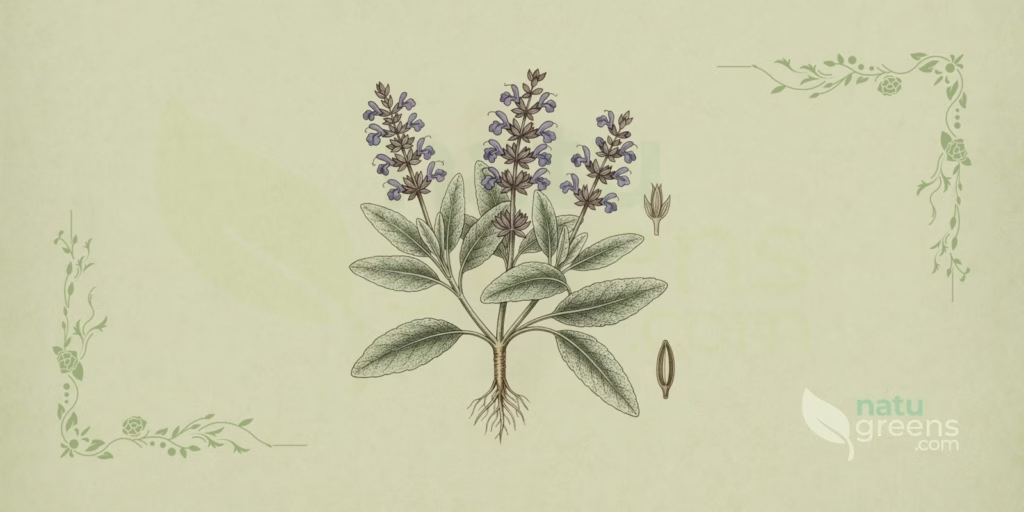
A low perennial subshrub, 30 to 70 centimetres tall in most populations and occasionally reaching 90 centimetres where conditions are especially favourable. The base is frankly woody and persists through winter, while the shoots of the current year stay herbaceous to semi-woody. Growth is sympodial and branching starts close to the ground, which produces dense rounded clumps roughly as wide as they are tall. Useful longevity in cultivation runs to some four to six years, after which the proportion of unproductive woody tissue increases and the clump opens up in the middle.
Leaves
The leaves are simple, opposite and decussate, each pair set at right angles to the one below. The blade is oblong-lanceolate to ovate-lanceolate, 4 to 8 centimetres long by 1 to 2 centimetres wide, with a rounded or slightly cordate base and a blunt apex. The margin is finely crenulate, the teeth rounded and barely prominent. The texture is thick and almost leathery, and the surface carries a distinctive relief: the reticulate venation stands proud on the abaxial face and sinks on the adaxial one, giving the bullate quality that the fingers pick up at once. Both faces are densely pubescent, with branched covering trichomes that lend the leaf its grey-green to silvery colour, strongest beneath. The petiole measures 1 to 3 centimetres and is equally hairy. Peltate glandular trichomes, visible under a hand lens, sit in the hollows between the veins and release the balsamic scent at the slightest friction.
Flowers
The inflorescence is an elongated terminal thyrse made up of verticillasters of four to eight flowers spaced at regular intervals along the axis. Each flower has a tubular-campanulate calyx, two-lipped, persistent and hairy, and a two-lipped corolla 2 to 3 centimetres long, blue-violet in the typical form, with pink and white variants among cultivars and wild populations. The upper lip is hooded and shelters the reproductive organs; the lower is three-lobed, its enlarged middle lobe working as a landing platform. The androecium bears only two fertile stamens, a reduction characteristic of the genus, mounted on an elongated hinged connective that forms the so-called lever mechanism: when a visitor pushes the lower sterile arm aside to reach the nectar, the upper arm swings down and presses the anther sacs against the insect’s back. The style is long, forked at the tip and projects beyond the corolla.
Fruits and Seeds
The fruit is schizocarpic and breaks at maturity into four nutlets, or mericarps, lodged at the bottom of the persistent calyx. Each nutlet measures 2 to 3 millimetres, is ovoid to subglobose in outline, smooth-surfaced and dark brown to almost black. Viable seed set is irregular in clonal plantings and more consistent in wild populations, where cross-pollination is frequent. Germination under controlled conditions takes fourteen to twenty-one days, at rates that vary considerably with the provenance of the batch.
Root and Stem
The stem is square in section, a constant feature of the Lamiaceae, and is clothed in dense whitish pubescence on the young shoots. The base lignifies over time, the bark turning greyish brown and peeling away in thin strips. Branching starts at the nodes, always in opposite pairs. The root system is taprooted in seedlings and becomes fibrous and laterally spreading in the adult plant, concentrated between 30 and 60 centimetres deep. Low branches that touch the soil put out adventitious roots readily, a trait that makes layering a practical means of propagation.
Distribution and Habitat of Common Sage
According to Plants of the World Online, the native range of Salvia officinalis runs from south-western Germany to southern Europe and takes in Albania, France, Greece, Italy, Spain, Switzerland and the north-western Balkan peninsula. Wild abundance peaks along the karst coasts of the eastern Adriatic, above all in Albania, Bosnia and Herzegovina, Croatia and Montenegro, where the species forms continuous patches on exposed slopes.
The typical habitat is open garrigue scrub and rocky grassland over limestone and dolomite, on shallow, alkaline, stony soils that drain fast. The species occurs from sea level to around 1,500 metres, with a marked preference for sunny aspects. The climate that suits it is the classic Mediterranean regime of hot dry summers, mild winters and annual rainfall between 500 and 900 millimetres. Established plants tolerate temperatures down to roughly 15 degrees Celsius below zero while dormant, but they will not put up with waterlogging, and excess moisture at the root is the leading cause of death outside the native range.
Beyond the Mediterranean, the species has been carried as a garden plant across temperate Europe, North America, Oceania and South America. Naturalisation is local and confined to ruderal ground, dry banks and field margins in regions with a compatible climate, and no invasive behaviour has been documented in any of those areas. In Brazil the plant arrived with Portuguese settlement and established itself as a dooryard crop in the milder parts of the South and Southeast, particularly the Serra Gaúcha, southern Minas Gerais and the hill country of São Paulo, without escaping consistently into native vegetation.
Cultivation
Commercial propagation rests mainly on cuttings, because seed produces offspring that vary in habit, leaf colour and essential-oil composition. Semi-ripe cuttings 8 to 12 centimetres long, taken in late spring and held in a light medium under intermittent mist, root in thirty to forty-five days. Division of the clump in late winter and layering of low branches serve on a smaller scale. Sowing remains in use where variability is wanted, or where the cost of vegetative material is prohibitive.
Full sun is non-negotiable: partial shade lengthens the internodes, thins out the glandular trichomes and cuts the essential-oil content. The ideal soil is light, calcareous to neutral, with a pH between 6.5 and 8.0 and free drainage; compacted clay calls for raised beds. Feeding should be restrained, since excess nitrogen drives soft, watery growth and impoverishes the aromatic profile. Irrigation is limited to prolonged dry spells, and a mulch of crushed stone or straw helps keep the surface dry and warm. Field spacing usually falls between 0.5 and 0.8 metres in the row and 0.8 to 1.2 metres between rows.
The commonest phytosanitary problems are aphids on the spring flush, powdery mildew caused by Erysiphe species, scale insects on the lignified stems and two-spotted spider mite in hot dry weather. The most destructive disease is the root rot associated with poorly drained soil, which tends to kill the whole clump within a few weeks. Leaf is harvested before anthesis, when essential-oil concentration peaks, cutting the stems 10 to 15 centimetres above the ground; two or three harvests a year are possible in favourable climates. Drying is done in the shade, in a well-ventilated space, over seven to fourteen days, until moisture content falls below 12 per cent. Average yields run between 3 and 8 tonnes of green mass per hectare per year, peaking in the second to fourth year, with replanting recommended every four to six cycles.
Phenology
In the northern hemisphere flowering runs from May to July, a few weeks earlier in the coastal Adriatic populations and correspondingly later at higher elevations. In the growing areas of southern and southeastern Brazil the same phenological window shifts to the stretch between September and December. Fruit matures four to six weeks after anthesis, and the dry calyx holds the nutlets for weeks before shedding them.
Pollination is entomophilous and depends above all on long-tongued bees, notably bumblebees of the genus Bombus and bees of the genus Anthophora. The staminal lever is the pivot of the whole system: it conditions the deposit of pollen on the visitor’s back and favours transfer between flowers of the same species. Protandry is common, with pollen released before the stigma matures in the same flower, which reduces self-fertilisation without ruling it out. Honeybees also work the flowers, and the species has a recognised value for beekeeping in the extensive growing regions of the Balkans.
Dispersal is passive. The nutlets bear no appendages, arils or flotation structures and fall by gravity a short distance from the parent plant; secondary transport happens through surface runoff on the slopes and, incidentally, through trampling by grazing livestock. That pattern explains the dense, sharply bounded patches in which wild populations occur.
Related Species and Confusions
In a genus of roughly a thousand species, identifying S. officinalis comes down to a small set of characters: a subshrub woody at the base, entire oblong-lanceolate bullate leaves, a dense ash-grey tomentum and a persistent two-lipped calyx. The relatives most often confused with it are:
- Salvia fruticosa Mill.: Greek sage frequently has trilobed leaves with a pair of smaller basal lobes, a taller and more branched habit, and an essential oil dominated by 1,8-cineole rather than thujone. It is the commonest commercial substitute in the dried-leaf trade of the eastern Mediterranean.
- Salvia lavandulifolia Vahl: treated by Kew as a subspecies of S. officinalis, it is distinguished by much narrower, almost linear leaves with revolute margins and a very dense white tomentum. It occurs in the Iberian peninsula and southern France.
- Salvia pratensis L.: herbaceous, with no woody base, a basal rosette of large leaves and a slender inflorescence. It grows in European meadows and never forms a shrubby clump.
- Salvia rosmarinus Spenn.: rosemary, transferred to Salvia in 2017, has linear leathery leaves with strongly revolute margins and a white underside. The confusion here is purely nomenclatural, never visual.
- Salvia sclarea L.: a robust biennial up to 1.2 metres, with much larger basal leaves and broad, brightly coloured floral bracts that dominate the inflorescence.
- Salvia tomentosa Mill.: very close morphologically, with larger leaves, an even thicker tomentum and a wider calyx. Telling the two apart reliably in dried material usually calls for examination of the calyx and of the volatile profile.
No species in the genus acts as a lethal look-alike for S. officinalis, and there is no record of confusion with toxic plants from other families. The documented risk is of another order: substitution of raw material in the dried-leaf trade, chiefly by S. fruticosa and S. tomentosa, which substantially alters the essential-oil composition of a given lot. It is worth adding that Salvia divinorum Epling & Játiva, endemic to Oaxaca, accumulates salvinorin A, a psychoactive diterpene, and is a plant whose cultivation and trade are controlled in a number of countries; it bears no morphological resemblance to common sage, but the shared vernacular name causes confusion in widely circulated texts.
Phytochemistry
The leaves of Salvia officinalis accumulate 1 to 2.5 per cent essential oil on a dry-weight basis, stored in peltate glandular trichomes spread over the epidermis of both faces. The content varies with phenological stage and reaches its maximum shortly before the flowers open, then declines through fruiting.
The volatile fraction is dominated by monoterpenes. Alpha-thujone is usually the major component, at levels the literature records between roughly 18 and 43 per cent depending on chemotype, geographic origin and harvest date; alongside it come beta-thujone, borneol, camphor, 1,8-cineole, alpha-pinene, beta-pinene and beta-caryophyllene, the last of these already in the sesquiterpene fraction. The thujones are neurotoxic ketonic monoterpenes, and ingestion of the pure essential oil causes seizures; for that reason European flavouring legislation sets maximum thujone limits in food and drink. Whole and dried leaf, by contrast, appears on the ASPCA list of plants that are non-toxic to cats and dogs, unlike the concentrated essential oil.
Three groups dominate the non-volatile fraction. The abietane-type phenolic diterpenes, among them carnosic acid, carnosol and rosmanol, concentrate in the leaves and are shared with rosemary. The pentacyclic triterpenes, chiefly oleanolic and ursolic acids, occur at higher density in the leaf cuticle. The soluble phenolics include caffeic acid, rosmarinic acid, which commonly accounts for 2 to 5 per cent of the dried leaf, and flavones such as apigenin and luteolin, present both free and as glycosides. Tannins occur at 4 to 8 per cent. Roots and lignified stems show a far poorer volatile profile than the leaves, and the flowers accumulate a composition qualitatively similar to the foliar one, though at lower concentration.
History and Ethnobotany
The written record of sage runs alongside the history of Western botany itself, although identifying the species of antiquity calls for caution. Theophrastus in the fourth century before the common era and Dioscorides in the first century described Mediterranean sages under the Greek name elelisphakos, which modern scholarship identifies chiefly with Salvia fruticosa, a far commoner plant in Greece than common sage. It was Pliny the Elder who recorded the plant in his Natural History under the Latin name salvia, and it was by that route that the designation reached the Romance languages.
In medieval Europe the species held a central place in monastery gardens. The Capitulare de Villis, a set of agricultural ordinances attributed to the Carolingian administration of the ninth century, listed sage among the species to be planted on the royal estates, which helps to explain its spread well beyond the original Mediterranean climate. The Schola Medica Salernitana, active from the eleventh century onwards, popularised the line “Cur moriatur homo cui salvia crescit in horto?”, which asks why a man should die who has sage growing in his garden, and the verse circulated for centuries in European compilations.
European apothecaries and herbalists of the sixteenth to nineteenth centuries recorded dried sage leaf in their pharmacopoeias in connection with complaints of the mouth and the throat, and the herbals of the period describe those entries at length. Rural communities in the Balkans burned dried stems to fumigate rooms and storehouses, and sheep farmers in Dalmatia linked grazing on sage-covered slopes to the quality of the milk and cheese made in the region, an association that survives in local lore. From the eighteenth century the plant established itself in European cooking, above all Italian and British, as a flavouring for meats, sausages and stuffings, and it was in that culinary role that it reached Brazil with the Portuguese colonists.
International trade in the dried leaf consolidated during the twentieth century around the Balkans. Albania became one of the largest suppliers in the world, with much of its volume still gathered from wild populations, while Bulgaria, Croatia and Turkey built supply chains of their own aimed at the European market.
Conservation
As of the date of this profile, no global assessment of Salvia officinalis has been published on the Red List of the International Union for Conservation of Nature, so the species should be treated as not evaluated at world scale. That absence does not signal risk: cultivation is widespread across three continents, the natural range is extensive, and no European regional flora records a general decline.
The documented pressures are local. Intensive wild collection for export affects populations in Albania, Bosnia and Herzegovina, Croatia and Montenegro, and it prompted sustainable-collection certification schemes and community management plans in parts of those areas. The abandonment of traditional grazing on the karst slopes of the Adriatic favours succession towards closed scrub and reduces the open habitat the species depends on, a process the literature on Mediterranean vegetation records in several regions. A third concern is genetic erosion: commercial propagation by cuttings works with a small number of clones, which narrows the genetic base available for breeding.
The species appears in none of the appendices of the Convention on International Trade in Endangered Species of Wild Fauna and Flora, and its export is not subject to control under that instrument.
Interesting Facts
- The staminal lever of Salvia flowers is one of the most closely studied pollination mechanisms among the angiosperms, and the variation in lever-arm length between species is tied to the size of the pollinator each one recruits.
- The molecular reclassification published in 2017 showed that Perovskia, Rosmarinus and other small genera were nested within Salvia; the most visible consequence was the transfer of rosemary, which became Salvia rosmarinus Spenn.
- The adjective officinalis, present in dozens of Linnaean binomials, describes no feature of the plant at all: it merely indicates that the species was held in the stock of the officina, the herb store of medieval monasteries.
- Several ornamental cultivars with variegated foliage, among them Berggarten, Icterina, Purpurascens and Tricolor, have received the Award of Garden Merit from the British Royal Horticultural Society, a distinction given to plants that perform consistently in the garden.
- Albania ranks among the largest exporters of dried sage leaf in the world, and much of that volume still comes from wild-gathered stands rather than planted fields.
Notice: this content is for informational purposes and does not replace professional medical advice. Consult a physician or herbal practitioner before using medicinal plants, especially during pregnancy, breastfeeding, or alongside medication.
References and Scientific Studies
View All 9 Cited References
Peer-Reviewed Scientific Studies (3)
- PEER American Society for the Prevention of Cruelty to Animals (ASPCA). Toxic and Non-Toxic Plants: Sage (Salvia officinalis). ↗
- DOI2017 Drew, B. T., González-Gallegos, J. G., Xiang, C.-L., Kriebel, R., Drummond, C. P., Walker, J. B., Sytsma, K. J. Salvia united: the greatest good for the greatest number. Taxon, 66(1), 133-145. 2017. ↗
- DOI2017 Will, M., Claßen-Bockhoff, R. Time to split Salvia s.l. (Lamiaceae): new insights from Old World Salvia phylogeny. Molecular Phylogenetics and Evolution, 109, 33-58. 2017. ↗
Supplementary Readings (6)
- Euro+Med PlantBase. Salvia officinalis L. Botanic Garden and Botanical Museum Berlin. ↗
- 2008 European Union. Regulation (EC) No 1334/2008 of the European Parliament and of the Council on flavourings, Annex III: maximum levels of thujone (alpha and beta) in foods and beverages. Official Journal of the European Union. 2008.
- 1972 Hedge, I. C. Salvia L. In: Tutin, T. G. et al. (eds.) Flora Europaea, vol. 3. Cambridge University Press. 1972.
- International Plant Names Index (IPNI). Salvia officinalis L., Sp. Pl. 1: 23. 1753. Identifier 456833-1. Royal Botanic Gardens Kew, Harvard University Herbaria and Australian National Herbarium. ↗
- Linnaeus, C. Species Plantarum, vol. 1, p. 23. Stockholm: Laurentius Salvius. 1753. ↗
- Plants of the World Online (POWO). Salvia officinalis L. Royal Botanic Gardens, Kew. ↗