Viscum album is a hemiparasitic subshrub of the family Santalaceae that spends its entire life anchored to the branches of woody trees, never once touching the ground. It occupies a broad band of the Old World, from Ireland to Nepal, and is by some distance the most thoroughly studied mistletoe on the planet. English speakers know it as European mistletoe or common mistletoe, and the epithet album points straight at the translucent berries that ripen in the depths of a European winter.
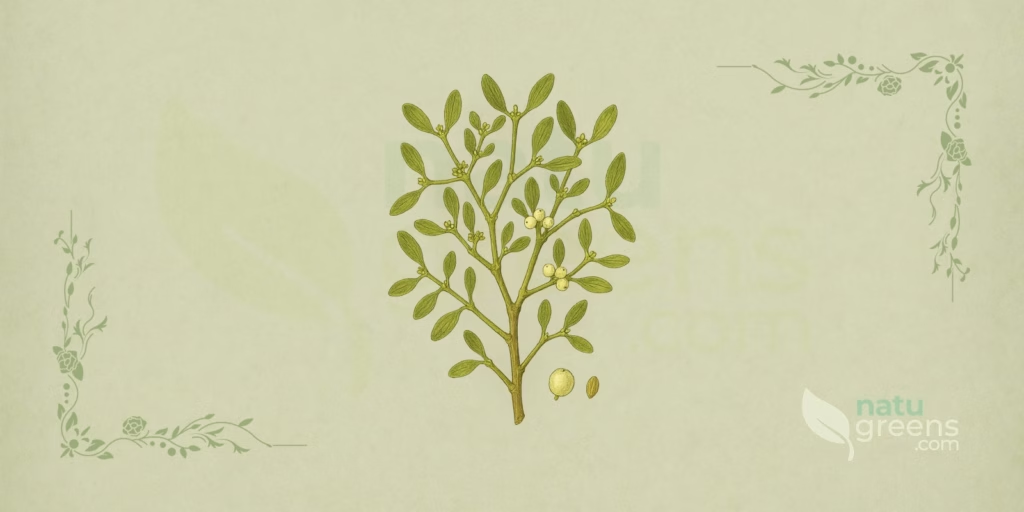
What makes it recognizable from a distance is its architecture. Every branch forks into two, always within the same plane of symmetry, and decades of that repeated pattern produce a compact green sphere suspended in the canopy. When deciduous trees drop their leaves, these balls stand exposed against the December sky and reveal at a glance how many separate plants a single apple tree or poplar can harbor. Counting dozens on one mature tree is not unusual.
The plant is a hemiparasite, and the distinction matters. It keeps its chlorophyll and photosynthesizes for itself, but depends entirely on its host for water and mineral salts, which it draws from the xylem through a system of internal connections. This profile describes the species from a botanical standpoint: taxonomy, morphology, parasitic biology, distribution, phenology, chemistry, and conservation.
European-mistletoe never touches the ground, spending its entire life anchored to the branches of woody trees.
European-mistletoe occupies a broad band of the Old World, from Ireland to Nepal, and English speakers also call it common mistletoe.
Taxonomy
The name Viscum album was published by Carl Linnaeus in 1753, in the second volume of Species Plantarum, and remains accepted without controversy. Instability has never touched the binomial; it has always been a matter of the family. Twentieth-century treatments placed the species in Loranthaceae and later in Viscaceae, while the APG IV classification, followed today by Plants of the World Online and World Flora Online, folds it into Santalaceae. The International Plant Names Index still records the family of original publication in a field of its own, which explains the discrepancy anyone will run into when comparing databases.
- Kingdom: Plantae
- Division: Tracheophyta (vascular plants)
- Class: Magnoliopsida (eudicots)
- Order: Santalales
- Family: Santalaceae (sensu APG IV; Viscaceae in earlier treatments)
- Genus: Viscum L.
- Species: Viscum album L. (1753), Species Plantarum 2: 1023
Synonyms and Infraspecific Taxa
The synonymy is lean for a plant with such a long history in the literature. Among the names now reduced to synonyms are Stelin album (L.) Bubani, Viscum laxum Boiss. & Reut., Viscum polycoccon Houtt., and Viscum stellatum Buch.-Ham. ex D.Don. The case of Viscum laxum deserves a footnote, since a number of European authors prefer to treat it as a subspecies in its own right rather than a straight synonym.
Internal variation, on the other hand, is substantial, and the criterion that organizes it is the host. Five subspecies are recognized in current treatments:
- Viscum album subsp. abietis (Wiesb.) Abrom., confined to firs of the genus Abies, across central and southern Europe as far as Turkey
- Viscum album subsp. album, the nominate form, which parasitizes a wide range of broadleaved trees
- Viscum album subsp. austriacum (Wiesb. ex Dichtl) Vollm., associated with Pinus and Picea, with berries of a yellowish cast
- Viscum album subsp. creticum N.Böhling, Greuter, Raus, B.Snogerup, Snogerup & Zuber, described in 2002 and endemic to Crete, on Aleppo pine
- Viscum album subsp. meridianum (Danser) D.G.Long, of Himalayan and Southeast Asian distribution
Etymology
Viscum is the classical Latin name for both the plant and the sticky glue extracted from its berries, and it passed into the Romance languages along two paths, naming the plant in some and any adhesive substance in others. English took a different route entirely: “mistletoe” descends from Old English mistiltan, a compound whose first element is generally read as a reference to bird droppings, in a nod to how the seeds arrive on a branch. The epithet album means white and refers to the ripe berries of the nominate subspecies, translucent and pearly.
Morphological Description
A perennial, dioecious, evergreen subshrub that forms dense, roughly spherical clumps 20 to 100 centimeters across, exceptionally up to 150. The plant has no trunk and no base in the soil: the entire aerial structure grows from a single point of attachment on the host’s bark. Well-established individuals can spend more than thirty years on the same tree, and their lifespan usually ends along with that of the branch holding them up.
Leaves
The leaves are opposite, leathery, and a dull yellowish green, with a waxy look that grows more pronounced toward the end of winter. They measure 2 to 8 centimeters long by 0.8 to 2.5 wide, oblanceolate to spatulate in outline, with a rounded tip and a base that tapers gradually into a very short or almost absent petiole. The margin is entire. The oddest feature is the venation: three to five longitudinal veins run parallel from petiole to tip, without the network of secondary veins one expects of a eudicot, and the result looks at first glance like the leaf of a monocot. Each leaf persists for two to four seasons before falling, which means the plant is never bare.
Flowers
Male and female plants are separate, and the flowers of both sexes are small, sessile, and yellowish green, 2 to 4 millimeters across. They appear in groups of three to five in the forks of the branches, which helps in locating them once you know where to look. Male flowers show four fleshy tepals with the stamens fused to the inner face, without any distinct filament, and release pollen in slightly sticky masses. Female flowers are more discreet still, with an inferior ovary and a sessile stigma, and go unnoticed until the fruit begins to swell. Neither sex produces a showy corolla, and the scent is faint but detectable up close.
Fruits and Seeds
The fruit is a globose pseudoberry 6 to 10 millimeters across, white and translucent in the nominate subspecies, yellowish in austriacum. Its pulp is the centerpiece of the species’ biology: it contains viscin, a mixture of polysaccharides and fatty acids that draws out into elastic threads when pulled and hardens on contact with air, gluing the seed to whatever bark it lands on. Each fruit generally holds one seed, occasionally two or three, green and photosynthetically active even before it germinates, with no hardened seed coat and no dormant period whatsoever. That absence of dormancy is a constraint: the seed has to find a suitable branch within a few weeks or it dies.
Stems and Haustorial System
The stems are cylindrical, jointed at the nodes and brittle when dry, yellowish green while young and grayish with age. The regular dichotomous branching, in which each axis produces two equivalent shoots, is what generates the spherical form of the clump and makes it possible to estimate the plant’s age by counting successive forks, one per year in most cases.
Beneath the bark the architecture is another matter entirely. The seed germinates on the branch and puts out a hypocotyl that flattens into a holdfast disc, and from that disc a wedge drives through the bark to the host’s cambium. From there the mistletoe sends out cortical strands that run lengthwise inside the bark, advancing roughly half a centimeter to a centimeter per year, and from these strands descend the so-called sinkers, peg-shaped inclusions that are progressively engulfed by the host’s new wood as the branch thickens. The whole assembly draws water and minerals from the xylem and has no demonstrated connection to the phloem, which is why the plant has to keep photosynthesizing on its own account.
Distribution and Habitat
The native range is Palearctic and runs from Europe to Lebanon and Nepal, with a disjunct population in northeastern Algeria. In Europe the species is common from southern Scandinavia to the Mediterranean, most abundant across the central and western belt of the continent, particularly in Austria, France, Germany, and Switzerland. In Britain the historical concentration lies in the counties of western England, in apple orchards. Eastward the native range crosses the Caucasus, Iran, and the Himalaya to southern China, Myanmar, and Vietnam, where the eastern subspecies take over.
The typical habitat is not a vegetation type but a position: open, well-lit crowns of deciduous trees or conifers, preferably on branches 2 to 10 centimeters thick. Orchards, avenues, street trees, roadsides, and woodland edges hold far more mistletoe than the shaded interior of closed forest, because germination demands direct light and the dispersing birds perch on exposed limbs. The species tolerates winter cold well but retreats from very dry summers and from severe late frosts at the seedling stage. It grows from sea level to about 1,300 meters in the nominate form, and higher in the conifer subspecies, which reach 2,000 meters in the Alps.
Outside its native range, the best-documented naturalization is in Sonoma County, California, where the species was deliberately introduced in the early twentieth century and has persisted ever since as a local population, without spreading aggressively. There is no record of spontaneous occurrence in Brazil or anywhere in South America, where the ecological role of canopy hemiparasite falls to genera in the family Loranthaceae. In Europe itself the recent trend is expansion: surveys in several countries record rising frequency and an advance in altitude since the 1980s, a pattern the literature links to milder winters and to the aging of urban tree stock and orchards.
Cultivation
Growing mistletoe means, in practice, planting it on a tree. Propagation is by direct inoculation: fully ripe berries are collected at the end of winter, between January and April in the northern hemisphere, and the seeds are pressed against the smooth bark of young branches on the chosen host, preferably on the underside, where they are less exposed to rain and to bird predation. The viscin does the work of an adhesive with no need for tying. Stored seed loses viability quickly, and material from previous years rarely germinates.
The choice of host determines almost everything that follows. Apple trees, and cultivars of Malus domestica in particular, are the most receptive, followed by limes, poplars, rowans, and willows. Oaks take inoculation poorly. Lineage matters too: seed taken from plants growing on pine will hardly ever establish on apple, and the reverse holds as well, because the subspecies are physiologically specialized. The success rate is low even under ideal conditions, on the order of 5 to 20 percent of attempts, which argues for inoculating many seeds to obtain a few plants.
Once attached, the wait is a long one. The first true leaves appear one to two years after germination and the first flowering usually comes between the fourth and sixth year. Harvesting shoots, where it is practiced, is done in winter and works like pruning: cutting above the point of attachment encourages regrowth, whereas removing the base kills the plant. Dedicated pests are few, the most specific being the psyllid Cacopsylla visci, which sucks sap from the leaves. Among fungi, Phaeobotryosphaeria visci turns up regularly on old clumps, causing shoot necrosis. The greatest source of loss, though, remains mechanical removal by orchard owners.
Phenology
The species’ calendar is inverted relative to that of most European plants, and it is precisely that inversion that sustains its cycle. Flowering falls in late winter and early spring, between February and April, when the host trees are still leafless and competition for pollinators is minimal. Pollination is carried out mainly by flies and small hymenopterans that take wing on the mild days of that season, with a secondary contribution from the wind.
The fruits take about nine months to ripen and are ready between November and February, at the peak of winter food scarcity. Dispersal is ornithochorous and depends on a small cast of birds, each with a method of its own. The mistle thrush, Turdus viscivorus, swallows the berries whole and voids the seeds still wrapped in pulp some distance away, capable of carrying them several kilometers. The Eurasian blackcap, Sylvia atricapilla, takes another approach: it eats only the outer part of the fruit and cleans its bill by wiping the seed on the branch it is perched on, which deposits the propagule exactly where it stands a chance. The Bohemian waxwing, Bombycilla garrulus, behaves like the thrush and swallows the fruits whole, reinforcing long-distance dispersal in the winters when it irrupts into the south of the continent. Germination follows in the weeks after, or in the spring immediately following, with no passage through a seed bank.
Related Species and Confusions
The genus Viscum brings together about a hundred species spread across Africa, Asia, Europe, and Oceania, and several other canopy plants from unrelated families go by the name mistletoe in everyday speech. The most frequent confusions involve the taxa below.
- Loranthus europaeus Jacq., of the family Loranthaceae, grows on oaks in central and eastern Europe. It is easy to tell apart, since it sheds its leaves in winter, unlike European mistletoe, and produces yellow-orange berries
- Phoradendron leucarpum (Raf.) Reveal & M.C.Johnst. is the North American mistletoe, similar from a distance but with broader, rounder leaves, less strictly dichotomous branching, and berries clustered in larger numbers
- Struthanthus and Psittacanthus, among other Loranthaceae genera, are the Brazilian mistletoes known locally as ervas-de-passarinho. They have larger leaves, showy tubular flowers, and none of the compact spherical symmetry of the European plant
- Viscum coloratum (Kom.) Nakai replaces the species in the far east of Asia, in China, Japan, and Korea, and is set apart by its yellow to orange berries
- Viscum cruciatum Sieber ex Boiss. occurs in the southern Iberian Peninsula and North Africa and is unmistakable for its red berries
In the field, the combination that identifies Viscum album with confidence is evergreen leathery leaves with parallel venation, dichotomous branching that yields a spherical clump, white berries with viscous pulp, and total absence of contact with the ground.
European-Mistletoe Phytochemistry
The chemical profile of the species is complex and, unusually, varies with the tree the plant happens to be growing on. Samples of the same subspecies collected from apple, poplar, and pine show different proportions of the same groups of compounds, and the season of collection adds another layer of variation, with concentrations that swing between summer and winter.
Four groups characterize the plant. The viscotoxins are small polypeptides of about 46 amino acids, rich in disulfide bridges and concentrated in the leaves and young stems. The mistletoe lectins, designated ML-I, ML-II, and ML-III, are glycoproteins that bind galactose and N-acetylgalactosamine, structurally of the ribosome-inactivating type, and reach their highest concentration in lignified stems. The flavonoids include isorhamnetin, quercetin, and kaempferol derivatives, many of them in glycosylated forms peculiar to the genus. The pentacyclic triterpenes, among them betulinic acid, lupeol, and oleanolic acid, are distributed through the waxy cuticle of the leaves. The pulp of the berries concentrates viscin, chemically distinct from the rest and made up of long-chain polysaccharides associated with fatty acids.
The entire plant is toxic. Leaves, stems, and berries contain viscotoxins and lectins in quantities sufficient to cause poisoning, and the white berries are particularly attractive to small children during the season when the plant decorates European interiors in winter. Ingestion causes gastrointestinal irritation with nausea and vomiting and, in larger quantities, cardiovascular effects that include a drop in blood pressure and disturbance of heart rhythm. The species is equally toxic to cats, dogs, and horses, and veterinary poison information centers rank it as the most dangerous of the ornamental plants of the year-end season. Drying does not neutralize the toxicity.
History and Ethnobotany
Mistletoe has one of the oldest written records of any plant in the European flora. Pliny the Elder devoted passages of the Naturalis Historia, in the first century, to the ritual harvest carried out by Gaulish druids on oaks, described as taking place with a golden sickle on the sixth day of the moon and accompanied by sacrifice. The account is Roman, written from the outside and with an ethnographic purpose, and it is the source of nearly all the Celtic imagery attached to the plant ever since. The genuine rarity of mistletoe on oak, now quantified at well under one percent of occurrences, helps explain why such a find was treated as exceptional.
Norse mythology gave it an equally central role. In the Icelandic Eddas, recorded in the thirteenth century, it is a dart of mistletoe that kills Baldr, son of Odin, because it was the one living thing that had not sworn to spare him. Medieval Scandinavia is also the source of the custom of hanging boughs as a sign of truce, under which no fighting took place.
Eighteenth-century England consolidated the domestic tradition that is now better known than the plant itself, with sprigs hung in doorways over the year-end holidays and the kissing custom attached to them. The practice spread through the English-speaking world in the nineteenth century and reached Brazil as a cultural import, without any local root, since the species does not occur there. Among European country people, nineteenth-century records also document the use of viscin from the berries to make birdlime for trapping, a practice now banned across most of the continent.
From the standpoint of the history of science, the species occupied naturalists for generations. Augustin Pyramus de Candolle was among the first, in the 1810s, to give a systematic description of the host relationship, and the experimental demonstration that the plant draws water and minerals from another plant’s xylem while maintaining photosynthesis of its own was consolidated by German researchers over the course of the nineteenth century. In the twentieth, in 1920, Rudolf Steiner and Ita Wegman introduced preparations of the plant into the repertoire of anthroposophic medicine, an episode that matters here only as a historical marker and as the origin of the commercial demand that still sustains the regulated harvest of the species in central Europe.
Conservation
Viscum album does not appear as assessed on the global Red List of the International Union for Conservation of Nature, which formally classifies it as not evaluated. The absence of an assessment does not stem from a lack of data but from the fact that the species is abundant and very widely distributed, a condition that tends to keep it outside screening priorities. European national red lists treat it as of no concern, and several regional surveys record increasing abundance over recent decades.
The pressure that does exist runs in the opposite direction to the usual conservation profile. In commercial orchards and in urban tree stock across parts of central Europe, dense infestations reduce the vigor and productivity of host trees, and the species is managed as a pest, with systematic removal of clumps. Some jurisdictions regulate harvesting, not to protect the mistletoe but to prevent damage to the trees during extraction. Demand from the European herbal industry is met by licensed wild collection and by apple orchards inoculated specifically for the purpose. The species appears in no CITES appendix.
Where attention is warranted is on the side of the hosts and the dispersers. The loss of traditional standard orchards in England and France has reduced the plant’s classic habitat in some regions, while street planting has favored it in others, and the net result varies considerably with the scale of the survey.
Interesting Facts
- The scientific name of the plant’s chief disperser acknowledges the mutual dependence: Turdus viscivorus means, literally, mistletoe-eating thrush
- Mistletoe leaves have parallel veins, an arrangement typical of monocots, although the plant is a genuine eudicot. It is a classic case of convergence that catches students out in practical botany exams
- The Latin viscum named both the plant and the glue obtained from the pulp of its berries, and it survives in the Romance languages in words for anything sticky; the English name took the wholly separate Germanic route through Old English mistiltan
- Counting the successive forks of a shoot gives a good estimate of the age of a clump, since the plant normally produces one dichotomy per year
- Mistletoe on oak, celebrated as sacred in the accounts of the druids, is botanically very rare indeed. Host surveys across Europe find it in fewer than one percent of recorded occurrences
Notice: this content is for informational purposes and does not replace professional medical advice. Consult a physician or herbal practitioner before using medicinal plants, especially during pregnancy, breastfeeding, or alongside medication.
References and Scientific Studies
View All 8 Cited References
Peer-Reviewed Scientific Studies (4)
- DOI1998 Barney, C. W.; Hawksworth, F. G.; Geils, B. W. Hosts of Viscum album. European Journal of Forest Pathology, 28(3): 187-208. 1998. ↗
- PEER2022 The future of Viscum album L. in Europe will be shaped by temperature and host availability. Scientific Reports, 12: 18857. 2022. ↗
- DOI2023 Thomas, P. A. et al. Biological Flora of Britain and Ireland: Viscum album. Journal of Ecology, 111. 2023. ↗
- DOI2004 Zuber, D. Biological flora of Central Europe: Viscum album L. Flora, 199(3): 181-203. 2004. ↗
Supplementary Readings (4)
- International Plant Names Index. Viscum album L. Royal Botanic Gardens, Kew; Harvard University Herbaria; Australian National Botanic Gardens. ↗
- Linnaeus, C. Species Plantarum, vol. 2, p. 1023. Stockholm. 1753.
- Plants of the World Online. Viscum album L. Royal Botanic Gardens, Kew. ↗
- World Flora Online. Viscum album L. ↗