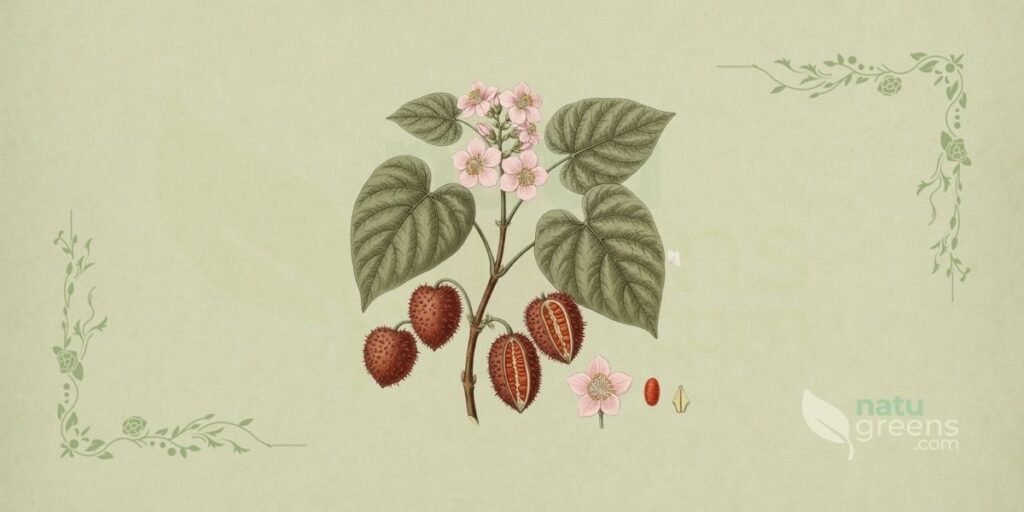
Cordia sinensis is a many-stemmed woody shrub, and at times a low tree reaching twelve metres, spread across the dry country that runs from the Sahel and the Horn of Africa to the Indian subcontinent. It belongs to the Boraginaceae, the same family as borage and comfrey, but within it the species sits in the subfamily Cordioideae, the tropical woody branch of the group. Anyone walking an ephemeral riverbed in Kenya, Somalia or Rajasthan picks the plant out from a distance by its rough greyish foliage and by the clusters of orange to red fruit hanging from its slender branches.
The scientific name plays a trick on whoever tries to infer the plant’s origin from the epithet. “Sinensis” means “of China”, a country where the species has never occurred naturally, and the mistake arose from the material Jean-Baptiste Lamarck examined at the end of the eighteenth century, labelled with that provenance. Because botanical nomenclature answers to priority rather than convenience, the geographical error has travelled with the species for more than two hundred years.
What follows gathers what the botanical literature records about the plant: formal classification and synonymy, characters for identification in the field, the ecology of arid environments, phenology, the chemistry described for it and its conservation status.
The grey-leaved-cordia belongs to the Boraginaceae, the same family as borage and comfrey, and sits within the woody tropical subfamily Cordioideae.
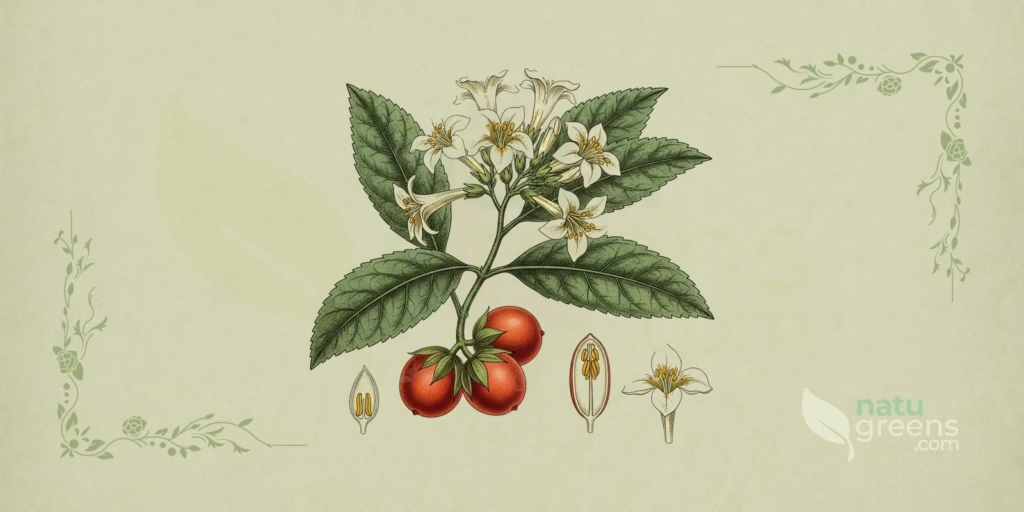
Across the dry country that runs from the Sahel and the Horn of Africa to the Indian subcontinent, grey-leaved-cordia is picked out along ephemeral riverbeds in Kenya, Somalia and Rajasthan.
Taxonomy
The accepted name is Cordia sinensis Lam., confirmed in the International Plant Names Index under record 114552-1 and treated as accepted by Plants of the World Online. The protologue appears in the first volume of the Tableau encyclopédique et méthodique, page 423, published in 1792. The classification below follows the circumscription adopted by Kew:
- Kingdom: Plantae
- Division: Streptophyta (angiosperms; Magnoliophyta in traditional nomenclature)
- Class: Equisetopsida (Magnoliopsida in older classifications)
- Subclass: Magnoliidae
- Order: Boraginales
- Family: Boraginaceae Juss.
- Subfamily: Cordioideae
- Genus: Cordia L.
- Species: Cordia sinensis Lam. (1792)
Synonyms
The species has piled up a long synonymy, the result of independent descriptions made at distant points of a range that crosses two continents. The names below are listed as synonyms in Plants of the World Online, with the homotypic ones marked:
- Cordia angustifolia Roxb.
- Cordia cuneata B.Heyne ex A.DC.
- Cordia gharaf Ehrenb. ex Asch.
- Cordia oblongifolia Hochst. ex A.DC.
- Cordia reticulata Roth
- Cordia rothii Roem. & Schult.
- Cordia senegalensis var. pelida DC.
- Cordia subopposita A.DC.
- Gerascanthus gharaf (Ehrenb. ex Asch.) Borhidi
- Gerascanthus sinensis (Lam.) Borhidi (homotypic)
- Lithocardium rothii (Roem. & Schult.) Kuntze
- Quarena sinensis (Lam.) Raf. (homotypic)
One correction deserves a note here, because secondary sources handle it badly: Cordia nevillii Alston is not a synonym of this species but a taxon of its own, described from Ceylon and recognised as its sister species in Warfa’s revision of 1990.
Etymology
The generic name honours Valerius Cordus, the German botanist and apothecary who lived between 1515 and 1544 and died at twenty-nine, leaving work enough for Linnaeus to dedicate a genus to him. The specific epithet derives from Late Latin sinensis, “of China”, and stands as evidence of a mistaken provenance recorded on the material Lamarck studied. IPNI itself keeps “China” as the origin note in the entry for the name, preserving the documentary trace of the error.
Morphological Description
Habit varies a great deal with the water on offer. In open stony bushland the plant behaves as a low dense shrub, tangled in the crown and branching from the base, while along riverbeds where the water table lies within reach of the roots it becomes a tree of three to twelve metres, with several trunks and slim branches that tend to droop. The whole plant reads as grey, an effect of the short hairs and the dry texture of the leaves, and it is that shade which gave the species its current English name.
Leaves
Leaf arrangement is inconsistent even on a single individual, opposite in places, subopposite in others, alternate elsewhere, a habit that once caused trouble in older identification keys. The blade is ovate to obovate and measures two to twelve centimetres long by one to four and a half centimetres wide, with an attenuate base and a rounded apex. The surface is glabrous or lightly pubescent and always rough to the touch, with the fine sandpaper feel that characterises much of the woody Boraginaceae. The petiole is about ten millimetres long and carries long pale hairs, a useful detail when the material is dry.
Flowers
The flowers gather in terminal cymes six to seven centimetres across, white or cream, with an urceolate corolla eight to nine millimetres long. The calyx lobes bear short soft hairs of a yellowish brown, and they darken as the flower goes over. Burkill recorded the sweet scent of the flowers in West African populations, a trait consistent with the insect pollination observed across the genus.
Fruits and Seeds
The fruit is a conical drupe that ripens from orange to bright red, measures seven to twenty millimetres and ends in a conspicuous drawn-out point. The fruits sit in clusters visible from a distance, which makes the plant unmistakable in the right season. The pulp is sweet and viscous, almost gummy, and surrounds one to four hard, wrinkled, cream-yellow seeds.
Root and Stem
The root system runs deep and draws water from sandy beds, a trait that explains the preference of the species for the margins of intermittent watercourses. Trunk bark is brown to creamy brown and splits lengthwise into a thin rhytidome, while on young branches it stays smooth and dark grey. The plant takes cutting well and coppices readily from the stump.
Grey-leaved-cordia Distribution and Habitat
The native range covers a continuous belt of seasonally dry land that Plants of the World Online sums up as running from Africa to the Indian subcontinent. In Africa the species reaches from Senegal, Mauritania and Cape Verde to Egypt, Sudan, Eritrea, Ethiopia, Somalia, Kenya and Tanzania, and follows the eastern dry corridor down into Mozambique, Zimbabwe, Namibia, Botswana and northern South Africa. It occurs in Madagascar and on Socotra as well. In Asia it extends to the Arabian Peninsula, the Levant, Pakistan, much of India, Sri Lanka and as far as records in Myanmar.
The typical habitat is dry riparian vegetation, where the plant forms a community with Salvadora persica, and open low-altitude bushland in arid and semi-arid regions. Termite mounds and coastal thicket also appear among the documented settings. The agroforestry database of the World Agroforestry Centre places the occurrence between sea level and fifteen hundred metres of altitude, with mean annual rainfall between six hundred and one thousand millimetres, although the species persists in considerably drier pockets wherever it can reach groundwater. Preferred soils are alluvial, sandy, red loam or rocky, always well drained.
There is no consolidated record of invasive behaviour outside the native range, and the plant does not appear among the species listed for Brazilian territory in the Flora e Funga do Brasil, either as native or as naturalised.
Cultivation
Propagation from seed is the usual route and presents no great difficulty. Fruit should be collected once it turns deep orange, the point at which viability peaks, and the agroforestry literature reports germination rates of up to eighty per cent in well-handled batches. The seed is orthodox in storage behaviour, so it keeps dry and cold for long periods without much loss of germinative power, and a kilogram holds roughly six thousand five hundred units. Vegetative propagation from hardwood cuttings is practised in dryland nurseries, though it is less documented than the seed route.
Planting requirements are modest and mirror the ecology of the species. Full sun is essential, the soil has to drain fast, and permanent excess moisture around the roots is the error that most often ruins nursery stock. The plant withstands extreme heat and long rainless spells but does not tolerate frost, which confines trial cultivation to regions with mild winters. Growth is reasonably quick for a dry-country species.
Under management it accepts pruning, crown reduction and clear felling, coppicing vigorously from the stump, a property that makes it useful in dryland agroforestry systems. The agroforestry database consulted lists no pests or diseases of economic importance for the plant. The real pressure observed in the field is browsing: goats, sheep, cattle and camels actively seek out the foliage, and young unprotected plantings rarely escape. Fruit harvesting follows the uneven ripening of the clusters and usually calls for more than one pass over the same plant.
Phenology
Reproductive cycles track the rainfall regime and show two peaks a year in East Africa. Flowering concentrates between December and February, with a second episode in August, and fruiting runs from April to June and again in December. This bimodal pattern explains why a single population commonly holds individuals in flower beside others already loaded with ripe fruit.
The small white scented flowers draw insects, the pollination pattern that predominates in Cordia. Dispersal is frankly zoochorous: monkeys, baboons and birds eat the sugary viscous pulp and act as the main agents of seed spread, which helps explain the distribution of the plant along riparian corridors, precisely the routes that this fauna travels.
Related Species and Confusions
Identifying Cordia sinensis in the field calls for attention to a handful of plants that share its habitat or its general look:
- Cordia africana Lam.: a far larger tree, with a broad crown and big cordate leaves, bearing showy paniculate inflorescences. It occupies wetter highlands rather than the dry low-altitude beds.
- Cordia myxa L.: the most frequent confusion, above all in India and Pakistan, where the fruits of several Cordia species carry the same vernacular name. It is told apart by its greater size, broader leaves and larger fruit with abundant mucilaginous pulp.
- Cordia nevillii Alston: the sister species. Warfa showed in 1990 that material previously treated as a single entity in Africa answers to two taxa, with C. nevillii largely confined to the Somali-Masai domain and present as well in southern Arabia, India and Ceylon. The separation rests on fine floral and foliar characters, and material without flowers is usually not enough to settle the question.
- Salvadora persica L.: a constant ecological companion in the same dry beds, and for that reason the likeliest look-alike at a distance. Its foliage is pale too, but the leaves are fleshy, opposite and smooth, the fruits are minute globose berries and the family is another one, Salvadoraceae.
- Ziziphus mauritiana Lam.: a shrub of similar size in the same arid landscapes, separable at once by the paired spines at the nodes and by the leaves with three veins running from the base. It belongs to the Rhamnaceae.
Phytochemistry
The chemical characterisation published for the species centres on phenolic compounds. A study carried out on aerial parts of material collected near Riyadh isolated nine substances from the ethyl acetate fraction of the methanolic extract, listed below in alphabetical order:
- trans-caffeic acid
- protocatechuic acid
- rosmarinic acid
- kaempferide-3-O-β-D-glucopyranoside
- kaempferide-3-O-α-L-rhamnopyranosyl-(1→6)-β-D-glucopyranoside
- kaempferol-3-O-β-D-glucopyranoside
- kaempferol-3-O-α-L-rhamnopyranosyl-(1→6)-β-D-glucopyranoside
- methyl rosmarinate
- quercetin-3-O-β-D-glucopyranoside
Rosmarinic acid and its methyl ester are worth a note from the chemotaxonomic side, since accumulation of this phenolic acid is a widespread trait in Boraginaceae and reappears in several genera of the family. Across the genus Cordia as a whole, the chemical marker most discussed is a different one: the meroterpenoid quinones, a group that gathers the cordiachromes and cordiachromene and that the natural products literature treats as a signature of the genus. Those quinones concentrate above all in the wood and roots of the species in which they have been investigated.
Two observations close the picture. The fruit pulp owes its viscous consistency to mucilaginous polysaccharides, and the trunk exudes a clear gum, both of them descriptive traits of the plant and not of any activity. As for pyrrolizidine alkaloids, frequent in other subfamilies of Boraginaceae, the literature consulted carries no published characterisation of such compounds for Cordia sinensis, so attributions along those lines found in secondary sources lack verifiable analytical support.
History and Ethnobotany
Lamarck described the species in 1792 from material whose recorded provenance pointed to China, which produced the epithet it still carries. Through the nineteenth century, collectors working in India, Sudan, Ethiopia and Senegal described the same plant again and again under new names, and the bulky synonymy set out above is the result. Only in 1990, with the revision by Ahmed Mumin Warfa published in the Nordic Journal of Botany, was the complex reorganised and the pair of related species clearly delimited.
The vernacular names sketch the cultural map of the plant. In Somali it is marer or mareer, in Swahili mkamasi and mnya mate, in Sudanese and other Arabic speech gharaf, the name that gave rise to the synonym Cordia gharaf, and in Rajasthan gondi. English uses grey-leaved cordia or grey-leaved saucer berry.
The most consistent ethnographic record is dietary. Pastoral and agropastoral communities of East Africa and northwestern India ate the fruit fresh, took the sweet pulp as a sweetener in cereal porridge, made drinks from it and let it ferment, at times combined with tamarind. The gum exuded by the trunk also entered the diet. As fodder, the species held a central place in dryland pastoral systems, serving as a green reserve for goats, sheep, cattle and camels in exactly the months when herbaceous grazing disappears. The wood, hard and close-grained, was worked into tool handles, walking sticks, clubs, spoons, stirrers, stools and pieces for rural building.
One safety note accompanies the historical record and is worth stating in the present tense: agroforestry databases that catalogue the species flag an abortifacient risk associated with home preparations of the root. The point is recorded here as a warning, with no detail of preparation whatsoever, and nothing in this profile describes or suggests any use of the plant in people or animals.
Conservation
The global assessment compiled by the IUCN Red List classifies Cordia sinensis as Least Concern, category LC. The reasoning is straightforward: the range is enormous, the species is common through much of it, and no documented use reaches a scale capable of threatening populations globally. There is no CITES restriction.
That does not mean an absence of local pressure. Degradation of riparian woodland in arid regions, sustained overgrazing, firewood extraction and the conversion of floodplains to farmland are reducing populations at specific points of the Sahel, the Horn of Africa and northwestern India. The picture deserves attention because the plant is a functional piece of those ecosystems: it stabilises sandy banks, casts shade, feeds dispersing fauna and sustains herds through the critical season.
Dryland restoration programmes and germplasm collections in India and East Africa have been taking the species on board, and Indian agronomic publications treat it as an underused fruit plant of hot arid regions.
Interesting Facts
- The epithet sinensis points to a country where the plant has never grown wild. The error of provenance entered the original description of 1792, survived through nomenclatural priority and remains on record in the origin notes of IPNI.
- The genus Cordia honours Valerius Cordus, who died at twenty-nine in 1544 and still left pharmacobotanical work influential enough to cross two centuries and become the name of a genus.
- In the dry beds of East Africa, finding Cordia sinensis almost amounts to finding Salvadora persica. The two form so constant an ecological pair that one serves as an indicator of the other in rapid vegetation surveys.
- A kilogram of seed holds about six thousand five hundred units, and orthodox storage behaviour allows it to be kept for whole seasons, a valuable feature in restoration programmes that depend on irregular harvests.
- Until 1990, botanists worked with a single species where two are recognised today. Warfa’s revision separated C. sinensis from C. nevillii and redrew the distribution maps of both across Africa and Asia.
Notice: this content is for informational purposes and does not replace professional medical advice. Consult a physician or herbal practitioner before using medicinal plants, especially during pregnancy, breastfeeding, or alongside medication.
References and Scientific Studies
View All 9 Cited References
Peer-Reviewed Scientific Studies (2)
- DOI2011 Al-Musayeib, N.; Perveen, S.; Fatima, I.; Nasir, M.; Hussain, A. Antioxidant, Anti-Glycation and Anti-Inflammatory Activities of Phenolic Constituents from Cordia sinensis. Molecules, 16(12), 10214-10226. 2011. ↗
- DOI1990 Warfa, A. M. Taxonomy and Distribution of Cordia sinensis and C. nevillii (Boraginaceae), a Widespread Species Pair in Africa and Asia. Nordic Journal of Botany, 9(6), 649-656. 1990. ↗
Supplementary Readings (7)
- 1994 Beentje, H. J. Kenya Trees, Shrubs and Lianas. National Museums of Kenya, Nairobi. 1994.
- 1985 Burkill, H. M. The Useful Plants of West Tropical Africa, 2nd ed. Royal Botanic Gardens, Kew. 1985.
- IPNI. International Plant Names Index: Cordia sinensis Lam., record 114552-1. Royal Botanic Gardens Kew, Harvard University Herbaria and Australian National Botanic Gardens. ↗
- 2020 IUCN. The IUCN Red List of Threatened Species: Cordia sinensis, Least Concern (LC). 2020. ↗
- Lamarck, J.-B. Tableau encyclopédique et méthodique des trois règnes de la nature. Botanique, volume 1, p. 423. Panckoucke, Paris. 1792.
- 2009 Orwa, C.; Mutua, A.; Kindt, R.; Jamnadass, R.; Anthony, S. Agroforestree Database: a Tree Reference and Selection Guide, version 4.0. World Agroforestry Centre. 2009.
- POWO. Plants of the World Online: Cordia sinensis Lam. Royal Botanic Gardens, Kew. ↗