The Scots pine (Pinus sylvestris L.) has the widest natural range of any conifer on the planet, and among the roughly 120 species of Pinus it is the only one that crosses the whole of Eurasia, from the Atlantic coast of Scotland and the sierras of the Iberian Peninsula to the river basins of the Russian Far East, facing the Pacific. It belongs to the Pinaceae, the largest and commercially most important family of conifers, and it holds a reference position within the group: it is the type species of section Pinus, the one from which the whole assemblage of pines with stiff needles bound in pairs is described.
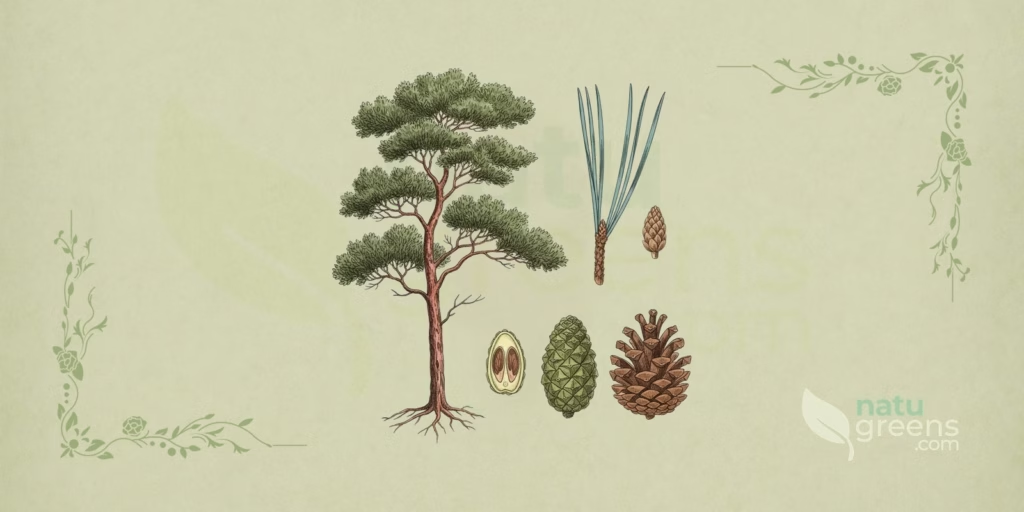
Anyone meeting the tree for the first time tends to notice the bark before anything else. The base of the trunk is dark, thick and broken into greyish plates, while the upper half flakes away in thin scales of a reddish orange that grows even more vivid under the low sun of a boreal winter. This two-toned contrast on a single bole is the most reliable field character of the species and allows it to be picked out at a distance, with no need to examine the needles. Add to that the crown, conical and regular in young trees, which over the decades sheds its lower branches and opens into a flattened, irregular head carried on a bare orange trunk.
Ecological breadth explains much of the tree’s importance. Scots pine thrives on poor sands, rock outcrops and peat bogs where few trees establish, tolerates winters of fifty degrees below zero in the Siberian interior and climbs beyond two thousand metres in the mountains at the southern edge of its range. That combination of toughness and good timber made it one of the pillars of European and Asian forestry, as well as a structuring element of the taiga, the largest forest biome in the world.
Taxonomy
The accepted name is Pinus sylvestris L., published by Carl von Linné in the second volume of Species Plantarum, page 1000, on 1 May 1753. The record appears in the International Plant Names Index under identifier 263353-1, and Plants of the World Online, from the Royal Botanic Gardens, Kew, recognises the binomial as accepted for the family Pinaceae. It was among the first conifers to receive a binomial name under the Linnaean system, which makes Scots pine a historical reference point in botanical nomenclature.
The full classification is organised as follows:
- Kingdom: Plantae
- Division: Pinophyta (conifers)
- Class: Pinopsida
- Order: Pinales
- Family: Pinaceae Spreng. ex F. Rudolphi
- Subfamily: Pinoideae
- Genus: Pinus L.
- Subgenus: Pinus, section Pinus, subsection Pinus
- Species: Pinus sylvestris L., 1753
Synonyms and Varieties
The sheer extent of the range produced a long synonymy, with dozens of names proposed through the eighteenth and nineteenth centuries for local populations that are understood today as geographical variation within a single species. Among the heterotypic synonyms that recur most often in the older literature are Pinus rigensis (Loudon) Trautv. and Pinus rubra Mill., both now subordinate to the Linnaean binomial.
The varieties currently recognised correspond, in practice, to broad geographical blocks:
- Pinus sylvestris var. hamata Steven: occurs in the Balkans, Crimea, the Caucasus and Turkey
- Pinus sylvestris var. lapponica Hartm.: occurs in Scandinavia, northern European Russia and western Siberia, with needles of especially long life
- Pinus sylvestris var. mongholica Litv.: occurs in Mongolia, Manchuria, eastern Siberia and Korea, with needles that run considerably longer than those of the type
- Pinus sylvestris var. sylvestris: the typical variety, spread across most of Europe
Etymology of the Binomial
The generic name Pinus is the classical Latin word for pine, applied by the Romans to the resinous conifers of the Mediterranean and taken up unchanged by Linnaeus. The specific epithet derives from silva, forest, and therefore means “of the woods” or “wild”, a choice that set the wild tree of the northern forests against the cultivated stone pine of Mediterranean orchards. Linnaeus spelled the epithet with a y, and that form became fixed by the principle of priority, even though the classical Latin spelling is silvestris.
Morphological Description
A large evergreen coniferous tree, commonly between 25 and 35 metres tall at maturity, with exceptional specimens recorded above 45 metres in Estonia. The trunk is straight and cylindrical in closed stands, reaching about 1 metre in diameter at breast height and up to 1.7 metres on the most productive sites, but it takes on twisted, heavily branched forms when the tree grows in the open, on dunes or in unenclosed fields. Typical longevity falls between 150 and 300 years, although far older individuals persist in the cold forests of the north.
Leaves
The leaves are needles borne in bundles of two, wrapped at the base by a persistent membranous sheath, the diagnostic character of the subsection to which the species belongs. They generally measure 2.5 to 5 centimetres long in adult trees, with a semicircular cross section and a helical twist that is visible to the naked eye. The colour is a glaucous green, with a distinct bluish cast that deepens on young shoots and darkens through the winter. Needle retention varies with climate, running from two to four years in the warmer parts of the range and reaching nine years in subarctic populations, where the short growing season offsets the slow turnover of foliage. Young plants also produce solitary primary leaves, flattened and finely toothed along the margin, which disappear as the axis matures.
Flowers
Being a gymnosperm, the species produces no flowers in the strict sense: the reproductive structures are unisexual strobili without a perianth, borne on the same individual. The male strobili, called microstrobili, are cylindrical and measure 8 to 12 millimetres, yellow or occasionally pink, gathered in dense clusters at the base of the current year’s shoots. Female strobili appear singly or in small groups at the tips of new shoots, at first only a few millimetres across and reddish in colour, turning green after pollination. Pollen release comes in mid to late spring and, in the great northern forests, produces yellow clouds visible from a distance.
Fruits and Seeds
Conifers form no true fruits, and what is popularly called a pine cone is the mature woody strobilus, a structure whose scales lignify and protect the seeds until dispersal. Scots pine cones are ovoid to conical-ovoid, 3 to 7.5 centimetres long, green in the first year and greyish yellow or brown at maturity, with scales whose apophysis is flat to slightly convex and whose umbo is small and carries no visible prickle. Ripening is slow and completes 22 to 24 months after pollination, so the tree carries cones of two generations at the same time. The seeds are small, 3 to 5 millimetres, dark, and bear a membranous wing of 12 to 20 millimetres that detaches easily.
Root and Stem
The root system is plastic and answers to the substrate: on deep sandy soils it develops a robust taproot alongside extensive lateral roots, whereas on peat and over shallow rock it becomes frankly superficial and spreading, which leaves the tree more vulnerable to strong winds. The fine roots maintain an obligate ectomycorrhizal association with a wide suite of fungi, and that partnership is what makes the colonisation of nutritionally poor sands and outcrops possible. The stem carries abundant resin canals in both wood and bark, and the resin that oozes from any wound seals the injury quickly. The bark is the most striking character of the species, thick, dark and fissured into plates at the base, thin, papery and orange on the upper bole and the main branches.
Distribution and Habitat
The native range extends from Europe to the Russian Far East and the Caucasus, covering roughly from latitude 37°N, in the mountains of southern Spain and Turkey, to beyond the Arctic Circle, near 70°N in Scandinavia. Along the longitudinal axis the species runs from the Atlantic to the Pacific, occupying many millions of hectares, which gives it the largest natural geographical range of any pine and places it, among conifers, second only to the junipers in extent.
Altitudinal behaviour tracks latitude with considerable regularity. In the north of the range the tree grows from sea level to about 1,000 metres, while in the southern portions it is a typically montane species, confined to belts between 1,200 and 2,600 metres, where it finds the cold and the moisture that are absent from the Mediterranean lowlands. The climates it occupies run from continental boreal to oceanic temperate, with annual rainfall between roughly 400 and 1,500 millimetres and tolerance of extreme temperature swings.
In edaphic terms, Scots pine is a species of poor ground by competitive vocation rather than physiological preference. It grows best on sandy or sandy loam substrates, acid to neutral, with pH between 4.5 and 7.0 and good drainage, and it turns up frequently on coastal dunes, rocky ridges and the margins of peat bogs. On fertile ground it grows well when planted, but natural succession quickly hands the site over to shade-tolerant broadleaves, which is precisely why spontaneous populations concentrate on the least generous sites. It is a pioneer tree, strongly light-demanding, colonising gaps, burnt ground and disturbed terrain, and it does not regenerate under its own closed canopy.
Beyond its native range, the species was planted on a large scale across the temperate and boreal zones worldwide and reached North America around 1600. In the United States and Canada it has naturalised in several northeastern states and provinces and is officially listed as invasive in Michigan and in Ontario, where it takes over abandoned fields and dunes. Similar records of naturalisation exist in New Zealand. Brazil has no commercial cultivation, since the humid tropical and subtropical climate does not meet the requirements of the species, and pine planting in the country rests on Pinus elliottii and Pinus taeda, both North American.
Cultivation of Scots Pine
Commercial propagation is by seed, collected from cones gathered in late autumn and winter, before the scales open naturally, and released in kilns that reproduce dry heat. The seed keeps its viability well in cold storage and germinates in two to four weeks on a sandy substrate, with a short cold stratification of two to four weeks improving the evenness of emergence. Ornamental cultivars, which do not come true from seed, are multiplied by grafting onto seedling rootstocks of the species itself. Among the selections most widespread in landscaping are ‘Aurea’, with golden yellow needles in winter, ‘Fastigiata’, narrowly columnar in habit, ‘Nana’, dwarf and rounded, and ‘Watereri’, compact and intensely blue in its foliage.
Field requirements are few and well defined. The tree needs full sun at every stage, does not tolerate prolonged side shading and responds badly to waterlogged or compacted soils, which compromise mycorrhization and favour root rots. It withstands moderate drought, wind-borne salt in coastal zones and extreme cold, which suits it to hardiness zones 2 to 7 in the North American system. In forest plantations, rotation lengths vary with site productivity and latitude, running from about 60 years in warmer regions to more than 120 years in the far north, where annual growth is slow and the very narrow rings produce the dense timber long known in European trade as red deal.
The main health problems of these stands are well documented in the European forestry literature:
- Diplodia sapinea: the fungus behind shoot blight, with necrosis of buds and dieback of branches, particularly after spells of water stress or damage from hail
- Hylobius abietis: a weevil whose adults gnaw the bark of newly planted seedlings, one of the classic bottlenecks of reforestation in northern Europe
- Lophodermium seditiosum: the agent of premature needle cast, frequent in nurseries and in overcrowded young plantations
- Melampsora pinitorqua: a rust that deforms the current year’s shoots and alternates hosts with species of Populus
- Thaumetopoea pityocampa: the defoliating pine processionary caterpillar, covered in urticating hairs, whose range has been advancing northwards and to higher elevations
- Tomicus piniperda: a bark beetle that bores into shoots and breeds under the bark of weakened trees, regarded as the primary pest of the species on the European continent
Phenology
The reproductive cycle stretches over nearly three years and is one of the more interesting aspects of the species’ biology. The strobili differentiate in the summer before pollination, and pollen release comes in mid to late spring, between May and June across most of the Northern Hemisphere, earlier in southern populations and considerably later in the far boreal. Pollination is strictly wind-borne, and pollen output is so heavy that the species ranks among the main sources of atmospheric pollen in the northern forest regions, which also makes it a classic marker in palynological studies reconstructing postglacial vegetation.
After the pollen arrives, fertilisation itself is completed only about a year later, a delay characteristic of the Pinaceae. The cones grow slowly through the second year and ripen 22 to 24 months after pollination, opening between February and April in response to dry weather. The winged seeds are dispersed by wind and travel from tens to a few hundred metres from the parent tree, reaching further over packed snow, a surface that cuts friction and lets the seed slide after it lands. Seed production is irregular from year to year, with heavy crops interspersed with lean seasons, a pattern that reduces the efficiency of specialised seed eaters, among them the crossbills of the genus Loxia, whose asymmetrical bill is adapted to extract seed from cones that are still closed, along with squirrels and small forest rodents.
Related Species and Confusions
Within the genus, the commonest confusions involve the other two-needled European pines. The combination of short, distinctly glaucous needles with orange bark over the upper half of the trunk settles nearly every case, and the main differences are worth knowing:
- Pinus cembra L. (Swiss stone pine): an alpine species, unmistakable for its needles in bundles of five and its large seeds with no functional wing
- Pinus mugo Turra (mountain pine): a prostrate or multi-stemmed shrub of the subalpine belt, which rarely forms a single trunk and never shows the orange upper bark
- Pinus nigra J. F. Arnold (black pine): needles 8 to 16 centimetres long, dark green and stiff, bark uniformly dark along the whole bole and larger cones, 5 to 10 centimetres
- Pinus pinaster Aiton (maritime pine): very long needles, 10 to 25 centimetres, cones of 8 to 22 centimetres and thick, deeply fissured bark with no orange portion
- Pinus pinea L. (stone pine): the characteristic umbrella crown at maturity, globose cones and large seeds with a hard coat
Outside the genus there is a confusion with far more serious consequences, and it deserves the attention of anyone walking through Old World conifer woods. The yew (Taxus baccata L.) is an evergreen conifer that grows in the same regions and contains taxines, highly toxic alkaloids present in the leaves, the bark and the seed; ingestion of yew plant material causes severe poisoning in people and in domestic animals. Telling the two apart is fortunately straightforward: yew leaves are flat, soft, a glossy dark green and set singly along the twig, never gathered into sheathed bundles, and the female reproductive structure is a fleshy red aril, quite unlike any woody cone. No pine produces anything of the sort.
Phytochemistry
The chemical profile of Scots pine is dominated by oleoresin, secreted in resin canals distributed through the wood, the bark and the needles. Industrially the oleoresin separates into two fractions: a volatile one, historically called turpentine, and a solid, brittle one known as rosin or colophony.
- Needles and shoots: concentrate the essential oil, whose major components are alpha-pinene, present in high proportion, followed by beta-pinene, delta-3-carene, limonene, myrcene and bornyl acetate. The needles also accumulate flavonoids, among them taxifolin, quercetin and kaempferol
- Bark: accumulates condensed tannins and oligomeric proanthocyanidins, along with free phenolic acids
- Heartwood and timber: contain stilbenes, notably pinosylvin and its methylated derivatives, compounds characteristic of the genus and associated with the natural durability of heartwood against wood-decay fungi
- Resin: the solid fraction brings together diterpenic resin acids, chiefly abietic acid and its congeners levopimaric, neoabietic, palustric and pimaric
One relevant safety fact is tied to this composition. Colophony derived from Pinus resins, the raw material of adhesives, varnishes, printing inks and the rosin used on string instruments, is a well established contact sensitiser and forms part of the standardised patch test series used in occupational dermatology. Repeated contact with fresh resin or with products derived from it causes contact dermatitis in sensitised people.
History and Ethnobotany
Few trees have carried comparable weight in the material history of northern Europe. The long, straight trunks of the boreal stands were, from the sixteenth to the nineteenth century, the main source of masts for the navies of the continent, and control of the supplying forests became a strategic question among the Baltic powers. The timber, traded as red deal, underpinned shipbuilding and the growth of the port cities, and heavy exploitation of the Scottish pinewoods went hand in hand with the advance of the Industrial Revolution, feeding the shipyards of Glasgow and Edinburgh.
Alongside the timber, resin gave rise to an industry of its own. Dry distillation of resinous wood produced pine tar, which Sweden and Finland exported in enormous quantities over centuries for caulking hulls and treating rigging, to the point that it became one of the leading export items of those economies before the industrial era. The turpentine obtained from the oleoresin and the residual rosin followed a similar path, supplying the varnish, soap and paint industries.
Ethnographic and archaeological records from Fennoscandia document that the Sámi took strips of inner bark from living pines, without girdling the trunk, and used the phloem as food in periods of scarcity, a practice tied to famine years and built into the calendar of reindeer herd movements. The scars left by that selective peeling remain legible on old trees and on dead wood in the forests of northern Sweden and Finland, and ring dating of those scars has become an important tool for reconstructing the chronology of human occupation in the region. In the coal mines of Flanders, props made from the timber of the species were preferred for an unusual practical reason: Scots pine gives off audible cracking before it fails under load, which gave the miners a warning that a prop needed replacing.
In Scotland the remnants of Caledonian pinewood hold a place of their own in national identity, and the species was adopted as the country’s national tree. Those forest fragments shelter a suite of pine-dependent wildlife, from the red squirrel (Sciurus vulgaris) to the capercaillie (Tetrao urogallus) and the crossbills, and they rank among the priority conservation habitats of the British Isles.
Conservation
The global assessment of the species on the Red List of the International Union for Conservation of Nature, carried out by M. Gardner and published in 2013 under the code e.T42418A2978732, classifies Pinus sylvestris as Least Concern (LC). The reasoning is straightforward: the range is immense, the global population runs to billions of individuals and the species is actively planted throughout the temperate and boreal zone, so no threat criterion applies at the global scale. The species is likewise absent from every CITES appendix.
That calm global picture coexists, however, with delicate local situations. The Caledonian pinewoods of Scotland, postglacial relicts of exceptional ecological value, have been reduced to a fraction of their original area and face chronic difficulty in regenerating naturally, mainly because of heavy deer browsing on the seedlings; restoring these fragments is the subject of long-term programmes. At the southern edge of the range, the isolated populations of Spain and Turkey face growing water stress as temperatures rise and summer rainfall declines, and the variety nevadensis, from the Sierra Nevada, was assessed as Vulnerable back in 1996. To these pressures add fragmentation through the conversion of natural forest into even-aged plantations, which impoverishes habitat structure, and the northward spread of pests once held in check by hard winters.
Interesting Facts
- The spelling with a y is an established error. Classical Latin writes silvestris, with an i, but the form used by Linnaeus in 1753 became fixed by the principle of priority and remains the official orthography of the epithet
- It is the national tree of Scotland and the country’s only native timber conifer, even though most of its world population sits thousands of kilometres away, in Siberia
- The oldest individual ever dated was past 760 years when it was sampled in Finnish Lapland in 2007, and ring chronologies assembled from historical timber in Albania cover more than a thousand continuous years
- No other pine covers so much ground. The natural range runs from the Atlantic to the Pacific and crosses the Arctic Circle, a record that among conifers only the junipers beat
- The tree carries two generations of cones at once, because ripening takes almost two years while flowering repeats annually, which means green cones of the year and brown cones about to open can be seen on the same branch
Notice: this content is for informational purposes and does not replace professional medical advice. Consult a physician or herbal practitioner before using medicinal plants, especially during pregnancy, breastfeeding, or alongside medication.
References and Scientific Studies
View All 8 Cited References
- Earle, C. J. (ed.). Pinus sylvestris L. The Gymnosperm Database. Available at ↗
- 2017 Farjon, A. A Handbook of the World’s Conifers, 2nd revised edition. Brill, Leiden. 2017.
- 2013 Gardner, M. Pinus sylvestris. The IUCN Red List of Threatened Species 2013: e.T42418A2978732, Least Concern (LC). Available at ↗
- Linnaeus, C. Species Plantarum, vol. 2, p. 1000. Stockholm. 1753.
- 1967 Mirov, N. T. The Genus Pinus. Ronald Press, New York. 1967.
- POWO. Pinus sylvestris L. Plants of the World Online, Royal Botanic Gardens, Kew. Available at ↗
- 1959 Steven, H. M. & Carlisle, A. The Native Pinewoods of Scotland. Oliver and Boyd, Edinburgh. 1959.
- The International Plant Names Index. Pinus sylvestris L., record 263353-1. Available at ↗