



Quick summary
Ficus religiosa L. / Sacred Fig, a tree of the Moraceae family also known as bo tree, peepal and bodhi tree, is native to the Indian subcontinent and Indochina, from the Himalayan foothills to southwestern China, and is now planted in squares, temple grounds and gardens across much of the tropics, Brazil included. In…
Main caution: The sacred fig has a long and broad history of traditional use, but every property attributed to it is a preclinical or traditional finding, and the absence of adverse effects reported in some reviews is not based on…
Ficus religiosa L. / Sacred Fig, a tree of the Moraceae family also known as bo tree, peepal and bodhi tree, is native to the Indian subcontinent and Indochina, from the Himalayan foothills to southwestern China, and is now planted in squares, temple grounds and gardens across much of the tropics, Brazil included. In India it goes by the Sanskrit name ashvattha and holds a central place in Ayurveda, which uses the bark, leaves, figs and latex in household and classical preparations, and the tree is sacred to Hindus, Buddhists and Jains alike. That cultural prestige, however, is not the same as scientific proof: nearly everything attributed to the sacred fig comes from traditional use and from laboratory and animal studies, with no robust clinical trials in people, and every property described in this article should be read in that light.
Common and International Names of the Sacred Fig
- Chinese: pu ti shu (菩提树).
- English: bo tree, bodhi tree, peepal tree, sacred fig.
- French: arbre bo, arbre de Dieu, figuier des pagodes, figuier religieux.
- German: Bobaum, heiliger Feigenbaum, Pepulbaum.
- Hindi: pipal, pipul.
- Italian: fico del diavolo, fico sacro.
- Japanese: indo-bodaiju (インドボダイジュ).
- Portuguese: árvore bodhi, figueira-dos-pagodes, figueira-dos-templos, figueira-religiosa, pipal.
- Sanskrit: ashvattha, bodhidruma, pippala.
- Sinhala: bo.
- Spanish: higuera de agua, higuera sagrada.
- Swedish: tempelfikus.
- Tamil: arasu.
- Thai: pho (โพธิ์).
Not to Be Confused with the Banyan or Other Trees Called Bodhi
The most frequent mix-up in Ayurvedic literature is with Ficus benghalensis, the banyan or Indian fig (nyagrodha in Sanskrit), another sacred fig of India that sends down huge pillar-like aerial roots and has thick oval leaves without the long drawn-out tip typical of the sacred fig. The two often appear together in traditional formulas and in many scientific reviews, but they are different species with their own studies. In Japan, the name bodaiju (菩提樹), without the "indo" prefix, usually refers to a linden planted at Buddhist temples (Tilia miqueliana), a temperate tree that has nothing to do with the genus Ficus and took the fig's place in Japanese temples because the original tree cannot survive the country's winters. When buying bark, leaves or extracts, the scientific name Ficus religiosa on the label is the only reliable guide.
Botanical Synonyms of the Sacred Fig
The accepted name is Ficus religiosa L., published by Linnaeus in 1753 in Species Plantarum, and the epithet "religiosa" already recorded the tree's link with the temples of Asia. International taxonomic databases list as synonyms Ficus caudata Stokes, Ficus peepul Griff., Ficus rhynchophylla Steud., Ficus superstitiosa Link, Urostigma affine Miq. and Urostigma religiosa (L.) Gasp., the last of these the product of a nineteenth-century attempt to place the hemiepiphytic figs in a genus of their own, an idea that never took hold. Variety names also turn up, such as Ficus religiosa var. cordata Miq. and var. rhynchophylla Miq., which are now treated as part of the same species. Within the genus, the sacred fig belongs to subgenus Urostigma, the group of figs that tend to germinate on other trees or in cracks in walls.
Botanical Family: Moraceae
The Moraceae family comprises about 1,100 species found mainly in tropical regions, and more than half of them belong to the genus Ficus, which includes the edible fig (Ficus carica), the weeping fig and the great strangler figs of Brazilian forests. Mulberry, jackfruit and breadfruit belong to the family as well. A hallmark of the group is the milky white latex that seeps from any wound in the bark, leaves or fruit. In figs, the "fruit" is actually a syconium, a hollow structure lined with hundreds of tiny inward-facing flowers that are pollinated by specialized wasps; in the case of the sacred fig, the partner wasp is Platyscapa quadraticeps, and without it the tree produces no viable seed.
Parts Used of the Sacred Fig
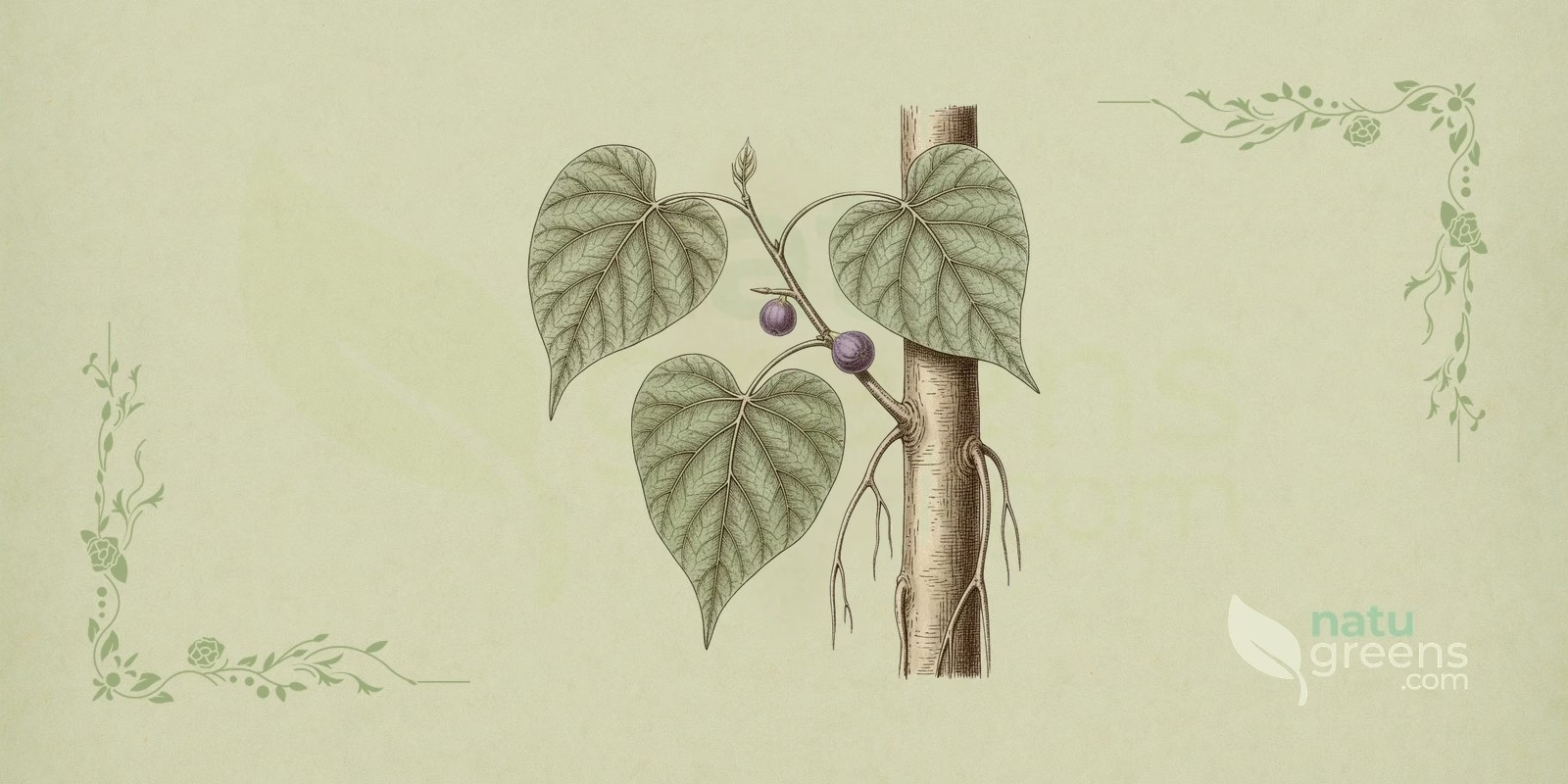
The trunk bark is the part most often cited in Ayurvedic texts and pharmacological studies, usually dried and used in decoctions, powders and pastes applied to the skin. The heart-shaped leaves, which end in a long slender tip, feature in preparations for wounds, skin complaints and digestive upsets, while the young shoots go into folk remedies for the mouth and airways. The figs, small, borne in pairs where the leaves meet the stem and purplish when ripe, are edible and traditionally used as a gentle laxative and in preparations for asthma. Latex, aerial roots and root bark round out the list, with narrower and less documented use.
Ethnobotanical and Traditional Uses of the Sacred Fig
Ethnomedical records from across South Asia link the sacred fig to some 50 kinds of complaints, a figure that conveys how important the tree is in Indian, Nepali and Sri Lankan folk medicine. Ayurveda classes it among the rasayana plants, considered rejuvenating, and the bark has an astringent taste, which accounts for many of its traditional uses. Among the uses most often described in ethnobotanical reviews are:
- Asthma and cough, with powdered dried figs or a bark decoction.
- Constipation, with ripe figs eaten as a laxative.
- Diabetes, mainly with the bark, a use that prompted several animal studies.
- Diarrhea and dysentery, owing to the astringent nature of the bark.
- Gonorrhea and discharges, in older folk medicine records.
- Mouth care, such as rinses with a bark decoction for inflamed gums and toothache.
- Nosebleeds and ear problems, in less widespread local uses.
- Wounds, skin ulcers and scabies, with leaves applied directly or a bark paste.
Medicinal Properties of the Sacred Fig
The properties below come from in vitro and animal studies, almost always with crude extracts at doses very different from those used at home, and none of them has been confirmed in clinical trials in people. Reviews of the species themselves note that the evidence is still insufficient to confirm its traditional uses.
- Analgesic (a methanolic bark extract reduced acetic acid-induced writhing in mice)
- Anticonvulsant (extracts of the figs and aerial roots reduced induced seizures in mice, possibly through serotonergic pathways; no human data)
- Antidiarrheal and astringent (a bark extract reduced castor oil-induced diarrhea in rats, in line with traditional use)
- Anti-inflammatory (bark and leaf extracts lessened carrageenan-induced paw edema in rats)
- Antimicrobial (leaf and latex extracts inhibited bacteria and Candida albicans in laboratory plates)
- Antioxidant (leaf and bark extracts scavenged free radicals in chemical assays)
- Antiplatelet (a methanolic fraction of stem buds reduced platelet aggregation in an ex vivo test, a finding that matters for anyone taking anticoagulants)
- Antiulcer (bark and leaf extracts protected the stomach lining in rat ulcer models)
- Hepatoprotective (extracts lowered markers of liver injury induced by acetaminophen and carbon tetrachloride in rats)
- Hypoglycemic (an aqueous bark extract lowered glucose and raised insulin in rats with streptozotocin-induced diabetes; never tested as a substitute for medication)
- Wound-healing (leaf and root ointments sped up wound closure in rats)
Detailed Phytochemical Profile of the Sacred Fig
The chemistry of the sacred fig has been described mainly in the bark, leaves and figs, dominated by tannins, phytosterols, triterpenes and flavonoids, along with two furanocoumarins that deserve attention for their photosensitizing potential. Because most studies used poorly standardized extracts, it is not clear which compounds account for each effect seen in animals.
- Alpha-amyrin and its acetate (triterpenes found in the leaves, bark and roots)
- Bergapten (a bark furanocoumarin known to sensitize the skin to sunlight)
- Bergaptol (a bark furanocoumarin closely related to bergapten)
- Beta-sitosterol (a phytosterol of the bark and root; a glycoside derivative isolated from the root bark has been linked to the hypoglycemic effect in animals)
- Eugenol (an aromatic phenolic compound identified in the leaves)
- Leucoanthocyanidins (such as leucocyanidin and leucopelargonidin glycosides, flavonoids of the bark and root)
- Lupeol (a triterpene found in the leaves, figs and roots, widely studied in the laboratory)
- Religiosins (serine proteases isolated from the latex)
- Saponins (associated with the anticonvulsant effect of the aerial roots in mice)
- Stigmasterol (a phytosterol found in the leaves, bark and figs)
- Tannins (responsible for the astringent taste of the bark and for much of its traditional use in diarrhea and mouth rinses)
- Volatile terpenes of the figs (such as alpha-pinene, beta-caryophyllene and limonene)
Preparation and Administration of the Sacred Fig
In traditional Indian practice, the most common form is a decoction of the dried bark, simmered for a few minutes and taken warm in small amounts or used as a mouth rinse and external wash. Powdered bark or dried figs are usually mixed with honey or water, and fresh leaves are warmed and laid on the skin or ground into a paste. Outside India, the plant turns up mainly in capsules and powders sold as Ayurvedic supplements, with active content rarely standardized, and in compound formulas where it is only one of several ingredients. There is no European monograph (EMA/HMPC) and no official dose recognized in Brazil, which is one more reason for caution with concentrated products.
Synergy with Other Medicinal Plants
Panchavalkala, the Five-Bark Formula
In Ayurveda, sacred fig bark is part of panchavalkala, a classical combination of the barks of five trees, among them the banyan (Ficus benghalensis), the cluster fig (Ficus racemosa) and the portia tree (Thespesia populnea). The tannin-rich decoction of these barks is traditionally used to wash wounds and in sitz baths, and the reasoning behind the blend is to add up the astringent effect of similar plants. No good-quality clinical studies show that the mixture works better than each bark on its own.
Traditional Combinations Linked to Blood Sugar
In Indian folk formulas aimed at blood sugar control, sacred fig bark often appears alongside jambolan (Syzygium cumini), another plant with a hypoglycemic effect observed in animals. This combination may add up and push glucose lower than expected in people already taking diabetes medication, so it should not be tried on one's own or used in place of prescribed treatment.
Recipes and Usage Protocols for the Sacred Fig
Bark Decoction for Mouth Rinses
In the traditional method, one tablespoon of chopped dried bark is simmered in two cups of water for about ten minutes, strained and used warm as a mouth rinse and gargle, without swallowing, as Indian folk medicine does for sensitive gums. There is no evidence that this rinse can replace brushing, flossing or a dentist's assessment, and persistent gum bleeding needs professional care.
Ripe Figs as Food
The ripe figs, small and faintly sweet, are eaten fresh or dried in some parts of India, and tradition credits them with a mild laxative effect, though no human studies have measured it. As an occasional food in small amounts they do not usually cause problems, but people allergic to latex or to other figs should avoid them.
Leaves for External Use
In folk practice, washed fresh leaves are gently warmed and placed over small skin lesions, or ground into a paste with a little water, with no clinical proof of benefit. The latex that oozes from the leaf stalk can irritate the skin, and because the plant contains furanocoumarins, it is wise to keep the area out of the sun right after application. These uses follow traditional records and are no substitute for professional advice, especially for deep or infected wounds or wounds that will not heal.
The preparations above follow traditional records and do not replace professional guidance. Before any internal use, check the contraindications and interactions described in this article.
Therapies Associated with the Sacred Fig
Clinical Herbal Medicine
In Western herbal medicine, the sacred fig is rarely used and does not appear on the official medicinal plant lists of Anvisa, Brazil's health regulator, or in the EMA monographs. Herbalists who know it tend to regard it as an astringent plant of research interest, whose internal use would require standardized extracts and clinical studies that do not yet exist. For now, the most prudent role for the plant is as a subject of research and of occasional traditional use, not as a supplement for continuous intake.
Ayurveda
Since no relevant homeopathic use is documented for the species, the system most closely tied to it is Ayurveda, where ashvattha appears in the classical texts as a rasayana plant with an astringent taste, recommended for balancing the pitta and kapha doshas. The bark goes into decoctions, powders and medicated oils, and the whole tree carries ritual value, so many Indian families know it more for its religious meaning than for its medicinal use. Ayurvedic formulations sold outside India should come from manufacturers that can show testing for contaminants, since products of this kind have been linked to heavy metals.
Contraindications and Side Effects of the Sacred Fig
The sacred fig has a long and broad history of traditional use, but every property attributed to it is a preclinical or traditional finding, and the absence of adverse effects reported in some reviews is not based on safety studies in people. Acute toxicity tests in rats and mice showed no deaths even at high extract doses, which says nothing about prolonged use in humans. There are no robust safety data in pregnancy and breastfeeding for extracts, capsules or concentrated decoctions, so pregnant and breastfeeding women should avoid these forms of use, as should young children. The plant's latex can irritate the skin and eyes, and people allergic to rubber latex or to other figs, such as the weeping fig and the edible fig, may experience cross-reactions. The presence of furanocoumarins such as bergapten suggests a risk of dark patches and burns if skin that has touched the plant is exposed to the sun. Because it is rich in tannins, the bark can cause constipation, stomach irritation and reduced iron absorption with frequent use. People with diabetes, seizures or liver disease should not use the plant without medical supervision, and use should be stopped about two weeks before surgery because of the possible effect on platelets and blood glucose observed in the laboratory.
Drug Interactions
There are no human interaction studies, but animal and laboratory findings point to some predictable risks. The hypoglycemic effect of the bark may add to that of insulin, metformin, sulfonylureas and other antidiabetic drugs, with a risk of hypoglycemia. The antiplatelet activity seen ex vivo is reason to avoid the plant together with anticoagulants (warfarin, rivaroxaban, apixaban, heparin) and antiplatelet drugs (aspirin, clopidogrel), given the possibility of bleeding. Since the anticonvulsant studies suggest action on serotonin pathways, it is prudent to avoid combining it with anticonvulsants and serotonergic antidepressants without medical guidance. The tannins in the bark can reduce the absorption of iron medicines and supplements taken at the same time, and sensitivity to light may increase in people already taking photosensitizing drugs.
Curiosities and Historical Facts
According to Buddhist tradition, Siddhartha Gautama attained enlightenment while meditating beneath a sacred fig at Bodh Gaya, in northern India, which is why the species became known as the bodhi tree, from the Pali and Sanskrit word for "awakening". A sapling from that tree is said to have been carried to Sri Lanka in the third century BC, giving rise to the Sri Maha Bodhi at Anuradhapura, planted around 288 BC and considered the oldest human-planted tree in the world with a recorded planting date. In Hinduism, ashvattha is mentioned in the Rigveda and in the Bhagavad Gita, where Krishna declares that among trees he is the ashvattha itself. The heart-shaped leaves, whose long tip helps rainwater drain away, flutter in the faintest breeze and are often painted and sold as souvenirs at temples. Because it sprouts so easily in crevices, the sacred fig is also known for growing on walls, rooftops and ancient monuments, whose structures its roots can split over time.
Frequently Asked Questions About the Sacred Fig
Is the Sacred Fig Proven to Work for Diabetes?
No. The studies that showed lower glucose were done in rats with laboratory-induced diabetes, and no clinical trials have confirmed the effect in people. Anyone with diabetes should not stop or cut back on medication on their own, and taking the bark alongside antidiabetic drugs can cause hypoglycemia.
Are the Sacred Fig and the Banyan the Same Plant?
No. The banyan (Ficus benghalensis) is a different species of the same genus, with thick oval leaves and aerial roots that turn into pillars, while the sacred fig (Ficus religiosa) has heart-shaped leaves with a long tip. Both are used in Ayurveda and sometimes appear together in formulas, but studies on one do not automatically apply to the other.
Can Pregnant or Breastfeeding Women Use the Sacred Fig?
There are no robust safety data in pregnancy and breastfeeding for extracts, capsules or concentrated teas made from the plant, so the most prudent course is to avoid this use during these stages. Having the tree in gardens or temples, or occasional contact with its leaves, does not raise the same kind of concern.
Can the Sacred Fig Be Grown Outside Asia?
Yes, the species adapts well to tropical and subtropical climates, including those of Brazil, where it is planted as an ornamental tree in squares and parks. Because it grows very large and has aggressive roots, it needs plenty of space, away from sidewalks, walls and pipes. In Brazil the tree rarely sets seed, since its pollinating wasp is native to Asia, and it is usually propagated from cuttings.
Can People with a Latex Allergy Have Problems with the Plant?
Yes. Studies with the weeping fig have shown cross-reactivity between fig latex, the edible fig and natural rubber latex, and this risk is considered possible for other species in the genus. People allergic to latex should avoid contact with sacred fig sap and seek medical care if itching, swelling or shortness of breath occurs.
Notice: this content is for informational purposes and does not replace professional medical advice. Consult a physician or herbal practitioner before using medicinal plants, especially during pregnancy, breastfeeding, or alongside medication.
How to cite this article
NATUGREENS. Sacred Fig (Ficus religiosa): Uses and Precautions. Natugreens, 26 Nov. 2026. Disponível em: https://natugreens.com/ficus-religiosa-sacred-fig/. Accessed: Nov. 26, 2026.
Natugreens. (2026). Sacred Fig (Ficus religiosa): Uses and Precautions. Natugreens. https://natugreens.com/ficus-religiosa-sacred-fig/
References and Scientific Studies
View All 11 Cited References
- DOI2011 Singh, D., Singh, B., Goel, R. K. (2011). Traditional uses, phytochemistry and pharmacology of Ficus religiosa: a review. Journal of Ethnopharmacology, 134(3), 565-583. ↗
- DOI2010 Chandrasekar, S. B., Bhanumathy, M., Pawar, A. T., Somasundaram, T. (2010). Phytopharmacology of Ficus religiosa. Pharmacognosy Reviews, 4(8), 195-199. ↗
- DOI2021 Murugesu, S., Selamat, J., Perumal, V. (2021). Phytochemistry, Pharmacological Properties, and Recent Applications of Ficus benghalensis and Ficus religiosa. Plants, 10(12), 2749. ↗
- DOI2024 Rawat, R., Kumar, H., Singh, N., Deep, A., Narasimhan, B., Singh Yadav, S., Kumar, S. (2024). Comprehensive review on ethnomedicinal, phytochemistry and pharmacological profile of Ficus religiosa L. Journal of Traditional Chinese Medicine, 44(5), 1052-1057. ↗
- DOI2010 Pandit, R., Phadke, A., Jagtap, A. (2010). Antidiabetic effect of Ficus religiosa extract in streptozotocin-induced diabetic rats. Journal of Ethnopharmacology, 128(2), 462-466. ↗
- DOI2011 Kirana, H., Jali, M. V., Srinivasan, B. P. (2011). The study of aqueous extract of Ficus religiosa Linn. on cytokine TNF-α in type 2 diabetic rats. Pharmacognosy Research, 3(1), 30-34. ↗
- DOI2009 Singh, D., Goel, R. K. (2009). Anticonvulsant effect of Ficus religiosa: role of serotonergic pathways. Journal of Ethnopharmacology, 123(2), 330-334. ↗
- DOI2012 Singh, D., Singh, B., Goel, R. K. (2012). Role of saponins for the anticonvulsant effect of adventitious roots of Ficus religiosa. Pharmaceutical Biology, 50(7), 816-822. ↗
- DOI2013 Gregory, M., Divya, B., Mary, R. A., Viji, M. M., Kalaichelvan, V. K., Palanivel, V. (2013). Anti-ulcer activity of Ficus religiosa leaf ethanolic extract. Asian Pacific Journal of Tropical Biomedicine, 3(7), 554-556. ↗
- DOI2023 Kumar, S., Arif, M., Kamal, M., Jawaid, T., Khan, M. M., Mukhtar, B., Khan, A., Ahmed, S., AlSanad, S. M., Al-Khamees, O. A. (2023). Ex Vivo Antiplatelet and Thrombolytic Activity of Bioactive Fractions from the New-Fangled Stem Buds of Ficus religiosa L. with Simultaneous GC-MS Examination. Molecules, 28(9), 3918. ↗
- DOI1998 Brehler, R., Abrams, E., Sedlmayr, S. (1998). Cross-reactivity between Ficus benjamina (weeping fig) and natural rubber latex. Allergy, 53(4), 402-406. ↗
You May Also Like

Take your time and tell us everything you think, details included. Every response is read by someone on our editorial team and goes into the article's revision. An honest critique helps us more than a polite compliment.
Take your time and tell us everything you think, details included. Every response is read by someone on our editorial team and goes into the article's revision. An honest critique helps us more than a polite compliment.