Jacaranda caroba (Vell.) DC. / Caroba, popularly known as caroba or Brazilian caroba-tree, is a medicinal plant native to the Brazilian Cerrado. This species, belonging to the Bignoniaceae family, has been widely used in traditional medicine for its diverse therapeutic properties. Historically, caroba has been employed in the treatment of a variety of conditions, from gastrointestinal problems to skin conditions and venereal diseases. Phytochemical research has identified phenolic compounds and flavonoids in the species, but the studies are still few and neither confirm the traditional uses nor establish safe doses.
For the taxonomy, morphology and cultivation of this plant, see the Botanical Profile of Jacaranda caroba (Caroba).
Popular and International Names of Caroba
- English: Brazilian caroba-tree, caroba.
- Spanish: caroba, gualanday, jacarandá.
- Portuguese: caroba, caroba-miúda, carobinha.
- French: caroba.
- Italian: caroba.
- German: Caroba.
Botanical Synonyms of Caroba
The taxonomy of Jacaranda caroba presents some synonyms that have been used throughout botanical history. The currently accepted name is Jacaranda caroba (Vell.) DC., but other designations have been employed for the same species or for closely related varieties. Understanding these synonyms is fundamental for the correct identification of the plant in different scientific and historical contexts.
- Bignonia caroba Vell.
- Jacaranda caroba var. oxyphylla (Cham.) Bureau
- Jacaranda clausseniana Casar.
- Jacaranda elegans Mart. ex DC.
- Jacaranda mendoncaei Bureau & K.Schum.
- Jacaranda oxyphylla Cham.
Botanical Family: Bignoniaceae

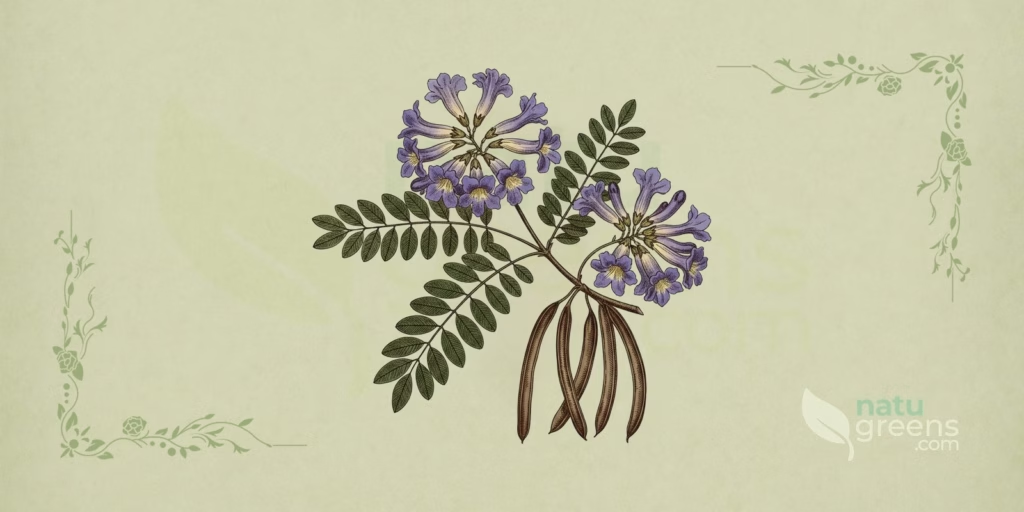
Botanical illustration of Jacaranda caroba (Vell.) DC. (caroba, Brazilian caroba-tree), a medicinal plant native to the Brazilian Cerrado, of the Bignoniaceae family, showing the elliptical or nearly round, semi-woody fruit with hyaline-membranous winged seeds, in 19th-century botanical encyclopedia style on a sage-green herbarium paper background. Details of the fruit and seed structure are prominent, highlighting the most important part of the plant for identification and propagation.
Jacaranda caroba belongs to the Bignoniaceae family, a diverse group of plants that includes trees, shrubs, and lianas. This family is widely distributed in tropical and subtropical regions of the world and is known for its showy flowers and characteristic fruits. Many species of the Bignoniaceae family have economic and medicinal importance, being used in landscaping, in the timber industry, and in traditional medicine.
Plants of the Bignoniaceae family are frequently recognized by the presence of compound, usually opposite leaves and tubular or bell-shaped flowers. The phytochemical diversity of this family is remarkable, with the production of various bioactive compounds that confer therapeutic properties on many of its species. Jacaranda caroba shares many of the morphological and phytochemical characteristics typical of this family.
Parts of Caroba Used
- Bark
- Leaves
Ethnobotanical and Traditional Uses of Caroba
- Blood purifier
- Rheumatism and rheumatic conditions
- Skin conditions (wounds, hives, ulcers, skin problems)
- Stomach and liver problems
- Urethritis
- Venereal diseases (syphilis, gonorrhea; historical record, they require medical antibiotic treatment)
Therapeutic Properties of Caroba
- Alterative (restores the body’s normal functions)
- Anti-inflammatory (reduces inflammation)
- Antimicrobial (fights microorganisms); traditional use, without established clinical efficacy
- Antioxidant (fights free radicals)
- Antisyphilitic (historical use; syphilis requires medical antibiotic treatment)
- Anxiolytic (reduces anxiety); traditional use, without established clinical efficacy
- Astringent (contracts tissues and blood vessels)
- Cathartic (promotes bowel evacuation)
- Depurative (so classified in folk tradition, which credits the plant with cleansing the body)
- Diuretic (increases urine production)
- Sedative (calms the nervous system)
- Sudorific (promotes perspiration)
- Tonic (strengthens the body)
Detailed Phytochemical Profile of Caroba
- Flavonoids
- Iridoids
- Isorhamnetin-3-O-rhamnoside-7,4′-di-O-glucoside
- Jacaranone (genus marker, associated with the cytotoxicity described for Jacaranda)
- Lignans
- Phenolic compounds
- Quercetin-3-O-(2-O-pentosyl)-hexoside
- Terpenoids
Preparation and Administration Forms of Caroba
- Compresses
- Sitz baths
- Tea (infusion/decoction)
- Tinctures
- Washes
Synergy with Other Medicinal Plants
Anti-inflammatory and Healing Potential
Although there are no specific studies on the synergies of Jacaranda caroba, it is plausible that the anti-inflammatory effects tradition credits it with could be reinforced by combining it with plants of a similar profile. Calendula (Calendula officinalis) is the most predictable pairing for skin care. Comfrey (Symphytum officinale) belongs to the same tradition, but it contains hepatotoxic pyrrolizidine alkaloids: its external use is limited to intact skin, for short periods, and never on open wounds. Such combinations need to be studied before any claim of safety and effectiveness.
Nervous System Support
Considering the use of caroba in preparations aimed at the nervous system, synergy with plants such as valerian (Valeriana officinalis) or passionflower (Passiflora incarnata) may be beneficial. These plants are known for their sedative and anxiolytic effects, and the combination could offer more comprehensive support for the nervous system. Research on these interactions may reveal new therapeutic approaches.
Recipes and Usage Protocols of Caroba
Sitz Baths as Comfort Care
Ingredients: 50 g of dried caroba bark or leaves, 1 liter of water.
Preparation: Make a decoction by boiling the bark or leaves in water for 10 to 15 minutes. Strain and let cool to a lukewarm temperature. Use this preparation for sitz baths, 2 to 3 times a day, as comfort care for external ulcers. The astringent action of caroba can help reduce local inflammation, but sexually transmitted infections require medical diagnosis and antibiotic treatment: the bath does not treat the infection.
Tea for Skin Irritation
Ingredients: 2 tablespoons of dried caroba leaves, 500 ml of water.
Preparation: Boil the caroba leaves in the water for about 5 minutes. Remove from the heat, cover, and let steep for another 10 minutes. Strain and use the warm liquid in compresses on irritated but intact skin, in adults. Do not apply to chickenpox blisters or open wounds: chickenpox lesions can become bacterially infected and require medical evaluation, not washing with a homemade preparation. The astringent action of caroba may ease local irritation, but no clinical study confirms a wound-healing effect. The preparation also works as a compress.
Tincture for Nervous Support
Ingredients: 100 g of dried caroba leaves, 500 ml of 70% grain alcohol.
Preparation: Place the leaves in a dark glass jar and cover with the alcohol. Let macerate for 14 days in a cool, dark place, shaking daily. Strain and store the resulting tincture. For use, dilute 20 drops in water once a day, in the late afternoon, occasionally and for a few days only. The tincture concentrates the plant’s compounds and, because caroba’s safety profile is not established, it should not be used continuously, nor by pregnant or breastfeeding women, children, or people taking antidepressants or sedatives. Consult a healthcare professional before use.
Associated Therapies
Homeopathy
The homeopathic picture of caroba, distinct from Brazilian folk uses, brings together vertigo, morning sickness, a runny nose with headache, a dry and sore throat, and eye dryness. In homeopathy, Jacaranda caroba is used as a mother tincture (Jacaranda caroba Q) on the basis of that symptom repertory, which also includes restlessness, nervousness, and disturbed sleep. These uses follow homeopathy’s own logic and should not be confused with herbal medicine or with clinical evidence of efficacy.
Contraindications and Side Effects of Caroba
General Contraindications
Although Jacaranda caroba is widely used in traditional medicine, research on its specific contraindications and side effects is limited. Caution is recommended for pregnant and breastfeeding women, as well as for children, due to the lack of conclusive safety studies in these groups. Individuals with a known allergy to plants of the Bignoniaceae family should avoid using caroba. No caroba preparation should ever be applied to the eyes. Homemade decoctions are not sterile, and ocular use can cause keratitis and serious infection; eye symptoms require an ophthalmological evaluation. It is always advisable to consult a healthcare professional before starting any treatment with medicinal plants, especially in cases of pre-existing health conditions or concomitant use of other medications.
Drug Interactions
The study that described caroba’s phenolic compounds showed that its extracts inhibit monoamine oxidase A. For this reason, the plant should not be combined with MAO-inhibiting antidepressants or selective serotonin reuptake inhibitors, due to the risk of serotonin syndrome, nor with other sedatives. Anyone taking psychiatric medication should consult a doctor before using any caroba preparation. However, due to the presence of bioactive compounds such as flavonoids and phenolics, it is possible that the plant could interact with medications that affect blood coagulation, blood pressure, or liver metabolism. Patients using anticoagulants, antihypertensives, or other continuous-use drugs should exercise caution and seek medical guidance to avoid potential adverse interactions.
Historical Notes and Interesting Facts about Caroba
Diversity of the Jacaranda Genus
The genus Jacaranda, to which caroba belongs, comprises about 49 species of flowering plants. These species are native to Central America, South America, and the Caribbean, and many of them are valued both for their medicinal properties and for their ornamental beauty. In Brazil, several Jacaranda species are known by the popular names caroba or carobinha, and are traditionally considered to have similar therapeutic properties, which reflects the region’s rich biodiversity and ethnobotanical knowledge.
Traditional Use in the Cerrado
Jacaranda caroba is an emblematic plant of the Brazilian Cerrado, a biome rich in biodiversity and with a vast tradition of medicinal plant use. Knowledge about caroba has been passed down through generations, being an integral part of the culture and health of local communities. Its use for stomach and liver problems, and as a blood purifier, demonstrates the deep connection between the population and the available natural resources, highlighting the importance of preserving this biome and the traditional knowledge associated with it.
Frequently Asked Questions about Caroba
Can Caroba Be Used for Skin Problems?
Yes, caroba is traditionally used for skin conditions such as superficial wounds, hives, and external ulcers. Its astringent properties may ease local irritation, but no clinical study confirms that it heals wounds. Use is topical, in washes or compresses on intact skin, never on chickenpox blisters, open wounds, or the eyes.
Does Caroba Help in the Treatment of Venereal Diseases?
Historically, caroba has been employed in folk medicine for the treatment of venereal diseases such as syphilis and gonorrhea. Tradition credited it with antisyphilitic and depurative action, but that is a historical record, not a confirmed property. However, it is crucial to emphasize that the treatment of sexually transmitted diseases requires medical follow-up and the use of specific medications. Caroba does not treat these infections and must not delay the start of antibiotics; any complementary comfort use should be agreed with the doctor.
Which Parts of Caroba Are Used Medicinally?
The parts of Jacaranda caroba most used for medicinal purposes are the bark and the leaves. Tradition credits the bark with astringent and depurative action, and the leaves with historical use against syphilis alongside a tonic effect. None of these actions is confirmed by clinical study. Both can be prepared as teas, decoctions, washes, or tinctures, depending on the condition being treated and the tradition of use.
Does Caroba Have Side Effects?
Research on the specific side effects of Jacaranda caroba is limited. However, as with any medicinal plant, adverse reactions may occur in sensitive individuals or in cases of inappropriate use. People with allergies to plants of the Bignoniaceae family should avoid its consumption. One concrete caution also stands out: caroba extracts inhibit monoamine oxidase A, so the plant must not be combined with MAO-inhibiting or SSRI antidepressants, because of the risk of serotonin syndrome, nor with other sedatives. It is essential to seek guidance from a healthcare professional before using caroba, especially if there are pre-existing health conditions or use of other medications.
Can Caroba Be Used During Pregnancy?
There are no conclusive studies on the safety of Jacaranda caroba during pregnancy and breastfeeding. As a precaution, it is recommended that pregnant and breastfeeding women avoid using the plant or consult a healthcare professional before any use. The safety of the fetus and the baby must always be the top priority in any phytotherapeutic treatment.
Notice: this content is for informational purposes and does not replace professional medical advice. Consult a physician or herbal practitioner before using medicinal plants, especially during pregnancy, breastfeeding, or alongside medication.
References and Scientific Studies
View All 8 Cited References
Peer-Reviewed Scientific Studies (3)
- PEER2013 Ferreres, F., Grosso, C., Gil-Izquierdo, A., Valentão, P., & Andrade, P. B. (2013). Phenolic compounds from Jacaranda caroba (Vell.) A. DC.: approaches to neurodegenerative disorders. Food and Chemical Toxicology, 57, 91-98.
- PEER2009 Gachet, M. S. (2009). Jacaranda—An ethnopharmacological and phytochemical review. Journal of Ethnopharmacology, 124(3), 373-382.
- PEER2025 Mohammad, S. A. E. M. (2025). An overview of the phytochemical and biological activities of Jacaranda species. South African Journal of Botany, 175, 112-125.
Supplementary Readings (5)
- Correa, M. P. (1926). Diccionario das Plantas Uteis do Brasil. Imprensa Nacional; Rio de Janeiro.
- Gould, G. M. (1907). An Illustrated Dictionary of Medicine, Biology and Allied Sciences. P. Blakiston’s Son & Co.; Philadelphia.
- 2014 Hernandes, L. S. (2014). Acute oral toxicity and total flavonoid content of Jacaranda caroba (Vell.) DC. used in folk medicine. Planta Medica, 80(10), 866-867.
- Teixeira da Fonseca, Eurico. (1940). Plantas Medicinales Brasileñas. Brasil, sine nomine.
- World Flora Online (WFO). Jacaranda caroba (Vell.) DC.