Few plants announce themselves as literally as Sanguinaria canadensis. Break the rhizome and a thick latex wells up, an orange red so saturated that it stains the fingers on contact and accounts in a single gesture for the name of the genus, for the English common name, and for much of the reputation the species has gathered across four centuries of European observation. It is a member of the Papaveraceae, close kin to the poppies and to greater celandine, and the only living representative of the genus Sanguinaria.
The species is native to the eastern half of North America, from central and eastern Canada through the central and eastern United States, where it occupies the floor of mature deciduous forest. Its above ground season is remarkably short. Bloodroot belongs to the functional group known as spring ephemerals, plants that exploit the narrow window of light between snowmelt and canopy closure in order to emerge, flower and set fruit before withdrawing into the rhizome for the remainder of the year. An entire population can pass from invisible to flowering and back to invisible in under three months.
This profile gathers what the botanical literature records about the species: formal taxonomy confirmed against the nomenclatural databases, morphology with measurements, habitat ecology, woodland garden practice, phenology and pollination, field separation from similar plants, descriptive chemistry, the historical and ethnographic record, and conservation status. Nothing here is guidance for use. The plant is toxic in all of its parts, and the text describes the organism rather than ways of employing it.
Bloodroot belongs to the Papaveraceae, close kin to the poppies and to greater celandine.
Taxonomy
The genus Sanguinaria is monotypic, meaning that it contains a single accepted species. The name was validated by Linnaeus in 1753, in the first volume of Species Plantarum, the work that marks the starting point of modern botanical nomenclature. The current classification, following the APG system adopted by Plants of the World Online, runs as follows:
- Kingdom: Plantae
- Clade: Angiosperms, eudicots
- Order: Ranunculales
- Family: Papaveraceae Juss., 1789
- Subfamily: Papaveroideae
- Genus: Sanguinaria Dill. ex L., 1753
- Species: Sanguinaria canadensis L., 1753
The binomial was checked against the International Plant Names Index, which records the original publication in Species Plantarum of 1753 and credits the authorship to Linnaeus, and against Plants of the World Online of the Royal Botanic Gardens, Kew, where Sanguinaria canadensis L. stands as the accepted name.
Synonyms
As happens with species that are heavily collected and highly variable, bloodroot has accumulated a long list of names now reduced to synonymy. At genus level, Belharnosia Adans. is a synonym of Sanguinaria. Among the synonyms of the species, the following are recorded:
- Belharnosia canadensis (L.) Nieuwl.
- Sanguinaria acaulis Moench
- Sanguinaria canadensis var. rotundifolia (Greene) Fedde
- Sanguinaria canadensis var. stenopetala Pursh
- Sanguinaria grandiflora Raf.
- Sanguinaria vernalis Salisb.
- Sanguinaria virginiana Gaertn.
Several varieties described by Fedde in 1909, such as australis, dilleniana and mesochora, along with later forms such as colbyorum Benke and incarnata Farw., correspond to continuous population variation and are no longer recognised as distinct taxa. The one exception of horticultural interest is the form multiplex (E.H.Wilson) Weath., with double flowers, treated below in the section on cultivation.
Etymology
The generic name derives from the Latin sanguis, blood, in direct reference to the red latex that the plant exudes when wounded. The epithet canadensis means simply of Canada and points to the origin of the material that reached Europe in the first colonial consignments, although the species occurs across a far wider area than Canadian territory alone. The English name bloodroot carries exactly the same image, and older sources also record bloodwort and red puccoon.
Morphological Description
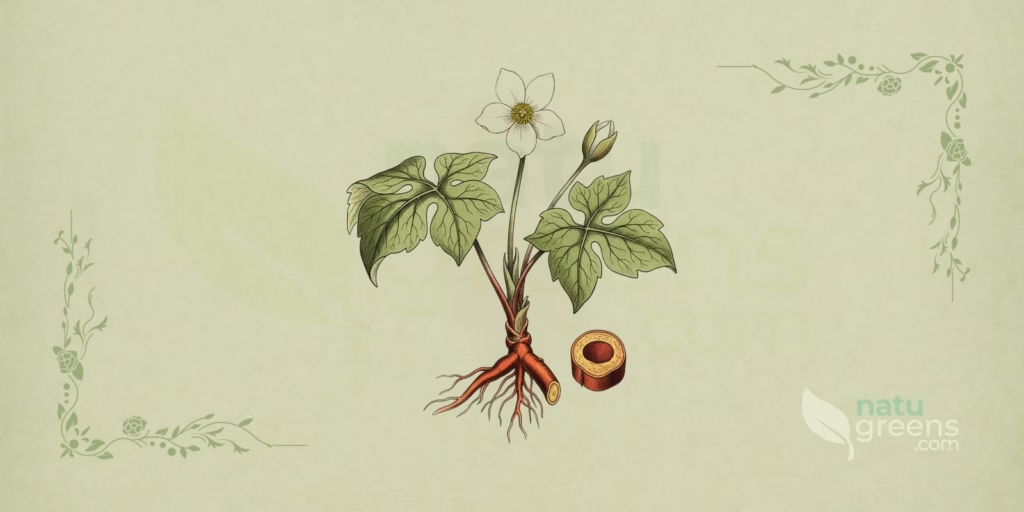
Bloodroot is a glabrous perennial herb with a branching rhizome, reaching around 40 centimetres in height and exceptionally 60 centimetres. Its appearance during flowering is peculiar enough to allow immediate recognition: each shoot produces a single leaf, which emerges wrapped like a cloak around the flower bud, so that the flower appears to rise from inside the leaf. Only after the flower has opened and faded does the blade unfurl completely and reach its final size. The whole of the above ground growth disappears over the summer.
Leaves
The leaf is solitary, basal and long petiolate, the petiole reaching up to 15 centimetres, fleshy and just as heavily charged with latex. The blade reaches 25 centimetres across and is orbicular reniform to cordate sagittate in outline, with five to seven deeply cut palmate lobes and a crenate to wavy margin. The upper surface is glaucous, a grey blue green that sets it apart from almost every neighbour on the forest floor, and the palmate venation shows clearly against the light. Leaf expansion continues for several weeks after flowering, and peak leaf area coincides with the moment when the forest canopy has already closed.
Flowers
The flowers are solitary and terminal on a scape, and remarkable for their brevity: each one lasts only a few days, and a population can move from peak bloom to the end of flowering in under a week. The two sepals measure about 1 centimetre and fall at anthesis. The petals are white, occasionally pink tinged, oblong to oblanceolate, 15 to 30 millimetres long, and variable in number, generally eight to twelve, the outer ones longer than the inner. The stamens are numerous, with golden yellow anthers that contrast against the white of the petals, and the ovary is superior, with two carpels and a two lobed stigma. The flower produces no nectar, only pollen.
Fruits and Seeds
The fruit is a fusiform, glabrous capsule, 35 to 60 millimetres long, which splits into two valves when ripe. The seeds are numerous, roughly spherical, 2 to 3 millimetres across, and range from black to orange red, with a faintly reticulate surface. Each seed carries an elaiosome, a fleshy lipid rich appendage that serves as a reward for ants and underpins the dispersal mechanism described in the section on phenology. Ripening takes place four to six weeks after flowering, the capsules drying out while the leaf is still fully expanded.
Rhizome
The rhizome is the most distinctive organ of the species and the reason for its name. It grows horizontally or obliquely a few centimetres below the surface, measures 5 to 15 centimetres long by 1 to 2.5 centimetres in diameter, branches with age and forms compact clonal colonies. The outer surface is reddish brown and the interior a vivid orange red that darkens on exposure to air. When cut, it releases abundant latex of the same colour. That latex is irritant to skin and mucous membranes and stains fabric persistently.
Distribution and Habitat
The native range of bloodroot covers central and eastern Canada and the central and eastern United States. In Canada it occurs from Nova Scotia and New Brunswick through Quebec, Ontario and Manitoba. In the United States it extends from New England to northern Florida and, westward, as far as North Dakota, South Dakota, Nebraska, Kansas, Oklahoma and eastern Texas. The central Appalachians hold the densest populations and the greatest morphological variation.
The typical habitat is the floor of mesophytic deciduous woodland, on deep soil, rich in organic matter and freely drained. The species turns up frequently on floodplains, along stream banks and on north facing slopes, where moisture stays more stable through the summer. It also occurs, less often, in clearings, meadows and stabilised dunes, and only rarely on disturbed ground, which makes it a good indicator of mature forest. The documented altitudinal range runs from sea level to around 1,300 metres.
The climate across its range is continental to humid temperate, with cold winters and well distributed rainfall. The rhizome requires a prolonged cold period to break dormancy, which severely limits cultivation in mild climates. The species does not occur naturally in Brazil or anywhere in South America, and there is no record of naturalisation outside its native range.
Cultivation
In the northern hemisphere, bloodroot is a classic component of the woodland garden, grown for its early flowering and for the glaucous foliage that fills the bed once the flowers have gone. Outside regions with hard winters, however, cultivation is difficult or unworkable, and in Brazil it is only worth contemplating at altitude where the cold is pronounced, in places such as the Serra Gaucha, the Serra Catarinense and the Campos do Jordao region. Even there the outcome is uncertain.
Propagation
Rhizome division is the most reliable method. It is carried out in autumn, after the leaf has died back, separating segments that carry at least two buds and replanting them horizontally at a depth of three to five centimetres. Propagation from seed is slower and demands attention: the seeds are recalcitrant, lose viability quickly on drying and should be sown as soon as they are harvested. Germination depends on double stratification, a warm period followed by a cold one, and usually occurs only in the second spring. Seed raised plants take three to five years to flower for the first time.
Requirements
The ideal soil is a woodland soil: friable, deep, high in humus and freely drained, with a pH between slightly acid and neutral. Waterlogged or compacted soils are the main cause of failure. Light levels should reproduce the natural regime, with direct sun in early spring and shade through the summer, which is achieved by planting beneath deciduous trees. Moisture must be constant during the growing period and may fall away once the leaf has withered. A layer of five to eight centimetres of dead leaves, renewed each autumn, serves as mulch and as feed at the same time.
Common Pests
The species suffers little attack, probably because of the alkaloids present throughout its tissues. Slugs and snails damage young leaves in wet springs, and deer rarely eat the plant, although they may break the flowers as they move through. Among diseases, rhizome rot associated with opportunistic fungi in waterlogged soil is the most serious, and the grey mould caused by Botrytis cinerea appears where excess moisture combines with poor ventilation.
Harvest and Ornamental Selections
In the garden, the only routine management is periodic division of the clumps, done every four or five years to prevent overcrowding. Among the cultivated selections, the form multiplex is by far the most widespread: its double flowers recall miniature peonies, last longer than those of the single form because there is no pollen for visitors to remove, and since they set no viable seed the plant can only be increased by division. Selections with narrow petals and with pink based petals also circulate, all of them scarce in the trade.
Phenology
Flowering takes place in early spring in the northern hemisphere, between March and May depending on latitude and altitude, placing bloodroot among the first species to flower on the forest floor. The flowers open in morning sun and close at night and on overcast days. Anthesis is protogynous: the stigma becomes receptive before the anthers of the same flower shed pollen, an arrangement that favours crossing between individuals. If cross pollination does not occur within the few days that the flower persists, the stamens curve over the stigma and self pollination takes place.
Since the flower offers pollen and not nectar, the effective visitors are above all pollen collecting bees, notably solitary bees of the genera Andrena and Lasioglossum. Flies, small beetles and wasps also visit the flowers, with a smaller contribution to pollen transport. Fruiting follows quickly, with ripe capsules between May and June.
Dispersal is the most thoroughly studied chapter in the natural history of the species. Bloodroot is myrmecochorous: the elaiosome on each seed attracts ants, chiefly of the genera Aphaenogaster and Formica, which carry the seed back to the nest, consume the appendage and discard the seed intact in the refuse chambers. The result is a modest displacement, generally of a few metres, but into a microsite that is moist, nutrient rich and sheltered from seed predators. That short range explains why the species colonises new ground slowly and why it seldom reappears in young secondary woodland.
Related Species and Confusions
Being the sole member of its genus, bloodroot has no congeners with which it might be confused. The relevant comparisons are with other Papaveraceae that carry coloured latex and with spring ephemerals that share the same habitat.
Within the family, three species come up regularly in comparisons. Chelidonium majus L., the Eurasian greater celandine, produces orange latex and isoquinoline alkaloids of the same group, but has a branched stem, compound leaves and small yellow flowers in umbels. Macleaya cordata (Willd.) R.Br., from Asia, also accumulates sanguinarine, but is a herbaceous shrub of two to three metres with plumed inflorescences. Stylophorum diphyllum (Michx.) Nutt. shares the woodlands of eastern North America with bloodroot, but has yellow latex, a leafy stem and yellow flowers.
Among the neighbours that flower at the same time, the distinction rests on simple characters. Thalictrum thalictroides (L.) A.J.Eames & B.Boivin, the rue anemone, has similar white or pink flowers, but they are gathered in groups of two to five above ternately compound leaves and there is no latex at all. Hepatica spp. bear solitary flowers of comparable size, with blue, lilac or white tepals, and leathery three lobed leaves that persist through the winter. Podophyllum peltatum L. has a large palmate leaf of similar appearance, but each fertile stem carries two leaves and the flower hangs in the axil between them.
The decisive character in the field is the latex. No other plant in the flora of eastern North America produces an orange red exudate comparable to that of the bloodroot rhizome, and a shallow cut settles any doubt over identification.
Phytochemistry
The chemical profile of the species is dominated by isoquinoline alkaloids, concentrated in two structural groups. The first is the benzophenanthridines, which include sanguinarine and chelerythrine, the two major compounds of the rhizome, along with sanguilutine, chelilutine, chelirubine and sanguirubine in smaller proportions. The second is the protopines, represented above all by protopine and allocryptopine. Sanguinarine accounts for the colour of the latex and, together with chelerythrine, makes up the greater part of the alkaloid fraction.
Distribution through the plant is markedly uneven. The rhizome holds the largest quantities, the roots come next, and leaves, flowers and fruits show comparatively low levels. There is temporal variation as well: sanguinarine levels in the rhizome reach their maximum during flowering and early fruiting. Studies in chemical ecology on wild populations record the influence of altitude, rhizome water content, collection site and genotype on the final concentration, which makes wild material a chemically heterogeneous commodity.
From a safety standpoint, bloodroot is toxic in all of its parts. Sanguinarine is a cytotoxic alkaloid that interferes with the sodium and potassium pump of cell membranes, and the latex is corrosive to skin and mucous membranes, capable of causing chemical burns and tissue destruction on direct contact. Ingestion of any part of the plant causes poisoning, with irritation of the digestive tract among the early manifestations. The toxicity extends to domestic animals: dogs, cats and small herbivores are susceptible, and for that reason the species is not advisable in gardens where animals roam.
Bloodroot in History and Ethnobotany
The first detailed European record of the species precedes the Linnaean description by more than a century. Jacques Philippe Cornut published in 1635, in the Canadensium Plantarum Historia, an illustration of the plant in flower with the rhizome exposed, a work that documents the immediate interest the red latex aroused among French naturalists. Linnaeus formalised the binomial in 1753 from North American material circulating in European herbaria.
Indigenous peoples of eastern North America, among them the Algonquin, the Cherokee and the Iroquois, used the latex of the rhizome as a pigment. Ethnographic sources of the eighteenth and nineteenth centuries describe its use in body painting, in the decoration of objects and in dyeing basketry and textile fibres, with tones ranging from orange to deep red according to the mordant applied. Records from the same period mention that European settlers took up the plant as a dyestuff, and the root featured among the forest products gathered and traded in the Appalachians.
The chemistry of the species entered the literature in 1827, when James Freeman Dana isolated sanguinarine, one of the first plant alkaloids obtained in North America. In the twentieth century, sanguinarine was incorporated into oral hygiene products sold in the United States during the 1980s and 1990s. That episode ended badly: investigations linked prolonged use of those products to the appearance of oral leukoplakia, and they were withdrawn from the market. The case is now cited in the literature as an example of a plant compound whose commercial application was reversed by evidence of harm.
Conservation
Bloodroot has no published global assessment on the IUCN Red List. The reference for status in North America is NatureServe, the red listing authority for plants of the region, which assigns the species the global rank G5, corresponding to secure. The assessment reflects the wide area of occurrence and the large number of documented populations.
The picture is less comfortable at local scale. Several jurisdictions assign restrictive state ranks, and the species carries protective designations in parts of the edge of its distribution, among them the status of exploitably vulnerable species in New York and species of special concern in Rhode Island. The organisation United Plant Savers includes bloodroot on its At Risk list and recommends cultivation in place of wild collection. The species is not listed in any CITES appendix.
The documented threats add up on three fronts. Commercial harvesting of rhizomes from wild populations has caused localised declines in the Appalachians, aggravated by the fact that removing the rhizome kills the plant and that recolonisation from seed is slow. Fragmentation and conversion of mature forest eliminate the habitat on which the species depends, with no substitute in young secondary woodland. And invasive understorey plants, notably Alliaria petiolata and Microstegium vimineum, occupy the same layer and suppress regeneration.
Interesting Facts
- The flower has no nectar whatsoever to offer. The entire investment in reward went into pollen, and the bees that visit leave loaded with it and with nothing else.
- The leaf works as packaging. It comes out of the ground wrapped around the flower bud and opens only after the bloom has unfolded, an arrangement that shields the reproductive structure from the late frosts of early spring.
- Ants are the transport system of the species, and not a particularly fast one: each seed travels a few metres to the nest, which helps explain why bloodroot turns up in old forest and almost never in recent scrub.
- Cornut’s illustration of 1635 showed the plant with the rhizome cut open to view. It was a deliberate choice by the artist, since without that detail the name the species would receive a century later would make no sense at all.
- The double flowered form is sterile, and every specimen in cultivation descends, through successive rhizome divisions, from a handful of original plants found in the midst of wild populations.
Notice: this content is for informational purposes and does not replace professional medical advice. Consult a physician or herbal practitioner before using medicinal plants, especially during pregnancy, breastfeeding, or alongside medication.
References and Scientific Studies
View All 10 Cited References
Peer-Reviewed Scientific Studies (1)
- PEER NatureServe. Sanguinaria canadensis (Bloodroot). NatureServe Explorer. Arlington: NatureServe. ↗
Supplementary Readings (9)
- Cornut, J.-P. Canadensium Plantarum Historia. Paris: Simon Le Moyne, 1635. ↗
- 1997 Flora of North America Editorial Committee (Ed.). Flora of North America North of Mexico, vol. 3: Magnoliidae and Hamamelidae. New York and Oxford: Oxford University Press, 1997.
- International Plant Names Index. Sanguinaria canadensis L., Sp. Pl. (1753). Royal Botanic Gardens Kew, Harvard University Herbaria and Australian National Herbarium. ↗
- Linnaeus, C. Species Plantarum, vol. 1. Stockholm: Laurentius Salvius, 1753. ↗
- Plants of the World Online. Sanguinaria canadensis L. Royal Botanic Gardens, Kew. ↗
- 2005 Predny, M. L.; Chamberlain, J. L. Bloodroot (Sanguinaria canadensis): An Annotated Bibliography. General Technical Report SRS-86. Asheville: USDA Forest Service, Southern Research Station, 2005.
- 2001 Salmore, A. K.; Hunter, M. D. Elevational trends in defense chemistry, vegetation, and reproduction in Sanguinaria canadensis. Journal of Chemical Ecology, 27(9), 1713-1727, 2001.
- 2001 Salmore, A. K.; Hunter, M. D. Environmental and genotypic influences on isoquinoline alkaloid content in Sanguinaria canadensis. Journal of Chemical Ecology, 27(9), 1729-1747, 2001.
- United Plant Savers. Species At-Risk List: Bloodroot (Sanguinaria canadensis). Rutland: United Plant Savers. ↗