American basswood, Tilia americana L., is the largest of the lindens native to North America and one of the most characteristic trees of the mesophytic forests of the eastern half of the continent. It occupies fertile valleys and slopes with deep soil, where it forms stable associations with sugar maple and American beech, and its broad, dense crown shapes the forest landscape from southern Canada down to the mountains of central Mexico. The species belongs to the family Malvaceae, in the subfamily Tilioideae, a group that modern phylogenetic classification absorbed from the former family Tiliaceae.
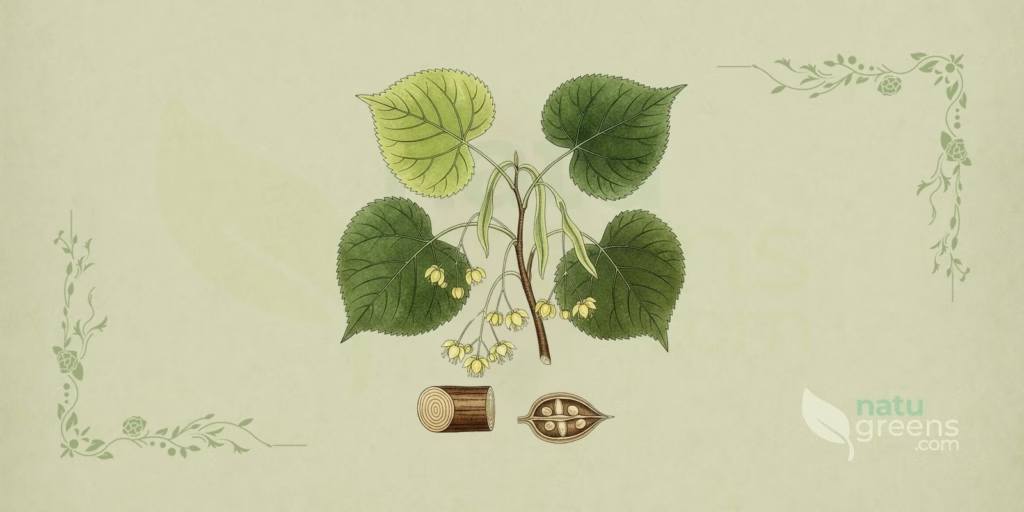
The first thing that catches the eye in the field is the leaf: heart-shaped, broad, with a distinctly asymmetrical base and a margin serrated by sharp, regular teeth. Add to that the membranous bract fused to the peduncle of the inflorescence, and identification becomes practically unmistakable even at a distance, since the bract stays on the branches alongside the dry fruits through much of the winter. Few temperate trees offer such a clean set of characters to anyone learning to recognize woody species.
This profile gathers what the botanical and forestry literature documents about the species: formal classification as confirmed in the reference nomenclatural databases, detailed morphology, distribution and ecological requirements, propagation, phenology, close relatives, the chemical composition described for the genus, ethnographic records and conservation status.
American-basswood ranges from southern Canada down to the mountains of central Mexico.
American-basswood forms stable associations with sugar maple and American beech across the mesophytic forests of the eastern half of the continent.
Taxonomy
The name Tilia americana L. was published by Carl von Linné in 1753, in the first volume of Species Plantarum, page 514. The record is confirmed in the International Plant Names Index, and the taxon stands as an accepted name in Plants of the World Online, maintained by the Royal Botanic Gardens, Kew. The full hierarchy is as follows:
- Kingdom: Plantae
- Division: Magnoliophyta (angiosperms)
- Class: Magnoliopsida (eudicots)
- Order: Malvales
- Family: Malvaceae Juss.
- Subfamily: Tilioideae
- Genus: Tilia L.
- Species: Tilia americana L., 1753
An apparent disagreement between databases deserves a word of explanation. IPNI files the taxon under Tiliaceae because it records the family of the protologue, that is, the one in force when the name was published. The currently accepted circumscription, adopted by POWO and by the APG IV system, moves the lindens into Malvaceae in the broad sense, where they occupy the subfamily Tilioideae alongside Craigia and Mortoniodendron.
The morphological variability of the species across a continental range has produced an extensive synonymy, with more than a hundred recorded names. Among those that turn up most often in the older literature are:
Synonyms
- Tilia ashei Bush
- Tilia caroliniana Mill.
- Tilia glabra Vent.
- Tilia heterophylla Vent.
- Tilia neglecta Spach
- Tilia pubescens Aiton
The infraspecific circumscription remains under discussion. Regional floras and Hardin’s 1990 revision recognize geographic varieties such as var. americana, var. caroliniana, var. heterophylla and var. mexicana, while POWO treats most of those names as synonyms of a single broad and variable species. Anyone working with herbarium material will find both conventions in simultaneous use, which calls for care when reading old labels.
As for etymology, Tilia is the classical Latin name for the lindens, probably related to the Greek ptelea, which was applied to broad-leaved trees. The epithet americana records the geographic origin and sets the species apart from the European and Asian lindens already familiar to eighteenth-century botanists.
Morphological Description
A large deciduous tree with a straight trunk and a broad crown, rounded to slightly oval. The usual height in mature forest falls between 18 and 30 meters, with exceptional individuals passing 37 meters on sites with deep, moist soil. Trunk diameter at breast height generally ranges from 60 to 120 centimeters. The bark is grayish and smooth on young branches, becoming dark with age and deeply furrowed by narrow vertical fissures with flattened ridges. Beneath that outer layer lies the fibrous inner bark, elastic and tough, which accounts for much of the historical importance of the species. Maximum longevity is estimated at more than 200 years, although structural decline rarely sets in before the age of 120.
Leaves
The leaves are alternate, arranged in two ranks along the branch, and provide the most practical diagnostic character of the species:
- Apex: acuminate, ending in a short, sharp point
- Base: cordate and markedly asymmetrical, with one side running further down the petiole than the other
- Length: 10 to 20 centimeters, occasionally up to 25 on vigorous shoots, the largest in the genus
- Lower surface: pale green, glabrous or with tufts of trichomes in the vein axils, densely white-tomentose in the Appalachian populations attributed to var. heterophylla
- Margin: serrate, with regular, sharp, forward-pointing teeth
- Petiole: 3 to 6 centimeters, cylindrical, glabrous to slightly pubescent
- Upper surface: dark green and glabrous
- Venation: palmate at the base, with three to five main veins, becoming pinnate above
- Width: 8 to 15 centimeters
Flowers
The inflorescence is a pendent cyme of six to twenty flowers, carried on a peduncle that fuses lengthwise to a leafy bract 5 to 12 centimeters long, yellowish green and papery in texture. That bract is the most distinctive structure in the genus and serves an aerodynamic function in fruit dispersal. Individual flowers measure 10 to 14 millimeters across, with five sepals, five free oblong petals of a creamy yellow color, and numerous stamens gathered into five bundles. The ovary is superior, pubescent and five-locular. The scent is sweet, intense and noticeable from dozens of meters away at the peak of flowering, which explains the massive attraction of bees and the North American nickname bee-tree.
Fruits and Seeds
The fruit is a dry, indehiscent nutlet, globose to slightly pear-shaped, 6 to 10 millimeters across, covered by a short, dense grayish brown indumentum. The wall is woody and the ribs, when present, are faint. Each nutlet holds one to three seeds. Dispersal is by wind but of modest reach: the persistent bract spins like a propeller and carries the fruit cluster a distance equivalent to one or two tree heights, with gravity and rodents completing the journey. The seeds show double dormancy, combining an impermeable seed coat with embryo dormancy, which delays germination and allows seed banks to build up in the forest soil for a year or more. One kilogram holds between 9,700 and 13,200 fruits.
Root and Stem
Seedlings first develop a taproot, replaced during growth by a system of oblique lateral roots, vigorous and widely spread, complemented by surface roots. Association with ectomycorrhizal fungi is the rule in forest settings. The stem has one decisive ecological peculiarity: it sprouts vigorously from the stump after cutting, windthrow or fire. Practically every tree up to 10 centimeters in diameter resprouts, and the new stems grow faster than any competing seedling, in time forming multi-stemmed clumps around the original stump.
American-Basswood Distribution and Habitat
The native range covers the eastern half of North America. At its northern limit the species reaches southeastern Manitoba, Ontario, Quebec, New Brunswick and New England; to the south and west it extends through the Dakotas, Nebraska, Kansas and northeastern Oklahoma, reaching northern Arkansas, Tennessee, western North Carolina and, in the southern populations often treated as distinct varieties, Texas, Florida and the mountain ranges of central and eastern Mexico. Outside the native range there are records of localized naturalisation in Germany and Uzbekistan, without the species appearing on any list of aggressive invaders.
Typical habitat is mesophytic deciduous forest on rich soils, above all valleys, floodplains and mid slopes. In the formation known as sugar maple and basswood forest, the species holds the position of second dominant alongside Acer saccharum, and it also grows with Betula alleghaniensis, Fagus grandifolia, Fraxinus americana, Quercus rubra and Tsuga canadensis. North-facing and east-facing slopes, cooler and moister, are the preferred ones.
In climatic terms, annual precipitation across the range varies from about 530 millimeters at the western edge of the distribution to roughly 1,140 millimeters in the northeast, with a frost-free period of 80 to 180 days. Best development occurs where July averages fall between 18 and 27 degrees Celsius, and the northern limit roughly follows the January isotherm of minus 18 to minus 17 degrees Celsius. Soils range from sandy to silty clay, with the best performance on fine textures, a pH band between 4.5 and 7.5 and a clear preference for the less acidic to slightly basic substrates, especially those derived from limestone. The commonest soil orders are Alfisols, Inceptisols and Spodosols. As for elevation, the species occurs from sea level up to about 1,500 meters in the southern Appalachians, while the Mexican populations of cloud forest reach bands between 780 and 2,625 meters.
Cultivation
Propagation from seed calls for patience and a two-stage treatment, because dormancy combines the physical barrier of the seed coat with dormancy of the embryo. Nursery practice uses scarification followed by cold stratification at 2 to 5 degrees Celsius for a period that usually runs from 110 to 130 days; even then, epigeal germination commonly occurs only in the second spring after sowing. Ornamental cultivars are multiplied by whip grafting onto seedling rootstocks, since hardwood cuttings root poorly and softwood cuttings reach only moderate rates even with auxins.
Planting requirements follow those of the natural habitat. The tree asks for deep, fertile, moist and well-drained soil, tolerates full sun and some shade in its early years, and withstands harsh winters within hardiness zones 3 to 8. Prolonged subtropical heat, soil compaction, salinity and air pollution are the factors that most limit its performance in urban settings, where life expectancy falls well below the potential of the species. Growth is moderate, with average diameter increment of 3 to 5 millimeters a year in forest stands.
Among the commonest health problems are the eriophyid mite Eriophyes tiliae, responsible for the elongated red galls on the upper leaf surface; the aphid Eucallipterus tiliae, which produces abundant honeydew and encourages sooty mold; assorted defoliators, including beetles and caterpillars; and the linden borer. On the disease side come anthracnose and leaf spots in rainy springs, along with wood rots, to which the soft timber is quite susceptible. Commercial harvest of the timber in managed stands usually takes place between 60 and 80 years, and cutting triggers the stump sprouting that ensures the stock is replaced.
Phenology
Flowering happens in early summer in the northern hemisphere, typically in June, varying from May to July according to latitude and elevation, and lasts about two weeks on each tree. It is a late flowering compared with most of the associated forest trees, which concentrates visitation in a period when other nectar sources have already run dry.
Pollination is by insects and is intense. Honeybees and bumblebees of the genera Apis and Bombus dominate daytime visitation, accompanied by hoverflies and other dipterans, while night-flying moths take over after dusk, drawn by a scent that grows stronger towards evening. Nectar production is exceptional in volume and sustains monofloral honey crops where the species is abundant.
The fruits ripen from September to October and stay attached to the branches into winter, coming loose in staggered fashion. Seed production generally begins around the age of 15, with isolated records from 8 onwards, and heavy crops recur at short intervals, having occurred in about two thirds of the years covered by long-term surveys. Wind dispersal, aided by the bract, is followed by secondary transport by rodents, which also consume a considerable share of the seeds available in the leaf litter.
Related Species and Confusions
The genus Tilia brings together about thirty species spread across the temperate regions of the northern hemisphere, and several of them share space in urban plantings, which multiplies the chances of misidentification. The most reliable points of separation are leaf size, the indumentum of the lower surface and the texture of the fruit:
- Tilia cordata Mill.: much smaller leaves, 5 to 8 centimeters, more leathery, with tufts of rusty trichomes in the vein axils on the lower surface
- Tilia platyphyllos Scop.: leaves as large as those of American basswood, but with soft pubescence spread over the whole lower surface, and fruits with prominent ribs and a rigid wall, against the nearly smooth fruits of the American species
- Tilia tomentosa Moench: lower surface densely white-tomentose, giving a silvery flash when the wind turns the foliage, and a proportionally longer petiole
- Tilia × europaea L.: hybrid between T. cordata and T. platyphyllos, with intermediate characters and a strong tendency to throw up dense shoots at the base of the trunk
Outside the genus, the commonest confusion involves other heart-leaved trees. Telling them apart is straightforward once three characters are read together. Cercis canadensis has entire-margined leaves with a symmetrical cordate base and no serration at all. Species of Catalpa bear opposite or whorled leaves, also entire-margined, whereas basswood has alternate, two-ranked leaves. Mulberries of the genus Morus may have serrate leaves and an asymmetrical base, but they exude white latex when the petiole is broken, something basswood never does. At any time of year the membranous bract fused to the peduncle settles the matter, since none of those trees has one.
One ecological question tied to the genus is also worth recording. The nectar of Tilia tomentosa was long blamed for the mortality of bumblebees found under trees in flower, a hypothesis now disputed by work that attributes the phenomenon to scarcity of resources at the end of the flowering period. The debate remains open in the entomological literature.
Phytochemistry
Chemical characterization of the genus Tilia centres on the flowers and bracts, and most published data come from the European species, above all T. cordata and T. platyphyllos. The profiles described for T. americana follow the pattern of the genus, with quantitative variation between populations and between stages of floral development. The account below is strictly compositional.
- Condensed tannins: oligomeric procyanidins, accumulated above all in the bark and to a lesser degree in the dried flowers
- Essential oil: a volatile fraction of low yield in fresh flowers, on the order of 0.02 to 0.1 percent, with farnesol, geraniol, linalool, citronellol and 2-phenylethanol among the components responsible for the characteristic odor
- Flavonoids: glycosylated derivatives of kaempferol and quercetin, notably tiliroside, which is kaempferol-3-O-(6”-p-coumaroyl)-glucoside, together with astragalin and rutin; concentrated in the flowers and bracts
- Mucilages: hydrophilic polysaccharides, chiefly galactomannans and arabinogalactans, abundant in the flowers and present in the inner bark as well
- Phenolic acids: caffeic, chlorogenic and p-coumaric, present in flowers, bracts and leaves
The wood is poor in extractives, which makes it pale, homogeneous and neutral in odor, characteristics that explain why it is preferred for uses demanding an odorless material. The inner bark combines long cellulose fibers with mucilage, an association that accounts for the flexibility and strength of the material once separated by retting.
History and Ethnobotany
The relationship between the Indigenous peoples of North America and basswood is an old one, documented by ethnography and archaeology alike. Cords identified as Tilia fiber have been recovered from Hopewell tradition sites in Ohio and from Glacial Kame contexts in Canada, which places this use on a scale of millennia. The raw material was the inner bark, the so-called bast, taken in long strips in spring, when the sap was flowing and the bark came away more easily.
Ethnobotanical compilations from the early twentieth century record the use of that fiber among nations such as the Lakota, Menominee, Meskwaki, Ojibwe, Omaha, Pawnee, Ponca and Potawatomi, who turned it into ropes, fishing nets, mats, baskets, sleeping garments and construction lashings. Among the Iroquois, accounts credit the women with spinning the material. In the Ojibwe language the tree carried the name wiigob, a term tied precisely to the fiber drawn from it. The same compilations record the use of the flowers and bark in traditional care settings, though the original accounts described no standardized procedures.
The English common name basswood derives from bast, and not from any connection with fish or with a low musical register, as is sometimes supposed. European settlers took up the Indigenous practice of stripping the fiber and at the same time transferred to the American species the symbolic repertoire of the European lindens, trees central to community life in central Europe, where specimens in the village square sheltered open-air assemblies and courts in the Germanic tradition of the Gerichtslinde. The scientific description fell to Linné in 1753, and the first detailed forestry accounts came with André Michaux, in the Flora Boreali-Americana of 1803, and with his son François-André Michaux, in the Histoire des Arbres Forestiers de l’Amérique Septentrionale, published between 1810 and 1813.
Conservation
The species is assessed as Least Concern, category LC, on the Red List of the International Union for Conservation of Nature, with a global population regarded as stable. The range is vast, the species is abundant across much of it, and stump sprouting ensures persistence even in forests subject to selective cutting. It appears in no CITES appendix.
That reassuring global picture coexists with far more delicate local situations. The Mexican populations, treated as Tilia americana var. mexicana, are confined to fragmented patches of montane cloud forest and appear in the Mexican official standard NOM-059 under the category of species in danger of extinction. Cloud forest is one of the most threatened ecosystems in the country, which deepens the reproductive isolation of those nuclei.
Across the rest of the range, the documented pressures are the conversion of mature forest to agriculture and urban use, heavy browsing by overabundant deer, which suppresses seedling regeneration over large areas of the eastern United States, and the chronic stress of trees planted in compacted sidewalks and planting beds. The species does not appear among the plants toxic to dogs, cats and horses in the ASPCA reference database. Even so, eating leaves, bracts or fruits in quantity can cause gastrointestinal discomfort in pets, as happens with any foliage that is not part of their usual diet.
Interesting Facts
- A name that came from fiber: basswood is a corruption of bast, the English term for the fibrous inner bark, and bears no relation to the fish called bass or to a low musical register
- Bee-tree: a single mature tree in full flower sustains an audible cloud of visitors, and the monofloral honey produced from it is a recognized and valued product on the North American market, pale in color and delicate in flavour
- Botanical propeller: the bract fused to the peduncle is a textbook case of a leaf structure recruited for an aerodynamic function, spinning like a rotary wing when the fruit cluster comes loose
- Carver’s wood: light, soft, fine and even in grain and practically odorless, the timber is the favorite for hand carving, blinds, beehive frames and the bodies of musical instruments
- Century-old clumps: the rings of stems that form around old stumps are clones of the original individual, and the genetic lineage of one such clump can be far older than any trunk visible in it
Notice: this content is for informational purposes and does not replace professional medical advice. Consult a physician or herbal practitioner before using medicinal plants, especially during pregnancy, breastfeeding, or alongside medication.
References and Scientific Studies
View All 11 Cited References
Peer-Reviewed Scientific Studies (2)
- DOI1990 Hardin, J. W. Variation patterns and recognition of varieties of Tilia americana s.l. Systematic Botany, 15(1), 33-48. 1990. ↗
- DOI2012 Pigott, C. D. Lime-trees and Basswoods: A Biological Monograph of the Genus Tilia. Cambridge University Press. 2012. ↗
Institutional Sources (2)
- GOV1990 USDA Forest Service. Tilia americana L., American basswood. In: Silvics of North America, vol. 2, Hardwoods. Agriculture Handbook 654. Washington. 1990. ↗
- GOV USDA Forest Service. Tilia americana, American basswood. Fire Effects Information System. Rocky Mountain Research Station. ↗
Supplementary Readings (7)
- ASPCA. Linden (Tilia americana). Toxic and Non-Toxic Plants. ↗
- 2015 Flora of North America Editorial Committee. Tilia L. Flora of North America North of Mexico, vol. 6. Oxford University Press. 2015. ↗
- International Plant Names Index (IPNI). Tilia americana L. Royal Botanic Gardens, Kew; Harvard University Herbaria; Australian National Botanic Gardens. ↗
- IUCN. The IUCN Red List of Threatened Species. International Union for Conservation of Nature. ↗
- Linnaeus, C. Species Plantarum, vol. 1, p. 514. Stockholm. 1753. ↗
- Plants of the World Online (POWO). Tilia americana L. Royal Botanic Gardens, Kew. ↗
- 2010 SEMARNAT. Norma Oficial Mexicana NOM-059-SEMARNAT-2010, Protección ambiental, especies nativas de México de flora y fauna silvestres. Diario Oficial de la Federación. Mexico. 2010. ↗