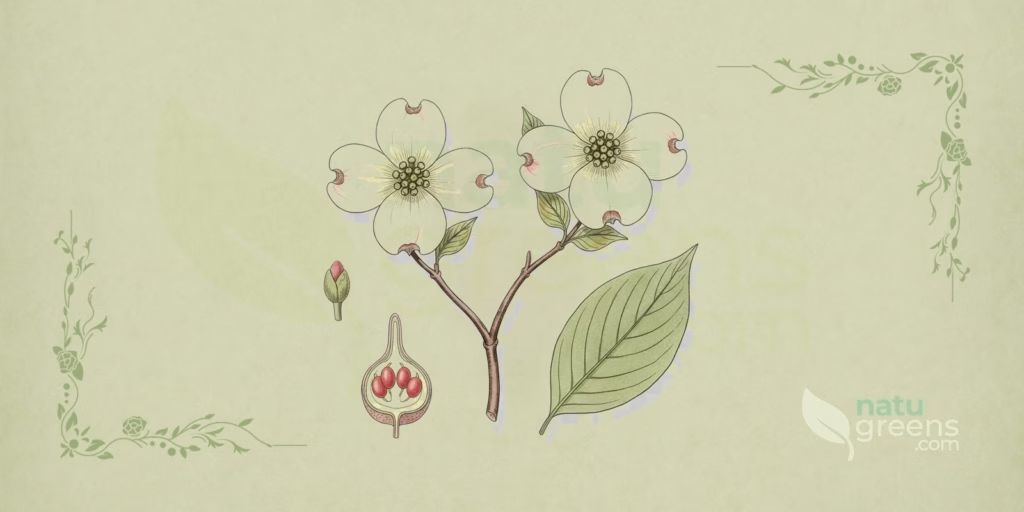
Cornus florida L. / Flowering Dogwood, also popularly known as American dogwood, is an ornamental tree species of the Cornaceae family. This plant is native to eastern North America and northern Mexico, and its original range extended from coastal southern Maine to northern Florida and west into eastern Texas, Oklahoma, and Kansas. It is frequently cultivated in residential and public areas thanks to its showy bracts and the interesting structure of its bark. The beauty of the flowering dogwood is appreciated in many cultures.
Popular and International Names of Flowering Dogwood
- English: flowering dogwood, American dogwood, Florida dogwood, Indian arrowwood, Cornelian tree, white cornel, white dogwood, false box, false boxwood.
- Spanish: cornejo florido.
- Portuguese: corniso-da-flórida, dogwood-florido, corniso-florido.
- French: cornouiller à grandes fleurs, cornouiller de Floride.
- Italian: corniolo da fiore.
- German: Blumen-Hartriegel.
Botanical Synonyms of Flowering Dogwood
The taxonomy of Cornus florida L. presents some relevant botanical synonyms. These names were applied in different periods or by different classifications, and understanding them is important for botanical research. They help identify the plant across various scientific sources, and in this way accuracy in documentation is ensured.
- Benthamidia florida (L.) Spach
- Cornus candidissima Mill.
- Cornus urbiniana Rose
- Cynoxylon floridum (L.) Britton & Shafer
- Swida candidissima (Mill.) Small
Botanical Family: Cornaceae
Cornus florida belongs to the Cornaceae family, a group composed of trees and shrubs. The species of the Cornaceae family are known for their hard wood and ornamental beauty, and many of them are valued in landscaping. Concentrated in the temperate regions of the northern hemisphere, the family gathers about a hundred species, of which the flowering dogwood is a notable example.
Parts of Flowering Dogwood Used
- Bark (from the root and trunk)
- Flowers
- Leaves
- The fruits are not used: they are poisonous to humans and must not be consumed in any preparation
Ethnobotanical and Traditional Uses of Flowering Dogwood
Cornus florida has a rich history of ethnobotanical use, since several indigenous communities of North America employed this plant. Its medicinal properties were widely recognized, and the root bark was used as an astringent and analgesic. It also served as an antidiarrheal and febrifuge, while the trunk bark was applied to relieve headaches and back pain. In the form of an infusion, it was also used for throat problems and measles.
The flowers, in turn, were employed to relieve colic and reduce fever. The Houma people, now settled in southern Louisiana and originally from the banks of the Mississippi River, used bark shavings or roots as a remedy for malaria, using it as a stand-in for quinine during periods when the medicine was scarce, though its effectiveness against the parasite was never demonstrated. Other uses included increasing strength and stimulating the appetite, and the plant was considered a general tonic. Curiously, the bark was also used to treat mange in dogs, a fact that may have contributed to the popular name dogwood. Popular tradition also attributes to it a role in cleaning ulcers, although this last application lacks robust scientific validation.
Therapeutic Properties of Flowering Dogwood
Cornus florida has been the subject of scientific studies that investigate its therapeutic properties, and the plant demonstrates promising biological activities. It has anti-inflammatory action, inhibiting the COX-1 and COX-2 enzymes, and it also shows remarkable antioxidant potential. Preliminary studies suggest antidiabetic and lipid-lowering effects, along with moderate antiplasmodial and antileishmanial activity seen only in laboratory assays and with no bearing on the treatment of either disease. The astringent, analgesic, and antidiarrheal properties are confirmed. It also acts as a febrifuge, reducing fever, and neuroprotective and immunomodulatory potential has been observed in other Cornus species. Thus, these properties may extend to Cornus florida, and research continues to reveal the vast potential of this plant.
- Analgesic (relieves pain)
- Antidiabetic (helps control blood sugar); traditional use, without established clinical efficacy
- Antidiarrheal (fights diarrhea)
- Anti-inflammatory (reduces inflammation)
- Antileishmanial (moderate activity observed only in the laboratory, with no use in treating leishmaniasis)
- Antioxidant (fights free radicals)
- Antiplasmodial (moderate activity observed only in the laboratory, with no use in treating malaria)
- Antipyretic (reduces fever)
- Astringent (contracts tissues and blood vessels)
- Hypolipidemic (lowers blood fat levels); traditional use, without established clinical efficacy
- Immunomodulatory (modulates the immune system); traditional use, without established clinical efficacy
- Neuroprotective (protects the nervous system); traditional use, without established clinical efficacy
Detailed Phytochemical Profile of Flowering Dogwood
Cornus florida is rich in various phytochemical compounds that contribute to its medicinal properties. The plant contains iridoids, such as cornin, a bitter glycoside characteristic of the genus, along with loganic acid, loganin, sweroside, and cornuside. Flavonoids are abundant, most notably quercetin-3-O-α-L-arabinosyl-glucoside and quercetin-3-O-galactoside, while quercetin hexoside, kaempferol hexoside, and quercetin (6″-O-malonyl)-3-O-β-D-glucoside are also present. The fruits are a source of anthocyanins, such as cyanidin-3-O-galactoside and cyanidin-3-O-glucoside.
Delphinidin-3-O-glucoside and pelargonidin-3-O-glucoside are also found, together with phenolic acids such as gallic acid, ellagic acid, and tetragalloylglucose. Tannins contribute to the plant’s astringency, while triterpenoids, such as ursolic acid, oleanolic acid, lupeol, and betulinic acid, are found in other Cornus species and probably in C. florida. The leaves stand out for the calcium they accumulate, a trait that gives the species a recognized role in the nutrient cycling of forest soils. This complex chemical composition justifies its traditional use and the scientific interest it attracts.
- Betulinic acid (presence presumed, described in other Cornus species)
- Cornin (verbenalin)
- Cornuside
- Cyanidin-3-O-galactoside
- Cyanidin-3-O-glucoside
- Delphinidin-3-O-glucoside
- Ellagic acid
- Gallic acid
- Kaempferol hexoside
- Loganic acid
- Loganin
- Lupeol (presence presumed, described in other Cornus species)
- Oleanolic acid (presence presumed, described in other Cornus species)
- Pelargonidin-3-O-glucoside
- Quercetin (6″-O-malonyl)-3-O-β-D-glucoside
- Quercetin hexoside
- Quercetin-3-O-α-L-arabinosyl-glucoside
- Quercetin-3-O-galactoside
- Sweroside
- Tannins
- Tetragalloylglucose
- Ursolic acid (presence presumed, described in other Cornus species)
Preparation and Administration Forms of Flowering Dogwood
- Compresses
- Decoction
- Infusion
- Poultice
- Tincture
Synergy with Other Medicinal Plants
Traditional Combinations
Cornus florida has traditionally been used in synergy with other plants, and the combination with sassafras (Sassafras albidum) is a notable example. This mixture was employed to clean ulcers and, in some cases, to treat cancer. However, it is essential to point out that these applications lack robust scientific validation. Modern research has not yet confirmed the effectiveness of these synergies, so prudence is advisable when considering such uses.
Popular tradition, however, values these combinations, because they represent ancestral knowledge about plants. Scientific exploration may still reveal new potentials in them, so research is crucial to validate these uses. It should be added, though, that sassafras contains safrole, a hepatotoxic compound classified as a carcinogen in animal studies and banned as a food additive in several countries. Safety comes first in phytotherapy: this traditional combination should not be reproduced, and a qualified healthcare professional should always be consulted.
Recipes and Usage Protocols of Flowering Dogwood
Bark Decoction for Fevers
Ingredients: 10 to 15 grams of dried Cornus florida bark (root or trunk), 500 ml of water.
Preparation: Place the bark and water in a pan, bring to a boil, and let simmer for 15 to 20 minutes. Strain the decoction, let it cool, and consume 100 to 150 ml, two to three times a day. This preparation has a traditional record for fever, pain, and diarrhea. A fever above 38.5 degrees, a fever lasting more than three days, bloody diarrhea, or signs of dehydration call for medical care and must not be managed with teas. The root bark is particularly effective, since the decoction concentrates the plant’s active principles. It is important to follow the recommended dosages and to consult a healthcare professional before starting any treatment.
Bark Tincture for Pain
Ingredients: 50 grams of dried Cornus florida bark (root or trunk), 250 ml of 70% grain alcohol.
Preparation: Grind the bark, place it in a dark glass jar, and cover with the alcohol. Seal the jar tightly, shake daily, and let it macerate for 14 days in a cool, dark place. After this period, strain the tincture and store it in a dark glass bottle. Take 20 to 30 drops diluted in water, twice a day. This tincture is used for headaches and back pain, and it can also act as a general analgesic. Because the concentration of active principles is higher in the tincture, the dosage must be precise. A specialist should be consulted before use, since self-medication can be dangerous.
Floral Infusion for Colic
Ingredients: 1 teaspoon of dried Cornus florida flowers, 200 ml of boiling water.
Preparation: Place the flowers in a cup, add the boiling water, and cover. Let steep for 5 to 7 minutes, then strain and drink warm. This infusion is traditionally used to relieve colic pain, since the flowers have calming properties. It is a gentle way to take advantage of the plant’s benefits, though moderation is essential. Do not exceed the recommended dose, and seek medical advice if symptoms persist.
Associated Therapies
Clinical Phytotherapy
In clinical phytotherapy, Cornus florida appears mainly in artisanal bark preparations; no standardized extracts are established, and the available research concentrates on other species of the genus. The plant is employed as a natural anti-inflammatory, and it also acts as an astringent and febrifuge. Its application is individualized, taking into account the patient’s profile and possible drug interactions. Modern research validates many of its traditional uses, but the supervision of a professional is indispensable. Safety and effectiveness are always priorities, and phytotherapy offers a complementary approach. It can be integrated with conventional treatments, always with proper medical guidance.
Contraindications and Side Effects of Flowering Dogwood
Drug Interactions
Cornus florida can interact with certain medications, and its biological properties make caution necessary. Patients taking anticoagulants should pay attention, because the plant may potentiate their effects. Individuals with diabetes should monitor their blood sugar, since Cornus florida may have hypoglycemic effects. Anyone taking anticoagulants or diabetes medication should tell their doctor, since data on this plant’s interactions remain scarce, and you should never self-medicate without professional advice.
General Contraindications
Cornus florida, although beneficial, has important contraindications, starting with the fruits, which are poisonous to humans. Their consumption must be strictly avoided, and individuals with a known allergy to plants of the Cornaceae family should refrain from use. Allergic reactions may occur, ranging from mild to severe, and pregnant or breastfeeding women should avoid use. Safety for these groups has not been established, and young children should also avoid contact. Consulting a healthcare professional and seeking medical guidance before any use is always recommended.
Historical Notes and Interesting Facts about Flowering Dogwood
The wood of Cornus florida is remarkably hard and dense, which is why it was widely used in the manufacture of various objects. Among them, weaving shuttles and tool handles stand out, and mallets and butcher blocks were also made from this resistant wood. During the American Civil War, the bark of the flowering dogwood played a crucial role.
It served as a stand-in for quinine whenever the medicine ran short, a substitution dictated by scarcity rather than by proven efficacy. The popular name dogwood may have a curious origin, since some believe it derives from the use of the bark to treat mange in dogs. This practice was common at the time, and Cornus florida is a symbol in several American states. It is the state tree and flower of Virginia, as well as the state tree of Missouri. It is also the state flower of North Carolina, and these historical and cultural facts enrich its relevance.
The specific epithet florida means flowering in Latin and carries no reference to the state of Florida, which covers only the southern edge of the tree’s range. The species is listed as threatened on the IUCN Red List because of the anthracnose caused by the fungus Discula destructiva, which argues against harvesting bark from wild trees.
Frequently Asked Questions about Flowering Dogwood
Is Flowering Dogwood Safe for Human Consumption?
The fruits of Cornus florida are poisonous to humans, and their consumption must be avoided at all costs. However, other parts of the plant, such as the bark and flowers, have traditionally been employed for medicinal purposes. It is crucial to differentiate the safe parts from the dangerous ones. The use of any part of the plant must be done with extreme caution, always under the guidance of a qualified healthcare professional. Self-medication is not recommended, so specialized advice should always be sought before use.
What Are the Main Medicinal Uses of Flowering Dogwood?
Cornus florida is traditionally known for several medicinal properties, acting as a febrifuge that helps to reduce fever. It also has analgesic action, relieving pain, and it is an effective antidiarrheal with astringent properties. Modern studies indicate anti-inflammatory and antioxidant potential, and some laboratory research reports moderate antiplasmodial and antileishmanial activity, which does not translate into any use against malaria or leishmaniasis. These properties justify its use in various conditions, but its application must be evidence-based. It should always be carried out with the supervision of a healthcare professional.
Are There Side Effects Associated with the Use of Flowering Dogwood?
Yes, there are side effects and contraindications, beginning with the fruits, which are poisonous to humans. Their consumption can cause serious adverse reactions, and people with allergies to plants of the Cornaceae family may have allergic reactions. Pregnant or breastfeeding women should avoid use, and the plant can interact with anticoagulant medications. It can also affect blood sugar levels in diabetics. It is vital to consult a healthcare professional, who will be able to assess the risks and benefits.
How Do I Prepare Flowering Dogwood for Medicinal Use?
The most common forms of preparation include decoctions and infusions, with the decoction made by boiling the bark in water. This method is used to extract the active compounds, while infusions are prepared with flowers or bark in hot water. Tinctures, which involve macerating the bark in alcohol, are also an option, and poultices and compresses are used topically. It is essential to follow the specific recipes and dosages, because the concentration of active principles varies according to the method. The guidance of a healthcare professional is crucial to ensure safe preparation and use, and self-medication is not recommended.
Where Can I Find Reliable Information About Flowering Dogwood?
Reliable information can be found in various sources, and scientific articles and botanical databases are excellent resources. Books on phytotherapy and ethnobotany are also valuable, and websites of research institutions and universities offer accurate data. It is important to verify the credibility of the source and to avoid unverified information or information of dubious origin. Always consult qualified healthcare professionals, who can provide personalized guidance, because thorough research is essential for safe and effective use.
Notice: this content is for informational purposes and does not replace professional medical advice. Consult a physician or herbal practitioner before using medicinal plants, especially during pregnancy, breastfeeding, or alongside medication.
References and Scientific Studies
Peer-Reviewed Scientific Studies (4)
- PEER2024 Badoni, S., et al. (2024). Therapeutic Potential of Cornus Genus: Navigating Phytochemistry, Pharmacology, Clinical Studies, and Advanced Delivery Approaches. Chemistry & Biodiversity.
- PEER2006 Vareed, S. K., et al. (2006). Anthocyanins in Cornus alternifolia, Cornus controversa, Cornus kousa and Cornus florida fruits with health benefits. Phytochemistry.
- PMC2022 Khan, A., et al. (2022). Phytochemical Profiling, Anti-Inflammatory, Anti-Oxidant, Anti-Diabetic, and Anti-Cancer Potential of Cornus macrophylla. Molecules.
- PEER Miller, E. R. (1928). Cornin: A glucoside from Cornus florida L. Journal of the American Pharmaceutical Association.
Supplementary Readings (3)
- 2018 Stritch, L. (2018). Cornus florida. IUCN Red List of Threatened Species.
- 2006 Wennerberg, S. (2006). Plant Guide: Flowering dogwood Cornus florida. N.R.C.S. United States Department of Agriculture. Baton Rouge, LA.
- 2020 Truba, J., et al. (2020). Inhibition of Digestive Enzymes and Antioxidant Activity of Extracts from Fruits of Cornus alba, Cornus sanguinea subsp. hungarica and Cornus florida – A Comparative Study. Plants.