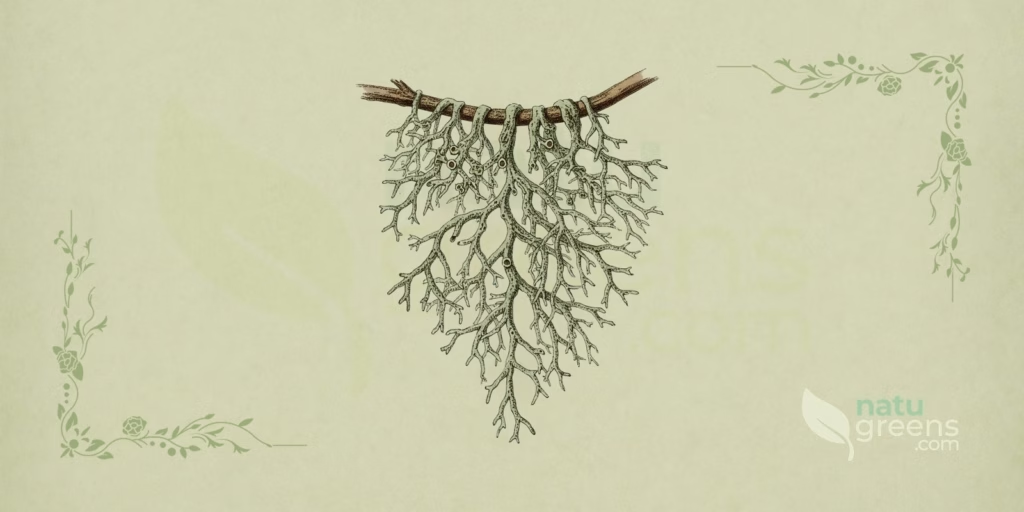
Usnea barbata (L.) Weber ex F.H.Wigg. / Old Man’s Beard, also known as beard lichen, is a fruticose lichen of the Parmeliaceae family. It was described by Carl Linnaeus as Lichen barbatus and transferred to the genus Usnea by Friedrich Heinrich Wiggers in 1780. This symbiotic organism, composed of a fungus and an alga, is native to temperate, humid forests around the world. Its distinctive appearance, resembling a long grayish-green beard hanging from tree branches, gives it a prominent place in the landscape and in traditional medicine. Old man’s beard has been used for centuries in many cultures, from Native Americans to practitioners of traditional Chinese medicine, for its remarkable medicinal properties.
In the European herbal tradition, Usnea barbata is valued for its potent antimicrobial and immune-stimulating qualities. Its historical applications range from the treatment of respiratory infections to wounds and skin problems. The lichen is recognized for its rich phytochemical composition, most notably usnic acid, a compound with strong antibiotic activity. Modern scientific research has been confirming many of its traditional uses, validating its role as a valuable phytotherapeutic resource and consolidating its importance in the global natural pharmacopoeia.
Popular and International Names of Old Man’s Beard
- English: old man’s beard, beard lichen, tree moss, witch’s hair.
- Spanish: barba de viejo, barba de capuchino, musgo de árbol.
- Portuguese: barba-de-velho, barba-de-pau (BR), líquen-barbudo, musgo-barbado.
- French: barbe de vieillard, mousse d’arbre, usnée barbue.
- Italian: barba di bosco, muschio d’albero, usnea barbata.
- German: Bartflechte, Baumbart, Greisenbart.
- Chinese (TCM): song luo.
Taxonomic Synonyms of Old Man’s Beard
Lichen barbatus L. is the original basionym described by Carl Linnaeus. Over time, the taxonomic complexity of the genus Usnea led to the publication of numerous synonyms, many of which are today considered morphological variations or chemotypes of the same species. Phylogenetic and chemical studies continue to refine the classification, but intraspecific variability remains a challenge.
Usnea florida var. barbata (L.) Willd. Names such as Usnea dasopoga and Usnea plicata, once treated as synonyms, correspond today to Usnea filipendula, a separate species.
Classification and Family: Parmeliaceae
The Parmeliaceae family is one of the largest and most diverse families of lichens, with more than 2,700 species distributed across about 80 genera. Members of this family are found in almost all terrestrial ecosystems, from polar to tropical regions. They are characterized by a wide variety of growth forms, including foliose, fruticose, and crustose. The symbiosis between the fungus (mycobiont) and the alga or cyanobacterium (photobiont) allows them to colonize substrates such as rocks, soil, and tree bark.
The Parmeliaceae family is notable for its complex secondary chemistry, producing a wide range of lichen acids with important biological properties, including antimicrobial, anti-inflammatory, and antitumor activities. Genera such as Usnea, Parmelia, and Cetraria are of great ethnobotanical and pharmacological importance, being used in traditional medicine, as natural dyes, and as bioindicators of air quality.
Parts of Old Man’s Beard Used
- Fresh thallus
- Whole lichen (dried thallus)
Ethnobotanical and Traditional Uses of Old Man’s Beard
- Abscesses and boils
- Asthma and bronchitis
- Fever and colds
- Fungal infections (candidiasis, athlete’s foot)
- Sore throats and pharyngitis
- Treatment of wounds and skin ulcers
- Urinary infections
- Vaginal infections
Therapeutic Properties of Old Man’s Beard
- Analgesic (relieves pain)
- Antibacterial (fights bacteria, especially Gram-positive); traditional use, without established clinical efficacy
- Antifungal (fights fungal infections)
- Anti-inflammatory (reduces inflammation)
- Antiproliferative (under study, with inhibition of tumor cell growth observed only in the laboratory)
- Antipyretic (reduces fever)
- Antiviral (fights viruses); traditional use, without established clinical efficacy
- Expectorant (helps expel mucus)
- Immunostimulant (stimulates the immune system); traditional use, without established clinical efficacy
- Vulnerary (promotes wound healing)
Detailed Phytochemical Profile of Old Man’s Beard
- Barbatic acid
- Diffractaic acid
- Evernic acid
- Lobaric acid
- Norstictic acid
- Polysaccharides (with immunostimulant action)
- Salazinic acid
- Usnic acid (main bioactive constituent)
Preparation and Administration Forms of Old Man’s Beard
- Alcohol extract (tincture)
- Compresses
- Decoction
- Infusion (tea)
- Poultice
- Powder
Synergy with Medicinal Plants
Respiratory Infections
Combining old man’s beard with echinacea (Echinacea purpurea) and elderberry (Sambucus nigra) creates a powerful immunostimulant and antiviral formula. The usnic acid of Usnea acts synergistically with the polysaccharides of echinacea and the flavonoids of elderberry to fight upper respiratory tract infections, such as colds and flu, relieving congestion and sore throat.
Topical Applications
In skin preparations, old man’s beard pairs with calendula (Calendula officinalis) for the care of superficial cuts and abrasions. The vulnerary and anti-inflammatory properties of calendula accompany the antimicrobial action of Usnea. Comfrey should be left out of these formulas: its pyrrolizidine alkaloids are hepatotoxic and should not be applied to broken skin.
Urinary Health
For urinary tract infections, old man’s beard can be paired with bearberry (Arctostaphylos uva-ursi) and juniper (Juniperus communis). The antibacterial action of usnic acid complements the antiseptic effect of the arbutin in bearberry and the diuretic action of juniper, helping to eliminate bacteria and reduce irritation of the bladder and urethra.
Recipes and Usage Protocols of Old Man’s Beard
Antibacterial Tincture
Ingredients: 1 part dried old man’s beard, 5 parts 50% alcohol (vodka or brandy).
Preparation: Place the lichen in a glass jar and cover with the alcohol. Seal tightly and let macerate for 4 to 6 weeks in a dark place, shaking daily. Strain and store in a dark glass bottle. Take 20 to 40 drops diluted in water, 2 to 3 times a day, for short periods and under professional guidance. The tincture does not treat systemic infections, which are medical emergencies, and continuous use should be avoided because of the liver risk from usnic acid.
Decoction for Respiratory Infections
Ingredients: 1 tablespoon of dried old man’s beard, 500 ml of water.
Preparation: Simmer the lichen in the water for 15 to 20 minutes over low heat. Strain and drink 1 to 2 cups a day. This decoction helps relieve coughs and sore throats and fights the underlying infection. It can be sweetened with honey, which also has antibacterial properties.
Gargle for Sore Throat
Ingredients: 1 teaspoon of old man’s beard tincture, 1 glass of warm water.
Preparation: Dilute the tincture in the warm water. Gargle for 30 to 60 seconds, 3 to 4 times a day. The antimicrobial and anti-inflammatory action of Usnea provides fast relief from pain and inflammation in the throat.
Infusion for Urinary Health
Ingredients: 1 teaspoon of dried old man’s beard, 250 ml of boiling water.
Preparation: Pour the boiling water over the lichen and let steep for 10 to 15 minutes. Strain and drink up to 3 cups a day. This infusion is a traditional remedy for mild urinary discomfort and does not treat a urinary infection, which requires diagnosis and antibiotics. Seek medical care for burning on urination, fever, lower back pain, or blood in the urine.
Powder for Superficial Abrasions
Ingredients: Dried old man’s beard.
Preparation: Grind the dried lichen into a fine powder and apply it only to clean, superficial abrasions, never to deep or puncture wounds or to wounds that are already infected. Material prepared at home is not sterile. Spreading redness, pus, increasing pain, or fever call for immediate medical care.
Associated Therapies
Clinical Phytotherapy
In clinical phytotherapy, Usnea barbata is used in the form of standardized extracts, tinctures, and capsules mainly in topical formulations and respiratory support protocols. The activity of usnic acid against Gram-positive bacteria has been observed in the laboratory and does not replace antibiotics in any infection, resistant or not; the documented activity is mainly against staphylococcal and streptococcal infections. It is commonly prescribed in protocols for respiratory, urinary, and gynecological health, often in combination with other immunostimulant and antimicrobial plants for a synergistic effect.
Traditional Chinese Medicine (TCM)
In TCM, Usnea (known as song luo) is classified as an herb that clears heat and detoxifies. It is used to treat coughs with yellow expectoration, sore throats, and skin infections. Its cold, bitter nature allows it to act on the Lung and Liver meridians, eliminating toxic heat and dampness.
Contraindications and Side Effects of Old Man’s Beard
Common Side Effects
When used topically, Usnea can cause contact dermatitis in sensitive individuals. Oral consumption may, in rare cases, cause gastrointestinal discomfort. The most significant risk is associated with the consumption of weight-loss supplements containing high concentrations of usnic acid, which have been linked to cases of acute liver failure. Traditional use and homemade preparations, which contain lower concentrations, are generally considered safer.
Drug Interactions
Due to its potential hepatotoxicity, Usnea should not be combined with other hepatotoxic medications or with excessive alcohol consumption. Caution is advised when combining it with drugs metabolized by the liver, although there are no conclusive studies on specific interactions.
General Contraindications
The use of Usnea barbata is contraindicated during pregnancy and breastfeeding due to the lack of safety studies. Individuals with pre-existing liver disease should avoid oral consumption of Usnea preparations, as usnic acid, in high doses, has been associated with hepatotoxicity. People with a known allergy to lichens should avoid its use.
Historical Notes and Interesting Facts
- Herbal tradition credits Usnea with a role as a field dressing in nineteenth-century conflicts, although documented records of that use are scarce.
- Historically, due to its fibrous, absorbent texture, Usnea was used as material for wound dressings and even as diapers for babies by some Native American tribes.
- Old man’s beard is an excellent bioindicator of air quality. Its abundant presence indicates an environment with little air pollution, especially sulfur dioxide.
- Some bird species incorporate old man’s beard into their nests, using its long fibers to structure and camouflage the construction.
Frequently Asked Questions about Old Man’s Beard
Is Old Man’s Beard Tea Safe for Daily Consumption?
Daily consumption in moderate doses is generally considered safe for most people. However, due to the presence of usnic acid, intermittent use is recommended (for example, for 2 to 3 weeks, followed by a break) instead of continuous long-term use, especially for internal use. The same rule applies to every internal preparation described in this article, including the tincture, which should not be used preventively or for long stretches.
Can I Harvest Old Man’s Beard Directly from Nature?
Yes, but it is crucial to identify the species correctly and harvest sustainably. Collect only lichens that have fallen from trees after a storm, or harvest small amounts from abundant areas. Make sure the harvesting area is not polluted, as lichens absorb toxins from the environment.
What Is the Difference Between Old Man’s Beard and Spanish Moss?
Despite their similar appearance, they are completely different organisms. Old man’s beard (Usnea barbata) is a lichen, while Spanish moss (Tillandsia usneoides) is a flowering plant of the bromeliad family. Although both are epiphytes, their properties and uses are distinct.
Notice: this content is for informational purposes and does not replace professional medical advice. Consult a physician or herbal practitioner before using medicinal plants, especially during pregnancy, breastfeeding, or alongside medication.
References and Scientific Studies
Peer-Reviewed Scientific Studies (2)
- DOI2002 Ingólfsdóttir, K. “Usnic acid.” Phytochemistry, 61(7), 729-736. 2002. ↗.
- DOI2008 Guo, L., Shi, Q., Fang, J. L., et al. “Review of usnic acid and Usnea barbata toxicity.” Journal of Environmental Science and Health, Part C, 26(4), 317-338. 2008. ↗.
Supplementary Readings (3)
- 2021 Engle, D. M., & Lumbsch, H. T. “Systematics and evolution of the lichen genus Usnea (Parmeliaceae, Ascomycota).” Journal of Systematics and Evolution. 2021.
- 2011 Gupta, V. K., Gupta, M., & Sharma, R. “Usnea barbata: A potential antimicrobial and anticancer drug.” International Journal of Pharmaceutical Sciences and Research. 2011.
- 2011 Pawar, N., & D’Mello, P. “A comprehensive review on Usnea barbata.” International Journal of Nutrition, Pharmacology, Neurological Diseases. 2011.