



Quick summary
Balanites aegyptiaca (L.) Delile, known in English as desert date, is a thorny tree of the Zygophyllaceae family that grows wild across the drylands of Africa south of the Sahara, from the Sahel to the Rift Valley, as well as in the Arabian Peninsula, the Middle East and arid parts of India such as Rajasthan and…
Main caution: The desert date is rich in steroidal saponins, among them diosgenin glycosides, and has a history of traditional use in the Sahel and Egypt, but the absence of human safety studies sets clear limits. Its use is…
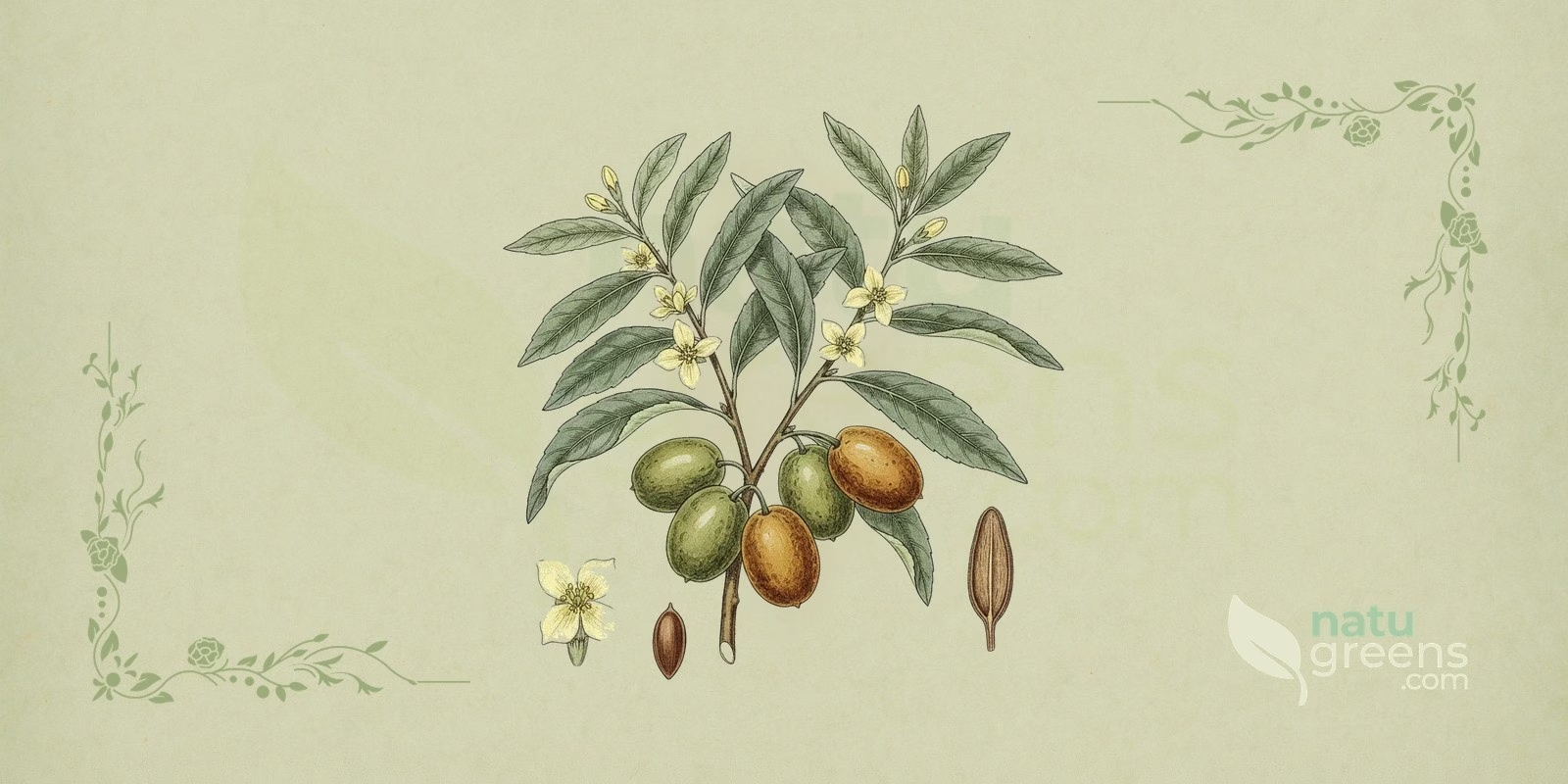
Balanites aegyptiaca (L.) Delile, known in English as desert date, is a thorny tree of the Zygophyllaceae family that grows wild across the drylands of Africa south of the Sahara, from the Sahel to the Rift Valley, as well as in the Arabian Peninsula, the Middle East and arid parts of India such as Rajasthan and Gujarat. Its edible fruit, the oil pressed from its kernel and several other parts of the tree have belonged to the diet and folk medicine of peoples in the Sahel, Sudan and Egypt for generations, and the species has drawn a great deal of research because of the steroidal saponins it concentrates, including those derived from diosgenin. Almost everything known about its effects comes from laboratory and animal experiments, with only one small pilot clinical study in people, so no benefit can be considered proven and any use calls for extra caution, above all during pregnancy.
Common and International Names of the Desert Date
- Arabic: heglig (hijlīj), with lalob used for the fruit in Sudan
- English: desert date, Egyptian balsam, soapberry tree, thorn tree
- French: balanite, dattier du désert, hagueleg
- German: Wüstendattel
- Hausa: aduwa
- Hindi: hingol, hingot, hingota
- Portuguese: tâmara-do-deserto
- Sanskrit (Ayurveda): dirghakantaka, ingudi, tapasa vriksha
Not to Be Confused with the Date Palm
Despite its common name, the desert date is not related to the true date palm (Phoenix dactylifera), a palm of the Arecaceae family whose fruits are the dates sold in markets and grocery stores. The nickname arose because the fruit of Balanites, an elongated drupe that turns yellow as it ripens and has a bittersweet pulp, loosely resembles a date, but the likeness ends there: the tree is thorny, its leaves are made up of two leaflets, and inside the fruit sits an extremely hard woody stone surrounded by a saponin-rich pulp that leaves a distinctive bitter aftertaste. Anyone looking for information on ordinary dates should consult the date palm profile instead, since the composition, uses and precautions are entirely different.
Botanical Synonyms of the Desert Date
The accepted name is Balanites aegyptiaca (L.) Delile. Linnaeus originally described the species as Ximenia aegyptiaca L., its basionym, and it was later moved to the genus Balanites by Alire Raffeneau Delile, the botanist of the French expedition to Egypt at the end of the eighteenth century. Synonyms recorded in the literature include Agialida barteri Tiegh., Agialida senegalensis Tiegh., Agialida tombuctensis Tiegh., Balanites latifolia (Tiegh.) Chiov. and Balanites ziziphoides Mildbr. & Schltr. Some older classification systems, such as Cronquist's, placed the genus in a family of its own, Balanitaceae, but current phylogenetic classification keeps it within Zygophyllaceae.
Botanical Family: Zygophyllaceae
The Zygophyllaceae family brings together plants adapted to hot, dry environments, many of them with compound leaves bearing few leaflets, woody stems and strong tolerance of drought. Its members include lignum vitae (Guaiacum officinale), famous for its extremely dense wood, the creosote bush of the North American deserts (Larrea tridentata) and tribulus (Tribulus terrestris), a creeping plant with spiny fruits that is often found in supplements. The desert date is a shrub or tree reaching about 10 meters, with a rounded crown, grey to dark brown, deeply fissured bark and branches armed with green or yellowish thorns that can exceed 8 centimeters. Its small, fragrant, greenish yellow flowers appear in clusters in the leaf axils and are pollinated by insects, while the seeds are dispersed after the fruit is eaten by birds, goats and camels.
Parts Used of the Desert Date
In folk tradition nearly the whole tree finds some use. The pulp of the ripe fruit, the mesocarp, is the part most widely consumed, both as food and in home preparations, and the kernel inside the stone yields an edible oil that is also applied to the skin. The leaves, stem bark, root bark and the root itself appear in ethnobotanical records from different countries, as do the thin twigs, chewed as toothbrushes, and the latex. Bark, root and kernel, however, contain high levels of saponins, which accounts both for their old use as soap and for their toxicity to fish and snails.
Ethnobotanical and Traditional Uses of the Desert Date
Reports of traditional use are numerous and vary widely from one region to another, and none of them has been confirmed by adequate clinical studies. Among those best documented in the ethnobotanical literature are:
- Constipation and colic, with fruit, root and seeds used as purgatives in Senegal, Nigeria, Morocco, Ethiopia and Sudan
- Diabetes, for which the fruit pulp is a traditional home remedy in Egyptian folk medicine and was mentioned by almost every respondent in a survey carried out in Mauritania
- Fertility regulation, with root, leaf or bark preparations described as contraceptives in India, Nigeria and Somalia, along with a record of abortifacient use in Nigeria
- Fevers and malaria, with bark and root employed in various regions of Africa
- Intestinal worms, with dried fruits mashed into millet porridge, ground seeds and bark used as dewormers, mainly in East Africa
- Jaundice and liver complaints, with an aqueous extract of the fruit pulp in Sudanese folk medicine
- Wound care and skin infections, with leaves used to clean wounds in Libya and Eritrea and the kernel oil applied to wounds in Nigeria and to paronychia in Mauritania
Outside medicine, the saponin-rich bark and fruits go into homemade soap in Sudan and Chad, the bark was once used as a fish poison, and fresh branches are burned in Chad to keep insects away.
Medicinal Properties of the Desert Date
The properties listed below come from laboratory and animal experiments and, in the case of blood sugar, from a single pilot study with few participants, and none of them has been proven in humans. They indicate what research has been investigating, not a promise of any effect.
- Anthelmintic activity (fruit extracts and a seed saponin showed activity against worms in the laboratory and in animals, consistent with traditional use, without confirmation in humans)
- Anti-inflammatory and analgesic activity (bark extracts and two isolated saponins reduced swelling and writhing in rats and mice; no studies in people)
- Antimicrobial activity (leaf extracts and saponins from the kernel press cake inhibited bacteria in laboratory tests, which is not the same as effectiveness against infections in the body)
- Antioxidant activity (attributed to the polyphenols and flavonoids of the pulp, leaves and galls, measured only in chemical assays)
- Hypoglycemic activity (the most studied line of research, with dozens of rodent studies and one pilot clinical study in 30 patients with type 2 diabetes; the authors of a 2025 systematic review themselves point out that full clinical trials are lacking)
- Lipid-lowering activity (reductions in cholesterol and triglycerides seen in rats and in the same pilot study, with results that remain preliminary)
- Molluscicidal and larvicidal activity (bark, root, fruit and kernel extracts kill the snails that transmit schistosomiasis and mosquito larvae, an effect of environmental and public health interest rather than personal use)
Detailed Phytochemical Profile of the Desert Date
The chemistry of the desert date revolves around steroidal saponins, found in the fruit mesocarp, kernel, leaves, stem and root bark, alongside flavonoids, coumarins, simple alkaloids and phytosterols. Recent reviews count more than eighty compounds identified so far, most of them isolated from the fruit and kernel. The most notable groups and compounds are:
- Alkaloids from the bark (N-trans-feruloyltyramine and N-cis-feruloyltyramine, in small amounts)
- Balanitins 1 to 7 (saponins from the root, bark and kernel; balanitins 6 and 7 are diosgenin glycosides)
- Balanitoside and balanitesin (furostanol saponins isolated from the fruit mesocarp)
- Coumarins from the bark (bergapten, a furanocoumarin, and marmesin)
- Diosgenin and yamogenin (steroidal sapogenins that form the backbone of many of the plant's saponins; diosgenin is the same molecule industry uses as a starting point for the semisynthesis of steroid hormones)
- Flavonoids (quercetin and isorhamnetin glycosides, such as rutinosides and diglycosides, mainly in the leaves and fruit)
- Kernel oil (30% to 60% of the seed, with more than 70% unsaturated fatty acids, mainly linoleic and oleic, plus palmitic and stearic acids, tocopherols and beta-sitosterol)
- Kernel proteins (about 30% of the kernel, which makes the press cake left after oil extraction attractive for animal feed, provided it is treated to reduce saponins, phytates and oxalates)
- Pregnane glycosides (such as balagyptin, described in the fruit)
- Sugars and organic acids (the dried pulp holds about 33 g of sugars per 100 g, which explains its bittersweet flavor and the use of the fruit as a sweet snack)
Preparation and Administration of the Desert Date
In its native regions, the most common way to consume the plant is the pulp of the ripe fruit, sucked straight from the stone as a snack or soaked in water to make a sweetish, slightly bitter drink; in a survey carried out in Mauritania, maceration was the most frequently cited method, followed by sucking the fruit and decoction. Cold-pressed kernel oil is used in cooking and on the skin, and the press cake left over serves as animal feed once processed. Bark, root and leaves appear in folk-medicine decoctions and infusions, yet these are precisely the parts richest in saponins and the ones linked to abortifacient and contraceptive use, so they are not suitable for home preparation. In the only clinical study available, participants took capsules containing 400 mg a day of a standardized fruit extract under medical supervision, a setting very different from home use. Outside Africa, India and Egypt, products from the plant are rare, and no official European monograph establishes a safe dose.
Synergy with Other Medicinal Plants
Traditional Pairing for Blood Sugar Care
In Egyptian folk medicine, desert date pulp is often used alongside other plants traditionally taken for blood sugar, such as fenugreek (Trigonella foenum-graecum), known locally as helba. No studies have evaluated this combination, and pairing two plants with a possible blood sugar lowering effect may reduce glucose more than expected, especially in people already taking diabetes medication, so any such combination only makes sense with professional supervision and blood glucose monitoring.
Pairing with Moringa and Hibiscus in Sahelian Cuisine
Moringa (Moringa oleifera) and roselle hibiscus (Hibiscus sabdariffa) share the same land and the same kitchens as the desert date in the Sahel, where the leaves, flowers and fruits of these plants go into everyday drinks and meals. In the laboratory, Balanites and moringa leaf extracts tested together showed stronger antibacterial activity against Salmonella typhi than either one alone, but a result in a culture dish does not justify any use for infections, which require medical diagnosis and care.
Recipes and Usage Protocols for the Desert Date
Traditional Fruit Pulp Drink
In the method described in Sahelian communities, the pulp of a few ripe fruits, with skin and stone removed, is soaked in cold water for a few hours, then mashed and strained, giving a sweetish drink taken as a refreshment or as food. This is the form of use closest to ordinary eating and the only one worth reproducing outside its original context, in small amounts and only occasionally, never during pregnancy and never as a replacement for any medication. People with diabetes who already take medication should talk to their doctor first, because the pulp contains sugars and compounds that can affect blood glucose.
Kernel Oil for External Use
Cold-extracted kernel oil is traditionally applied in small amounts to dry skin, superficial wounds and inflammation around the nails, directly on the affected area. Before the first use it is wise to test a drop on the inner forearm and wait a day to check for redness or itching, and deep or infected wounds, or wounds that do not heal, need professional assessment. Bark and root decoctions, described in many folk records, should not be prepared at home, because they concentrate saponins and are associated with abortifacient use. These uses follow traditional records and are not a substitute for professional advice.
The preparations above follow traditional records and do not replace professional guidance. Before any internal use, check the contraindications and interactions described in this article.
Associated Therapies for the Desert Date
Clinical Phytotherapy
In clinical phytotherapy, the desert date is still a plant under investigation. The most relevant study is a randomized, double-blind, placebo-controlled crossover trial carried out in Cairo with 30 patients with type 2 diabetes who took 400 mg a day of fruit extract for eight weeks, showing a drop in post-meal blood glucose and an improved lipid profile, with no adverse effects recorded during that period. As a small, short pilot study, it serves to justify larger trials rather than to guide use, and a 2025 systematic review that pooled 32 animal studies reached the same conclusion that full clinical trials are still lacking.
Ayurveda and Unani Medicine
There is no documented homeopathic use of the species, but it does have a place in the traditional systems of India. In Ayurveda it is called ingudi and also goes by names such as tapasa vriksha, the tree of the ascetics, a reference to the plant's association with hermits in classical Sanskrit texts, and it appears in records related to jaundice, liver and spleen problems and metabolic disorders. In Unani medicine it is known as hingan. These indications reflect the traditions of these systems and have not been confirmed by modern clinical research.
Contraindications and Side Effects of the Desert Date
The desert date is rich in steroidal saponins, among them diosgenin glycosides, and has a history of traditional use in the Sahel and Egypt, but the absence of human safety studies sets clear limits. Its use is contraindicated during pregnancy, in any form or medicinal amount: the ethnobotanical literature records preparations of the plant being used as an abortifacient, especially bark decoctions in West Africa, as well as root, leaf and bark preparations used as contraceptives and a spermicidal effect of the fruit extract observed in the laboratory. For the same reason, couples trying to conceive should avoid medicinal use. There are no robust safety data for breastfeeding or for children, and the plant should not be used as a remedy in these groups. Toxicity tests in rats with root and bark extracts showed no serious effects at high doses for up to 30 days, but animal results do not guarantee safety in people, especially with prolonged use.
Saponins can irritate the stomach and intestines and cause nausea, cramps and diarrhea, an effect consistent with the plant's traditional use as a purgative, so people with gastritis, ulcers or inflammatory bowel disease should avoid it. Bark, root and raw kernel are toxic to fish and snails and should not be ingested in homemade preparations. The bark contains bergapten, a furanocoumarin that can make the skin sensitive to sunlight, which calls for care with external applications of bark preparations before sun exposure. People with frequent hypoglycemia, poorly controlled diabetes, or liver or kidney disease should consider any medicinal use only under medical guidance.
Drug Interactions
There are no formal human interaction studies, but the blood sugar lowering effect seen in animals and in the pilot study makes additive effects likely with insulin, metformin, sulfonylureas such as glibenclamide (glyburide) and other oral antidiabetic drugs, with a risk of hypoglycemia. Anyone taking these medications should not start using the plant on their own, and any use requires supervision with glucose monitoring. The cholesterol reduction seen in animals also suggests caution in people already taking lipid-lowering medication. It is advisable to stop use at least two weeks before scheduled surgery because of the possible effect on blood glucose, and to tell your doctor and pharmacist about any product from the plant you are using.
Curiosities and Historical Facts
The genus name comes from the Greek balanos, meaning acorn, an allusion to the shape of the fruit, and the epithet aegyptiaca recalls that the species was described from Egyptian material, where Delile studied it during Napoleon's expedition. The tree is one of the most common in Senegal and much of the Sahel, withstands annual rainfall of only 250 to 400 millimeters and begins bearing fruit between five and seven years of age. The stone is so hard that it accounts for more than half the weight of the fruit, and even so goats and camels swallow it and help spread the species across the desert. The saponins that make the bark and fruit useful for soapmaking have also caught the attention of researchers looking to control the snails that transmit schistosomiasis, and in several African countries the fruit is still sold at markets and sucked by children as a sweet.
Frequently Asked Questions About the Desert Date
Is the Desert Date the Same as an Ordinary Date?
No. The ordinary date is the fruit of the date palm (Phoenix dactylifera), a palm tree, while the desert date is the fruit of Balanites aegyptiaca, a thorny tree of the Zygophyllaceae family. The two differ in composition and precautions, and the Balanites fruit contains saponins that the ordinary date does not.
Does the Desert Date Help Lower Blood Sugar?
This is the most researched property of the plant, with consistent results in animals and one pilot study in 30 people with type 2 diabetes that showed a drop in blood glucose over eight weeks. Even so, the evidence in humans is limited and preliminary, and the plant is no substitute for diabetes care; anyone taking glucose-lowering medication risks hypoglycemia if they combine the two without supervision.
Can Pregnant Women Consume the Desert Date?
No. There are ethnobotanical records of the plant being used as an abortifacient and as a contraceptive, and there are no safety studies in pregnancy, so medicinal use is contraindicated at every stage of pregnancy. Reliable data are also lacking for breastfeeding and for children, and the most prudent course is to avoid it.
Is the Desert Date Fruit Edible?
Yes, the pulp of the ripe fruit has been eaten for generations in Africa and India, including by children, and the kernel oil is used in cooking. Occasional consumption of the pulp as food is different from the medicinal use of extracts, bark and roots, which concentrate saponins and call for much more caution.
Where Does the Desert Date Grow?
The species is native to the dry regions of Africa south of the Sahara, from Senegal to the Rift Valley, and extends into the Arabian Peninsula and the Middle East. It also occurs in arid areas of India and has been introduced into cultivation in a few parts of Latin America, but it is not native to the Americas.
Notice: this content is for informational purposes and does not replace professional medical advice. Consult a physician or herbal practitioner before using medicinal plants, especially during pregnancy, breastfeeding, or alongside medication.
How to cite this article
NATUGREENS. Desert Date (Balanites aegyptiaca): Uses and Precautions. Natugreens, 26 Nov. 2026. Disponível em: https://natugreens.com/balanites-aegyptiaca-desert-date/. Accessed: Nov. 26, 2026.
Natugreens. (2026). Desert Date (Balanites aegyptiaca): Uses and Precautions. Natugreens. https://natugreens.com/balanites-aegyptiaca-desert-date/
References and Scientific Studies
View All 13 Cited References
Peer-Reviewed Scientific Studies (12)
- DOI2020 Abdelaziz, S. M., Lemine, F. M. M., Tfeil, H. O., Filali-Maltouf, A., Boukhary, A. O. M. S. (2020). Phytochemicals, Antioxidant Activity and Ethnobotanical Uses of Balanites aegyptiaca (L.) Del. Fruits from the Arid Zone of Mauritania, Northwest Africa. Plants, 9(3), 401. ↗
- DOI2024 Belemlilga, M. B., Ouedraogo, S., Boly, G. A. L., et al. (2024). Optimization and Standardization of the Extraction Method of Balanites aegyptiaca Del. Seeds (Zygophyllaceae) Used in the Formulation of an Antiparasitic Phytomedicine. Pharmaceuticals, 17(12), 1698. ↗
- DOI2011 Chothani, D. L., Vaghasiya, H. U. (2011). A review on Balanites aegyptiaca Del (desert date): phytochemical constituents, traditional uses, and pharmacological activity. Pharmacognosy Reviews, 5(9), 55-62. ↗
- DOI2024 El Harkaoui, S., El Kaourat, A., El Monfalouti, H., et al. (2024). Chemical Composition and Geographic Variation of Cold Pressed Balanites aegyptiaca Kernel Oil. Foods, 13(7), 1135. ↗
- DOI2017 Ezzat, S. M., Abdel Motaal, A., El Awdan, S. A. W. (2017). In vitro and in vivo antidiabetic potential of extracts and a furostanol saponin from Balanites aegyptiaca. Pharmaceutical Biology, 55(1), 1931-1936. ↗
- DOI2024 Gautam, S. K., Paul, R. K., Sawant, D. M., Sarwal, A., Raza, K. (2024). Critical Review on Balanites aegyptiaca Delile: Phytoconstituents, Pharmacological Properties and Nanointerventions. Chinese Journal of Integrative Medicine, 30(7), 653-663. ↗
- DOI1998 Kamel, M. S. (1998). A furostanol saponin from fruits of Balanites aegyptiaca. Phytochemistry, 48(4), 755-757. ↗
- DOI2020 Murthy, H. N., Yadav, G. G., Dewir, Y. H., Ibrahim, A. (2020). Phytochemicals and Biological Activity of Desert Date (Balanites aegyptiaca (L.) Delile). Plants, 10(1), 32. ↗
- DOI2025 Odeniran, O. A., Oyefabi, A. M., Oyeyemi, I. T., et al. (2025). Therapeutic effects of Balanites aegyptiaca DEL extract on diabetes mellitus: a systematic review. Frontiers in Clinical Diabetes and Healthcare, 6, 1651789. ↗
- DOI2017 Rashad, H., Metwally, F. M., Ezzat, S. M., Salama, M. M., Hasheesh, A., Abdel Motaal, A. (2017). Randomized double-blinded pilot clinical study of the antidiabetic activity of Balanites aegyptiaca and UPLC-ESI-MS/MS identification of its metabolites. Pharmaceutical Biology, 55(1), 1954-1961. ↗
- DOI2025 Salam, S., Inoussa, C., Patrice, B., Firmin, S., Fréderic, B. S., Mipro, H. (2025). Nutritional Value and Antinutritional Factors of Balanites aegyptiaca Seed Oils and Cakes for Animal Feed: A Review. Food Science and Nutrition, 13, e70478. ↗
- DOI2005 Speroni, E., Cervellati, R., Innocenti, G., et al. (2005). Anti-inflammatory, anti-nociceptive and antioxidant activities of Balanites aegyptiaca (L.) Delile. Journal of Ethnopharmacology, 98(1-2), 117-125. ↗
Institutional Sources (1)
- GOV1978 U.S. Department of Agriculture, Agricultural Research Service. (n.d.). Ethnobotanical Plant Balanites aegyptiaca. Dr. Duke's Phytochemical and Ethnobotanical Databases (record of abortifacient use in Nigeria, citing Ayensu, 1978). ↗
You May Also Like
Take your time and tell us everything you think, details included. Every response is read by someone on our editorial team and goes into the article's revision. An honest critique helps us more than a polite compliment.
Take your time and tell us everything you think, details included. Every response is read by someone on our editorial team and goes into the article's revision. An honest critique helps us more than a polite compliment.