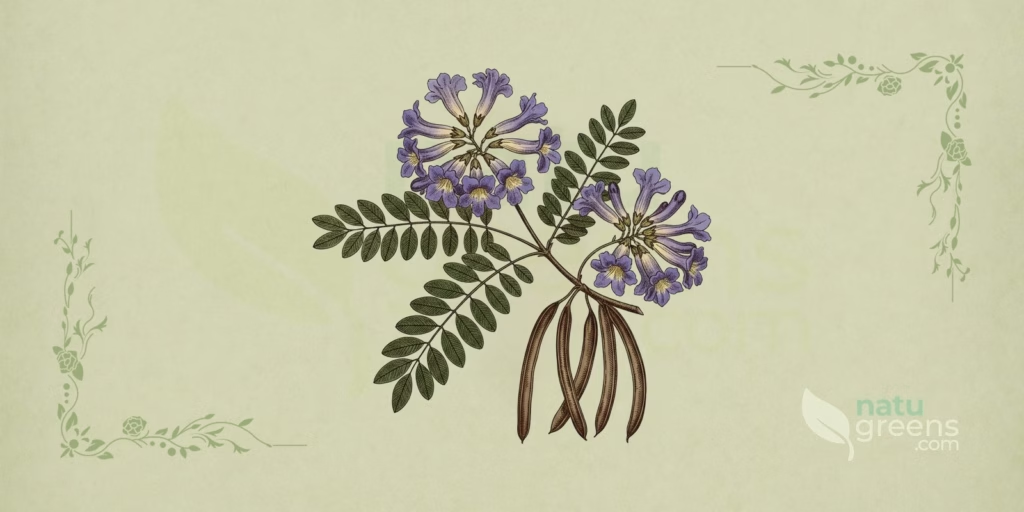
Jacaranda caroba (Vell.) DC. is a woody shrub of the family Bignoniaceae that belongs to the lower stratum of the Brazilian cerrado, where it rarely grows taller than three metres. Both the specific epithet and the common name come from the same Tupi root, and the plant is recognised in the field by its lacy compound leaves, its panicles of purplish tubular flowers and an underground woody organ that lets it resprout after the periodic fires of the biome.
Unlike the jacaranda planted along city streets across half the world, caroba does not impress by size. What makes it remarkable is its natural history: few species illustrate the shrub strategy of the cerrado so clearly, with much of the biomass held below ground, flowering timed to the end of the dry season and winged seeds handed over to the wind. Endemic to Brazil, it is concentrated on the Central Plateau and spreads into the savanna patches that reach the southeast and the south of the country.
This profile covers the formal taxonomy of the species, the characters that allow it to be identified in the field, its known range, its growing requirements, the phenological calendar, the chemical composition described in the literature and the historical record attached to the name.
For the traditional uses, properties and preparation methods of this plant, see the article Caroba (Jacaranda caroba): Properties and Benefits.
Taxonomy
The species belongs to Bignoniaceae, a mainly tropical family of some 80 genera that brings together trees, shrubs and lianas with showy tubular flowers. Within it, Jacaranda sits in the tribe Jacarandeae, a lineage of bipinnate leaves and flattened capsules that branches off early from the neotropical lianas of the tribe Bignonieae. The genus is entirely American and has its centre of diversity in Brazil.
- Kingdom: Plantae
- Division: Magnoliophyta
- Class: Magnoliopsida
- Order: Lamiales
- Family: Bignoniaceae Juss.
- Tribe: Jacarandeae
- Genus: Jacaranda Juss.
- Species: Jacaranda caroba (Vell.) DC., 1845
The basionym is Bignonia caroba Vell., published in Flora Fluminensis under the date 1825 and effectively circulated from 1829 onwards. The currently accepted combination was established by Augustin Pyramus de Candolle in volume 9 of the Prodromus Systematis Naturalis Regni Vegetabilis, in 1845. Part of the phytochemical literature spells the authorship as (Vell.) A.DC., crediting the transfer to Alphonse de Candolle; IPNI and Plants of the World Online record the shorter form DC.
Accepted Synonyms
- Bignonia caroba Vell. (basionym)
- Jacaranda caroba var. oxyphylla (Cham.) Bureau
- Jacaranda clausseniana Casar.
- Jacaranda elegans Mart. ex DC.
- Jacaranda mendoncaei Bureau & K.Schum.
- Jacaranda oxyphylla Cham.
Etymology of the Binomial
Jacaranda is the latinised form of yacarandá, a Tupi word applied to several trees with dark, hard heartwood, taken into colonial Portuguese long before it became a genus name. The epithet caroba comes from the Tupi ka’a rob, literally bitter leaf, the name Tupi speakers gave the shrub well before any formal description. The binomial is therefore unusual among Brazilian plants in being wholly indigenous in origin, with only the ending latinised.
Morphological Description
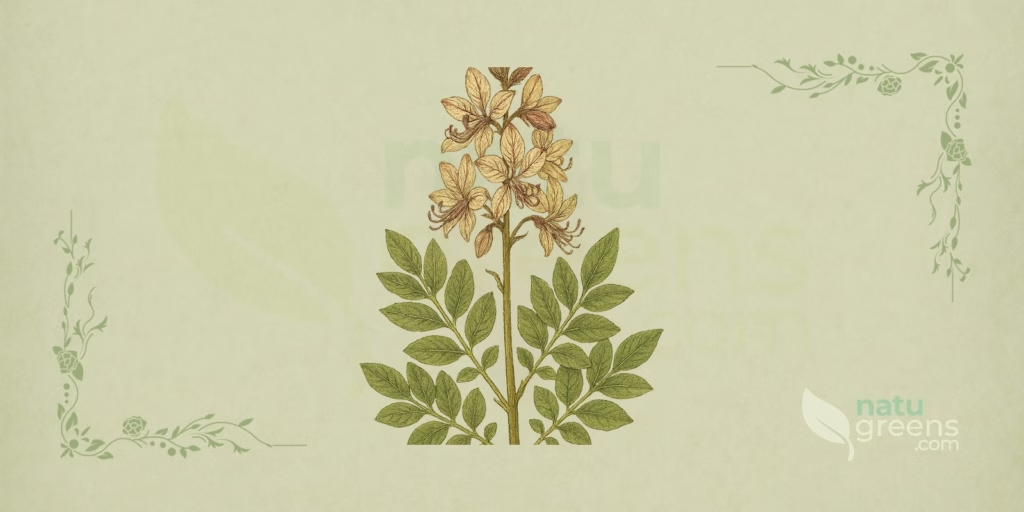
An erect shrub or small tree, usually between 1 and 3 metres tall and exceptionally reaching 5 metres on deep soils sheltered from fire. The trunk is short and the crown irregular and open, with branching from the base. The bark is greyish, corky and split lengthwise. Current year branches are quadrangular in cross section and covered in short hairs, becoming cylindrical and glabrous as they lignify. All vegetative parts give off a balsamic smell when crushed.
Leaves
The leaves are opposite and decussate, compound and bipinnate, and measure 10 to 25 centimetres overall. Each leaf carries 4 to 8 pairs of pinnae, and each pinna bears between 8 and 20 oblong-elliptic leaflets 1 to 3 centimetres long and 5 to 12 millimetres wide, with entire margins and blunt to rounded tips. The upper surface is dark green and the lower one paler, with hairiness that varies between populations. The petiole is 3 to 8 centimetres long and the blade is subcoriaceous in texture, an adaptation to the strong sunlight of the open cerrado.
Flowers
The inflorescence is an erect terminal panicle carrying 10 to 30 flowers that open in sequence over several weeks. Each flower is zygomorphic and two lipped, with a bell shaped calyx of five short teeth and a tubular funnel shaped corolla 3 to 5 centimetres long, violet to lilac, with a paler throat and dark streaks that act as nectar guides. The upper lip is two lobed and the lower one three lobed. The androecium follows the pattern of the genus: four fertile didynamous stamens plus one elongated hairy staminode that overtops the rest. Large bees, mainly carpenter and bumble bees of the genera Bombus and Xylocopa, are the main visitors, with hummingbirds as a complement.
Fruits and Seeds
The fruit is a flattened woody capsule, oblong to elliptic in outline, 4 to 8 centimetres long and 2 to 3.5 centimetres wide, with a rough surface. Dehiscence is loculicidal and splits the capsule into two stiff valves that stay attached to the branch after the seeds are shed. Each capsule holds 30 to 80 flattened seeds surrounded by a translucent membranous wing that carries them on the wind. Wind dispersal coincides with the height of the dry season, when air currents are strongest and the vegetation is at its most open.
Root and Stem
The underground system is the bulkiest part of the plant. A taproot descends 2 to 4 metres in search of deep water in the oxisols, while lateral roots work the surface horizon during the rains. At the base of the stem the plant develops a xylopodium, a thickened woody organ that stores starch, water and dormant buds. It is this xylopodium that allows caroba to rebuild its above ground parts within weeks of a fire or a clear cut, a habit shared with many cerrado shrubs and decisive for the survival of the species in fire managed areas.
Distribution and Habitat
Jacaranda caroba is endemic to Brazil and centred on the Central Plateau, from where it extends into western Bahia, into the remaining cerrado of the southeast and into the savanna patches of northern Paraná. Herbarium records confirm its occurrence in the following states:
- Bahia
- Distrito Federal
- Goiás
- Mato Grosso
- Mato Grosso do Sul
- Minas Gerais
- Paraná
- São Paulo
- Tocantins
Its typical habitat is cerrado in the strict sense, and it is also found in campo sujo, campo cerrado and the edges of cerradão woodland. The species grows at roughly 300 to 1,400 metres above sea level, on deep, acid, well drained sandy or sandy clay soils poor in exchangeable bases. It occupies the shrub layer in full sun and disappears quickly wherever the canopy closes, which makes it a useful indicator of open cerrado still in good condition.
Cultivation
Outside botanical collections and cerrado restoration projects the species is little grown, and the guidance below is drawn mainly from the conditions under which it thrives in the wild.
- Altitude: 300 to 1,400 metres, matching the plateau where the species occurs naturally.
- Fertilisation: unnecessary in most cases. This is a plant adapted to dystrophic soils, and an excess of phosphorus tends to hinder establishment.
- Irrigation: only during the first months after transplanting. Once the xylopodium has formed, the plant crosses the dry season without extra water.
- Light: full sun. It is a heliophilous species and does not tolerate prolonged lateral shading.
- Propagation: from seed collected from capsules that are still closed, between May and July, dried in the shade until the valves open and sown on the surface of a sandy medium. Germination takes 15 to 30 days, and rates fall sharply once seeds have been stored for more than one season. Resprouting from the xylopodium is the natural route to regeneration in the field but is of no use for nursery propagation.
- Soil: acid, with a pH between 4.0 and 5.5, deep and well drained. Oxisols and quartzarenic neosols reproduce the native conditions closely. Waterlogged or calcareous soils are unsuitable.
- Spacing: 2 to 3 metres between plants in enrichment and restoration plantings.
- Temperature: an optimum between 18 and 30 degrees Celsius, with tolerance of light, short lived frosts thanks to the protection of the underground organ.
Phytosanitary problems seen in cultivation include leafcutter ants of the genus Atta, which strip young plants, longhorn beetle larvae that bore into lignified branches, scale insects on new shoots and powdery mildew on soft leaves during the shift from dry to wet season. In poorly drained soil, soil fungi such as Fusarium and Sclerotium cause rotting of the xylopodium.
Phenology
The calendar of the species tracks the cerrado rainfall regime closely. Flowering is concentrated between August and November, that is, at the end of the dry season and into the first rains, a period when much of the shrub layer of the biome also flowers and the supply of nectar draws in far ranging pollinators. Fruits develop through the wet summer and the capsules ripen between May and July, opening in the middle of the dry season to release the winged seeds.
Leaf fall is partial and concentrated at the peak of the drought, with rapid renewal of the foliage before or alongside flowering. Plants raised from seed usually begin to flower in their second or third year. After fire, resprouting from the xylopodium starts within days and may bring forward flowering in that same season, a phenomenon well documented in cerrado shrubs.
Related Species and Look-Alikes
The genus Jacaranda holds around fifty neotropical species, several of them sharing cerrado ground with caroba. The commonest confusion involves congeners of different stature and one Bignoniaceae from another genus.
- Cybistax antisyphilitica (Mart. ex DC.) Mart.: the green ipê shares both habitat and shrubby habit, but has digitate rather than bipinnate leaves and greenish rather than violet flowers.
- Jacaranda brasiliana (Lam.) Pers.: a tree of 8 to 15 metres with smoother bark and no developed xylopodium, typical of cerradão and of the transition to the Caatinga.
- Jacaranda copaia (Aubl.) D.Don: an Amazonian tree that can exceed 25 metres, with a straight trunk and a high crown, sharing no habitat at all with caroba.
- Jacaranda cuspidifolia Mart.: an ornamental tree of the cerrado and the Atlantic Forest, with deeper violet flowers and leaflets that taper to a point.
- Jacaranda decurrens Cham.: the commonest mix-up. It is a prostrate subshrub that seldom passes 50 centimetres, with a winged leaf rachis and smaller leaves, whereas J. caroba is erect and clearly shrubby.
- Jacaranda mimosifolia D.Don: the ornamental jacaranda grown in mild climate cities worldwide, a tree of up to 20 metres native to southern Bolivia and northwestern Argentina, with tiny leaflets and broad panicles.
- Jacaranda puberula Cham.: a medium sized tree of the Atlantic Forest, with pinnate or bipinnate leaves of larger leaflets and downy branches.
It is worth noting that Jacaranda oxyphylla Cham., long treated as a separate cerrado species, is now regarded as a synonym of J. caroba. Herbarium material and literature predating that decision still circulate under the older name, so distribution records need to be compared with care.
Phytochemistry
The chemical composition of caroba has been studied mainly in leaves and bark, and the picture described in the literature matches the pattern known for the genus Jacaranda and for the family Bignoniaceae. The reported classes are as follows:
- Condensed tannins: concentrated in the bark and in mature leaves.
- Flavonoids: derivatives of apigenin, luteolin and quercetin, largely as glycosides.
- Glycosylated phenylethanoids: verbascoside, also called acteoside, a recurring marker in Bignoniaceae and in other Lamiales.
- Phenolic acids: caffeic acid and chlorogenic acid are the most frequently cited in leaf extracts.
- Quinones: jacaranone and related compounds, cyclohexadienones characteristic of the genus.
- Sterols: beta-sitosterol and stigmasterol, present in the apolar fractions.
- Triterpenes: oleanolic acid, ursolic acid and lupeol among the pentacyclic skeletons identified.
Published profiles vary with the origin of the material, the season of collection and the extraction solvent, which is to be expected in a widely distributed species that has not yet been the subject of chemical standardisation studies.
History and Ethnobotany of Caroba
Caroba entered the botanical literature through José Mariano da Conceição Vellozo, a Franciscan friar whose manuscript survey of 1790 was gathered into Flora Fluminensis and published decades later. It was there that the plant received the name Bignonia caroba, later moved to Jacaranda by De Candolle in the Prodromus.
Auguste de Saint-Hilaire, who travelled the Brazilian interior between 1816 and 1822, noted that caroba was among the plants most highly regarded by the backcountry population of Minas Gerais and Goiás, and recorded the Tupi name then in everyday use in those provinces. Through the nineteenth century, Brazilian and European compendia of plant materials repeated those field notes, and the dried plant was exported on a small scale, with scattered mentions in the pharmaceutical repertories of the period.
Culturally, the Tupi name outlived colonisation in place names and regional usage, and the plant stayed tied to the vocabulary of the cerrado backlands. The several popular spellings recorded in the nineteenth and twentieth centuries, among them caroba, carobinha, caroba-miúda and caroba-do-campo, show how widely the shrub was known in the interior of the country.
Conservation
Jacaranda caroba does not appear on the IUCN Red List, and Brazilian national assessments do not place it among threatened species. Its wide range, its capacity to resprout and its tolerance of poor soils explain that relatively comfortable position at species level.
The state of the habitat is far less reassuring. The cerrado has lost about half of its original cover to farming and cattle ranching, and conversion continues at a high rate along the edges of the biome, notably in the region known as Matopiba. Populations isolated in small remnants in the southeast and south are more exposed than the overall figures suggest.
The fire regime is the second decisive factor. Natural fires spaced a few years apart are part of cerrado dynamics and favour resprouting and flowering, whereas complete fire suppression leads to canopy closure and the loss of the sun loving shrub layer. Annual burning, at the other extreme, drains the reserves of the xylopodium. Because it is hardy and fire resistant, caroba is recommended for projects restoring degraded cerrado.
Interesting Facts
- A single capsule can release dozens of winged seeds, and the transparent membrane around them is so thin that a whole seed weighs only a few milligrams.
- In Spanish speaking countries the name gualanday, applied locally to other species of Jacaranda, ended up attached to caroba in imported texts as well, a frequent source of bibliographic confusion.
- The binomial is a rare case of a scientific name derived entirely from Tupi, with genus and epithet drawn from the same indigenous language.
- The dark streaks in the throat of the corolla work as a landing strip for large bees, an optical pattern that in several Bignoniaceae also reflects in the ultraviolet, a band visible to bees and invisible to us.
- The underground biomass of many cerrado shrubs, caroba included, outweighs the parts above ground, which earned the biome its description as an upside down forest.
Notice: this content is for informational purposes and does not replace professional medical advice. Consult a physician or herbal practitioner before using medicinal plants, especially during pregnancy, breastfeeding, or alongside medication.
References and Scientific Studies
- 1992 Gentry, A. H. (1992). A synopsis of Bignoniaceae ethnobotany and economic botany. Annals of the Missouri Botanical Garden, 79(1), 53-64.
- IPNI. International Plant Names Index. Royal Botanic Gardens, Kew; Harvard University Herbaria; Australian National Herbarium. ↗
- Jardim Botânico do Rio de Janeiro. Flora e Funga do Brasil: Jacaranda. ↗
- 2009 Olmstead, R. G., Zjhra, M. L., Lohmann, L. G., Grose, S. O., & Eckert, A. J. (2009). A molecular phylogeny and classification of Bignoniaceae. American Journal of Botany, 96(9), 1731-1743.
- POWO. Plants of the World Online: Jacaranda caroba (Vell.) DC. Royal Botanic Gardens, Kew. ↗
- Saint-Hilaire, A. (1824-1828). Plantes usuelles des Brésiliens. Grimbert; Paris.
- Vellozo, J. M. C. (1829). Flora Fluminensis. Typographia Nationalis; Rio de Janeiro.