Few tropical climbers carry as much ambiguity as Dioscorea hispida. It is a twining, prickle-armed liana of the family Dioscoreaceae, able to smother entire clearings of secondary forest and to build up underground tubers of more than ten kilograms, a considerable starch reserve in environments where the dry season imposes scarcity. That same storage organ concentrates dioscorine and cyanogenic glycosides, the combination behind the poisoning episodes documented throughout Southeast Asia. Eating raw or insufficiently processed tubers causes severe intoxication, with a neurological picture that can progress to respiratory depression.
The species occurs naturally from the Indian subcontinent to the Malay archipelago, reaching New Guinea and the far north-east of Australia, always tied to the humid tropical biome. Beyond that belt it is rarely cultivated, and in Brazil it belongs neither to the native flora nor to the table yams, a role filled there by Dioscorea alata and Dioscorea cayenensis. The botanical interest of Dioscorea hispida lies elsewhere: in the combination of trifoliolate leaves, prickly stems and strict dioecy, a set of characters that separates it clearly from most of its cultivated relatives.
What follows describes the plant, not its use. The taxonomy follows Plants of the World Online, from the Royal Botanic Gardens, Kew; the morphology, ecology and phenology come from regional botanical literature; and the ethnographic record appears as history, in the past tense. Toxicity is the one exception to that rule, and it is given in the present tense because it is safety information.
Taxonomy
The accepted name is Dioscorea hispida Dennst., published in 1818 in the Schlüssel zum Hortus Indicus Malabaricus, page 33. The hierarchy below reproduces the classification adopted by Plants of the World Online.
- Kingdom: Plantae
- Phylum: Streptophyta
- Class: Equisetopsida
- Subclass: Magnoliidae
- Order: Dioscoreales
- Family: Dioscoreaceae
- Genus: Dioscorea Plum. ex L.
- Species: Dioscorea hispida Dennst., 1818
Older manuals place the same species within the traditional classification of the angiosperms, as Magnoliophyta, Liliopsida and Dioscoreales. Both hierarchies describe the same taxon, and the divergence is one of reference system alone.
Synonyms
POWO recognises sixteen heterotypic synonyms, most of them a product of the long nomenclatural instability of the genus in tropical Asia, where the same material was described independently by botanists working in Java, in British India and on the Indochinese mainland.
- Dioscorea daemona Roxb. (1832)
- Dioscorea daemona var. reticulata Hook.f. (1892)
- Dioscorea hirsuta Blume (1827)
- Dioscorea hispida var. daemona (Roxb.) Prain & Burkill (1936)
- Dioscorea hispida var. mollissima (Blume) Prain & Burkill (1927)
- Dioscorea hispida var. neoscaphoides Prain & Burkill (1927), not validly published
- Dioscorea hispida var. reticulata (Hook.f.) Prain & Burkill (1927)
- Dioscorea hispida var. scaphoides Prain & Burkill (1927)
- Dioscorea lunata B.Heyne ex Roth (1821)
- Dioscorea mollissima Blume (1827)
- Dioscorea triphylla var. daemona (Roxb.) Prain & Burkill (1914)
- Dioscorea triphylla var. mollissima (Blume) Prain & Burkill (1914)
- Dioscorea triphylla var. reticulata (Hook.f.) Prain & Burkill (1914)
- Dioscorea virosa Wall. ex Klotzsch & Garcke (1862)
- Helmia daemona (Roxb.) Kunth (1850)
- Helmia hirsuta (Blume) Kunth (1850)
Etymology
The generic name Dioscorea honours Pedanius Dioscorides, the first-century Greek author responsible for one of the earliest systematic compilations on the plants of the Mediterranean world. The epithet hispida comes from the Latin hispidus, meaning rough or bristling with stiff hairs, a direct reference to the indumentum of the petioles, the veins and the young shoots. Two of the synonyms record how the plant’s toxicity was historically perceived: daemona alludes to the demon, and virosa derives from virus, the Latin word for poison or venomous secretion.
Morphological Description
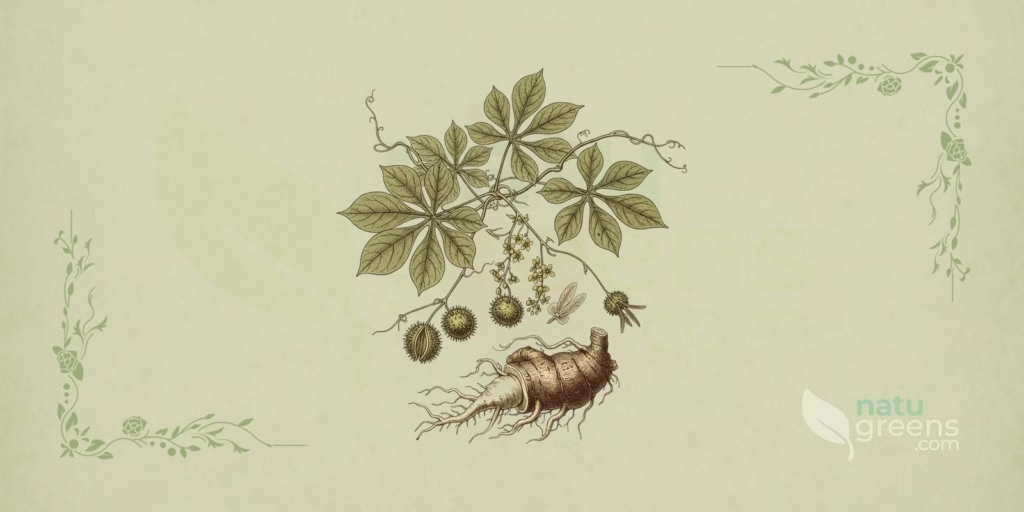
Dioscorea hispida is a perennial herbaceous climber with a tuberous underground organ, classed by POWO as a scandent tuber geophyte. The twining shoots reach 10 to 20 metres where suitable support is available, winding over shrubs and edge trees. The stem is cylindrical and armed with short, rigid prickles concentrated at the base and at the nodes, and the whole vegetative body bears a rough pubescence that is obvious to the touch.
Leaves
- Colour: dark green on the upper surface, paler and distinctly pubescent beneath
- Indumentum: stiff hairs on the petiole, the rachis and the main veins
- Leaflets: 8 to 20 centimetres long by 5 to 12 centimetres wide, ovate to elliptic, with an acuminate apex and an entire or slightly undulate margin
- Petiole: 5 to 15 centimetres, often prickly at the base
- Phyllotaxy: alternate, with trifoliolate leaves, an unusual character among the cultivated yams
Flowers
- Colour: greenish yellow to pale yellow, barely showy
- Female inflorescences: short, pendulous spikes, with more widely spaced flowers
- Male inflorescences: elongated, pendulous axillary racemes or panicles
- Sexuality: dioecious species, with male and female individuals on separate plants
- Size: 3 to 5 millimetres in diameter
Fruits and Seeds
- Dehiscence: loculicidal, the seeds being released while the capsule is still on the plant
- Fruit: three-winged capsule of 2 to 3 centimetres, dry and leathery at maturity
- Seeds: flattened and furnished with a membranous wing that surrounds the seed body
Root and Stem
The tubers are the most distinctive structure of the species. They are irregular and lobed, frequently branched into fingers that diverge from a central body, and they sit between 30 and 60 centimetres below the surface. Well developed specimens weigh 5 to 15 kilograms. The periderm is brown, wrinkled and covered with fine adventitious roots, while the flesh ranges from white to pale yellow and is densely starchy. It is in this storage tissue that dioscorine and the calcium oxalate crystals accumulate, which makes the tuber the most dangerous part of the plant.
Distribution and Habitat
According to Kew Backbone Distributions, the native range of the species extends across tropical and subtropical Asia to northern Australia. The recorded distribution units are as follows:
- Andaman Islands
- Assam
- Bangladesh
- Bismarck Archipelago
- Borneo
- Cambodia
- East Himalaya
- Hainan
- India
- Java
- Lesser Sunda Islands
- Maluku
- Myanmar
- Nepal
- New Guinea
- Peninsular Malaysia
- Philippines
- Queensland
- South-East China
- Sulawesi
- Sumatra
- Taiwan
- Thailand
- Tibet
- Vietnam
- West Himalaya
Typical habitat takes in humid tropical forest and, above all, secondary formations, forest margins, regrowth thickets and the edges of swiddens, well lit places where the climber finds low support. The altitudinal range runs from sea level to about 1,500 metres. The species thrives under rainfall regimes between 1,500 and 4,000 millimetres a year and in a thermal band of 25 to 35 degrees Celsius during the growing period, with no tolerance of frost. Preferred soils are deep, well drained and loamy to sandy loam in texture, with a pH between 5.5 and 7.0.
Being tolerant of disturbance, Dioscorea hispida behaves as a vigorous coloniser of altered ground within its own native range. Outside that range there is no consolidated record of aggressive naturalisation, nor any listing as an invasive species, a situation quite unlike that of Dioscorea bulbifera, which has become a recognised invader in subtropical regions of the Americas.
Cultivation
Cultivation of the species is marginal and confined to traditional farming systems of Southeast Asia, where it tends to be tolerated in home gardens and along field margins rather than planted at scale. Vegetative propagation is the usual method: tuber fragments carrying viable buds are buried at the start of the rainy season, and each fragment gives rise to a new twining shoot within a few weeks. Multiplication from seed is possible, although germination is irregular and slow, which makes it impractical outside breeding work and germplasm conservation.
The plant needs staking, since growth without support sharply reduces the exposed leaf area and, with it, the filling of the tuber. The productive cycle follows the seasonality of the rains, and harvest takes place once the aerial parts have dried out completely, the moment at which the underground reserve reaches its greatest accumulation of starch. Digging calls for care because the tubers are fragile and deep, and handling the fresh flesh irritates the skin on account of the calcium oxalate crystals.
Among the phytosanitary problems recorded for the species and for the genus in tropical Asia, the most frequent are these:
- Anthracnose (Colletotrichum gloeosporioides): dark leaf spots that coalesce and bring on defoliation in humid spells
- Defoliating beetles (Crioceris spp. and related chrysomelids): scraping of the lamina and loss of photosynthetic area
- Root-knot nematodes (Meloidogyne spp.): deformation of the tubers and an entry point for secondary rots
- Storage rots (Fusarium spp. and Penicillium spp.): post-harvest losses in tubers that are wounded or kept in damp conditions
Phenology
The annual rhythm of Dioscorea hispida is strongly seasonal. Sprouting starts from the tuber with the first rains, and vegetative growth is concentrated in the wet months, when the liana can gain several metres in a matter of weeks. Flowering occurs in the course of the rainy season, with marked regional variation across the wide distribution range, and the pendulous inflorescences appear in the axils of shoots that are already well developed.
Pollination is entomophilous and depends on small insects, above all flies and minute hymenopterans drawn to the inconspicuous flowers, a pattern common in the genus. Because the species is dioecious, fruit set depends on male and female individuals growing near one another, which helps to explain why many local populations fruit sparingly and persist mainly through vegetative multiplication of the tubers.
Fruiting is completed at the end of the rains and the beginning of the dry season. The capsules ripen, dry and open while still attached to the plant, releasing winged seeds that are carried off by the wind, an anemochorous mechanism that favours the colonisation of recent clearings. Once the cycle closes, the aerial parts dry out entirely and the plant passes the unfavourable season as a dormant tuber.
Related Dioscorea Species and Confusions
The genus Dioscorea gathers several hundred tropical species, and field identification usually rests on the combination of leaf type, presence of prickles and stem shape. The most relevant confusions involve the taxa below, listed with the characters that set them apart.
- Dioscorea alata L.: quadrangular, winged stem without prickles, and simple, cordate leaves that are generally opposite. It is the most widespread table yam in Asia and Africa, and its entire leaf cannot be mistaken for the trifoliolate leaf of D. hispida.
- Dioscorea bulbifera L.: simple, broadly cordate, alternate leaves, with conspicuous aerial bulbils in the axils. The bulbils are diagnostic and do not occur in D. hispida.
- Dioscorea esculenta (Lour.) Burkill: stem prickly as in D. hispida, but with simple leaves and numerous small tubers clustered near the surface instead of a single deep tuber.
- Dioscorea pentaphylla L.: the most serious confusion. It too has an armed stem and compound leaves, varying from three to five leaflets, and an overlapping Asian range. Telling them apart depends on details of the indumentum, on the modal number of leaflets and on the shape of the tuber, which makes any hasty field identification a risky one.
There is also a nomenclatural trap. Three varieties originally published under Dioscorea triphylla by Prain and Burkill now stand in the synonymy of Dioscorea hispida, and for that reason the older literature applies the name D. triphylla ambiguously, sometimes to the species treated here and sometimes to different material. When consulting floras from the early twentieth century, it is worth checking the protologue before accepting an identification.
Phytochemistry
The chemical make-up of Dioscorea hispida is dominated by the storage tissue of the tuber, where the groups described below are unevenly distributed.
- Alkaloids: dioscorine is the characteristic alkaloid of the species and accumulates in the flesh of the tuber
- Calcium oxalate: needle-shaped crystals, the raphides, scattered through the parenchyma of the tuber and present in the leaves as well
- Cyanogenic glycosides: present in the tuber, where they account for part of the toxicity described for the species
- Flavonoids: kaempferol and quercetin, detected mainly in leaves and skin
- Starch: somewhere between 20% and 30% of the fresh weight of the tuber, in fine-grained granules
- Steroidal saponins: these include diosgenin, at a low concentration compared with other species of the genus exploited industrially
The distribution of these compounds varies with the age of the organ, the geographical provenance and the season, a pattern consistently recorded for the genus. The oxalate crystals gather close to the vascular bundles, while starch fills the parenchyma cells of the central body of the tuber.
From a safety standpoint, the essential fact is this: the tubers of Dioscorea hispida contain dioscorine and cyanogenic glycosides in quantities sufficient to cause poisoning, and eating raw or insufficiently processed material causes severe intoxication, with nausea, vertigo, sweating, convulsions and respiratory depression. The oxalate raphides add mechanical irritation of the mucous membranes and the skin. Poisoning cases are still reported in the regions where the plant grows, including cases arising from confusion with edible species of the same genus.
History and Ethnobotany
The formal description of the species fell to August Wilhelm Dennstedt, who published it in 1818 in the Schlüssel zum Hortus Indicus Malabaricus, a work conceived as a key of access to the monumental Hortus Malabaricus, the survey of the flora of the Malabar coast compiled in the seventeenth century. The plant, however, had long been known to the peoples of tropical Asia, who called it by names of their own such as gadung in Java, ubi gadung on the Malay peninsula and nami in the Philippines.
The most recurrent element of the ethnographic record links the species to famine food. Rural communities in Java, Borneo, the Philippines and mainland Indochina turned to the tubers in years when the rice harvest failed and conventional stores ran out. Consumption depended on prior processing, and the sources describe regional detoxification traditions based on prolonged washing, alkaline treatment and fermentation, knowledge built up over generations and entrusted to people with a practical command of the matter. None of this makes the plant safe outside the context in which those techniques were developed, and poisonings from badly processed material still occur. British colonial literature documented such practices in detail, notably in the dictionary of economic products of the Malay peninsula compiled by Burkill in 1935 and in Coursey’s monograph on the yams, of 1967.
The same toxic principle was turned to the opposite purpose. Groups in Malaysia and the Indonesian archipelago used the fresh tuber as a fish poison, thrown into river pools to stun fish, and also in the preparation of arrow tips and traps for hunting. There was also the use of the crushed material against rats and insects in grain stores, recorded by observers of the colonial period. All these applications belong to the documented ethnographic past and are presented here as history, not as advisable practice.
Conservation
Dioscorea hispida has no published global assessment on the IUCN Red List, and it must therefore be treated as a species that has not been evaluated, category NE. A draft assessment produced within initiatives devoted to crop wild relatives is in circulation, with a preliminary indication of least concern, but until formal publication that result does not constitute official status.
The available reading of the species is one of low risk in general terms. Its range is extensive, covers dozens of geographical units across three biogeographical regions and includes disturbed environments, where the plant establishes itself readily. That plasticity reduces the vulnerability affecting congeners of restricted distribution, some of which are among the threatened species of the genus.
The documented pressures are local. The conversion of Southeast Asian tropical forest into oil palm and other monocultures wipes out whole populations at a regional scale, and the gathering of wild tubers exerts additional pressure where extraction is intense, since removing the storage organ kills the individual. The species appears in none of the CITES appendices, unlike Dioscorea deltoidea, listed in Appendix II since 1975 because of collection pressure on its Himalayan populations.
Interesting Facts
- Two of the historical synonyms of the species record fear in botanical Latin: Dioscorea daemona, published by Roxburgh, and Dioscorea virosa, by Wallich, names that say as much about the plant’s reputation as any morphological description.
- In Indonesia, industrially processed tuber starch gives rise to the chips known as keripik gadung, a regional product whose viability depends entirely on controlled detoxification, and poisonings linked to inadequate home processing still appear in reports from the local health authorities.
- The genus Dioscorea was central to the chemical industry of the twentieth century, which extracted diosgenin from Mexican species as the raw material for the semisynthesis of steroids. D. hispida was left out of that chain precisely because it accumulates the sapogenin at too low a level.
- A well grown tuber can reach fifteen kilograms sixty centimetres below the surface, dimensions that turn digging into hours of work and help to explain why the species survives well in areas where the aerial vegetation is cut or burnt repeatedly.
- For all the size of the plant and the weight of the tuber, the seeds are light and winged, dispersed by the wind, a striking asymmetry between underground gigantism and the delicacy of the propagule.
Notice: this content is for informational purposes and does not replace professional medical advice. Consult a physician or herbal practitioner before using medicinal plants, especially during pregnancy, breastfeeding, or alongside medication.
References and Scientific Studies
View All 9 Cited References
- Burkill, I. H. A Dictionary of the Economic Products of the Malay Peninsula. Crown Agents for the Colonies, London, 1935.
- 2026 CITES. Appendices I, II and III. Convention on International Trade in Endangered Species of Wild Fauna and Flora. Accessed 2026.
- 1967 Coursey, D. G. Yams: An Account of the Nature, Origins, Cultivation and Utilisation of the Useful Members of the Dioscoreaceae. Longmans, London, 1967.
- Dennstedt, A. W. Schlüssel zum Hortus Indicus Malabaricus. Weimar, 1818.
- 2007 Govaerts, R.; Wilkin, P.; Saunders, R. M. K. World Checklist of Dioscoreales: Yams and their allies. Royal Botanic Gardens, Kew, 2007.
- 2026 IPNI. The International Plant Names Index. Available at www.ipni.org. Accessed 2026.
- 2026 IUCN. The IUCN Red List of Threatened Species. Available at www.iucnredlist.org. Accessed 2026, with no global assessment published for the species.
- 2026 POWO. Plants of the World Online, Royal Botanic Gardens, Kew. Entry for Dioscorea hispida Dennst. Available at powo.science.kew.org. Accessed 2026.
- 2009 Wilkin, P.; Thapyai, C. Dioscoreaceae. Flora of Thailand, volume 10, part 1. The Forest Herbarium, Bangkok, 2009.