Rheum officinale is a stately perennial herb of the damp slopes and valley bottoms of the mountains of south-central China. It belongs to the Polygonaceae, the family of the sorrels, the bistorts and buckwheat, and it builds a basal rosette whose rounded leaves comfortably exceed half a metre across before the flowering stalk lifts two metres off the ground. Among the species of Rheum, it is one of the few whose epithet carries a direct trace of the human interest that surrounded it for centuries.
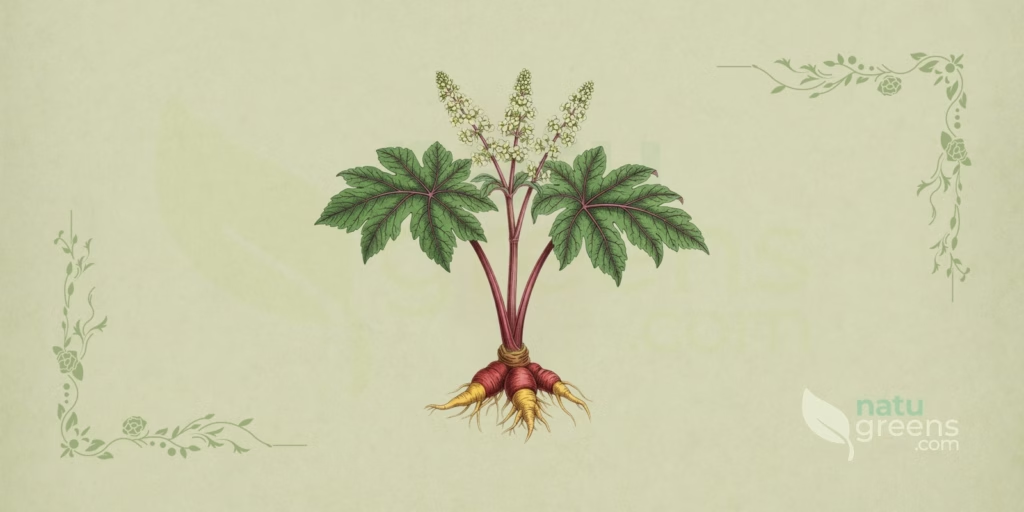
The species is endemic to a fairly narrow arc of Chinese territory, spread across Guizhou, Henan, Hubei, Shaanxi, Sichuan and Yunnan, at altitudes ranging from a little over a thousand metres up into the alpine belt. Below ground it builds a thick, branching rhizome whose inner tissue shows an intense yellow, the feature that Chinese growers link to the name da huang (大黃), literally “great yellow”. It was that dried root, and not the living plant, that crossed Central Asia and reached European markets long before any Western botanist had seen a specimen in the field.
This page gathers the complete botanical profile of the species: formal taxonomy checked against the standard nomenclatural indexes, detailed morphology with field measurements, distribution and habitat, cultivation practice, phenology, the characters that separate it from its neighbours in the palmatum complex, descriptive chemistry, historical record and conservation status.
Taxonomy
The name Rheum officinale Baill. was published by Henri Ernest Baillon in the journal Adansonia, volume 10, page 246, in 1872, based on material from the mountainous interior of China. The International Plant Names Index record confirms the authorship, the date and the protologue, and the name remains accepted without dispute in current nomenclatural indexes. The Polygonaceae bring together some fifty genera, mostly of temperate distribution in the northern hemisphere, and the genus Rheum concentrates roughly sixty species across the ranges and plateaus of Asia.
- Kingdom: Plantae
- Division: Magnoliophyta (flowering plants)
- Class: Magnoliopsida (eudicots)
- Order: Caryophyllales
- Family: Polygonaceae Juss.
- Subfamily: Polygonoideae
- Tribe: Rheeae
- Genus: Rheum L.
- Species: Rheum officinale Baill., 1872
Accepted Synonyms
The species shows unusual nomenclatural stability for a taxon with such a long commercial history. Only two names stand today as heterotypic synonyms:
- Rheum baillonii F. Heim
- Rheum pichonii Pierre ex A. Chev.
One recurring error in popular literature is worth correcting: Rheum potaninii Losinsk. is not a synonym of R. officinale but a name handled within the Rheum palmatum complex. In the same way, R. officinale and R. tanguticum, which some authors once reduced to varieties of R. palmatum, remain accepted as species in their own right, even though the boundaries between them are still debated among taxonomists.
Etymology of the Binomial
The generic name goes back to the Greek rheon, a form tied to the old trade name of the dried root, rha. Some authors connect the term to the Rha, the classical name of the river Volga, one of the axes along which the goods reached Western ports, and the same root survives in the English word rhubarb, from medieval Latin reubarbarum, the rha that came from foreign lands. The epithet officinale comes from Latin officina, the workshop or apothecary where preparations were compounded, and in nineteenth century nomenclature it marked the species that appeared in the official lists of the pharmacopoeias of the day. It is a historical label, not a description of any present-day use.
Morphological Description
This is a robust perennial herb with a broad basal clump and an erect flowering stem that reaches 1.5 to 2 metres, occasionally more in deep, well nourished soil. The stem is hollow, finely grooved lengthwise and covered in white hairs that grow denser towards the top and at the nodes. The whole aerial part dies back completely at the end of the growing season and resprouts from the underground structure the following spring, a cycle the plant repeats for one to two decades.
Leaves
The basal leaves define the look of the species and rank among the largest of any temperate herb. The blade is orbicular, more rarely broadly ovate, and measures 30 to 50 centimetres across in established plants, approaching 75 centimetres in the most vigorous specimens. The base is subcordate, five to seven main veins radiate from that point, and the division is palmately lobed, with shallow triangular lobes and a subacute tip. The upper surface is glabrous, the lower one pubescent, and the overall texture is leathery and slightly rough to the touch. The petiole is cylindrical and fleshy, 20 to 60 centimetres long, shading from green to purplish near the base. The cauline leaves repeat the pattern on a progressively smaller scale as they climb the stem. The ocrea, the membranous sheath that wraps the node just above the insertion of the petiole, reaches 15 centimetres, has a densely hairy outer surface and is the most reliable family marker for recognising a member of the Polygonaceae in the field.
Flowers
The inflorescence is a broad terminal panicle with open branching, carried on the flowering stem. The flowers are small and numerous, arranged in clusters along the branches, each with six tepals ranging from greenish to yellowish white, elliptic to narrowly elliptic, 2 to 2.5 millimetres long and 1.2 to 1.5 millimetres wide. The three outer tepals are narrower than the inner ones. The androecium gathers nine stamens, and the ovary is superior, topped by three short styles with capitate stigmas. The pedicel is jointed near the base, a detail that helps the ripe fruit detach.
Fruits and Seeds
The fruit is a three-angled achene of oblong-ellipsoid outline, 8 to 10 millimetres long and 7 to 9 millimetres wide, with the three edges drawn out into membranous wings roughly 2 to 2.5 millimetres broad. The colour shifts from greenish to reddish brown and then to dark brown as ripening advances. Each fruit holds a single seed. The wings are wind dispersal structures and explain how efficiently the species colonises banks and clearings on the slopes where it grows.
Root and Stem
The underground system is the bulkiest structure of the plant and combines a thick, branching rhizome, 5 to 20 centimetres across in adult specimens, with coarse, fibrous secondary roots. The outer surface is brown and marked by lengthwise furrows. Cut open, the inner tissue shows an intense yellow to orange colour, the result of anthraquinone derivatives accumulating in the parenchyma, with a radiating pattern of darker bundles that classical pharmacognosy described as a star-shaped figure. The taste is frankly bitter and astringent, and the smell is earthy.
Distribution and Habitat
The species is endemic to China, and its natural range covers the north-central, south-central and south-eastern parts of the country, with well established records in Guizhou, south-western Henan, western Hubei, Shaanxi, Sichuan and Yunnan, plus probable occurrences in Fujian. The core of the distribution coincides with the ranges that make the transition between the Sichuan basin and the eastern rim of the Tibetan plateau, a region of broken relief and heavy summer rainfall.
The typical habitat is the understorey of montane forest, forest edges, shaded gullies and valley bottoms with deep soil rich in organic matter. The recorded altitudinal range is wide, running from about 1,200 metres to 4,000 metres, with the densest populations concentrated in the middle band. The preferred climate combines cool, moist summers with cold, long winters, a regime that forces the aerial part into complete dormancy. Loam to clay loam soils, well drained and slightly acid to neutral, support the best growth.
Outside its natural range, the species entered cultivation and appears as locally naturalised in Great Britain and in the region of the former Czechoslovakia, with further records of occurrence in Laos and Vietnam. None of these introduced populations shows documented invasive behaviour, and the requirement for cold winters sharply limits any expansion towards lower latitudes. In Brazil there is neither commercial cultivation nor recorded naturalisation, a situation explained by the mismatch between the thermal demands of the plant and the climate of the country.
Cultivation
Commercial propagation relies mainly on seed, sown in a protected bed between late winter and early spring. Germination takes two to four weeks, and the young plants go out to the field after six to twelve months of growing on. Clump division is the alternative used when the genetic identity of a selected line has to be preserved: the adult rhizome is cut into pieces that keep one or two viable buds and replanted in the same season. Tissue culture is being developed for clonal propagation at scale, but it has not yet replaced conventional methods in current production.
As for its requirements, the plant asks for full sun in cold climates and welcomes partial shade where summers run hotter, since the wide leaf blade scorches under intense sunlight. The soil should be deep, fertile and well drained, with a pH between 5.5 and 7.0 and a generous incorporation of organic matter at planting. The comfortable temperature band lies between 5 and 20 degrees Celsius, with good tolerance of severe frost during dormancy and a marked drop in performance above 28 degrees. Suitable rainfall runs to around 700 to 1,500 millimetres a year, well distributed, and drip irrigation covers the gaps in dry years. Usual spacing is 1.2 to 1.5 metres between plants in both directions, and a thick mulch is standard practice to steady soil temperature and conserve moisture over the shallow root system. Sites sheltered from strong wind spare the largest leaves from tearing.
Among the most frequent problems are slugs and snails, which attack young leaves in wet spells, and aphids, which settle in under water stress and can carry leaf viruses. On the disease side, powdery mildew coats the foliage with a whitish film in dry phases, leaf spot caused by fungi of the genus Ramularia produces reddish brown lesions, and root rot associated with Phytophthora is the most serious of all, almost always linked to waterlogged or poorly drained soil.
The underground system is lifted in autumn, once the plant has four to eight years in the field behind it and the aerial part is going into senescence. The work is done by hand: the whole clump is dug up, rhizome and coarse roots are separated from petioles and leaves, the material is washed, cut into slices or cubes and dried in the sun or in a drier at moderate temperature until it stabilises below 12 per cent moisture. Flowering stems are usually removed as soon as they appear in crops grown for the rhizome, a practice that redirects photosynthates to the underground portion.
Phenology
The basal rosette resprouts as spring temperatures climb, and leaf expansion is complete within a few weeks, which gives the plant one of the fastest rates of leaf area accumulation among mountain herbs. The flowering stem appears from the third or fourth year of life onwards and does not necessarily come every year, depending on the vigour banked in the rhizome.
Flowering concentrates in June and July in the northern hemisphere, and fruiting follows from July to September, ripening in stages along the panicle. The flowers are small, pale and clustered, an arrangement that draws small flies and hymenopterans, but the open architecture of the inflorescence and the lightness of the pollen also favour wind pollination, and the literature describes the genus as functionally ambophilous. Dispersal is anemochorous: the three membranous wings of the achene slow the fall and let the wind on the slopes carry the fruits some distance from the mother plant. Secondary dispersal by surface runoff on sloping ground completes the picture.
Related Rheum Species and Confusions
The confusions that matter involve the other large species of section Palmata and the garden rhubarb, and the leaf character settles most cases in the field.
- Rheum australe D. Don: a species of the western Himalaya, with an ovate to orbicular leaf whose lobing is very faint or absent and a generally smaller habit. Its geographical separation from R. officinale is virtually complete.
- Rheum palmatum L.: the commonest confusion. The blade of R. palmatum is deeply palmately divided, with lobes that cut down towards a pinnatisect pattern and a jagged margin, while R. officinale has shallow triangular lobes and a nearly entire margin. R. palmatum occupies higher mean altitudes and extends into the north and north-west of the country, an area where R. officinale does not occur.
- Rheum rhabarbarum L.: the rhubarb grown in European gardens. Its leaf has a rounded outline with no apparent lobing, the petiole is bright red, fleshy and juicy, the panicle is smaller and less showy, and the inner tissue of the rhizome lacks the intense yellow that marks the species of section Palmata.
- Rheum tanguticum (Maxim. ex Regel) Maxim. ex Balf.: a plant of the high country of Tibet and neighbouring provinces, with leaf lobes deeper and narrower still than those of R. palmatum, cutting the blade almost apart. It occurs above the altitudinal band typical of R. officinale.
One further caution reaches beyond the genus. Large, orbicular leaves with a cordate base, carried on long petioles, also occur in plants with no relation to Rheum whatsoever, among them species of Petasites and burdock, Arctium lappa. The presence of the membranous ocrea wrapping the node, unique to the Polygonaceae, settles the question at once.
Phytochemistry
The chemical profile of Rheum officinale is dominated by anthraquinone derivatives concentrated in the rhizome and the coarse roots, where they account for the yellow-orange colour of the parenchyma. The compounds most consistently identified in that group are aloe-emodin, chrysophanol, emodin, physcion and rhein, present both in free form and bound to sugars as anthraquinone glycosides. Alongside them occur dimeric anthranoids of the sennoside type, designated by the letters A to F, whose proportion varies with the age of the specimen, the altitude of origin and the drying process applied to the harvested material.
The second most abundant class is the tannins, which reach substantial levels in the dried rhizome and include both hydrolysable forms, such as gallotannins and gallic acid derivatives, and condensed forms of the proanthocyanidin type, accompanied by free catechin and epicatechin. Stilbenoids, among them resveratrol and its glycosides, appear in modest amounts. Flavonoids such as rutin round out the picture, along with starch, pectins and the mineral set usual in a storage organ, potassium, calcium and phosphorus above all.
These compounds are not spread evenly through the plant. The anthraquinones concentrate in the underground tissue, the tannins are more widely scattered, and the oxalates predominate in the leaf blade. That last point is a safety matter and admits no middle ground: the leaves of Rheum officinale, like those of every species in the genus, contain oxalic acid and oxalate salts in high concentration, and eating them causes poisoning, with a risk of severe kidney damage. The best documented episode occurred during the First World War, when rhubarb leaves were promoted in Great Britain as a substitute vegetable amid food shortages, advice that led to cases of poisoning and to recorded deaths. The leaves are not edible in any preparation. Oxalate toxicity also applies to dogs, cats and horses, which is why veterinary reference databases list the genus among the plants toxic to companion animals.
History and Ethnobotany
The oldest written record associated with the dried root of the genus sits in the Shennong Bencao Jing, a Chinese pharmacobotanical compilation whose earliest layers go back to the first centuries of the common era, where the material appears under the name da huang. Over the following centuries Chinese authors distinguished sources and commercial grades of the goods, and what circulated under that name brought together roots of R. officinale, R. palmatum and R. tanguticum, gathered in different regions and traded without strict separation by species.
The dried root was one of the most valuable long distance articles of pre-industrial Eurasia. Merchants carried the product along the routes that linked the Chinese interior to Central Asia and from there to the Mediterranean, and European chroniclers of the Middle Ages and the Renaissance recorded prices that at certain moments placed the goods above their equivalent weight in precious metals. Between the seventeenth and eighteenth centuries the Russian state organised the trade as a monopoly: from 1736 an inspection post operated at Kyakhta, on the Siberian border with the Qing empire, through which every consignment entering Russian territory had to pass, and rejected lots were destroyed on the spot. That control sustained for decades the reputation of so-called Russian rhubarb in the markets of Western Europe, until the opening of the Chinese ports and the loss of the monopoly, around 1860, redrew the routes entirely.
On the European side, the living plant took far longer to arrive than the merchandise. Eighteenth century botanical gardens grew specimens obtained with difficulty from seed brought back by diplomats and travellers, and the botanical identification of the species that supplied the root stayed confused for generations, a situation that only began to resolve when Baillon formally described R. officinale in 1872 from Chinese material. The epithet he chose records the standing the species held in the official lists of the apothecaries of his time. In the mountains of western Hubei and southern Shaanxi, rural communities managed the wild populations for generations, leaving young specimens in place while collecting, a practice documented by nineteenth and twentieth century observers as a way of securing the replacement of harvested stock.
Conservation
The species has no published assessment on the Red List of the International Union for Conservation of Nature and therefore stands as not evaluated. The absence of a formal assessment should not be read as an absence of pressure, and the Chinese literature on the subject consistently points the other way.
The main threat is extractive collecting from wild populations. Because the commercially interesting organ is underground, harvesting means removing the entire specimen, with no possibility of regrowth, and the four to eight years a plant needs to reach harvestable size makes natural replacement slow against the intensity of demand. Genetic diversity studies carried out with molecular markers on remaining populations of R. officinale recorded fragmentation and recommended in situ conservation of the most variable populations, along with ex situ collecting spread across the whole range. The conversion of forested slopes to farmland adds to the picture as a driver of habitat loss.
No species of the genus Rheum currently appears in the CITES appendices. On the side of measures in force, China has expanded cultivation under good agricultural practice protocols over recent decades, shifting most of the industrial supply from wild populations to established fields, and the Chinese Academy of Sciences maintains germplasm collections of the genus aimed at preserving its genetic base.
Interesting Facts
- The Chinese name da huang, “great yellow”, describes literally what appears when the rhizome is cut, and the colour comes from the anthraquinone derivatives stored in the reserve parenchyma.
- The word rhubarb carries an old geography: it comes from medieval Latin reubarbarum, a compound of the Greek rha, a name that stood both for the plant and for the river Volga, with barbaron, foreign. The goods reached Europe from the north, and the language recorded the route before any botanist recorded the species.
- For nearly a century and a half a border post in Siberia set the price of the product in Europe: between 1736 and the middle of the nineteenth century, every consignment entering Russia passed the inspection at Kyakhta, and rejected lots were burned on the spot.
- The same botanical family holds two extremes that live side by side in one garden: the petiole of garden rhubarb is a common ingredient of pies and preserves in Europe, while the leaf of any species in the genus contains oxalates at toxic concentration.
- The basal leaves of Rheum officinale reach 75 centimetres across and rank among the largest leaf blades produced by a herbaceous plant of the temperate northern hemisphere.
Notice: this content is for informational purposes and does not replace professional medical advice. Consult a physician or herbal practitioner before using medicinal plants, especially during pregnancy, breastfeeding, or alongside medication.
References and Scientific Studies
View All 10 Cited References
Peer-Reviewed Scientific Studies (2)
- DOI2010 Hu, Y. et al. Genetic diversity of the endemic and medicinally important plant Rheum officinale as revealed by inter-simple sequence repeat (ISSR) markers. International Journal of Molecular Sciences, 11(12), 5060-5074. 2010. ↗
- DOI2006 Komatsu, K. et al. Comparative study of chemical constituents of rhubarb from different origins. Chemical and Pharmaceutical Bulletin, 54(11), 1491-1499. 2006. ↗
Supplementary Readings (8)
- American Society for the Prevention of Cruelty to Animals. Rhubarb (Rheum spp.). Toxic and Non-Toxic Plants Database. ↗
- Baillon, H. E. Sur le Rheum officinale. Adansonia, vol. 10, p. 246. Paris. 1872.
- 2003 Flora of China Editorial Committee. Rheum officinale Baillon. Flora of China, vol. 5. Science Press and Missouri Botanical Garden Press. 2003. ↗
- 1992 Foust, C. M. Rhubarb: The Wondrous Drug. Princeton University Press. 1992.
- International Plant Names Index. Rheum officinale Baill., Adansonia 10: 246. 1872. Royal Botanic Gardens Kew, Harvard University Herbaria and Australian National Botanic Gardens. ↗
- Plants of the World Online. Rheum officinale Baill. Royal Botanic Gardens, Kew. ↗
- 2016 Wanner, M. The Russian-Chinese trade in Kyakhta, its organisation and commodity structure. Prague Papers on the History of International Relations, p. 35-49. Charles University, Prague. 2016.
- World Flora Online. Rheum officinale Baill. WFO Plant List. ↗