Eschscholzia californica is a herbaceous member of the Papaveraceae family that has become the floral face of the North American West. When winter delivers enough rain, whole Californian hillsides wake up beneath an orange carpet that runs for kilometres, a spectacle locals call a superbloom and one that occasionally turns up in satellite imagery. The species is native to a band reaching from the western United States into northern Mexico, and since 1903 it has held the title of official state flower of California.
The common name California poppy invites a confusion worth clearing up at the outset. The plant belongs to Eschscholzia, a genus quite separate from Papaver, and its chemistry bears no relation to that of the opium poppy: there is no morphine, codeine or thebaine in its tissues. The two lineages share nothing beyond the botanical family and a certain family resemblance in the four silky petals. The sap differs as well, watery and almost colourless here, milky and abundant in Papaver.
This profile gathers what the botanical literature documents about the species: the formal classification and its peculiar etymology, the morphological characters that allow it to be recognised in the field, the phenological behaviour, the phytochemistry described for the various organs, the record of naturalisation on other continents and the ethnographic material associated with it.
The California poppy is a herbaceous member of the Papaveraceae family, native to a band that runs from the western United States into northern Mexico.
Taxonomy
The species was described by Adelbert von Chamisso in February 1820, in Horae Physicae Berolinenses, edited by Nees von Esenbeck, where it occupies page 74 and plate 15. The accepted binomial is Eschscholzia californica Cham., and its systematic position runs as follows.
- Kingdom: Plantae
- Clade: Angiosperms (basal eudicots)
- Order: Ranunculales
- Family: Papaveraceae Juss.
- Subfamily: Eschscholzioideae
- Genus: Eschscholzia Cham.
- Species: Eschscholzia californica Cham., 1820
The genus holds roughly twelve accepted species, all of them confined to western North America. Within E. californica, current taxonomic databases recognise two subspecies: the typical subsp. californica and subsp. mexicana (Greene) C.Clark, the latter smaller in stature and desert in distribution.
Synonyms
The species accumulated a considerable number of names over the nineteenth century, a reflection of how variable its populations are and of how poorly herbaria of the period communicated with one another. Among the synonyms now reduced to the accepted binomial or to its subspecies are the following.
- Chryseis californica (Cham.) Lindl.
- Chryseis crocea Lindl.
- Eschscholzia crocea Benth.
- Eschscholzia douglasii Benth.
- Eschscholzia procera Greene
- Eschscholzia californica var. tenuifolia (Benth.) Curran
Etymology
The specific epithet is self-explanatory and points to the region where the first specimens were collected. The generic name carries a stranger story. Chamisso coined it in honour of Johann Friedrich von Eschscholtz (1793 to 1831), the Baltic German physician and naturalist who sailed with him aboard the Russian brig Rurik during the circumnavigation of 1815 to 1818. When the name went to press, however, the surname lost its t: what appeared was Eschscholzia, not Eschscholtzia. Later botanists spent more than a century trying to restore the spelling, but Chamisso’s original form prevailed and is the one carried today by the nomenclatural indexes.
Morphological Description
This is a short-lived perennial herb in its native range, where it rarely passes five years, and it behaves as an annual wherever winters are severe. Clumps reach 20 to 60 centimetres in height and 30 to 50 centimetres across, with slender, open branching. The stems are glabrous and glaucous, thanks to a bluish waxy coating, and their succulent texture turns somewhat woody near the base in second-year plants. The sap is watery, colourless to faintly orange.
Leaves
The foliage has a lacy look, the result of a deep dissection repeated three times over. Leaves are alternate, crowded into a basal rosette and sparser along the flowering stems, 3 to 8 centimetres long including the petiole, which measures 3 to 6 centimetres and broadens where it joins the stem. The blade is triternate to three times pinnatisect, with linear to oblong segments 2 to 5 millimetres wide and blunt at the tip. The blue-green colouring and the waxy, water-repellent surface are constant characters and help with recognition even outside the flowering season.
Flowers
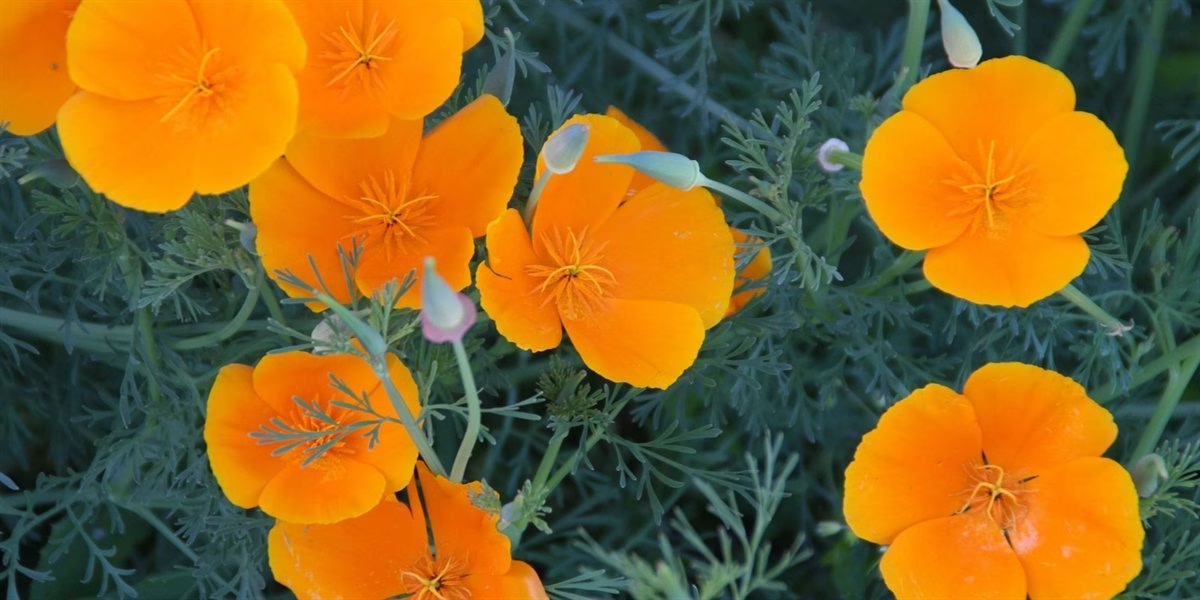
Solitary California poppy flowers above the glaucous, finely cut foliage; on the buds still closed you can make out the conical calyptra that slips off in one piece as the flower opens.
Flowers are borne singly at the tip of erect peduncles 10 to 25 centimetres long. They measure 3 to 7 centimetres across and carry four petals arranged in a cross, each 2 to 4 centimetres, satiny in texture and with a sheen that shifts with the angle of the light. In the wild form the colour ranges from golden yellow to deep orange, often with a darker blotch at the base; cultivars selected for gardens cover a far wider range, from white to crimson.
The diagnostic character of the genus lies in the calyx. The two sepals are fused into a conical calyptra that caps the bud like a hood and comes away in one piece as the flower opens, rather than splitting into separate parts. Another striking feature is the receptacle, expanded into a flattened ring, the torus, which encircles the base of the petals and has no equivalent in related genera. The stamens are numerous, between 20 and 60, with orange filaments and anthers.
Fruits and Seeds
The fruit is an elongate, narrowly cylindrical capsule, 3 to 9 centimetres long and 3 to 5 millimetres in diameter, ribbed lengthwise. Ripening takes 30 to 45 days after fertilisation. Once dry, the capsule splits into two valves that curl back abruptly, flinging the seeds up to nearly two metres from the parent plant. Each capsule holds 50 to 200 spherical seeds of 1 to 1.5 millimetres, with a netted seed coat and a colour running from dark brown to black.
Root and Stem
The root system is a fleshy taproot that descends 30 to 60 centimetres in sandy ground. Cut open, the root shows an orange to orange-brown colouring linked to the alkaloids that accumulate there. This architecture explains two practical traits of the species: a remarkable tolerance of drought and an almost absolute refusal to be transplanted, since breaking the taproot is usually fatal to the seedling.
Distribution and Habitat
The native range covers the western and south-central United States, with its core of abundance in California, and extends into northern Mexico, including Baja California and Sonora. Within that band the species occupies coastal prairies, rocky slopes, interior valleys, stabilised dunes, chaparral clearings and the edges of roads and disturbed ground, where it behaves as a pioneer coloniser. Altitudinally it runs from sea level to around 2,000 metres.
Its preferred climate is Mediterranean, with rainfall concentrated in winter and a long dry summer, and annual precipitation between 250 and 600 millimetres. Soils are typically sandy, stony, low in fertility and fast draining, with a pH between 6.0 and 8.0. Population abundance swings widely from one year to the next, tracking the previous winter’s rainfall closely.
Beyond the native range, ornamental cultivation opened the way to naturalisation in practically every Mediterranean-climate region on the planet. Central Chile provides the most closely studied case, with populations established along roadsides and in open country since the nineteenth century. In Australia the species is treated as an environmental weed in Western Australia, New South Wales and Victoria, where abundant seed production allows it to move quickly from degraded ground into adjoining native vegetation. Naturalisation is also well documented in South Africa, New Zealand and several Mediterranean countries of Europe, Spain and Portugal among them, with official invasive alien species listings in some of these. In Brazil its presence is essentially ornamental cultivation in upland subtropical regions, with no broad naturalisation on record.
California Poppy Cultivation
Propagation is by seed alone, and sowing has to be done straight into the final position because of the plant’s intolerance of transplanting. In a Mediterranean climate, autumn is the season to aim for; where winters are cold, early spring works better. Seed is scattered on the surface and merely pressed against the soil, without covering, and germinates in 10 to 21 days at temperatures of 15 to 18 degrees. Thinning afterwards leaves 15 to 25 centimetres between plants.
Management demands are few and run counter to conventional gardening instincts. Full sun is non-negotiable, because the flowers simply will not open without direct light and partial shade produces drawn, unproductive plants. Fertiliser is unnecessary and usually makes matters worse, since rich soils favour foliage at the expense of bloom. Watering should be minimal or none once the plants are established, and excess water is the most common cause of failure. The comfortable temperature band lies between 15 and 28 degrees, with tolerance of light frosts down to minus 5 to 8 degrees, but little resistance to prolonged humid tropical heat.
Among the commoner pests are aphids, which attack young shoots in spring, caterpillars of various moths and butterflies, and slugs and snails, the last of these capable of wiping out whole batches of seedlings in wet spells. On the disease side, root rot caused by Pythium and Rhizoctonia leads the list and is nearly always tied to waterlogged or compacted soil, so correcting the drainage deals with the problem at source. Botrytis cinerea shows up in damp, poorly ventilated beds, and mosaic-type viruses arrive by way of aphids, leaving the leaves mottled.
The harvest that matters in a home garden is seed for the following season. Capsules should be gathered once they turn from green to straw, but before they split, because the explosive opening scatters the entire contents in seconds. Letting some capsules ripen in the bed guarantees spontaneous self-seeding, and populations established that way persist for many years without intervention. For cut flowers the ideal moment is the bud already coloured and still closed, though vase life is short.
Phenology
In California flowering runs from February to September, with the peak concentrated between March and May, shifting to the September to March window when the species is grown in the southern hemisphere. Each plant begins to flower 60 to 90 days after germination. The flowers show pronounced nyctinasty: they open in direct sun, close towards evening and stay shut on overcast days, behaviour that shields the pollen from damp and concentrates visits in the hours when insects are busiest.
The reward on offer to visitors is pollen alone, since the flowers produce no nectar. Pollination falls mainly to native bees, notably the genera Andrena, Bombus and Perdita, along with halictids, and is supplemented by beetles, hoverflies and introduced honeybees. Populations in the native range are largely self-incompatible and depend on cross-pollination, whereas some of the naturalised populations in Australia and New Zealand are self-compatible, a trait that helps explain the colonising success in places short of suitable pollinators.
Dispersal is autochorous and ballistic, carried out by the explosive dehiscence already described. Seeds that reach the ground form a persistent bank and show negative photoblastism, meaning they germinate better in darkness, which favours those that end up buried and synchronises emergence with soil disturbance. That combination of a long-lasting seed bank and a response to disturbance is the central mechanism behind both the superblooms of the native range and the plant’s persistence in invaded areas.
Related Species and Confusions
Within the genus itself, the distinctions rest mainly on stature, colour and flower size. Eschscholzia caespitosa forms smaller tufts with pure yellow flowers; E. glyptosperma and E. minutiflora are desert ephemerals with reduced flowers; E. lobbii has deep yellow flowers and a slight annual habit. All share the characteristic conical calyptra, but none matches the stature and flower diameter of typical E. californica.
Outside the genus, four confusions deserve attention.
- Hunnemannia fumariifolia, the Mexican tulip poppy, has very similar glaucous, dissected foliage, but larger yellow flowers, petals of a stiffer texture and sepals that fall away separately.
- Papaver rhoeas bears red flowers with a dark basal blotch, petals as delicate as tissue paper and a globose capsule, against the narrowly cylindrical capsule of Eschscholzia.
- Papaver somniferum has glaucous leaves that are entire and merely toothed, larger flowers of 6 to 10 centimetres, a globose capsule with apical pores and abundant white latex, absent in the California poppy.
- Stylomecon heterophylla, placed within Papaver by part of the recent literature, has similar orange flowers but is set apart by its whitish latex and its conspicuous club-shaped style.
The most reliable set of characters for field recognition comes down to three items: the calyptra that lifts off whole, the ring of the receptacle at the base of the petals, and the long, narrow capsule. None of the look-alikes has all three.
Phytochemistry
The chemical profile of the species is dominated by isoquinoline alkaloids, spread unevenly among the organs. The aerial parts concentrate protopine-type alkaloids, with protopine as the major component, accompanied by allocryptopine and cryptopine. To that group are added two characteristic pavine alkaloids, californidine and escholtzine, the latter originally described from the genus.
The root shows a different make-up, marked by benzophenanthridine alkaloids. Sanguinarine, chelerythrine, chelirubine and macarpine have been identified in these tissues, and the orange colouring of the root is tied to the presence of that set. These are compounds recognised as toxic to vertebrates, and the difference between root and aerial composition matters for any handling of the plant. The species does not appear on the formal toxic plant lists maintained by the ASPCA animal poison control centre, which falls well short of a clean bill of health: californidine and escholtzine come from the same benzylisoquinoline pathway that yields the opioids of the opium poppy, its relative within the Papaveraceae. Independent veterinary sources link ingestion by dogs and cats to incoordination, mild sedation and vomiting. Set alongside the alkaloid load of the root, that evidence is reason enough to keep plantings out of reach of pets and small children.
Outside the alkaloid fraction, the petals accumulate the carotenoids responsible for their colour, chiefly zeaxanthin and beta-carotene. Flavonoids such as isorhamnetin, quercetin and rutin have also been described, along with the phytosterols beta-sitosterol and campesterol. What is absent is worth recording: none of the morphinan alkaloids typical of Papaver somniferum, that is codeine, morphine and thebaine, has been found in E. californica.
Over recent decades the species has become a model organism in plant molecular biology, both for the evolution of floral development in basal eudicots and for mapping the biosynthetic routes of isoquinoline alkaloids, which accounts for the unusual volume of chemical literature available for an ornamental plant.
History and Ethnobotany
Ethnographic records compiled between the nineteenth century and the early twentieth document that Indigenous peoples of California, among them the Chumash, Costanoan, Luiseño and Miwok, made use of the plant in several ways. The sources describe the root being employed against toothache, the leaves applied as poultices over skin injuries and the pollen used as a facial cosmetic. These accounts belong to the ethnographic past and are set down here as part of the cultural history of the species.
The European arrival added another layer of names. Spanish explorers described the flowering slopes of the Californian coast with phrases such as copa de oro, cup of gold, a reference that survives in some of the common names still in use. Formal scientific collection came with the Rurik expedition: in 1816, in the San Francisco Bay area, Chamisso gathered the specimens that would underpin the description published four years later.
The plant’s route into European gardening was a swift one. Introduced as an ornamental in the early nineteenth century, it found a place in Mediterranean gardens thanks to its long flowering season and its indifference to poor soils. By the twentieth century, as droughts intensified across the American West, the species had become an emblem of low-water gardening in California itself, featuring in public landscaping programmes and in seed mixes for the restoration of degraded land.
Conservation
The species has no published global assessment on the IUCN Red List, a common situation for widely distributed and abundant plants. North American conservation databases rank it as secure or apparently secure, and it does not appear in the CITES appendices. In population terms, it is one of the most numerous wild plants of the western United States.
That does not mean it faces no pressure. Rapid urbanisation of California’s interior valleys has removed extensive tracts of the original prairies, and competition with exotic annual grasses has altered the make-up of the communities where the species once grew at its highest densities. Its situation is worth distinguishing from that of its relatives: Eschscholzia rhombipetala is considered possibly extinct, and other narrowly distributed species of the genus face real risk from habitat loss.
The other side of the coin appears outside the native range, where the same toughness that guarantees abundance turns into somebody else’s conservation problem. In the Mediterranean regions of Chile, Australia, South Africa and southern Europe, naturalised populations compete with local flora in disturbed settings, and some countries maintain official invasive alien species listings for it.
As for legal protection, the notion circulates widely that picking a California poppy is a crime because it is the state flower. The actual rule is both more prosaic and broader: section 384a of the California Penal Code prohibits cutting or removing vegetation on public land or the land of others without authorisation, a rule that applies to any plant and not to this species in particular.
Interesting Facts
- The spelling of the genus preserves a typographical error from 1820. The surname being honoured is Eschscholtz, with a t, but the form Chamisso put into print came out without the letter and ended up enshrined by the rules of nomenclatural priority.
- The superblooms of rainy years can be detected by orbital remote sensing, and the phenomenon drives a flow of visitors capable of jamming entire rural roads in southern California.
- The state of California designated 6 April as California Poppy Day, and the week around that date concentrates environmental education activities at reserves such as the Antelope Valley reserve in Lancaster.
- The flowers produce no nectar. Everything that draws bees and beetles rests on pollen and on the visual signal of the petals, which reflect ultraviolet light in patterns invisible to the human eye.
- The ripe capsule fires its seeds with a snap audible from a few metres away, and the throw reaches close to two metres, enough for the plant to colonise the surrounding ground step by step without depending on any outside agent.
Notice: this content is for informational purposes and does not replace professional medical advice. Consult a physician or herbal practitioner before using medicinal plants, especially during pregnancy, breastfeeding, or alongside medication.
References and Scientific Studies
View All 12 Cited References
Peer-Reviewed Scientific Studies (2)
- PEER NatureServe. Eschscholzia californica. NatureServe Explorer. Arlington, Virginia. ↗
- DOI2014 Peña-Gómez, F. T.; Guerrero, P. C.; Bizama, G.; Duarte, M.; Bustamante, R. O. Climatic niche conservatism and biogeographical non-equilibrium in Eschscholzia californica (Papaveraceae), an invasive plant in the Chilean Mediterranean region. PLoS ONE, 9(8), e105025. 2014. ↗
Institutional Sources (1)
- GOV Clark, C. Eschscholzia. In: Jepson Flora Project (eds.). Jepson eFlora. University of California, Berkeley. ↗
Supplementary Readings (9)
- Calflora. Eschscholzia californica Cham. Berkeley, California: The Calflora Database. ↗
- 1962 Cook, S. A. Genetic system, variation, and adaptation in Eschscholzia californica. Evolution, 16(3), 278-299. 1962.
- 1997 Flora of North America Editorial Committee (eds.). Papaveraceae. In: Flora of North America North of Mexico, vol. 3. New York and Oxford: Oxford University Press. 1997.
- GBIF Secretariat. Eschscholzia californica Cham. GBIF Backbone Taxonomy. ↗
- International Plant Names Index (IPNI). Eschscholzia californica Cham., Horae Phys. Berol. 74, t. 15. 1820. Royal Botanic Gardens Kew, Harvard University Herbaria and Australian National Botanic Gardens. ↗
- 2013 Ministerio para la Transición Ecológica. Eschscholzia californica Cham.: catálogo español de especies exóticas invasoras. Madrid: Gobierno de España. 2013.
- POWO. Eschscholzia californica Cham. Plants of the World Online. Royal Botanic Gardens, Kew. ↗
- Reflora. Flora e Funga do Brasil. Jardim Botânico do Rio de Janeiro. ↗
- Weeds of Australia. Eschscholzia californica Cham. Biosecurity Queensland Edition, Lucid Key Server. ↗